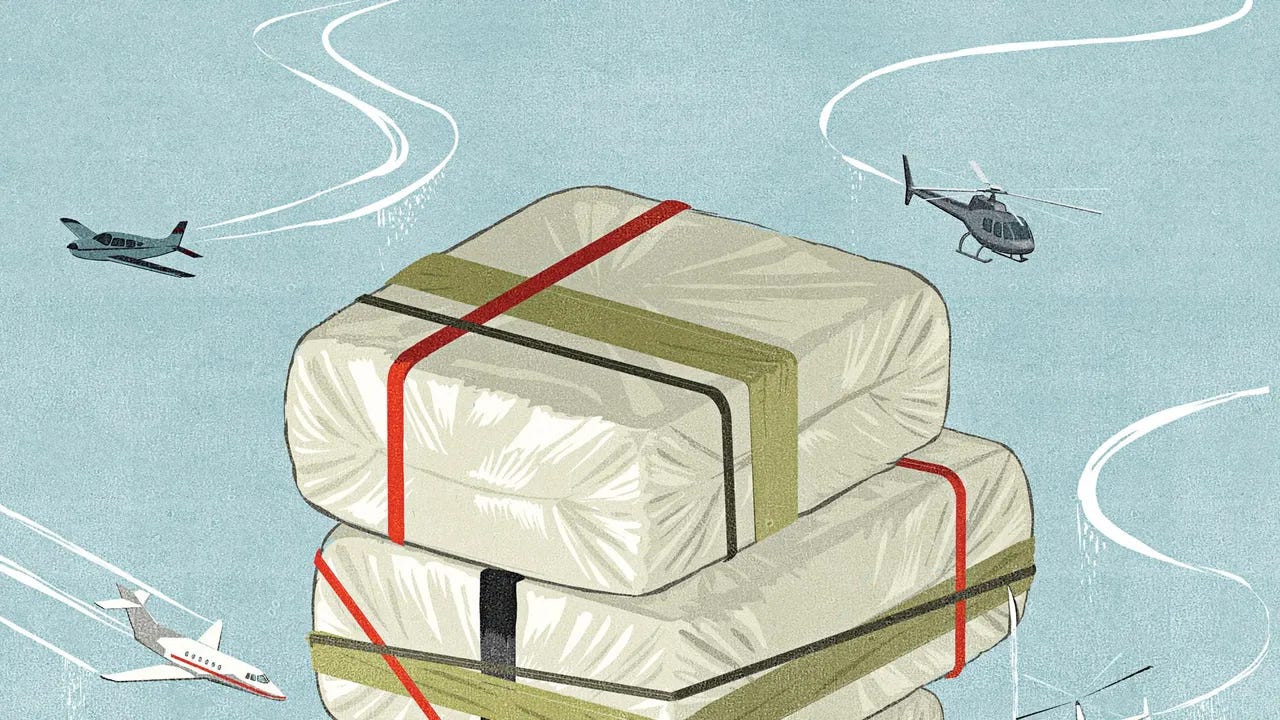
A Cocaine Superhighway, Pardoned
Honduras, Israel, and the network that reversed a federal conviction
On June 6, 2018, a DEA-vetted counter-narcotics unit in the Honduran department of Cortés acted on a tip and stopped a convoy on the highway. When agents searched a Volkswagen in the group, they found $190,000 in cash, grenades, and concealed beneath the rear seat, a hatch. Inside were eleven spiral notebooks. A switch in the Volkswagen connected to one in a second Toyota; when joined, a dashboard panel in the Toyota popped open to expose guns. The man in custody was a 37-year-old trafficker named Nery López Sanabria. One agent would later testify that when he reviewed the notebooks in the unit’s office, he recognised names immediately: Tony Hernández, younger brother of the sitting Honduran president, featured repeatedly as a recipient of cocaine shipments and money. So did a set of initials, “JOH,” with associated payment figures. The president of Honduras was Juan Orlando Hernández. His initials in the ledger, next to dollar amounts, beside shipment entries recording hundreds of kilos of cocaine moving through his country toward the United States.
López Sanabria was jailed in Honduras, where he began cooperating with the DEA. His notebooks went to New York, where they became central evidence in the October 2019 trial of Tony Hernández, who was convicted and sentenced to life in prison. Seven days after Tony’s conviction, on October 26, 2019, a guard in a green uniform at the El Pozo maximum-security prison in Ilama, Santa Bárbara, slid open a red security door. Six inmates in white T-shirts leapt through it. One carried an Uzi. The target was López Sanabria. He was shot multiple times and then stabbed. The murder was caught on the prison’s own surveillance cameras. The subsequent government statement suggested López had been killed to prevent him from challenging the authenticity of the notebooks. His former US lawyer, Robert Feitel, told reporters the suggestion was without any basis: “We never heard anything from our client about the ledgers not being authentic.”
The notebooks survived. In February 2024, Juan Orlando Hernández went to trial in the Southern District of New York on charges of cocaine trafficking and weapons offences. A jury convicted him in March. Judge P. Kevin Castel, nominated to the bench by George W. Bush, sentenced him in June 2024 to 45 years in federal prison and an $8 million fine. Castel called him a “two-faced politician hungry for power” who had used the machinery of the Honduran state to protect, enrich, and provide cover for the cartels he publicly campaigned against. The prosecution had described Honduras under Hernández as “one of the largest transshipment points in the world for United States-bound cocaine,” a conduit for more than 400 tons over eighteen years. Standing in a green prison uniform with two US marshals behind him, Hernández told the court through an interpreter: “It’s as if I had been thrown into a deep river with my hands bound.”
Seventeen months later, he walked out of a federal prison a free man.
The Transaction
The official account of what changed between the sentencing and the release runs as follows. In January 2025, Roger Stone, longtime political adviser to Donald Trump and himself a recipient of a Trump pardon in the first term, began publishing pieces on Substack calling for Hernández’s release. He framed the prosecution as Biden-era lawfare, a persecution of a pro-Trump Central American ally by a hostile Democratic Justice Department. The investigation had begun in 2015 and the indictment was filed in January 2022; neither of these dates correspond to any moment of particular Biden administration attention to Honduras, but the narrative did not depend on the chronology. Stone wrote three posts on the subject between January and November 2025.
On November 28, 2025, with Honduras two days from a presidential election, Stone contacted Trump and delivered a four-page handwritten letter from Hernández’s prison cell addressed to “Your Excellency.” The letter argued, in language that mirrored Trump’s own self-narration of political persecution, that Hernández had been targeted by radical leftist forces for his conservative values and his cooperation with US counter-narcotics operations. At 4:00 p.m. that afternoon, Trump posted on Truth Social endorsing Nasry Asfura, the National Party candidate in the Honduran election, describing him as “the only real friend of Freedom in Honduras.” Forty-eight minutes later, Trump posted that he would pardon Hernández. A White House official told the New York Times that Trump had not read the letter before making the announcement. Stone told reporters he passed the letter on, was not paid, and thought Trump had been moved by the story.
The recordings published by the Hondurasgate investigative platform between April 30 and May 6, 2026 supply a different account of what happened and why.
Extracted from WhatsApp, Signal, and Telegram exchanges between Hernández, Asfura, Vice President María Antonieta Mejía, Congressional President Tomás Zambrano, and other senior figures in the Honduran government and its external allies, the 37 audio files cover conversations from January to April 2026. The Hondurasgate platform submitted every file to the Phonexia Voice Inspector programme before publication, a forensic biometric authentication system used in law enforcement proceedings across multiple jurisdictions, which produced SHA-256 hashes, acoustic analysis, and AI-synthesis probability scores for each recording. Across the archive, the average AI-synthesis probability registered at approximately 6 percent. Every file, every hash, and the complete technical dossier are available at hondurasgate.ch for independent counter-analysis.
In a recording dated January 20, 2026, Hernández says: “The prime minister of Israel is going to support us.” In a March 14 message, speaking to Asfura, he says: “The money for the pardon didn’t even come from you. It came from a council of rabbis and from people who supported Israel.” Elsewhere, explicitly: “I sent you the people of Israel. They sent you money. I’m the one doing the lobbying.” And on Trump’s role in the broader arrangement: “That’s what we discussed with President Trump.”
The pardon was not, in this account, an impulsive act of executive mercy triggered by a handwritten letter and a phone call from a trusted adviser. It was a transaction, with financing on one side, a free man on the other, and a set of political arrangements extending across Honduras, Israel, Argentina, and the Trump White House locked in between.
The Operatives
To understand how the Honduran election was won, start with a viral video posted in Brazil in October 2022. Fernando Cerimedo, an Argentine political operative based in Buenos Aires, published a detailed analysis claiming the Brazilian presidential election, which Luiz Inácio Lula da Silva had just won, had been fraudulently manipulated against Jair Bolsonaro. The video spread across Bolsonaro’s networks, providing the evidentiary scaffolding for the refusal-to-concede operation. Brazil’s federal police later concluded the video was part of a broader conspiracy to keep Bolsonaro in power by manufacturing the appearance of a stolen election. They recommended criminal charges against Cerimedo. He was never charged. He was not extradited. He moved on to his next client.
In 2023, Cerimedo’s firm Numen, co-founded with former Trump campaign manager Brad Parscale and based in Buenos Aires, advised Javier Milei’s Argentine presidential campaign. That arrangement is documented in a Justice Department filing: Milei’s Washington representation was handled by Latin America Advisory Group LLC, which contracted with Numen, creating a paper trail connecting the Argentine far-right president to the Parscale-Cerimedo operational apparatus. The following year, Numen and Parscale worked for Rodrigo Paz’s Bolivian presidential campaign. Parscale travelled to La Paz during the campaign. Paz won, ending twenty years of socialist governance. In 2025, Numen provided voter microtargeting and data infrastructure for Asfura’s Honduran campaign. Cerimedo became the public face of the campaign’s data operation, appearing on Honduran television in the weeks of vote-counting chaos when both sides were claiming victory and analysing partial results in the Parscale-built systems. “Brad set up all the infrastructure that I work with,” Cerimedo told the New York Times.
Parscale’s work for Israeli interests ran alongside his Latin American operations, not separately from them. In autumn 2025, he registered under the Foreign Agents Registration Act as a contracted representative of the Israeli Foreign Ministry, undertaking to influence how artificial intelligence systems depict Israel. His partner in that contract was Salem Media Group, a Christian nationalist conglomerate owning approximately 200 US radio stations and the conservative-MAGA outlets RedState, Townhall, and PJ Media, with which he was training AI chatbots with pro-Israel content. That FARA registration was active while he was advising Asfura’s campaign through Numen.
The geographic footprint of the Parscale-Cerimedo apparatus, Argentina to Bolivia to Honduras, tracks precisely the sequence of elections the Hondurasgate recordings describe as targets of the network’s expansion: three countries repositioned from varying degrees of diplomatic distance from Israel toward active alignment with the US-Israeli axis, by the same operational team, using the same data infrastructure, producing the same result in each case. The Bolivia result came with an immediate and precisely timed consequence. On March 4, 2026, both Honduras and Bolivia announced their withdrawal from the Hague Group, the coalition of states working to enforce International Court of Justice and International Criminal Court rulings against Israel. March 4 was the day of the group’s most consequential meeting of the year. Guillaume Long, a diplomatic adviser to the Hague Group, confirmed to Mondoweiss that the dual withdrawals on that specific day were deliberate: “Obviously Israel wanted to weaken the meeting. They wanted both countries to announce their withdrawal from the group on that day so that would be the main news.”
Nine Spiral Notebooks and a Real Estate Project
In April 2022, three months after Hernández left office, the Honduran National Congress voted 128-0 to repeal the ZEDE law he had created. The vote was near-unanimous because the political opposition to special economic zones had been building since the first of them were proposed, accumulating into a national sovereignty movement that had made repeal a central demand of Xiomara Castro’s successful presidential campaign. The legislation enabling the zones had itself been passed by a Congress that Hernández controlled after he fired the four Supreme Court justices who had ruled an earlier version unconstitutional in 2012, replacing them with judges who approved the revised text.
The most developed ZEDE was Próspera, established in 2017 on Roatán island, backed by Peter Thiel, Marc Andreessen, Balaji Srinivasan, and Pronomos Capital, the libertarian venture fund run by Patri Friedman, a grandson of the economist Milton Friedman. The zone offered residents their own legal code, cryptocurrency as legal tender, gene therapy at $25,000 per treatment, what its marketing described as subdermal implantation services, and a governance model its founders called “Governance as a Service.” It sat on the north coast of Roatán, beside the Garifuna community of Punta Gorda, whose people had lived on that stretch of coast for more than two hundred years and whose land rights had been the subject of a binding Inter-American Court ruling in 2015 that the Honduran state had not enforced. In November 2022, Honduran police and soldiers arrived in Punta Gorda and carried out a violent eviction of the community. Among those detained and beaten was Melissa Martínez, a human rights defender with OFRANEH. “We have two comrades beaten, one of them seriously,” she said from detention, her phone momentarily restored to her.
When Castro repealed the ZEDE law in 2022, Próspera filed for international arbitration through the World Bank’s ICSID tribunal, seeking damages it would eventually put at $11 billion, an amount approaching two thirds of Honduras’s annual budget. The Honduran Supreme Court declared the ZEDEs unconstitutional with retroactive effect in 2024, in a 3-2 ruling. Honduras withdrew from ICSID entirely in August 2024 to block future arbitration claims, while the Próspera case remained pending. The legal impasse was still unresolved when Asfura took office in January 2026. His government’s stated intention is to expand the ZEDEs and restore the full legal architecture that made them possible. In a recording from February 10, 2026, Asfura tells Hernández that investor circles have already approved the expansion of ZEDEs in Roatán and Comayagua, and that a second US military installation modelled on Palmerola, the Soto Cano Air Base that has accommodated American military personnel continuously since 1982, is confirmed for Roatán. Thiel and Andreessen are among the most significant financial backers of the Trump political operation. Punta Gorda is next door.
The interoceanic railway was also in the recordings. The $20 billion project connecting Honduras’s Atlantic and Pacific coasts was negotiated under Castro with Chinese investment, as part of the BRI framework established when Castro broke Honduras’s eighty-two-year diplomatic relationship with Taiwan in March 2023 to establish formal ties with Beijing. The Asfura government cancelled the Chinese participation and awarded the project to General Electric. Asfura reports this to Hernández in the recordings with satisfaction. The reorientation away from Beijing and toward Tel Aviv and Washington is not described in the recordings as a policy choice. It is described as a set of deliverables.
The Year of Latin America
On January 7, 2026, Gideon Saar’s office in Jerusalem confirmed publicly that Honduras’s president-elect would arrive in Israel on January 17. Asfura would not be inaugurated until January 27. He was arriving as a private citizen holding a future office, with no constitutional authority to commit the Honduran state to anything. Saar had been the first foreign official to call Asfura on election night and had used that call to issue the invitation with a specific timing: before the swearing-in, not after. On the morning of January 18, Asfura sat with Netanyahu, who told him the two countries were “refashioning the relationship” toward “traditional lines of friendship” while seizing the future. He then met President Isaac Herzog at the presidential residence. He met Saar, who described 2026 as “the Year of Latin America.” US Senator Lindsey Graham, in Israel that day for separate meetings with Netanyahu about the Iran situation, joined part of the proceedings at Herzog’s residence. The Israeli Foreign Ministry’s Director-General, Eden Bar-Tal, attended Asfura’s inauguration in Tegucigalpa on January 27. Three days after that ceremony, Honduras and Bolivia withdrew from the Hague Group.
The sequence requires a brief excavation to read properly. Israel’s strategic engagement with Honduras is not new and was not invented by Netanyahu or Saar. Through the 1970s and 1980s, as Honduras functioned as the primary logistical base for US counter-insurgency operations across Central America, Israel supplied the hardware. Twelve refurbished Dassault Super-Mystere fighter jets, three Arava transport planes, Galil automatic rifles, Uzi submachine guns, fourteen RBY Mk armoured cars, rapid patrol boats. In December 1982, in what a military source at the time described as a semi-secret meeting, Ariel Sharon agreed to sell Honduras Kfir fighter jets, armoured tanks, and additional assault rifles. The same island where Próspera now operates and where a second Palmerola is planned was part of the territorial infrastructure of that earlier US-Israeli regional security architecture. The relationship predates the current governments by four decades and has been periodically interrupted by leftward shifts in Honduran politics only to be resumed when those shifts are reversed.
Israel’s public diplomacy budget for 2026 was set at approximately $730 million, nearly five times the $150 million allocated the previous year, itself a twentyfold increase over pre-Gaza war levels. Within that budget: a contract of at least $9 million with Parscale’s firm to influence AI depictions of Israel; a geofenced digital advertising campaign targeting evangelical church congregations across the United States; and what Israeli documents call the Esther Project, a paid influencer programme compensating participants $7,000 per pro-Israel post. Asfura, the son of Palestinian Christian migrants from Bethlehem, arrived at the Western Wall on January 17 before meeting the three senior Israeli officials. His congressional president, Tomás Zambrano, whom Hernández is recorded directing to enforce the network’s political agenda inside the legislature, chairs Honduras’s Congressional Israel Allies Caucus, a chapter of the Christian Zionist Israel Allies Foundation. Roy Santos, among Asfura’s close advisers, served as honorary parliamentary president for Israel in Honduras during the Hernández years. In a country where evangelicals constitute approximately 48 percent of the population, the religious infrastructure and the political infrastructure are not separate things.
What the Journalism Cell Does
On January 30, 2026, Hernández tells Asfura to transfer $150,000 to an account belonging to someone he calls Rosales. The money will rent an apartment in the United States, where an office will be set up for a digital journalism unit managed by a Republican operative linked to the Trump administration, unnamed in the recording. The operation will be based in US territory precisely so it cannot be tracked from Honduras. “It’s going to be like a Latin American news site,” Hernández says. Asfura asks where the funds should come from. The answer: a “friend’s account” drawing on the Secretaría de Infraestructura y Obras Públicas, the Honduran public infrastructure ministry. Honduran road and bridge money, redirected to a US-based propaganda operation with Trump White House personnel involved. Milei is contributing $350,000 to the broader communications effort, confirmed in a separate recording. The total documented financial commitment from Honduran public funds and the Argentine government exceeds $500,000.
The targets are Sheinbaum’s government in Mexico, Petro’s in Colombia, and the Zelaya political family in Honduras. The operation is designed to manufacture “files” against these governments, providing political cover for legal proceedings the Trump administration can then initiate against them. On April 29, 2026, the day before the first Hondurasgate recordings were published, the US government filed an extradition request for ten members of Mexico’s MORENA administration on drug trafficking charges.
The model was not invented for this operation. Cerimedo’s La Derecha Diario already functions as exactly this type of infrastructure: content calibrated to the electoral needs of the network it serves, packaged as journalism, distributed through the ecosystem of far-right digital media Parscale’s Salem partnership has helped build. The Bolsonaro fraud narrative, the Milei campaign content, the Paz election coverage in Bolivia, the Asfura data analysis in Honduras, and now a nominally independent news operation run by Trump administration figures from a US apartment, drawing on Honduran infrastructure funds: these are iterations of the same instrument applied to successive targets. The journalism is the casing. The targeting intelligence and the operational intent are what Cerimedo provides, what Parscale’s data architecture supports, and what the $500,000 buys.
The European Operations
In January 2026, the Slovenian government of Prime Minister Robert Golob, which had recognised Palestinian statehood and consistently challenged Israel’s military conduct in Gaza, was preparing for a national election. In the months before polling, the Israeli parastatal intelligence firm Black Cube, previously retained by Harvey Weinstein’s legal team to surveil and undermine his accusers, was reported operating near the headquarters of the SDS party led by far-right former Prime Minister Janez Janša. Materials emerged in early March 2026 seeking to implicate the incumbent government in corruption. Golob received a brief polling boost as the scandal broke, but the right secured a parliamentary majority in the election result. In the aftermath, Slovenia declined to join South Africa’s ICJ case against Israel, citing security vulnerabilities arising from its reliance on Israeli cybersecurity infrastructure.
Simultaneously, in France, La France Insoumise candidates were targeted during municipal elections in Marseille and Toulouse. A coordinated campaign in Marseille falsely accused mayoral candidate Sébastien Delogu of rape and violence. In Toulouse, a parallel operation accused François Piquemal of child abuse. Le Monde identified bot networks amplifying both campaigns that had also distributed content from Elnet, a pro-Israel lobbying organisation registered in France. Fake advertisements targeting LFI circulated on digital platforms during the legally mandated silence period before the second round of voting. Delogu and Piquemal both lost. The Toulouse margin was narrow enough that the disinformation operation may have been the difference. No legal accountability followed in either country.
The operational logic connecting Bolivia’s Hague Group withdrawal, Slovenia’s post-election ICJ retreat, and the electoral targeting of LFI is the same: governments and political formations that had adopted public positions against Israel’s conduct in Gaza, and that had the institutional capacity to advance international legal proceedings, became targets for electoral or political displacement through the same networked disinformation and interference apparatus operating across jurisdictions. Honduras is not an isolated case study. It is the jurisdiction where the network’s conversations happened to be recorded.
The Law and the Ledger
The legal questions the recordings generate are substantial and largely unpursued. The transfer of funds from Honduras’s public infrastructure ministry to finance a foreign disinformation operation is embezzlement of public resources. The explicit instruction, recorded in Hernández’s voice, to apply “any kind of violence” to maintain political control is incitement. The threat of “prison or death” issued against Electoral Councilor Marlon Ochoa is criminal intimidation. The multi-government coordination to destabilise Colombia and Mexico constitutes criminal conspiracy, and under international law, interference in the internal affairs of sovereign states. These are the charges that could be brought in Honduran courts, Colombian courts, Mexican courts, and before international bodies with relevant jurisdiction. None has been filed.
The pardon question is the one on which the American legal system has standing and has done nothing. Under federal law, the sale of a presidential pardon is bribery. The pardon power is constitutionally broad. It is not constitutionally unlimited, and it does not override federal criminal statutes prohibiting the exchange of official acts for consideration. Whether a sitting president can be charged remains a contested constitutional question following the Supreme Court’s 2024 immunity ruling in Trump v. United States. Whether receiving financing from a foreign government, routed through religious and political networks, in exchange for clemency for that government’s preferred operative would constitute bribery, a violation of FARA, or a related offence under existing statutes is, to date, an unlitigated question.
Hernández’s recordings say the consideration existed. They name Netanyahu as the principal. They name Israeli-aligned donors channelled through a council of rabbis as the financial vehicle. They describe Roger Stone as the access mechanism and Trump as the signatory who was aware of the arrangement. The US Attorney who prosecuted Hernández said he had enabled “billions of individual doses” of cocaine sent to American consumers “with the protection and support of the former president of Honduras.” Judge Castel, who sentenced him, said he had protected the cartels “with the full power of the state.” Those findings have not been vacated. They were reversed by a phone call and, if the recordings are authentic, a payment. Whether the payment was ever recorded anywhere inside the US government is a question American journalists and congressional investigators could pursue through the available legal mechanisms. The narco-ledgers from Nery López Sanabria’s Volkswagen went to New York and produced a conviction. The question of what else has been written down, and where, is still open.
Back on Roatán, the Garifuna community of Punta Gorda is watching construction continue on land that borders theirs. The Inter-American Court ruling from 2015 ordering Honduras to restore their communal land rights has not been implemented by any Honduran administration. Próspera’s $11 billion ICSID case is pending. The second military base is being planned. The ZEDE expansion is in motion. These are not abstractions about sovereignty or geopolitical architecture. They are the physical circumstances in which people who had no seat at any of these tables are living.


