A Million Displaced.
Israel's Operation Arrows of Fire
The families on the Ramlet al-Baida corniche had their tents. Canvas and aluminum poles on a seafront walkway in central Beirut. That is what remained after the Israeli air force had taken everything else: the apartment in Dahiyeh, the house in the south, the village near Bint Jbeil, the shelter in the Bekaa. Some had been displaced twice. A few, three times. They had tracked the expanding Israeli evacuation orders from the Litani River north to the Zahrani River, the perimeter of “safe zones” that kept shifting because there were no safe zones, only zones not yet struck. So they came to the sea. They put up tents on the corniche and waited for something to stop.
Israel sent a drone at two in the morning. The strike hit the seafront twice in sequence, a double-tap, the technique designed specifically to kill the people who run toward the first explosion to pull out the wounded. At least eight people were killed. Thirty-one were wounded. The IDF issued a statement that did not mention the corniche by name.
That strike did not make headlines in Washington or London the way it should have. It was catalogued, documented, absorbed into the running count, and then the world moved on to the next number. The numbers in Lebanon have become the kind of figures that appear in situation reports and UN statements and are processed as information rather than felt as the weight of specific human lives. More than 3,100 people have been killed since Israel launched its current offensive in early March. More than a million have been displaced. One hundred and three medical workers have been killed and 230 injured. The Lebanese Health Ministry, in language that a foreign ministry would call blunt and a reporter would call accurate, said the IDF had directly targeted medical response points in southern Lebanon. Ambulance crews. First responders. People whose only armament was a stretcher.
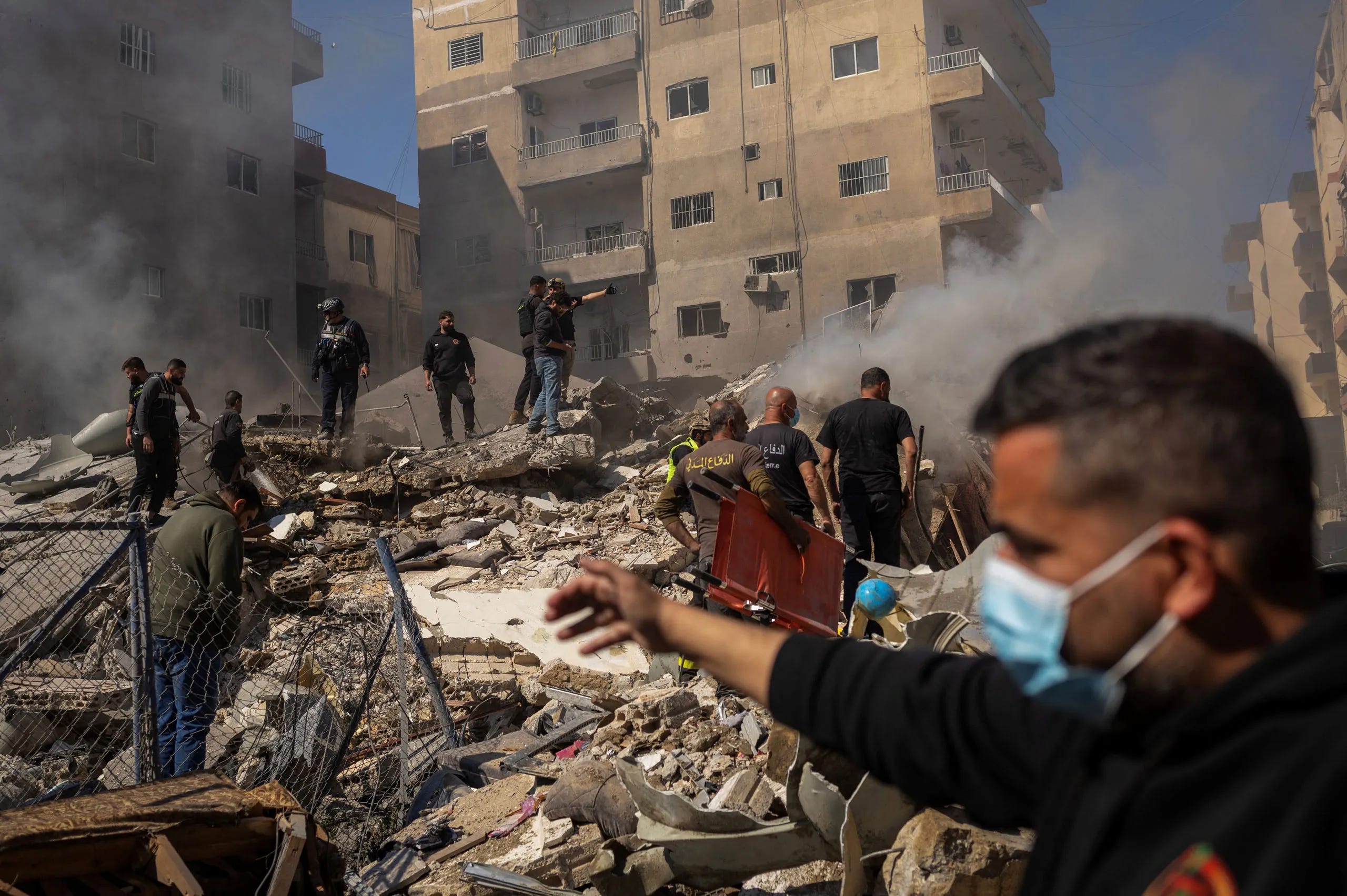
And now, this week, the operation has a new name. Operation Arrows of Fire. Strikes across more than 70 sites. Dahiyeh, the densely populated southern suburbs of Beirut, hammered again. Eight hundred thousand people forced from their homes in the immediate wave of this escalation alone. New evacuation orders pushing northward, the geography of displacement expanding with each communique, each named operation, each announcement from the IDF that it had hit what it invariably calls “Hezbollah infrastructure” in neighborhoods where hundreds of thousands of civilians live, cook, sleep, raise children, and have the audacity to remain in the country of their birth.
The Israeli military did not invent the targeting of civilian infrastructure as a method of coercion. But it did something unusual: it named the method, published it, and attached a general’s name to it as though it were a contribution to military theory rather than a description of a war crime.
In 2008, IDF Northern Command chief Gadi Eisenkot told the Israeli newspaper Yedioth Ahronoth that in any future conflict with Lebanon, Israel would apply disproportionate force to civilian infrastructure and neighborhoods, not as collateral damage but as deliberate pressure. The population would be made to bear the cost of Hezbollah’s presence. This became known as the Dahiyeh Doctrine. Dahiyeh is the name of the southern suburbs of Beirut that are being struck today.
The doctrine violates, by name and by explicit intent, the fundamental principles of international humanitarian law. The principle of distinction requires warring parties to separate military targets from civilians and civilian structures. The principle of proportionality prohibits civilian harm that is excessive relative to military advantage. Eisenkot’s statement dispensed with both. He was not describing a failure of targeting. He was describing the targeting philosophy. The Israeli government did not disavow it. The international community absorbed it without legal consequence. And when the bombs fell on Gaza in 2014, on Beirut in 2024, and on Dahiyeh again this week, the doctrine was not being improvised. It was being executed, on schedule, against a civilian population that had been designated in advance as an acceptable pressure mechanism.
This matters because Israel has constructed, over decades, an elaborate juridical vocabulary designed to make the Dahiyeh Doctrine sound like something else. “Precision strikes.” “Targeted operations.” “Mitigating harm to uninvolved individuals as much as possible.” That last phrase appeared in a formal IDF statement about the April strikes on Lebanon, the ones that killed 357 people in a single day, in which the military itself acknowledged that “most of the infrastructure that was struck was located within the heart of the civilian population.” Read that sentence again. The IDF confirmed, in its own statement, that it struck civilian population centers and then described the decision as mitigation. The press release and the doctrine are saying exactly the same thing in different registers: the civilians are the target. The press release just uses more passive voice.
There is one event in this sequence that requires its own reckoning, because its meaning cannot be softened by context or buried in a broader casualty count.
A ceasefire between the United States and Iran had been announced. Pakistan had brokered it. Hezbollah had publicly signaled a pause in its attacks consistent with the terms. Within hours of that announcement, the IDF launched what it publicly called its most powerful strikes on Lebanon since the current campaign began. One hundred and fifty locations struck simultaneously. Three hundred and fifty-seven people killed in a single day. Hospitals flooded. The American University of Beirut Medical Center, one of the finest hospitals in the Arab world, put out an emergency call for blood donations because its supply was gone. Tania Baban of MedGlobal, who was in Beirut, described what she saw as “total chaos” and told reporters the strikes had targeted civilian areas with no warning. Rush hour. Residential streets. Commercial districts in central Beirut. The IDF named the operation Operation Eternal Darkness.
The UN’s independent experts issued a formal condemnation that was remarkable in its directness: “This is not self-defence. It is a blatant violation of the UN Charter, a deliberate destruction of prospects for peace, and an affront to multilateralism and the UN-based international order.”
What makes this particular day legible as policy rather than as excess is the timing. The ceasefire had just been announced. Hezbollah had stood down. The moment a diplomatic off-ramp materialized, Israel drove straight through it. The message was not sent to Hezbollah. Hezbollah already understood the rules of this engagement. The message was sent to every party in the region and every government watching from outside it: that Israeli military operations are not constrained by negotiated agreements, ceasefire announcements, UN frameworks, or the diplomatic efforts of third-party mediators. The strikes on the day of the ceasefire were not a violation of an agreement. They were a statement about agreements.
Lebanon’s Prime Minister Nawaf Salam, a man who spent his career at the International Court of Justice, stood before the cameras and said Israel remains “utterly heedless of all regional and international efforts to halt the war” and that it had shown “utter disregard for the principles of international law and international humanitarian law, which it has never respected.” He called on the friends of Lebanon to act by every available means.
The friends of Lebanon issued statements.
Western media coverage of this campaign has consistently presented Israel’s evacuation orders as evidence of restraint. The argument runs: Israel warns civilians. Therefore Israel is acting proportionately. Therefore civilian deaths are regrettable but not criminal.
This argument does not survive contact with what actually happens when the orders are issued.
An evacuation order delivered to the population of Dahiyeh instructs roughly half a million people to leave a dense urban district within hours. Many have no vehicles. Many are poor. Many are elderly or disabled or caring for newborns. The roads designated as safe corridors have been struck in transit during multiple phases of this campaign. The Lebanese Red Cross has documented the deaths of its own workers responding to those strikes. The shelters and relatives in the north have been exhausted by successive waves of displacement. The UN’s own humanitarian monitoring confirms that civilians who attempted to comply with evacuation orders in previous operations were killed while moving.
Then there is January 2025. The November 2024 ceasefire had been signed. The terms required Israel to withdraw from positions it had occupied inside Lebanese territory. Israel did not withdraw. Displaced civilians from southern villages, who had been waiting in the north, began returning home. They walked down their own roads toward their own houses. IDF troops opened fire on them. Twenty-six people were killed, at least twenty-five of them civilians. One hundred and forty-seven were wounded. The Lebanese government protested. Israel said it was enforcing security. The international community noted it with concern.
The evacuation order is a legal construction, not a humanitarian one. It transfers the burden of guilt from the party launching the strike to the civilian who did not leave, could not leave, or had the nerve to come back. It exists to provide the IDF’s legal team with a document and the world’s editors with a headline that says “Israel warned civilians” before running a photograph of the rubble. The Geneva Conventions do not include a clause permitting the bombing of civilians who failed to heed an evacuation notice. The Dahiyeh Doctrine does, implicitly, by treating the civilian presence as the pressure mechanism itself.
Lebanon does not exist in isolation. It is being destroyed in parallel.
Gaza, as of this writing, has been under Israeli military assault for nineteen months. The United Nations has assessed that over 90 percent of Gaza’s housing stock has been damaged or destroyed. Famine conditions, documented by the Integrated Food Security Phase Classification, have been confirmed across the territory. The IDF has killed more than 52,000 Palestinians by the count of the Gaza Health Ministry, a figure the Lancet assessed as likely to undercount actual deaths by a factor of three or four when excess mortality from the collapse of the health system is included. Entire hospital complexes have been destroyed. The Kamal Adwan Hospital in northern Gaza was raided, its director arrested, its patients and staff left without functioning medical infrastructure in a zone where no functioning medical infrastructure existed anywhere else within reach.
What Israel is conducting in Gaza and in Lebanon simultaneously is not two separate wars managed by two separate military commands toward two separate political objectives. It is a single regional strategy aimed at the permanent military and political subordination of any organized resistance to Israeli territorial expansion, by any means available, at any human cost acceptable to a government that has demonstrated, over nineteen consecutive months, that no human cost is too high. The same arms pipeline feeds both theaters. The same legal team files the same justifications in both. The same American Security Council veto protects both from formal accountability.
Benjamin Netanyahu’s war cabinet has been explicit about its objectives in ways that Western capitals have largely declined to take at face value. Finance Minister Bezalel Smotrich has called for the resettlement of Gaza. National Security Minister Itamar Ben-Gvir has called for the “voluntary emigration” of Palestinians, a formulation that requires a particular absence of shame to use about a population being bombed into homelessness. These are not fringe voices contained at the margins of Israeli governance. They are cabinet ministers in a governing coalition. Their positions are not obstacles to Israeli policy. They are Israeli policy, stated by the people empowered to execute it.
The operational name “Arrows of Fire” is new. What it is executing is not.
A piece written about Israeli military conduct that does not name the American government as an active participant in that conduct is incomplete.
The weapons used to strike Dahiyeh, to hit the Ramlet al-Baida corniche, to kill 357 people on the day of the ceasefire announcement, and to land on Lebanon again this week under the name Operation Arrows of Fire did not materialize from the Israeli defense industry alone. The specific munitions categories required to sustain high-intensity operations at the tempo Israel has maintained, including precision-guided weapons, heavy bunker-penetrating ordnance, and the drone systems used in double-tap strikes on displaced civilians, require American resupply. Israel’s own defense establishment has confirmed that domestic production cannot maintain operational depth in these categories without external supply chains. The United States has maintained those supply chains across multiple administrations, through multiple ceasefire announcements, through the documented killing of medical workers, through the documented shooting of civilians returning home, through the documented destruction of hospitals, through the formal legal opinions of the International Court of Justice and the assessments of UN independent experts and the on-the-record statements of Lebanon’s prime minister and the published casualty figures of the Lebanese Health Ministry.
The Trump administration called Israel’s April strikes, the ones that killed 357 people on the day of the ceasefire, a sovereign right to self-defense. The legal framework used to transfer arms to Israel bypassed standard congressional oversight through a series of emergency authorizations and expedited foreign military sales that members of Congress had formally objected to and been overridden. The objections are in the record. The transfers went through anyway. Every bomb that falls on Beirut this week falls with American authorization attached.
There is a version of this story in which American support for Israeli military operations is a regrettable feature of an otherwise sound alliance, a policy failing that responsible advocates are working to change. That version requires ignoring that the policy has been maintained continuously across administrations of both parties, through every documented atrocity, through every ICJ ruling, through every UN expert condemnation, and through the ongoing assault on a country, Lebanon, that did not attack the United States and is not a threat to it. The relationship between Washington and Tel Aviv in this theater is not an alliance with uncomfortable features. It is the primary enabling mechanism for what is being done to Lebanon and Gaza. The primary enabling mechanism is not a complicating factor. It is the story.
The United Nations has counted more than 10,000 Israeli violations of the November 2024 ceasefire agreement. Ten thousand violations of a signed agreement, each documented, none of them triggering an enforcement response from any party with the power to enforce. The International Court of Justice issued provisional measures in the Gaza case finding a plausible risk of genocide. Those measures have not been enforced. The UN Security Council has been convened repeatedly. The American veto has been used repeatedly. The legal architecture for accountability exists in full. Every piece of the structure is in place. The documentation is meticulous. The condemnations are eloquent. The killing is uninterrupted.
Operation Arrows of Fire is the name Israel has given to what is happening to Lebanon this week. Next month it will have a different name. The month after that, another. The names are new. The Dahiyeh Doctrine is not. The American arms pipeline is not. The Security Council veto is not. The 800,000 displaced from their homes this week join more than a million already displaced, who join the families who were on the corniche with their tents, who join the twenty-six civilians shot while walking home, who join the 103 dead medical workers, who join the 3,100 killed since March, who join the 52,000 in Gaza, who join every name the Lebanese and Palestinian health ministries have recorded in the language of consequence for decisions made in Tel Aviv and Washington.
Whether the world treats this as a live war crime or a tragic but legally unresolvable conflict is not a factual question. It is a political choice. That choice has been made, repeatedly, by governments with the power to make a different one.
The tents on the Ramlet al-Baida corniche are gone. The families who put them up are somewhere in this country, if they are still alive. Nobody has been charged. The double-tap technique is still in operational use. Arrows of Fire is the name this week. There will be another name next week.


