By first light in Tehran on April 7, first responders were picking through the debris of the Rafi-Nia Synagogue in the city’s center. Hebrew texts lay scattered across broken concrete. Homayoun Sameh Najafabadi, the representative of Iran’s Jewish community in parliament, said in a statement carried by IRNA that the synagogue building had been completely destroyed and that Torah scrolls were left under the rubble. He noted the strike came during the Passover holiday. Neither the United States nor Israel acknowledged the attack.
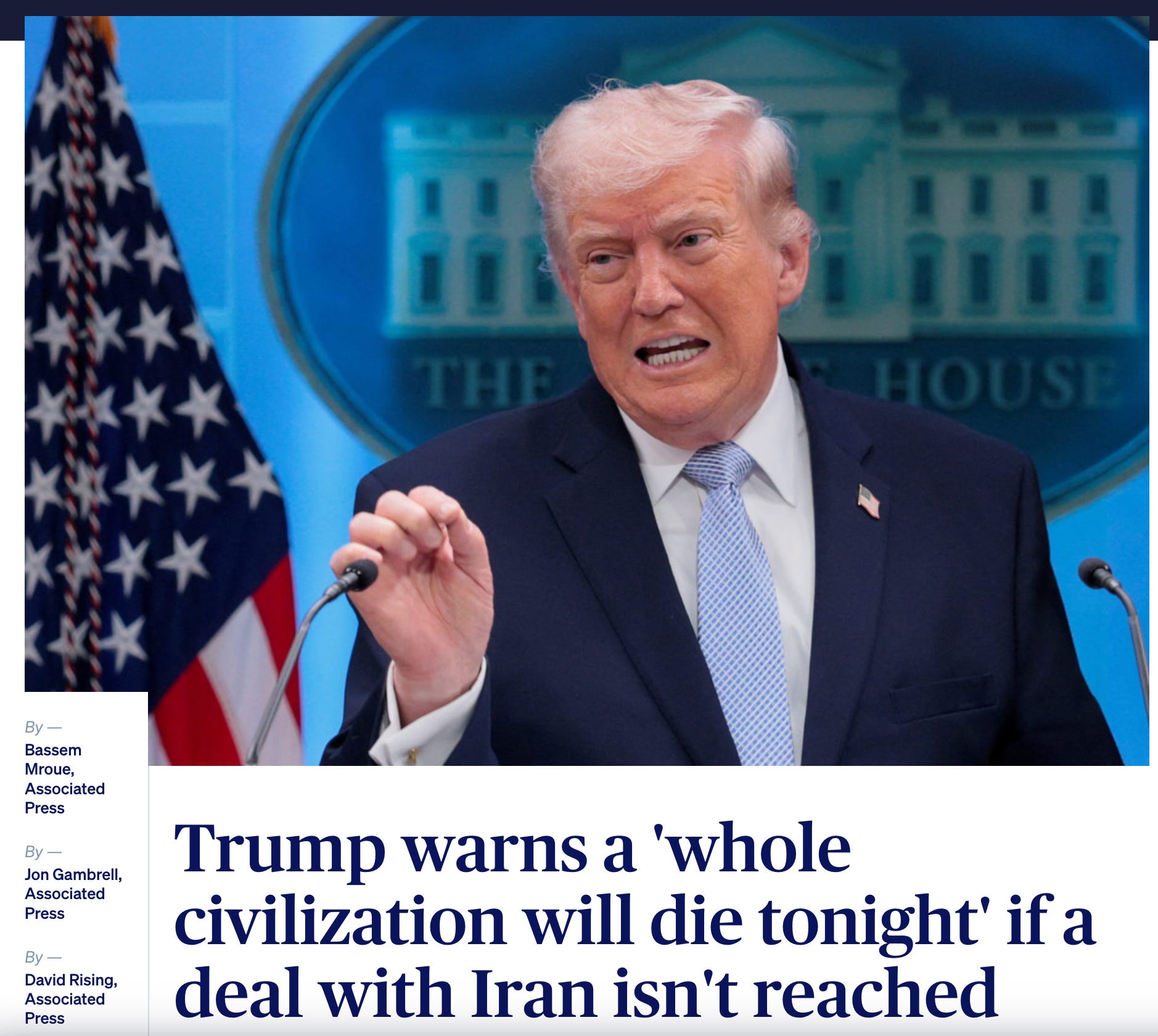
Hours later, Trump wrote: “A whole civilization will die tonight, never to be brought back again. I don’t want that to happen, but it probably will.” The post preceded his 8 p.m. deadline by hours. The Strait remains closed.
THE SYNAGOGUE AND THE BRIDGES
The Rafi-Nia Synagogue strike was not an isolated event in the overnight hours of April 6-7. Strikes hit the railway bridge over the Yahyaabad river in Kashan, Isfahan province, killing two people and wounding three, according to the Deputy Governor of Isfahan province cited by IRNA. Simultaneous strikes were confirmed on the Tabriz-Zanjan freeway in Iran’s northwest and a railway line in Karaj. Khorramabad International Airport in Lorestan province was also struck, according to Iranian state media. Before any of these strikes landed, the Israel Defense Forces had posted in Persian on social media warning Iranians to stay away from trains for 12 hours: anyone near railroads “endangers your life.” The warning was published before the strikes, not after. It functioned as a targeting announcement with a 12-hour fuse.
ALBORZ: THE DEAD
Eighteen civilians were killed in residential airstrikes in Alborz province in the early hours of April 7, including two young children. The figure was given by Deputy Governor Ghodratollah Seif, cited by Iranian state media. “Israeli fighter jets, with direct U.S. support, cowardly struck the homes and shelters of our defenseless citizens,” Seif said. Twenty-four others were wounded. Alborz province is where the B1 bridge stood before the April 2 strike that killed 13 civilians on the Sizdah Be-dar holiday. That was five days ago. Rescue teams were still working the residential zone as of the morning of April 7.
SHARIF UNIVERSITY
Strikes hit the Sharif University of Technology in Tehran on April 6-7. Iran’s Foreign Minister Abbas Araghchi condemned the attack publicly. The university, established in 1966, has produced the majority of Iran’s leading engineers and physicists. As of April 4, the Minister of Science had confirmed that five professors and more than 60 students had been killed in U.S.-Israeli strikes since February 28, with more than 30 universities targeted. The Sharif strike added to that count. The White House and Pentagon have not addressed the university targeting campaign.
KHARG ISLAND
U.S. forces struck military targets on Kharg Island overnight, confirmed independently by a U.S. official to NBC News and a White House official to PBS News, both speaking anonymously. The strikes did not target oil export infrastructure, both officials said. The island handles approximately 85 to 95 percent of Iran’s crude oil exports. Witnesses described the intensity of the overnight operation as at least comparable to the March 13 attack, when CENTCOM confirmed 90 targets struck including naval mine storage facilities, missile storage bunkers, and radar installations. U.S. crude climbed 3 percent to approximately $116 per barrel following confirmed reports of the strikes. U.S. crude has doubled in price since the start of 2026. Brent was trading above $110.
THE ULTIMATUM AND ITS LANGUAGE
Trump’s April 7 deadline carries specific operational content: destroy every bridge and power plant in Iran within four hours if the Strait does not reopen by 8 p.m. He has also threatened water desalination facilities. Both categories are civilian infrastructure protected under international humanitarian law. Kenneth Roth, former Executive Director of Human Rights Watch, told NBC News that the threat constitutes announced collective punishment, a violation of the Fourth Geneva Convention, and that making threats to terrorize a civilian population is itself a potential crime under international humanitarian law. The White House spokeswoman said Iran’s “best move is to make a deal.” Trump has issued and then retracted deadlines multiple times across the war’s 39 days. Iran’s Foreign Ministry spokesman Esmail Baqaei told reporters in Tehran on April 6 that U.S. ultimatums were “incompatible with negotiations.”
THE ISLAMABAD ACCORD
A ceasefire framework tentatively called the “Islamabad Accord” was in circulation between Washington and Tehran in the 24-hour window covered here. The proposal, built by Pakistan, Egypt, and Turkey, calls for an immediate cessation of hostilities, the reopening of the Strait, and 15 to 20 days of structured negotiations toward a broader settlement. Pakistan’s Army Chief General Asim Munir spent the overnight hours of April 5-6 in contact with U.S. Special Envoy Steve Witkoff, Vice President JD Vance, and Iranian Foreign Minister Araghchi, according to Reuters. Iran received the proposal and responded with a 10-point counter-position delivered through Pakistani intermediaries, rejecting the temporary ceasefire framing. A senior Iranian official, speaking anonymously to Drop Site News, described the framework as “detached from the realities on the ground,” adding that a temporary pause “under the shadow of war” had no place in Iranian policy. Iran’s position, transmitted through Pakistan, is a permanent ceasefire, guarantees against future attacks, sanctions relief, and financial reparations for reconstruction. Iran’s ambassador to Pakistan said on April 7 that Islamabad’s mediation was approaching a “critical, sensitive stage.” He gave no further detail.
One diplomatic gap closed in the same 24 hours: French President Emmanuel Macron announced that French citizens Cécile Kohler and Jacques Paris, held in Iran for over three years, had been permitted to leave the country and were sheltered inside French diplomatic premises before departure.
THE HUMAN CHAINS
The Iranian government spent April 7 calling on citizens to form human chains around the country’s power plants before Trump’s deadline. President Masoud Pezeshkian posted on X that 14 million Iranians had answered a national mobilization campaign. An IRGC general urged parents to send their children to man checkpoints. A major power plant in Tehran was closed off to the public for security purposes before the demonstration was due to start. The IRGC’s Cyber Guard unit posted to Telegram that it was ending its “self-restraint” and would move to “deprive the United States and its allies of the region’s oil and gas for years.” The warning was addressed to U.S. regional partners specifically. The IRGC’s naval command had previously stated the Strait of Hormuz “will never return to normal,” particularly for the United States and Israel. Iran’s position on the Strait has not shifted in 39 days.
DAY 39: THE SIGNAL ITEMS
Trump Posts “A Whole Civilization Will Die Tonight” — April 7, Truth Social; threat to destroy every bridge and power plant in Iran within four hours if Strait is not reopened by 8 p.m. Eastern; targeting civilian infrastructure for coercive purposes constitutes collective punishment under the Fourth Geneva Convention, per international legal experts cited by NBC News.
Kenneth Roth: Threats May Constitute War Crime — Former Executive Director of Human Rights Watch told NBC News on April 7 that Trump’s announced collective punishment targeting the Iranian civilian population rather than its military violates the Fourth Geneva Convention; threats designed to terrorize a civilian population are themselves a potential crime under international humanitarian law.
Rafi-Nia Synagogue Destroyed in Tehran During Passover — Struck overnight April 6-7; Hebrew texts found in the debris; condemned by Homayoun Sameh Najafabadi, Iran’s Jewish community parliamentary representative; neither the U.S. nor Israel has acknowledged responsibility.
Kashan Railway Bridge Struck: Two Killed — April 7, Isfahan province; Deputy Governor cited by IRNA; two civilians dead, three wounded; simultaneous strikes on the Tabriz-Zanjan freeway and a Karaj railway line confirmed.
IDF Advance Warning to Vacate Iranian Railways — Persian-language social media post published before the strikes warning Iranians to stay away from trains for 12 hours; no specific targets named; Israel confirmed striking rail infrastructure following the warning.
18 Civilians Killed in Alborz Province, Including Two Children — Early hours of April 7; Deputy Governor Ghodratollah Seif cited by state media; 24 further wounded; rescue teams still active; second consecutive day of confirmed civilian fatalities in Alborz.
Khorramabad International Airport Struck — Lorestan province, western Iran; confirmed by Iranian state media April 7.
Sharif University of Technology Hit — Confirmed strikes April 6-7; Foreign Minister Araghchi condemned the attack; over 30 universities targeted and 60+ students killed since February 28 per Minister of Science.
Kharg Island Struck for the Second Time — U.S. military targets struck overnight April 6-7; oil export infrastructure not targeted per U.S. official; intensity described by witnesses as comparable to or greater than the March 13 operation; confirmed independently to NBC News, CBS News, and PBS News.
Brent Crude Above $110; U.S. Crude at $116 — U.S. crude has doubled since January 2026; Kharg Island strikes drove a 3 percent intraday climb on April 7.
Iran Rejects 45-Day Ceasefire, Issues 10-Point Counter-Response — Delivered through Pakistani intermediaries April 6-7; Iran demands permanent ceasefire, sanctions relief, reparations, and an end to other regional wars; temporary ceasefire described as “detached from the realities on the ground” by a senior Iranian official to Drop Site News.
The Islamabad Accord Framework Circulated — Pakistan, Egypt, and Turkey; calls for immediate Hormuz reopening and 15 to 20 days of negotiations toward a broader settlement; Army Chief Asim Munir in overnight contact with Witkoff, Vance, and Araghchi on April 5-6; Iran’s ambassador to Pakistan says mediation is at a “critical, sensitive stage.”
French Hostages Released — Cécile Kohler and Jacques Paris, held for over three years, permitted to leave Iran and sheltered inside French diplomatic premises in Tehran; departure announced by President Macron on April 7.
IRGC Top Spy Maj. Gen. Majid Khademi Killed — Killed April 6; described by Supreme Leader Mojtaba Khamenei as having spent “decades in quiet and devoted service in the fields of security, intelligence and defense”; Khamenei said targeted killings of commanders would not deter the IRGC.
Istanbul Israeli Consulate Attack — April 7, Besiktas district; one gunman killed, two wounded, two police officers with minor injuries; consulate was not staffed at the time; Turkey’s Justice Minister opened an investigation; Israel and the United States condemned the attack.
Iran Fires Cluster Munitions at Sharon Plain — IDF confirmed the attack on multiple sites in central Israel’s Sharon plain on April 7; search and rescue teams deployed to several impact sites.
Japan and Philippines Seek Direct Energy Agreements with Iran — Both nations, heavily dependent on Middle Eastern supply, approached Tehran directly rather than waiting on U.S. efforts to reopen Hormuz; South Korea pursuing alternatives from other regional partners.
14 Million Iranians Declared as Volunteers — President Pezeshkian cited the figure on X, April 7; IRGC urged citizens to form human chains around power plants before Trump’s deadline; one major Tehran power plant closed for security before demonstrations were due.
UKMTO: Container Ship Struck off Kish Island — British Maritime Trade Operations Center confirmed April 7 that a container ship was struck by an unknown projectile near the western entrance to the Strait of Hormuz; crew safe; investigation ongoing.
IRGC Cyber Guard Lifts “Self-Restraint” — Telegram post April 7 warned of moves to “deprive the United States and its allies of the region’s oil and gas for years”; addressed specifically to U.S. regional partners; no timeline or mechanism specified.