Abu Dhabi's China Trip
A Report
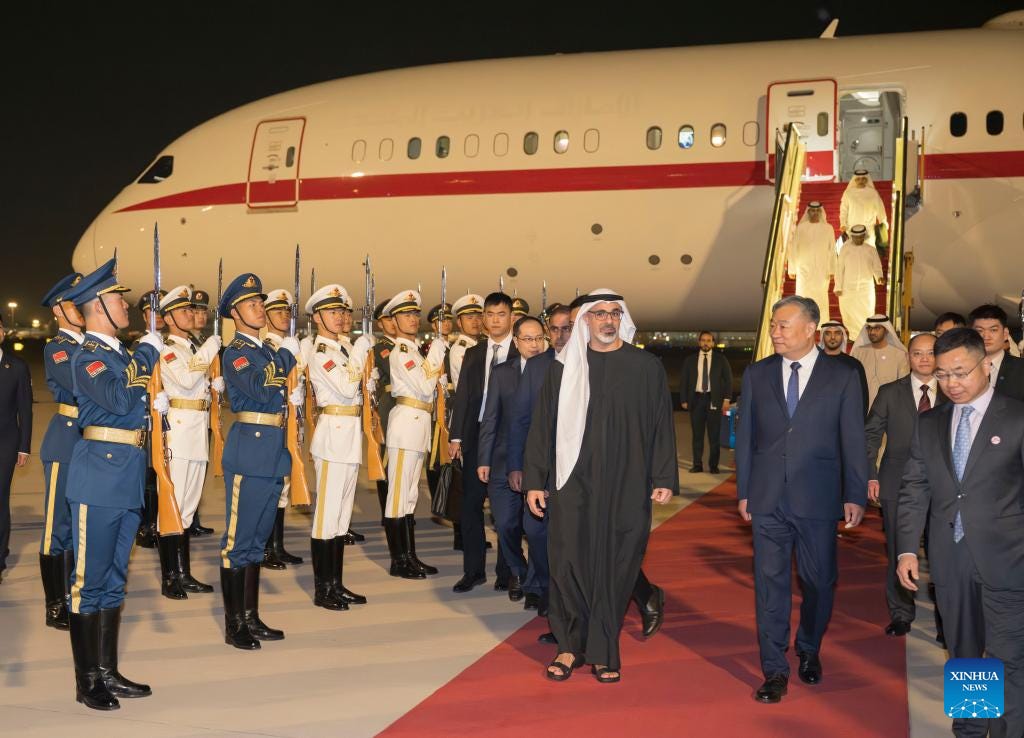
Six days after a fragile two-week ceasefire suspended the Iran-US-Israel war, Sheikh Khaled bin Mohamed bin Zayed Al Nahyan, Crown Prince of Abu Dhabi, landed in Beijing with a delegation whose composition, read carefully, is not a diplomatic courtesy call. Khaldoon Al Mubarak, Chairman of the Executive Affairs Authority and MBZ’s designated Special Envoy to China, was there. So was Sultan Al Jaber, who runs ADNOC and simultaneously holds the Industry Minister portfolio, alongside the Minister of Investment, the Minister of Foreign Trade, and two State Ministers from Foreign Affairs. It is a supply chain operation wearing the clothes of a state visit.
The visit ran April 12 to 14. Premier Li Qiang received the Crown Prince. Twenty-four agreements were signed at the UAE-China Business Promotion Conference, held under the theme “From Vision to Value,” a phrase that the Abu Dhabi Media Office produced without apparent awareness of its own precision. Value is exactly what the visit was about, and the question of where it flows is what the official communiques decline to answer.
The trade numbers are the starting point. Non-oil trade between the UAE and China crossed $100 billion for the first time in 2025, reaching $111.5 billion on annual growth of 24.5%. The UAE is China’s largest export market and second largest trading partner in the Middle East. Those figures predate the war. What the war created is a specific opening that Al Jaber’s presence names without stating.
China was Iran’s primary crude oil customer. The war disrupted that supply line, and prolonged disruptions in the Strait of Hormuz have compounded the pressure on China’s energy security, alongside Qatar’s LNG shutdown. Chinese refineries calibrated for Iranian crude are now operating under constraint. ADNOC, which has spent years building its production capacity and its position as a reliable Gulf supplier, is positioned to absorb that displacement. Al Jaber did not need to say any of this in Beijing. The fact of his being there said it.
The MoUs signed between Sheikh Khaled and Premier Li Qiang covered clean energy, investment, sustainable agriculture, environmental sustainability, health sciences, and advanced technology. Sheikh Khaled stressed the importance of working together to strengthen supply chains. The meeting also reviewed the Iran war, with both delegations calling for peaceful solutions to the conflict neither side naming what the other had done to produce it.
The UAE, whose aluminum producer EGA declared force majeure after the Taweelah plant was struck, whose territory sits inside the operational radius of a war that Iran helped initiate, whose government hosts CENTCOM and has integrated into the US-Israel security architecture across the Gulf, sat in Beijing with a government that spent the preceding weeks providing satellite intelligence support to the same Iranian military that attacked it. Beijing was unable to shield Tehran from the US-Israel strikes, but its cautious approach preserved its position as a potential post-conflict stabilizer. China’s public response was limited to diplomatic statements, including Wang Yi’s condemnation of the assassination of Ayatollah Khamenei as the “blatant killing of a sovereign leader,” while stopping short of any concrete intervention. Both delegations understood the record. Neither mentioned it.
This is not hypocrisy in any simple sense. It is the working logic of a system that has not resolved how states with overlapping and contradictory commitments are supposed to behave when a war forces those commitments into direct conflict. Abu Dhabi’s answer, on April 12, was to book the flight to Beijing anyway.
China holds comprehensive strategic partnerships with five Middle Eastern states: Algeria, Egypt, Iran, Saudi Arabia, and the UAE. Its highest-value contracts in the region are concentrated in Saudi Arabia and the UAE. The partnership with Iran is the ideological one. The partnerships with Riyadh and Abu Dhabi are the financial ones. Beijing has never regarded these as contradictory, and the UAE spent the years of maximum US pressure on Iran deepening its own China exposure. The war has not changed that calculation for either party.
Al Mubarak’s designation as Special Envoy to China signals that Abu Dhabi is running its China relationship separately from the UAE federal government. He chairs the Executive Affairs Authority, MBZ’s institutional instrument, and is not a foreign ministry appointment. His presence at Premier level means this visit was Abu Dhabi’s initiative, not a federal diplomatic formality, and the 24 deals signed on April 13 are infrastructure for Abu Dhabi’s positioning as the commercial gateway through which the forthcoming China-GCC architecture flows. China aims to complete negotiations on a China-GCC Free Trade Agreement at the second China-Arab States Summit, and Abu Dhabi, as the UAE’s dominant voice in GCC affairs, intends to be that entry point.
The reception was calibrated. Li Qiang is Premier, not President. MBZ met Xi Jinping in 2024. The Crown Prince met the economic premier, and the economic frame keeps the visit below the threshold of political commitment, which is precisely where Abu Dhabi needs it. The US security relationship requires that Abu Dhabi not be seen as aligning with China geopolitically. The economic relationship requires that Abu Dhabi not be seen as subordinating itself to Washington commercially. The Premier-level format resolves this tension in protocol, if not in substance.
Abu Dhabi is not a middle power in the ordinary sense. It is the wealthiest emirate in a federation that hosts US military infrastructure, manages one of the world’s largest sovereign wealth funds, controls ADNOC’s upstream production, and signed a package of agreements with the country that was providing navigational and satellite support to the force that bombed its industrial facilities. The word hedging does not capture that.
The visit’s sharpest moment was not ceremonial. On April 13, while Sheikh Khaled was witnessing the signing of the commercial agreements across town, Wang Yi held a separate bilateral with Al Mubarak in Beijing. Wang Yi is a Political Bureau member and Director of the Office of the Central Commission for Foreign Affairs, the highest-ranking diplomat in the Chinese system, and he does not typically take meetings with special envoys. He took this one. The reason was on the clocks: at 10 a.m. Eastern Time that Monday, US CENTCOM activated a naval blockade of all maritime traffic to and from Iranian ports, executing partly from Al Dhafra Air Base in Abu Dhabi, the same facility that hosted the American air defense infrastructure intercepting Iranian missiles throughout the war.
Wang Yi told Al Mubarak that blocking the Strait of Hormuz does not serve the common interests of the international community, and that a comprehensive and lasting ceasefire through political and diplomatic means is the fundamental way to resolve the issue. He added that China understands the legitimate security concerns of Gulf states and supports the UAE in safeguarding its national sovereignty, security, and legitimate rights and interests. The two statements belong in the same sentence. China acknowledges what happened to the UAE, supports its sovereignty, and then states that the military posture executing from UAE soil is contrary to global interests. The message was not delivered to Washington. It was delivered to the man whose government controls the base.
Al Mubarak’s response, per the Chinese Foreign Ministry readout, was to thank China for the arrangements for the visit, describe the UAE’s regard for China as a “second home,” and say that the UAE expects China to play a greater role in easing Middle East tensions. The UAE’s designated channel to Beijing told Beijing’s top diplomat that it wants more Chinese diplomatic engagement in a war that UAE territory is partly enabling. Wang Yi’s remarks were not a threat. They were China stating its position to the party most able to carry it back to Washington, using the bilateral channel the visit had created for exactly that purpose.
Whether Abu Dhabi can sustain the position that it is simultaneously the host of a US military blockade and the party asking China to end it, without one of those counterparties eventually demanding a clarification, is the question the visit leaves open. Abu Dhabi’s answer, for now, is to sign the agreements, ask China to do more, and keep Al Dhafra open.