AIPAC Funded Two Congressmen and a Lie in New York. All Three Lost.
AIPAC vs Zohran Mamdani
AIPAC’s machine does one thing. It finds the most exposed Democrat willing to vote its way on Israel, floods the district with money, and wins. That is the model, and it has worked often enough that nobody bothered to ask what happens when it doesn’t. New York was supposed to be the place it worked best: the most expensive media market in the country, two incumbents the lobby had financed for years, and a third race where simply invoking AIPAC’s name was supposed to be enough to finish an opponent. On Tuesday night the model produced nothing. Two AIPAC-funded congressmen lost their seats. A third candidate tried to use the lobby’s name as a weapon against a rival it had never actually funded, got caught making it up, and won the race anyway. Three different roads to the same result.
Start with what New York’s 13th District elected for twenty-nine years, what New York’s 10th District inherited from a denim fortune, and what neither incumbent’s allies could buy back once the votes were counted.
Adriano Espaillat held Harlem, Washington Heights, Inwood, and a slice of the Bronx since 2017. He chaired the Congressional Hispanic Caucus. He also took AIPAC delegation trips to Israel on the lobby’s dime, accepted a direct contribution from the group as recently as March 18 of this year, and built a campaign-finance relationship with AIPAC that, according to his challenger’s published accounting, ran past $676,000 across his career and more than $145,000 in this cycle alone.
The voting record behind the money is not ambiguous. In April 2024, Espaillat voted to send Israel an additional $14.5 billion in military assistance. He is not a co-sponsor of the Block the Bombs Act, the bill restricting certain munitions sales to Israel that the Congressional Progressive Caucus formally endorsed last year. Asked about it directly, he told reporters, “I’m not on that bill, but I tell you, what’s important is that we have a path to peace.” Pressed in debate on whether Israel’s campaign in Gaza amounted to genocide, he called it a “horrific situation” and added that “whoever perpetrated that action should be held to the highest standard of accountability,” a sentence built with real care to avoid naming who perpetrated anything. When his challenger, Darializa Avila Chevalier, raised the AIPAC money directly, his answer was the one every funded incumbent gives: “I am not influenced by anybody that contributes to my campaign.”
The refusal to back Block the Bombs cost him two endorsements he needed. The Working Families Party declined to back him over it. The New York Progressive Action Network rescinded a previous endorsement specifically because he kept taking AIPAC money and would not move on the bill. A Justice Democrats-commissioned poll found that 56 percent of voters in his own district viewed AIPAC unfavorably, with only 34 percent professing no opinion at all. Espaillat was defending a position the people who would decide his career had already turned against.
The money still came. AIPAC’s super PAC, the United Democracy Project, disclosed pouring $650,000 into BOLD America, a vehicle branded around promoting Hispanic Democrats that ultimately spent more than $2.8 million opposing Avila Chevalier and supporting Espaillat. The Congressional Hispanic Caucus’s own BOLD PAC, which had itself taken AIPAC money this cycle, added roughly $230,000 on June 1. BOLD America followed with $730,000 over the next two days, then another $1.2 million on June 9 and 10, almost entirely in attack ads against the insurgent. Through Democracy Engine, the bundling platform AIPAC uses to let donors route money to multiple candidates at once, Espaillat’s campaign took in an additional $376,398. On a single day, June 4, he raised just under $112,000 from sixty-nine wealthy donors averaging $1,623 a contribution. Not one of the sixty-nine listed an address inside his district. Forty-eight had given large sums to AIPAC since 2023; counting AIPAC-adjacent organizations like Democratic Majority for Israel and the Republican Jewish Coalition, that number rose to sixty-seven of sixty-nine. Among them was Bob Cohen, a national AIPAC board member who has raised tens of millions for the group and led its campaign against the Obama-era Iran nuclear deal. Six of the donors that day had personally given $428,000 to AIPAC’s own super PAC. Avila Chevalier’s campaign later put the full gap at nearly $7 million spent by pro-Espaillat outside groups against less than $3 million on her side, financed, her campaign said, entirely through small donors, with AIPAC, corporate PAC, and crypto money refused outright.
She raised that money from more than 10,000 individual donors at an average contribution of $66, becoming the first challenger in the district’s history to clear $1 million. At a debate, the two candidates were asked when they had last visited the Dominican Republic. Espaillat, beaming, said three times a year. Avila Chevalier said she could not afford to go every year. The exchange was not about travel. It was the entire campaign in one minute: a chairman with frequent-flyer comfort and a public defender who had to do the math out loud.
The Associated Press called it for Avila Chevalier at 49.4 percent to Espaillat’s 45.9, with roughly 86 percent of the vote counted. “Tonight wasn’t our night,” Espaillat told supporters. “But I love you anyway.” His twenty-nine years in elected office ended a few points short, after AIPAC’s network had spent at a level that, two years earlier, had been enough to remove sitting members of Congress in a single news cycle.
If Espaillat’s defeat shows the model straining, Dan Goldman’s shows it collapsing without much of a fight. Goldman is an heir to the Levi Strauss & Co. fortune, with a personal net worth financial disclosures place between $64 million and $253 million. In his first congressional run in 2022, he loaned his own campaign $4.9 million, never paid himself back, and still needed a 1,306-vote margin to win a crowded primary with just 26 percent of the field. His 2022 disclosures showed holdings in Lockheed Martin, Northrop Grumman, the gunmaker Sturm Ruger, Chevron, ExxonMobil, Halliburton, and Rupert Murdoch’s Fox Corporation; he says those positions have since gone into a blind trust. This cycle he raised $2.3 million in the first quarter alone, more than three times what his eventual challenger raised in the same period, and took in more than $377,000 in direct and earmarked AIPAC-linked contributions.
The donations bought specific behavior, not just an endorsement. In November 2023, Goldman was one of only twenty-two House Democrats who voted with Republicans to censure Rashida Tlaib, the chamber’s only Palestinian American member, over her use of the phrase “from the river to the sea.” In early 2024, he signed a majority-Republican letter attempting to discredit South Africa’s genocide case against Israel at the International Criminal Court of Justice, a letter AIPAC praised by name. The month after he signed it, AIPAC’s political action committee sent him $45,400. Days after he signed it, the ICJ ruled it plausible that Israel was committing genocide. A constituent group calling itself NY-10 Neighbors delivered a letter signed by more than 1,000 of his own voters condemning the move and asking him to retract it; his office would not let them present it in person and answered, one organizer said, with form emails that “sound like they were written by a robot.”
By 2026, Goldman had learned to manage the contradiction rather than resolve it. He told debate moderators that whether Israel’s conduct constitutes genocide “requires evidence” and is “somewhat beside the point.” He said publicly that AIPAC “has real problems” and “is harmful in many ways,” then in the next breath cited his own AIPAC endorsement, alongside one from the more centrist J Street, as proof that his views were independently held rather than purchased. He insisted he does not accept corporate PAC money, including from AIPAC’s PAC directly; campaign-finance disclosures show he received hundreds of thousands of dollars in individual contributions earmarked through AIPAC’s own donor infrastructure regardless, the distinction being more useful on a debate stage than on an FEC filing.
Two days before the vote, a Brooklyn coffee shop posted a security-camera photo of Goldman ordering a drink with the caption asking whether it “tastes like genocide juice.” The post went viral, Goldman called it shocking, and Trump’s Justice Department, through assistant attorney general Harmeet Dhillon, announced a civil-rights investigation into the shop on his behalf. A congressman who built his national profile leading the first impeachment of Donald Trump spent his campaign’s final week being defended in the press by Donald Trump’s own Justice Department. Neither the coffee shop posting nor the federal intervention moved the needle. Brad Lander, the former city comptroller who calls Israel’s conduct in Gaza a genocide and opposes funding for both offensive weapons systems and the Iron Dome missile-defense program, closed the night with roughly two-thirds of the vote. Goldman’s wealth, his blind trust, his Stanford law degree, and his AIPAC endorsement bought him a third.
The third contest is the strangest of the night because AIPAC was not in it at all. New York’s 7th District, the open seat vacated by retiring Rep. Nydia Velázquez, had no pro-Israel candidate on the ballot. Claire Valdez, Antonio Reynoso, and Julie Won each described Israel’s campaign in Gaza as a genocide. None of that stopped AIPAC’s name from becoming the deciding accusation anyway.
Valdez claimed Reynoso, the Brooklyn borough president and Velázquez’s hand-picked successor, was being propped up by AIPAC money through a super PAC called Real Fight NYC. She was wrong, and embarrassingly so: the American Federation of Teachers came forward to say it had supplied roughly $200,000 of the $750,000 the PAC ultimately spent, with no AIPAC involvement whatsoever. Real Fight NYC ran an ad pointing out the error. Valdez won the seat regardless, taking 58 percent against Reynoso’s 33 and Won’s 7 in a four-candidate field, a 20-plus-point margin in a district Reynoso was born and raised in and Valdez had lived in for seven years.
What the false accusation exposes matters more than whether it was accurate. AIPAC’s name has become load-bearing in New York Democratic politics, deployed by reflex even where the lobby has no presence to confirm. Valdez did not need the claim to be true to make it land with her base; she needed the brand to already be radioactive enough that the accusation alone did the work. It misfired on the specific fact and still describes, accurately, what AIPAC’s reputation has become in this electorate.
None of this happened without a preceding, deliberate institutional choice. Two and a half months before New York went to the polls, the Democratic National Committee’s Resolutions Committee met in New Orleans and considered a measure from Florida member Allison Minnerly naming AIPAC’s nearly $14 million in spending against progressive candidates in that cycle’s Illinois primaries. The committee voted it down, passing instead a generic resolution against “dark money” that named no organization. Minnerly’s response was direct: members claim they don’t want to single out AIPAC, she said, but AIPAC has no comparable reluctance about singling out progressive candidates, district by district, year after year. DNC Chair Ken Martin called the broader resolution a “blanket repudiation.” AIPAC’s spokesperson, Deryn Sousa, called the vote vindication: “The DNC made clear today that all Democrats, including millions who are AIPAC members, have the right to participate fully in the Democratic process, and we plan to do just that.” Separate resolutions on conditioning military aid to Israel and on recognizing Israel’s conduct in Gaza as genocide were deferred without a vote, shipped to a “Middle East working group” that has not been heard from since.
The same Progressive Caucus that endorsed Block the Bombs as official policy still ran its electoral arm’s endorsement through to Espaillat over the candidate who actually supported the bill. AIPAC itself boasted, in May 2024, that it is “the top fundraiser for Progressive Caucus members,” naming recipients including Ohio’s Shontel Brown and California’s Brad Sherman and Ted Lieu. Marie Newman, a former caucus member, called the arrangement what it is: “The ties between AIPAC and Netanyahu and the genocide are very clear, so it’s disappointing to see the Progressive Caucus back someone who is willing to support AIPAC.” The caucus’s own chair, Greg Casar, had denounced AIPAC’s $20 million spent against progressives in Illinois as something every Democrat should find outrageous. The caucus endorsed Espaillat anyway. The gap between what national Democratic institutions say about AIPAC and what they do about it is not an oversight. It is the operating procedure, and New York voters overruled it three times in one night without waiting for permission.
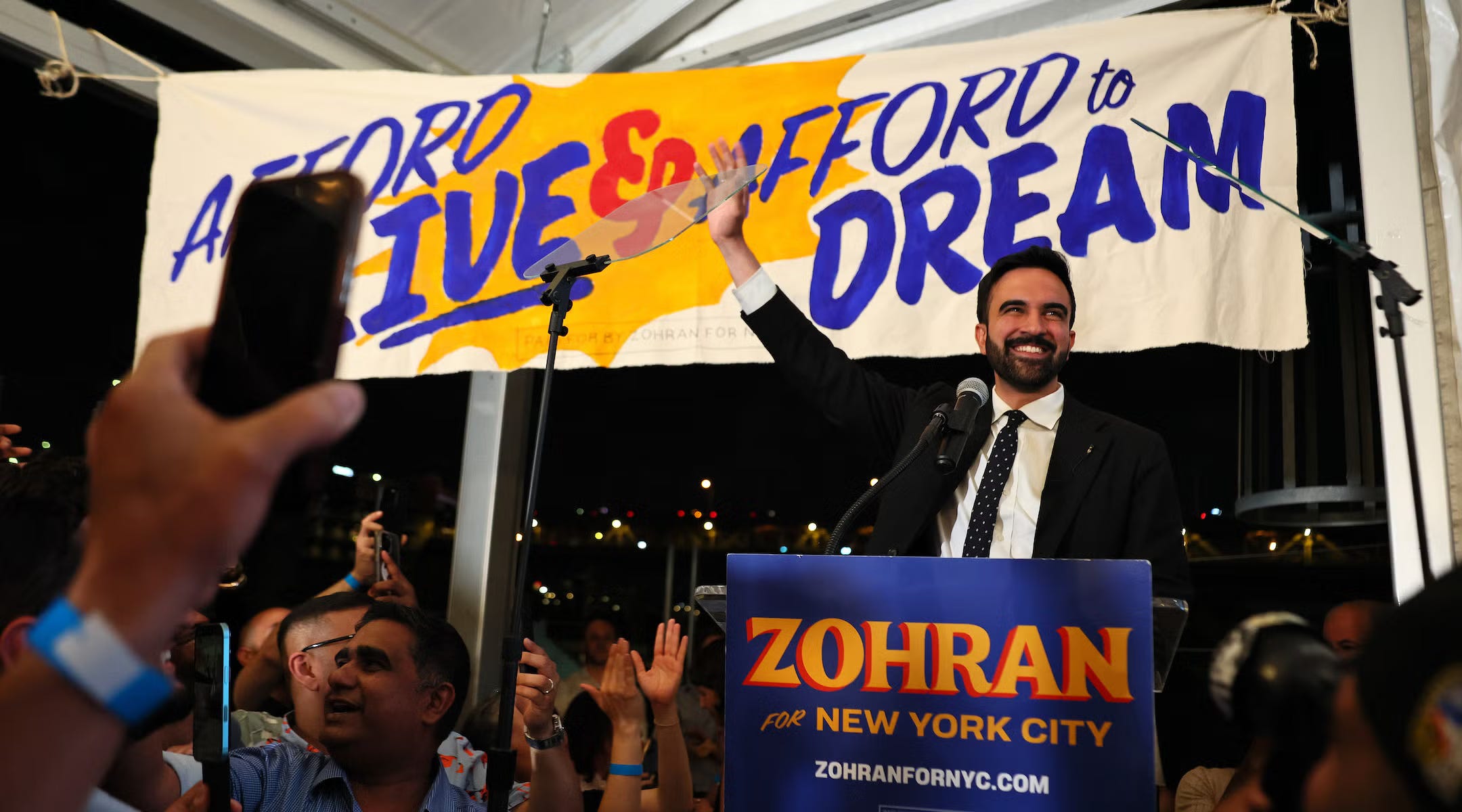
Credit assigned only to Mamdani’s endorsement undersells what beat AIPAC’s money, and overstates how personal the operation actually was. Mamdani endorsed eight candidates this cycle, five for the state legislature and three for Congress. All eight won. Valdez’s campaign knocked more than 300,000 doors over six months. Jews for Racial and Economic Justice sent 200 volunteers across 500 separate shifts canvassing for Lander alone, deploying what its communications director, Sophie Ellman-Golan, described as a grassroots Jewish left distinct from the establishment figures who marched in the Israel Day parade. NYC-DSA’s Eleanor Babaev, who helps run the chapter’s electoral field operation, put the win in terms longer than one election cycle: the infrastructure to pull this off had been built over years, door by door, precinct captain by precinct captain, since the chapter’s first wins against incumbents in 2018. Representative Alexandria Ocasio-Cortez did not endorse Mamdani’s congressional slate at all. The DSA-backed state legislative candidates she did back won anyway, which is its own answer to the question of whether this was a celebrity coattail effect or an organizing machine that no longer needs one man’s name on the door hanger to function.
The financing tells the same story from a different angle. Lander’s campaign built its early war chest from more than 11,000 individual donors before Goldman had finished writing his first check to himself. Avila Chevalier broke $1 million from 10,000 donors averaging $66 apiece while refusing AIPAC, corporate, and crypto money outright. Against that, Espaillat’s last six-figure infusion arrived from sixty-nine strangers who had never set foot in his district, and Goldman’s personal fortune bought him a debate-stage talking point about independence rather than the votes he needed to keep his seat.
House Minority Leader Hakeem Jeffries, watching two of his own state’s incumbents fall in a single night, chose understatement: “We have agreed to strongly disagree,” he said of Mamdani. “There are 215 members of the House Democratic caucus. A handful of primaries that go in one direction or the other, in a given state or two, aren’t going to reshape who we are as House Democrats.” The handful of primaries he was describing had just removed the chair of his own Congressional Hispanic Caucus and a member who built a national brand prosecuting Donald Trump, both of them sitting two subway stops from his own district office.
None of this should be presented as a clean morality play, and a careful account does not get to skip the parts that complicate it. Avila Chevalier spent the final weeks of her campaign answering for old social media posts, surfaced by Espaillat’s allies and the New York Post, in which she had called Joe Biden “a rapist,” written an obscenity directed at Kamala Harris over Harris’s remarks discouraging migration, and made disparaging comments about Black and Arab men. She attended a Democratic Socialists of America-promoted rally on October 8, 2023, the day after Hamas’s attack on Israel, an event other DSA members including Mamdani and Lander publicly distanced themselves from. Jewish Insider reported she has also faced accusations of spreading Kremlin talking points and COVID-19 disinformation online. Rabbi Chaim Steinmetz of Congregation Kehilath Jeshurun called Mamdani’s description of AIPAC as “monsters” reckless, arguing the mayor had effectively told every AIPAC supporter, rabbi included, that he believed they desired genocide. Political analyst JC Polanco warned days before the vote that depressed early turnout, fewer than 173,000 New Yorkers by the Monday before Election Day, suggested Mamdani’s strategy of nationalizing Gaza policy inside a House primary might not produce the coalition that elected him the previous fall.
The turnout warning was half right. It did not hold in the two races Mamdani’s candidates won by landslide margins. It came closest to true in the one race where AIPAC’s money and donor network fought hardest and longest, the one that finished under four points. That detail is the most useful fact in the entire night for anyone trying to measure what AIPAC’s spending still buys. It did not buy a win anywhere. It bought proximity to one, in exactly the district where it spent the most, which is either the last gasp of a model that used to work or the first sign of how much more expensive that model is about to get for a return that keeps shrinking.
The open question is not whether AIPAC will keep spending. Its national operation, by its own disclosures, spent more than $100 million in the 2024 cycle alone removing two sitting Democrats, and one of its allied super PACs is reportedly sitting on a war chest above $90 million for a single contested New York seat in November. The question is whether the Democratic National Committee, which would not vote in April to say AIPAC’s spending was a problem, looks at three New York results in June and changes that answer, or waits for the next district where nobody is counting the doors knocked and the donors averaged.
AIPAC spent and lost in the same season the party that depends on it for cover voted, by name, not to say so out loud.


