


Haley Stevens sat beside Republican Senate nominee Mike Rogers at Detroit’s Perfecting Church on the last Sunday before the election. The Democratic congresswoman had lost Michigan’s Senate primary to Abdul El-Sayed in August and had since told voters she would support him. Now she was endorsing the Republican he faced, in a race that could decide control of the Senate. Her explanation was that El-Sayed had made her unwelcome. Her longtime chief of staff resigned after the appearance, and Michigan Democrats condemned it. Rogers stood next to her and said he was honored.
That church visit was Stevens’s decision. The United Democracy Project did not send her there, and no public document establishes that AIPAC asked her to endorse Rogers. The financial history around her decision is damning enough without inventing an instruction. AIPAC’s super PAC had spent more on its Michigan effort than on any other contest in the cycle, trying to put Stevens ahead of El-Sayed in the primary and continuing to oppose him after he won. She crossed the party line anyway, and El-Sayed won the general election too. The organization that had presented itself as a guardian of a bipartisan US-Israel relationship had placed its money behind a Democrat who then helped Donald Trump’s Senate candidate forty-eight hours before voters chose their next senator.
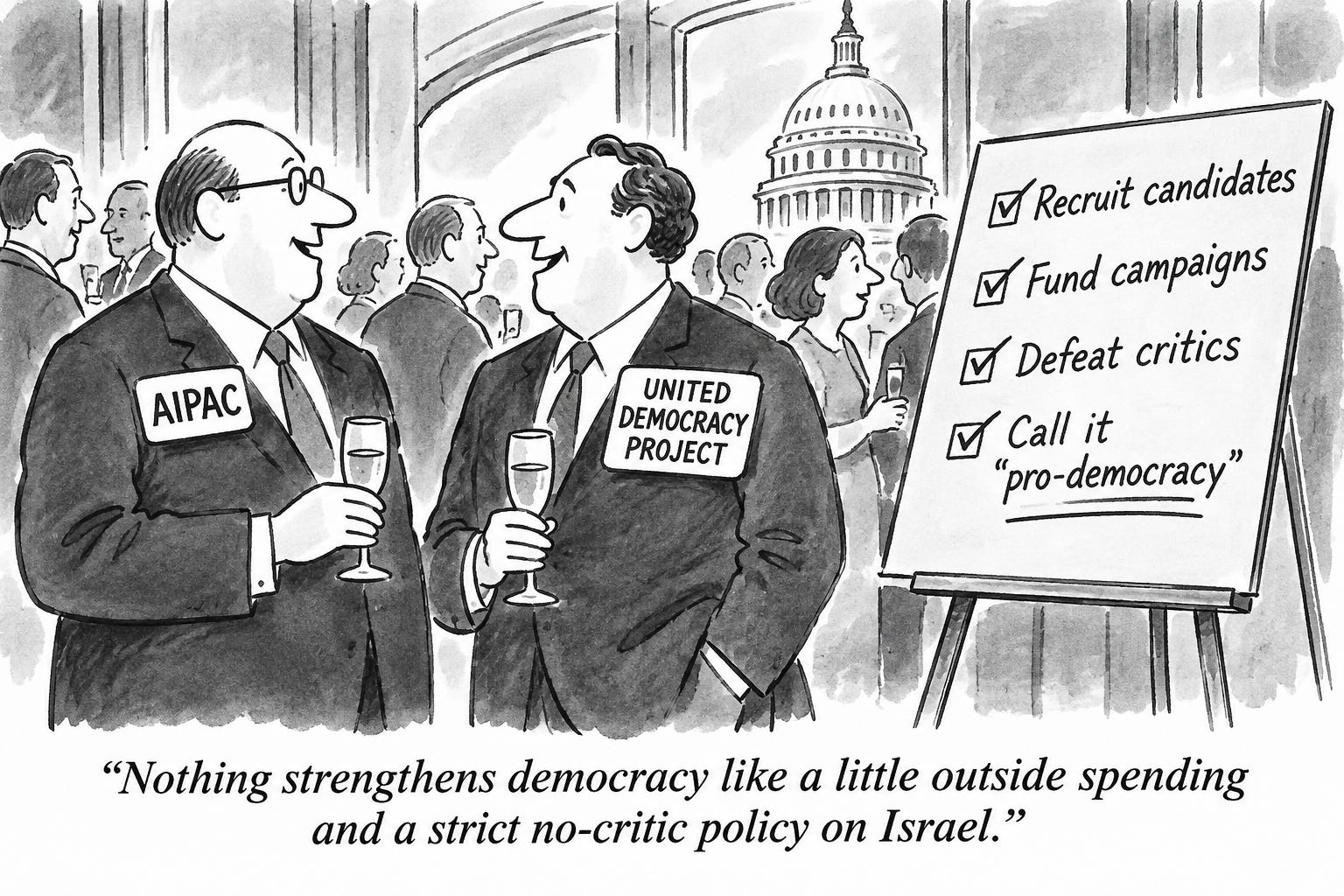
The episode ought to have ended the polite description of AIPAC’s electoral operation as a public education campaign. Its preferred Michigan candidate lost despite an extraordinary advertising advantage, its chief target entered the Senate, and yet the lobby’s ability to reach candidates and punish dissent did not vanish with the ballots. Three weeks before the election, AIPAC had already announced that it would stop issuing candidate endorsements and routing contributions through its named political action committee. It kept United Democracy Project. The visible badge came off while the spending apparatus stayed in place.
AIPAC created United Democracy Project as its super PAC in January 2022, after registering a conventional political action committee the previous December, and it retained its own name and lobbying operation. That arrangement gives us the first measure of its power. AIPAC remained the organization whose stated mission is to persuade the US government to strengthen its relationship with Israel. Its PAC could give directly to candidates within federal limits and could transmit contributions earmarked by individual donors. UDP could accept unlimited contributions and pay for independent advertising, provided it did not coordinate those expenditures with campaigns. Each entity occupied a different legal channel. Together they gave the lobby access to candidates, donors and voters at different points in an election.
A voter hearing “United Democracy Project” hears nothing about Israel, Gaza, US weapons or the American tax dollars used to pay for them. UDP’s federal registration identifies it as an independent expenditure committee; it does not tell the voter in a thirty-second television slot why that particular candidate has become worth millions of dollars to an organization devoted to one foreign-policy relationship.
The concealment can be legal and still be politically dishonest. AIPAC asks Americans to judge candidates on Israel while often paying to reach those same Americans through advertisements about other subjects. Voters can inspect the committee after seeing an ad, but the thirty-second message itself gives them no reason to look for the foreign-policy lobby behind the name.
What the federal accounts actually say
By the close of its October 14 reporting period, UDP had received $112.82 million during the 2025–26 cycle and disbursed $85.06 million. The Federal Election Commission divided the disbursements into $53.60 million in direct independent expenditures, $13.13 million in contributions to other political committees, $18.31 million in operating expenditures and $12,000 in refunds. The committee reported $56.57 million in cash on hand at that cutoff. Those figures came from a report ending before Election Day; later spending reports and post-election filings have to be read separately.
The separate AIPAC PAC reported $57.77 million in receipts and $56.25 million in disbursements through the same October 14 date. More than $53 million of its disbursements went to other committees, a category that includes money transmitted to candidates and committees. Many of those transactions were individual donations carried through AIPAC as an intermediary. They cannot all be described as checks written from AIPAC’s own treasury, and adding each donor’s original check to its transmission would count the same money twice.
AIPAC also moved money into UDP from its own organization. Federal records show transfers of $25 million in September 2025 and another $5 million in December. That is a traceable route into the super PAC, although it does not disclose every person whose money had entered the lobbying organization before the transfer.
UDP separately took contributions from named individuals. Paul Singer, Haim Saban and Marc Rowan appear among its large donors; earlier cycles brought in money from Republican financiers including Jan Koum and the late Bernard Marcus. The coalition has never been confined to Democratic donors, even when its largest advertising campaigns were directed at Democratic primaries.
The accounting matters because large round numbers can make a weak charge sound stronger. UDP’s $112.82 million in receipts describes what came in, not what reached voters in advertising. Its $85.06 million in disbursements includes administration and transfers as well as direct candidate advocacy. The $13.13 million sent to other committees can reappear when those recipients report their own spending. A journalist who adds every entry and calls the result a single election bill has inflated the case. The defensible case is already severe: tens of millions spent directly in races, more than $13 million sent through additional committees, and a named PAC that processed tens of millions more across the same congressional map.
Consider what that structure lets a donor buy. A person can give an unlimited sum to UDP and finance an independent attack campaign. Another can earmark a contribution through AIPAC PAC and appear in a candidate’s federal disclosures. AIPAC’s lobbying staff and activists can organize meetings and press an officeholder over a weapons shipment after Election Day. The law treats those as separate activities, as it should; the voter living with the resulting policy experiences them as a sustained institutional presence that continues after the campaign’s last ad has aired.
The charge rests on the electoral capacity the money buys: selecting expensive fights, surrounding a candidate with advertising, and making every other candidate calculate the price of taking the same position. A financial relationship alone cannot establish a purchased vote, and the political system should not require proof of bribery before its unequal distribution of power becomes objectionable.
The primary where a Jewish critic became the target
Andy Levin met that system in Michigan in 2022. Redistricting placed him in a primary against Stevens, another Democratic incumbent. Levin was a former synagogue president and the author of a bill seeking to distinguish US support for Israel from US support for settlement activity and occupation. Those credentials did not protect him from AIPAC’s electoral campaign. UDP spent more than $4 million backing Stevens, according to contemporary reporting, and she won the primary. Levin’s defeat is central to the story because it dispenses with the suggestion that criticism of AIPAC is hostility toward Jewish Americans. A progressive Jewish lawmaker objected to occupation policy, and an American lobbying organization spent heavily to remove him. The disagreement concerned the use of US power. The money settled who would hold the seat, although the money alone cannot establish that it was the only reason voters chose Stevens. The political lesson for other members was plain: communal standing, legislative seniority and a record of support for Israel would not spare a lawmaker who insisted on conditions.
UDP’s first full cycle ended with $35.94 million in receipts, $32.94 million in disbursements and $26.12 million in independent expenditures. The numbers came from the FEC, and the distinction between the categories is the same one that matters in 2026. AIPAC had found a way to intervene at a scale unavailable to a conventional candidate contribution. A member of Congress watching Levin’s loss did not need a secret memo to understand the threat.
The mechanism grew during the 2024 Gaza war. UDP’s final 2023–24 FEC account recorded $87.18 million received, $61.37 million disbursed and $37.86 million in independent expenditures. In New York’s Sixteenth District, it spent more than $13 million supporting George Latimer and opposing Jamaal Bowman; in Missouri, it poured millions against Cori Bush. Both incumbents had criticized Israel’s assault on Gaza, and both lost to challengers AIPAC favored. Their defeats had other political causes, including local grievances and the candidates’ own records, but UDP decided those races warranted spending that most congressional campaigns could not approach. A Bowman advertisement could attack a vote on infrastructure, and a Bush advertisement could raise a question about constituent service. Voters were entitled to assess those subjects. They were also entitled to know why a lobby organized around military and diplomatic backing for Israel was paying so much to place those messages in their homes. The sponsor’s policy interest and the advertisement’s spoken subject could be separated precisely because the law required a disclaimer identifying the spender, not a confession of the spender’s strategic objective.
While Palestinian families watched US-supplied weapons fall on Gaza, members of Congress watched the advertising fall on colleagues who challenged the transfer of those weapons, and yet Washington continued to speak of the two events as separate debates. In the House, each primary defeat reduced the number of members willing to risk a fight over military aid. That is how an electoral intervention reaches foreign policy without the donor ever handing a legislator a written instruction.
Michigan spent the money and rejected it
The next open Michigan Senate seat brought the lobby back to Stevens. Gary Peters was retiring, El-Sayed was running as an outspoken critic of unconditional US support for Israel, and UDP made the primary its most expensive battle. A post-election analysis by Responsible Statecraft attributes $31.47 million of UDP spending across the primary and general-election effort to preventing El-Sayed’s victories. Reporting immediately after the election identified roughly $30.6 million during the primary alone and at least $12.7 million in general-election spending by AIPAC-linked super PACs. The latter figure covers more than UDP. Adding it to every other Michigan figure without checking the same transactions would produce a counterfeit total.
The primary attacks reached well beyond Israel. El-Sayed faced advertising about his fitness for office and his treatment of women, including an outside-group ad he denounced. A voter could form an independent judgment about any substantiated charge. The uncomfortable fact for AIPAC is that its largest spending decision coincided with a campaign to defeat the candidate most willing to place conditions on US arms for Israel. If the central dispute was foreign policy, the voters deserved to hear that argument from the organization paying the bill.
El-Sayed won the August primary. The closeness of the result made UDP’s loss more striking, since the spending had been large enough to alter the contest and yet had failed to produce AIPAC’s preferred nominee. A candidate’s survival does not tell us how many votes the spending changed; it tells us the spending was insufficient to stop him. That is a meaningful limit on a lobby that had spent years making its ability to end careers part of its reputation.
The general election introduced an awkward complication for a group that describes itself as bipartisan. AIPAC had spent heavily against the Democrat who became the nominee. Stevens then endorsed Rogers, the Republican, after initially saying she would support El-Sayed. Her church appearance exposed the human cost of a primary system in which party leaders could spend August appealing for unity while an outside foreign-policy lobby spent millions fighting the person those same voters eventually selected. AIPAC’s spending did not cause the endorsement on the public evidence available. It had helped make Stevens the candidate through whom that fight was conducted, first against Levin and then against El-Sayed. The Associated Press found Stevens beside Rogers at Perfecting Church and reported the endorsement after the service, followed by her chief of staff’s resignation. Debbie Dingell, who had helped organize a joint appearance with El-Sayed, said she had asked Stevens to stay away because her presence had become a distraction. Stevens went to Rogers’s church service instead. The remaining details are already extraordinary: a congresswoman chose the Republican opponent of her party’s nominee, and her staff and state party were left to absorb the consequences during the final hours of the campaign.
El-Sayed went on to defeat Rogers. The first Muslim elected to the US Senate had survived the largest attack UDP mounted against a single opponent in 2026, and the organization entered the next cycle knowing the old warning could fail even when it was backed by more than $30 million. Michigan will be studied by every member who has been told to keep quiet about Israel because a super PAC might come for them.
Where the name went
AIPAC’s leaders sent members a letter on October 21 announcing a change in their political method. The PAC would stop endorsing candidates, making direct contributions and serving as a publicly listed intermediary on earmarked donations. Supporters would instead organize direct individual giving, while UDP would continue its independent spending. On AIPAC’s own website, an argument for the change said the organization was adapting its tools to retain political influence. The mission remained intact. A candidate who once had an AIPAC PAC line on a filing could receive the same donor’s personal contribution without AIPAC appearing as the conduit. Federal law still requires qualifying donors to be disclosed by the receiving campaign. A person looking only for AIPAC’s name in the donor column, however, would miss the organizational work behind those individual checks unless separate reporting identified it. That is the practical significance of the change. AIPAC has shed a visible marker that critics had taught voters to recognize.
UDP remains in plain view as a registered committee, and its direct donors and disbursements are generally reportable. The opacity grows when money moves through intermediary committees. UDP’s October FEC summary showed $13.13 million contributed to other committees. Some of those committees purchased advertisements under names that suggested local civic campaigns rather than a foreign-policy fight. The Intercept traced UDP money through operations including Elect Chicago Women and Affordable Chicago Now, and reported that some complete donor disclosures arrived after the primaries they sought to influence. A late filing may satisfy the legal calendar while failing the voter who needed the information before casting a ballot. That legal gap is more serious than a clever committee name. If a Detroit or Chicago voter sees an ad about rent, jobs or party loyalty, its sponsor might be an organization financed by a lobby whose central purpose is maintaining US military and diplomatic support for Israel. The ad can make a claim about a real local issue, but the hidden funding route prevents the voter from weighing the sponsor’s reason for spending. AIPAC can defend the activity as political speech. The voter can still call the concealment what it is: an engineered loss of information at the only moment that information can affect a vote.
AIPAC says its donors are American, and its FEC filings do not establish that the Israeli government supplied UDP’s campaign funds. That fact belongs in the indictment because the machinery operates through American law, American wealth and American political choices. The problem does not require a foreign-government check. It requires a country in which wealthy people can finance an electoral screen for a policy that sends American weapons abroad while the public learns the sponsor’s route after the election.
The defeats that money could not prevent
Responsible Statecraft calculated that AIPAC-linked committees spent $84.1 million in races decided by Election Day and that $55.3 million of it went to contests in which the groups’ preferred candidates lost. That is an attributed post-election analysis of selected race spending, not UDP’s complete cycle disbursement total. The same analysis put UDP’s failed Michigan investment at $31.47 million. Its other major loss came in Illinois’s Ninth District, where UDP spent about $6.31 million trying to prevent Daniel Biss’s victory. In Maryland’s Fifth, the group’s approximately $5.73 million intervention for Adrian Boafo produced the result it wanted. A serious accounting must carry the wins and losses on the same page. AIPAC’s defeats do not prove every recipient will turn against its agenda. A candidate who wins with little contest may still welcome its support, and a lawmaker who survived its attack may still face renewed spending in 2028. The institutional power in this system comes partly from selection. A donor group can invest in likely winners, claim credit afterward and build relationships even when its most conspicuous attacks fail. It can also spend enough to make dissent costly for people who never appear on its public target list.
The 2026 results nevertheless damaged an important part of the lobby’s political authority. Bowman and Bush had lost in 2024, and their defeats were held up as warnings. El-Sayed and Biss won despite major UDP spending. Michigan’s Democratic nominee then won a general election after a former primary rival backed the Republican. Those outcomes give other candidates something they did not have when Levin lost in 2022: a recent, expensive demonstration that the lobby’s preferred result is not inevitable.
AIPAC’s own October statement explained what the organization wanted from its electoral activity. It praised its network for helping candidates win and keeping opponents out of Washington so Congress would stand with Israel after October 7. That claim should be taken seriously. It ties fundraising, electoral defeat and the continuation of a US foreign-policy commitment together in the organization’s chosen words. The lobby is entitled to make its argument in American politics; Americans are entitled to ask how much of their government’s policy has been insulated from ordinary electoral disagreement by the price AIPAC can place on dissent. The question grows sharper when the next Congress takes up arms transfers. AIPAC’s candidates will be voting on appropriations, oversight and the legal conditions attached to US aid. The people who opposed those transfers will be asking for votes too. They will do so after years in which Palestinian civilians bore the consequences of the policy, American taxpayers financed it, and primary advertisements often addressed almost anything else. A country that can name the donor and still decline to debate the policy has allowed the money to set the boundaries of permissible politics.
The argument waiting on the House floor
The next test for UDP will occur after the campaign ends, when a member introduces a measure to condition or block a weapons sale and House leaders decide whether it reaches a vote. An individual contribution cannot compel a member’s decision. A super PAC cannot legally coordinate an independent ad with a campaign. Neither limit prevents an officeholder from understanding that the same organization which helped unseat colleagues can return to their district. The institutional pressure is most effective when no one has to say it aloud. Members who oppose that pressure have more room than they were told. El-Sayed will arrive in the Senate after surviving UDP’s largest failed fight, and the public disclosure of AIPAC’s intermediary committees has made the operation legible to voters who might once have seen only a local-sounding name. Those facts do not finish the contest. They change its terms. The lobby can still raise money, hire consultants and buy airtime; a candidate can now point to Michigan and ask voters to judge the expenditure itself.
AIPAC’s October retreat from named endorsements shows it understood the danger of becoming an issue on the ballot. It could have defended its preferred arms policy in the advertisements it financed. Instead, it chose a less visible route for direct giving and retained the unlimited-spending arm that had already transferred millions through other committees. Its political answer to a public challenge was to make the financing harder to see at the moment the voter needed to see it. That choice says more about the organization’s confidence in its own argument than any victory statement issued after a primary.
El-Sayed’s victory will give a senator who opposed AIPAC a vote on future weapons transfers; it will not give him control of the Senate floor schedule. When the next Israeli arms package comes before Congress, party leaders will decide whether members cast a clean vote on the transfer or accept it folded into a larger funding bill. AIPAC spent years making that question expensive. Michigan has made it unavoidable.