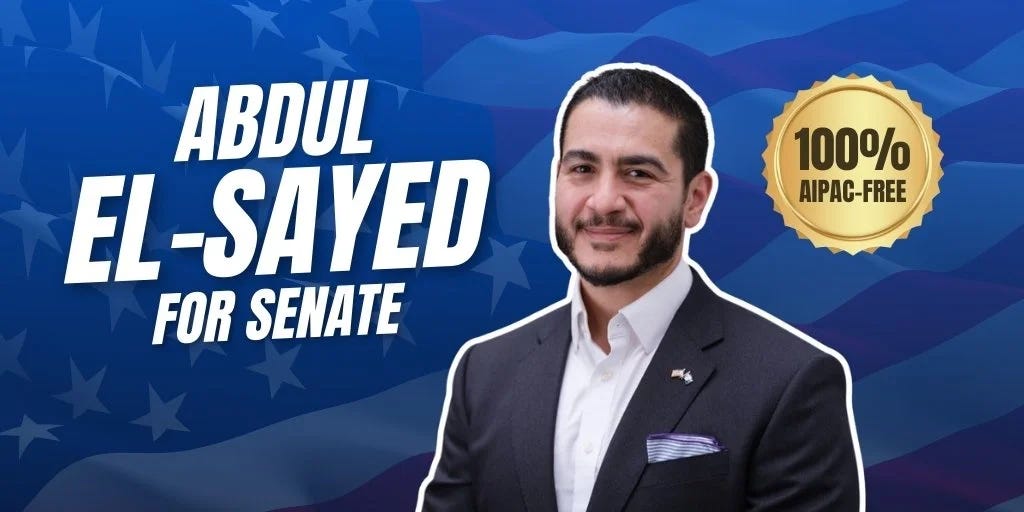
AIPAC’s $2 Million Problem Is Named Abdul El-Sayed, And He Is Not The Only One
A Michigan Senate primary shows what happens when the lobby’s only weapon is money and the candidates stop needing it
Eight weeks before Michigan Democrats vote in their August 4 Senate primary, the United Democracy Project reserved $2.33 million in broadcast, cable, and satellite advertising for a single week, and tacked on another $300,000 in radio and mail for the same window, and the candidate this money is built to destroy has never taken a meeting with AIPAC, never asked for its endorsement, and never touched a dollar of its money, and yet he is the frontrunner the lobby’s super PAC has decided is worth $2.6 million to stop before the argument he’s making ever reaches a debate stage.
That candidate is Abdul El-Sayed. He is leading the Democratic field for an open Senate seat, he carries the UAW endorsement, and the single fact that distinguishes him from every other name in the race is the fact AIPAC’s spending exists to bury: he is the only candidate who built a winning coalition without going through the building on K Street where these decisions get made. Let’s sit with that for a second, because it is the whole story. AIPAC did not spend $2.6 million against El-Sayed because he said something inflammatory about Israel in a debate. He hasn’t had the debate yet. They spent it because the polling told them what direction this was heading, and the only tool in the box that has ever worked against a candidate like this is volume: enough ads, enough weeks, enough saturation that by the time voters walk into the booth, the version of El-Sayed they’re holding in their heads was manufactured in a media buy, not earned on a stage.
Here’s the part that should stop you. This is not AIPAC’s first rodeo in this exact seat. In 2024, the United Democracy Project spent nearly $4 million in this same Michigan Senate race against Andy Levin, a sitting member of Congress, a Jewish American, and the most prominent congressional voice for conditioning aid to Israel that the Democratic caucus had produced in a generation. Levin lost. Haley Stevens won. And now, in 2026, with El-Sayed leading a field that once again includes Stevens, the same PAC is running the same play against a different name, because the mechanism doesn’t care who the candidate is. It cares whether the candidate took the money.
Let’s be precise about what “the same machine” means here, because FTGN has spent this cycle documenting it and the documentation is the point. AIPAC and its affiliated structures have deployed roughly $96 million across this primary cycle alone, much of it routed through shell PACs with names engineered to look like anything other than what they are: “Elect Chicago Women,” “Affordable Chicago Now!” These are not grassroots formations. They are vehicles, registered with the FEC, that exist so that a voter scrolling through a mailer in Illinois or Michigan has no way of knowing that the group paying for the attack ad against their preferred candidate is funded by the same network that just spent $2.33 million in one week against a UAW-endorsed frontrunner two states over. More than 75 AIPAC-endorsed candidates have cleared their primaries this cycle. The strategy works often enough that the PAC doesn’t need to win every race, it needs to win enough of them, and it needs every race it loses to look like an aberration rather than evidence.
And yet there are aberrations now, and they are starting to cluster, and that clustering is the actual story underneath the Michigan numbers. In Pennsylvania this cycle, Chris Rabb won his primary despite a $1 million UDP spend against him. The lobby’s response to that loss was not to recalibrate its position on Gaza. It was to improve the opacity of the next spend, to make the next “Elect Chicago Women” PAC even harder to trace back to its source. That is what an institution does when it has decided the problem is visibility, not substance. But visibility is exactly what El-Sayed’s campaign is built to deny them, because his answer to the $2.6 million question is the cleanest version of the argument AIPAC has faced all cycle: “I don’t take corporate money. So I rely on the people to back this movement.” There is no UDP reservation to point to on his side, no shell PAC, no $5 million in obscured donor flows of the kind El-Sayed says has already moved toward Stevens across this race. There is just the arithmetic of a Senate seat that, on paper, belongs to the people who are about to vote for it, and a lobby that has decided $2.6 million is a reasonable price to make sure it doesn’t.
Here’s what the timing tells you. The reservation landed eight weeks out, which in primary politics is early, early enough that it isn’t responding to a closing gap so much as trying to prevent the gap from opening in the first place. AIPAC’s super PAC does not need El-Sayed to lose the argument about Gaza on the merits, because on the merits, AIPAC has been losing that argument with the Democratic base for two years running. NBC’s polling has tracked the collapse: 60 percent of Democrats now hold negative views of Israel, up from a position of broad sympathy as recently as 2023. Half of independents say the same. This is not a fringe shift. This is the floor moving under an entire party’s electorate, and it is moving in exactly the direction El-Sayed’s candidacy represents, which is precisely why the money has to arrive before the debate does. If the contest becomes a conversation, AIPAC loses the conversation. So the contest has to stop being a conversation. It has to become 2.33 million dollars of saturation advertising that defines El-Sayed to low-information primary voters before he gets the chance to define himself, and that is not a campaign strategy, that is a demolition schedule.
Compare that to what Stevens represents in this equation, because she is not incidental to the story, she is the mechanism’s chosen vessel, the same way she was in 2024 against Levin. AIPAC does not need Stevens to be a compelling candidate. It needs her to be the candidate who is still standing when the dust from the ad buy settles, the way she was still standing after the $4 million spent against Levin two years ago. The pattern is now documented across two consecutive cycles in the same Senate seat: a candidate emerges who won’t take AIPAC money and is positioned to win, and within the same election cycle, the United Democracy Project identifies the strongest available alternative and writes a check large enough to flip the outcome. Twice. Same PAC. Same seat. Same mechanism. The only variable is which anti-AIPAC candidate gets targeted, and this cycle, that’s El-Sayed.
There’s a phrase that gets used loosely in online discourse, the idea of “putting Israel in its place” as a kind of abstract foreign policy posture, and it’s worth being precise about what that phrase cashes out to in a race like this one, because it isn’t abstract at all. It is a candidate standing in front of Michigan voters and saying, in effect, that the foreign policy lobby that has dictated the boundaries of acceptable speech on this issue for forty years does not get veto power over who represents Michigan in the United States Senate. That’s it. That’s the whole content of “putting Israel in its place” as it actually exists on a primary ballot in 2026. It is not a position on borders or ceasefires or the right of return. It is a refusal to let a foreign policy lobby’s checkbook function as a primary qualification for federal office, and the fact that refusing that is treated by AIPAC as a $2.6 million emergency tells you how load-bearing that veto power has been.
And this is where the Michigan race connects to something larger than Michigan, because El-Sayed is not running this race in isolation. He is running it in the same cycle where Rabb survived a million-dollar UDP spend in Pennsylvania, in the same cycle where the lobby has had to deploy $96 million across dozens of races just to maintain its win rate, in the same cycle where the polling shows a six-in-ten Democratic majority that no longer holds the sympathetic view of Israel that used to make AIPAC’s spending almost unnecessary. There was a version of American politics, not that long ago, where AIPAC’s endorsement was close to dispositive and its opposition was close to disqualifying, where the $2 million didn’t need to be spent because the candidates who needed stopping rarely got far enough to be worth stopping. That version of American politics required a Democratic base that broadly trusted the premise AIPAC was selling. That base doesn’t exist anymore, not at 60 percent negative, and the $2.6 million in Michigan is what it costs to manage a primary electorate that has moved past the institution trying to manage it.
Here is the structural fact underneath all of this, the one that doesn’t get said in the trade press coverage of these ad buys: every dollar AIPAC spends to stop a candidate like El-Sayed is itself evidence for El-Sayed’s argument. The candidate is saying the lobby has too much power over American elections. The lobby’s response is to spend $2.6 million in eight weeks to prove him right. There is no version of this where the spending refutes the premise, because the spending is the premise made visible. A campaign funded by small donors and a single major union endorsement should not, in a healthy political system, require a $2.6 million counter-operation from a single-issue foreign policy PAC eight weeks before voters even go to the polls. The fact that it does is not a sign of AIPAC’s strength. It is a sign of how thin the ice has gotten, and how hard the institution now has to work to keep candidates like El-Sayed from demonstrating, on a debate stage, in front of Michigan voters, that the ice was never as solid as the lobby spent forty years insisting it was.
What happens in the next eight weeks in Michigan will be read, correctly, as a signal for every primary after it, in every state where a candidate is running on the same refusal El-Sayed is running on: no corporate money, no AIPAC contact, no debt to the lobby that has, until now, been able to define the limits of what a Democratic candidate for federal office is allowed to say about Gaza. If El-Sayed wins despite $2.6 million in eight weeks of saturation advertising, the lesson other candidates will draw is not subtle. It will be that the lobby’s deterrent no longer deters, that the checkbook that used to end campaigns before they started can now be absorbed and survived, and that the candidates who used to calculate the cost of crossing AIPAC into their decision about whether to run at all can stop doing that math.
The money landed first. It always does. What happens with the eight weeks that are left is up to the people whose seat this actually is.
The vote.


