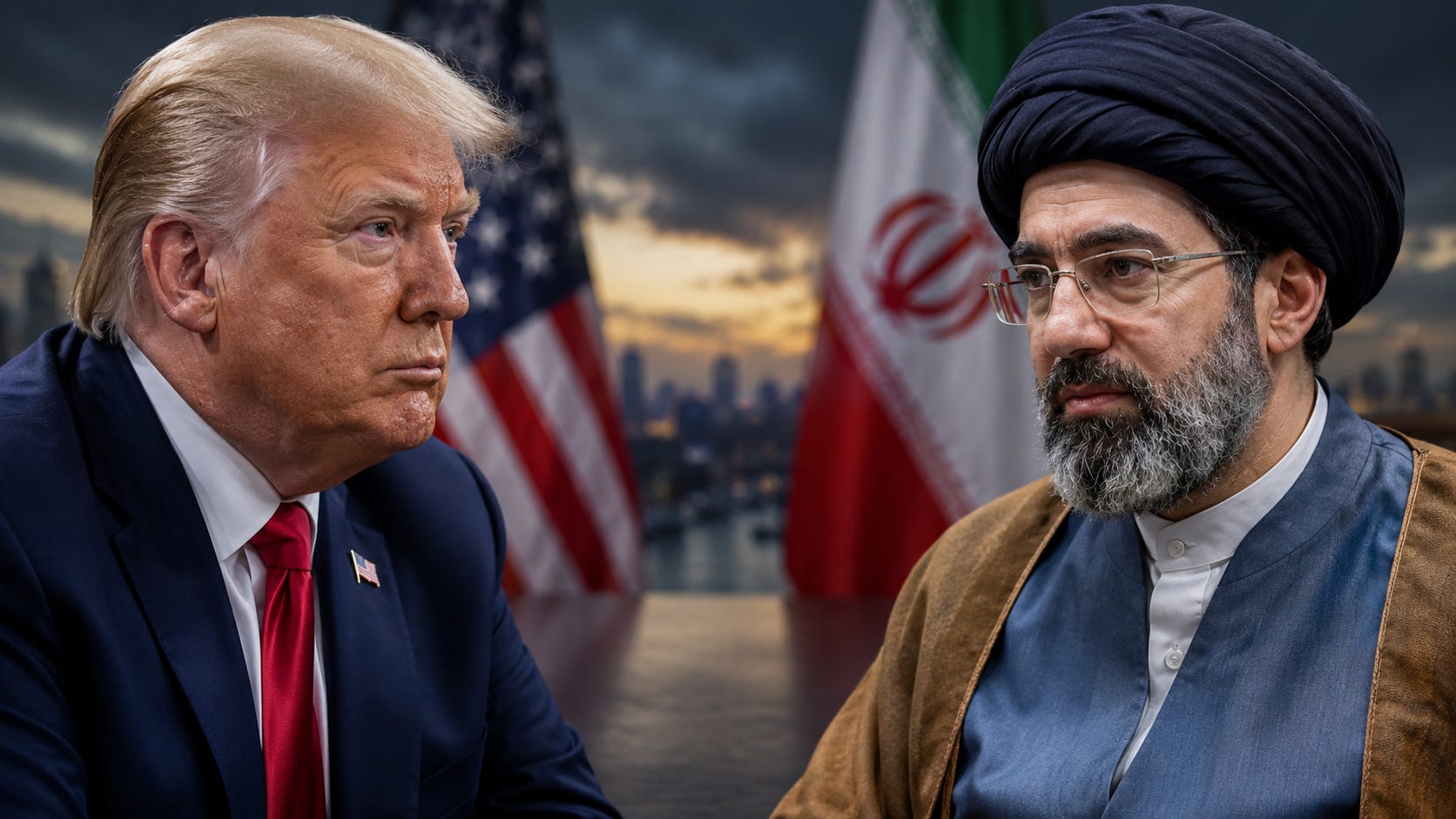
The U.S.-Iran memorandum is not a final peace. It is something more fragile and, if handled with discipline, more valuable: a chance for Washington to begin exchanging the burdens of failed ownership for the advantages of strategic distance.
The new memorandum of understanding between the United States and Iran should be approached with calm, not romance. It is not a treaty. It is not a settlement. It is not the end of a conflict whose roots run through coups, revolutions, invasions, sanctions, proxy wars, oil chokepoints, ideological theater, and the long American habit of confusing military reach with political control. It is an interim instrument, a narrow bridge, a suspended piece of diplomacy hanging over a landscape littered with the wreckage of larger ambitions. That is precisely why it matters.
Washington’s loudest factions will try to force the old script onto it. One side will call it weakness because any pause in coercion now counts, in certain circles, as surrender. Another will treat it as breakthrough, as if one memorandum can dissolve half a century of accumulated grievance and two decades of strategic overextension. Both readings are unserious. The document’s value lies elsewhere. If it holds, and if it matures into the kind of final arrangement its drafters claim to seek, it could mark the beginning of something the American foreign policy establishment has resisted for years: a deliberate reduction of U.S. ownership in the Middle East.
That is the point worth defending. Not because Iran has changed its nature. Not because the region has become simple. Not because diplomacy is morally cleaner than force by some automatic law of history. The point is worth defending because a strong United States has no obligation to remain indefinitely trapped inside the consequences of its own past errors. A republic that wishes to recover its seriousness must know how to leave the rooms it once entered in arrogance.
The memorandum itself reflects uncertainty. It opens a process. It does not complete one. It creates a timetable for further talks on the unresolved core questions, including the nuclear file and the architecture of sanctions relief, while tying immediate de-escalation to practical matters such as navigation, military restraint, and reciprocal steps that can still fail under pressure. That incompleteness is not a flaw in the argument advanced here. It is central to it. This op-ed is not claiming that America has already escaped the Middle Eastern trap. It is arguing that, for the first time in a long while, Washington has placed a hand on the door.
If that hand stays there, and if cooler minds prevail over the familiar coalition of ideologues, contractors, prestige hawks, and clients who thrive on endless emergency, then the United States could begin a strategic rebalancing long overdue in both geopolitical and domestic terms. The goal is not abandonment. The goal is proportion. The goal is not isolation. The goal is hierarchy. The goal is not retreat from the world. The goal is to stop behaving as though the political metabolism of the Middle East must forever be subsidized by the American state.
That would be good for the United States. Very good.
The burden of old arrangements
The American relationship with Iran has always contained a central delusion. Washington repeatedly assumed that it could shape Iran’s strategic conduct without ever fully accounting for the historical memory through which Iran understood American power. That blindness did not begin yesterday. It began in the early Cold War, when the United States discovered how easily the language of order could be fused with the mechanics of intervention.
In 1953, the United States and Britain helped remove Mohammad Mossadegh after he challenged the political economy of Western access to Iranian oil. The coup did not just alter a government. It altered the moral structure through which generations of Iranians would read American intentions. In Washington, that operation became one episode in the repertoire of anti-communist statecraft. In Iran, it became something else: proof that sovereignty would be tolerated only when it remained decorative. The restored monarchy was then folded into the American security architecture as a pillar of regional order, heavily armed, heavily indulged, and presumed durable.
That period shaped more than bilateral resentment. It shaped the American method itself. The shah became a regional instrument, the local custodian of an order whose beneficiaries sat far beyond Tehran. In that sense, the arrangement was elegant by the standards of imperial management. It was cheaper than direct rule, deniable enough for polite company, and useful to every bureaucracy in Washington that preferred control without accountability. It was also doomed. Systems built on external sponsorship and internal repression tend to look stable right up to the moment they become impossible.
The revolution of 1979 shattered the arrangement but not the American reflexes behind it. Washington lost a client and gained an obsession. The embassy hostage crisis hardened that obsession into doctrine. Since then, vast areas of U.S. policy have treated Iran less as a difficult state requiring disciplined management and more as a symbolic theater in which American resolve must constantly be demonstrated. That distinction matters. Great powers can negotiate with rivals when interests require it. Political classes that require enemies for psychological coherence cannot.
Then came the Iran-Iraq War. Washington tilted toward Saddam Hussein’s Iraq as a counterweight, accepted moral contamination as strategy, and normalized once again the idea that regional balance could be engineered through selective complicity. The habit persisted through the Gulf order of the 1990s, through sanctions regimes that were always presented as temporary leverage and always evolved into semi-permanent architecture, and through the repetitive American assumption that enough pressure, enough naval presence, enough covert friction, and enough allied coordination would eventually produce an Iranian capitulation to a security order written elsewhere.
It never did.
What the United States produced instead was a durable crisis machine. Every round of coercion generated adaptation. Every adaptation generated a stronger argument in Washington for renewed coercion. Each side trained the other. Each side made the other’s hard men more persuasive. Each side learned how to speak of necessity while feeding the conditions of repetition. The Middle East, in this respect, became less a region of policy than a system of mutual addiction.
Iraq and the collapse of American judgment
The real hinge, however, was Iraq. If the 1953 coup was the opening sin of the U.S.-Iran relationship, the 2003 invasion of Iraq was the event that converted American misjudgment into strategic self-harm on a civilizational scale. By destroying the Iraqi state in the name of remaking the region, the United States demolished one of the central pillars of the old Arab balance and opened space that Iran, with patience and intelligence, was always going to exploit.
This is the part American hawks still struggle to say aloud. Much of the current regional map was drawn not by Iranian genius alone, nor by Arab weakness alone, but by American overreach. Washington removed Baghdad as a counterweight, shattered the Sunni political core of Iraq, armed new factions, produced a war economy of militias and patronage, and then watched in astonishment as Tehran learned how to play on the terrain the United States itself had cleared. That was not an unforeseen side effect. It was the structural consequence of imperial intoxication.
And then, as ever, the American system adapted in the wrong direction. Instead of asking whether the premise of regional ownership had become intellectually bankrupt, Washington doubled down on management. More deployments. More emergency doctrine. More reassurance of nervous allies. More sanctions. More intelligence entanglement. More dependence on the argument that American credibility lived or died by how deeply the United States remained embedded in the politics of the Gulf, Iraq, Syria, Lebanon, and every corridor in between.
That argument should have been buried years ago. It survived because it served too many interests. Regional clients liked it because it kept American power near at hand. Security bureaucracies liked it because it guaranteed budget, mission, and relevance. Ideological networks liked it because it preserved the emotional theater of existential confrontation. Even critics of intervention often accepted its premises in miniature, disagreeing over tactics while leaving the structure intact. The one constituency that benefited the least from this arrangement was the American public.
That public paid for the wars, absorbed the debt, sent its sons and daughters through the rotations, and watched domestic renewal become a speech rather than a program. The post-9/11 wars alone have consumed staggering sums, with Brown University’s Costs of War project estimating roughly $8 trillion across Iraq, Afghanistan, Pakistan, Syria, and related theaters, not counting future interest payments, while direct and indirect death tolls run into the millions and displacement has uprooted tens of millions more. Those are not just foreign casualties and budget categories. They are the historical price of a governing class that mistook motion for wisdom.
An empire can survive error. A republic that keeps importing the costs of error back into its own civic life begins to rot from inside.
The MOU as opening, not conclusion
This is why the present memorandum deserves a reading more sophisticated than either triumphalism or panic. It is not yet a settlement. It is a mechanism for trying to reach one. Many of the hardest questions have been deferred to later negotiations. The sequencing of sanctions relief, the scope of nuclear concessions, the machinery of verification, the regional implications, the political durability of commitments on both sides, all of that remains unsettled. An agreement that postpones the hardest questions can still be useful if it postpones them into a structure that lowers temperature rather than raising it.
That is where the opportunity lies.
For an independent observer who is also unambiguously pro-American, the memorandum’s promise is not that Iran will become friendly. The promise is that the United States may be able to reduce its direct exposure to a theater whose disorder has become strategically corrosive. The aim is not fraternity. The aim is disentanglement. Not full disengagement. Not a fantasy of vanishing consequences. Disentanglement. There is a difference, and great powers ignore it at their own expense.
The most intelligent American policy in the Middle East now would not be to seek ownership under a softer name. It would be to preserve only those instruments of influence necessary to protect core interests while steadily transferring the burden of regional balance back to the states that actually inhabit the region. That means accepting that Saudi Arabia, Iran, Turkey, Israel, Egypt, and the Gulf monarchies will have to carry more of the costs, risks, and compromises generated by their own neighborhood. It means declining the old invitation to turn every local rivalry into a referendum on American resolve.
The memorandum can serve that objective if Washington treats it not as a pause before resuming the same pattern, but as the first formal acknowledgment that the old pattern has become too expensive to sustain. The United States does not need to govern the rhythm of every ceasefire, every militia alignment, every shipping threat, every sectarian wound, and every symbolic contest between capitals that have learned to outsource danger upward. It needs to know which fires truly threaten the republic and which ones have been kept alive by decades of American proximity.
There is nothing anti-American about that judgment. On the contrary, it is the most pro-American judgment available.
Why this is the patriotic position
Foreign policy debate in Washington often relies on a sleight of hand. It assumes that “American leadership” means active supervisory involvement across multiple theaters, and that any reduction in visible command is a retreat from history. That formula flatters the capital and flatters the officials who speak it. It does not flatter reality. A nation can be powerful without being omnipresent. A nation can be feared without being overextended. A nation can defend itself without making the maintenance of foreign systems a substitute for domestic competence.
The patriotic argument for giving this MOU every possible chance to mature into a real settlement begins with that distinction. America’s first duty is not to preserve the emotional satisfaction of managing old theaters. Its first duty is to preserve the strength, coherence, and prosperity of the United States itself. If Middle Eastern entanglement no longer serves that end, then reducing it is not concession. It is statecraft.
The deeper American interest now lies at home. It lies in restoring industrial depth, rebuilding infrastructure, managing debt, strengthening borders, lowering energy vulnerability, reviving institutional trust, and directing federal seriousness toward the long neglected terrain of domestic capacity. None of that becomes easier when Washington remains addicted to every Gulf crisis. Attention is finite. Fiscal bandwidth is finite. The time of planners, officers, legislators, diplomats, intelligence services, and presidents is finite. Every state eventually discovers that it cannot rank every theater first.
For too long, the United States pretended otherwise. It acted as though it could fund domestic renewal and endless strategic overstretch at the same time, as though the same political class that struggled to run a rail network or secure a border crossing could indefinitely choreograph the balance of the Levant, the Gulf, Iraq, and the Red Sea. Such fantasies survive only in capitals. The country beneath them sees the tradeoff clearly. Americans may not all follow the technical details of sanctions sequencing or maritime deconfliction, but they understand when their own state looks overcommitted abroad and underperforming at home.
That is why a controlled reduction of American burdens in the Middle East is not just a geopolitical correction. It is a domestic necessity. The republic cannot be renewed while it remains trapped inside an imperial workflow that turns every regional crisis into a claim on American money, attention, and prestige. A country serious about national revival must learn strategic refusal.
The regional balance must become regional again
There is another advantage to taking the memorandum seriously as the opening of a new posture rather than the conclusion of an old one. It compels the region’s own powers to confront one another more directly, and more honestly, without always presuming that the final insurer of consequences will sit offshore in an American carrier group.
That does not mean the region will become stable overnight. It means the incentives may begin to change. For decades, American overpresence has distorted local decision-making. Allies took risks under the assumption of rescue. Rivals calibrated aggression around American thresholds. Political factions within weak states positioned themselves not just against domestic opponents but toward Washington’s anticipated response. In that environment, the natural maturation of a regional order is delayed because too many actors expect external subsidy, external enforcement, or external political theater to shape outcomes.
A wiser United States would stop feeding those expectations. Let regional powers negotiate their balances with greater responsibility for their own exposure. Let them bear more of the cost of escalation. Let them discover that politics changes when the imperial safety net is no longer assumed to be permanent.
Iran, for its part, is not about to abandon its ambitions or dissolve its deterrent logic out of diplomatic gratitude. No serious analyst believes that. But the United States need not eliminate every rival ambition to improve its own position. It only needs to structure the environment so that its direct liabilities diminish while its core interests remain protected. Maritime security matters. Nuclear nonproliferation matters. Preventing sudden regional war matters. Owning the Middle East does not.
This is the elegant possibility hidden inside the awkwardness of an interim memorandum. A modest document can announce a large shift if those implementing it understand the historical opening before them. The MOU can become the first step in telling the region that America is still present, still capable, still attentive to its red lines, but no longer willing to convert every unresolved conflict into a permanent mortgage on American power.
That would change the diplomatic atmosphere in ways many in Washington cannot yet admit. Smaller promises would produce clearer strategy. Reduced ownership would produce greater freedom. Less theatrical dominance could produce more durable influence. The United States might discover that stepping back from the front row of every Middle Eastern quarrel does not diminish its stature. It may preserve it.
The diplomacy required now
None of this will happen automatically. Interim agreements fail all the time. Technical talks collapse. Domestic factions sabotage implementation. Allies panic. Adversaries probe. Prestige politics returns with a vengeance. The whole architecture can still unravel under the pressure of mistrust, ideology, or one more bout of regional violence. That is exactly why the diplomacy around this MOU must be disciplined rather than euphoric.
Washington will need to resist its own bad instincts. It will need to avoid treating every implementation dispute as proof that only maximal pressure ever made sense. It will need to understand that interim documents are strongest when they are protected from rhetorical excess. The administration should not sell this as peace in our time. It should sell it, quietly and coldly, as a mechanism to test whether America can secure narrower interests at lower cost while holding open the path to a larger unwinding.
That requires a different language of power. Not missionary, not sentimental, not punitive for performance’s sake. Strategic, patient, and exact. The United States must speak as a state that has finally remembered the difference between influence and ownership. It must make clear that the ultimate American interest is not eternal stewardship of the Middle East but a region sufficiently balanced that Washington no longer has to pour disproportional blood, money, and attention into managing its every convulsion.
There is a diplomatic intelligence in accepting limited good over impossible mastery. Great powers age badly when they lose that intelligence. They become attached to symbols of command long after command itself has become ruinously expensive. They cling to posture while the strategic ledger turns against them. They call that posture credibility. Their rivals call it predictability. Their citizens call it exhaustion.
The United States still has time to choose differently.
The America on the other side of this choice
If this memorandum matures, and that remains an if, the real dividend will not be found in a photo line, a signed paper, or the temporary reduction of one immediate military danger. The deeper dividend will be the restoration of strategic choice. America will have more room to act where its future actually lies. In technology. In infrastructure. In industrial policy. In debt stabilization. In social repair. In the forgotten competency of governing its own territory with seriousness.
That is what makes the pro-American case for this opening so strong. The United States does not need another generation of Middle Eastern ownership to prove its strength. It needs the confidence to stop proving strength in ways that leave the nation internally thinner. The world will not respect America less because it has chosen not to remain the permanent custodian of every corridor, militia frontier, and ideological fracture from the Gulf to the Levant. It may respect America more if the country shows that discipline can still prevail over compulsion.
The MOU is not yet the destination. It is a possibility. It may fail. It may narrow. It may be sabotaged by men whose careers depend on the continuation of strategic emergency. It may become one more footnote in the archive of unfinished Middle Eastern diplomacy. But it may also become the moment Washington finally admitted to itself that the age of owning this region had become incompatible with the age of rebuilding America.
That would be no small thing. The United States helped create much of the strategic disorder from which it now seeks relief. It backed the shah, lived with the consequences of 1979 without ever understanding them fully, shattered Iraq, subsidized dependency, sanctified overreach, and spent decades calling management what was often just the maintenance of self-inflicted burden. None of that can be undone by a memorandum.
But an honorable power does not need to erase its past before it changes course. It needs only to decide that the future will no longer be governed by the reflexes that damaged it. If this MOU leads where it should lead, then America will not have won the Middle East. It will have achieved something wiser.


