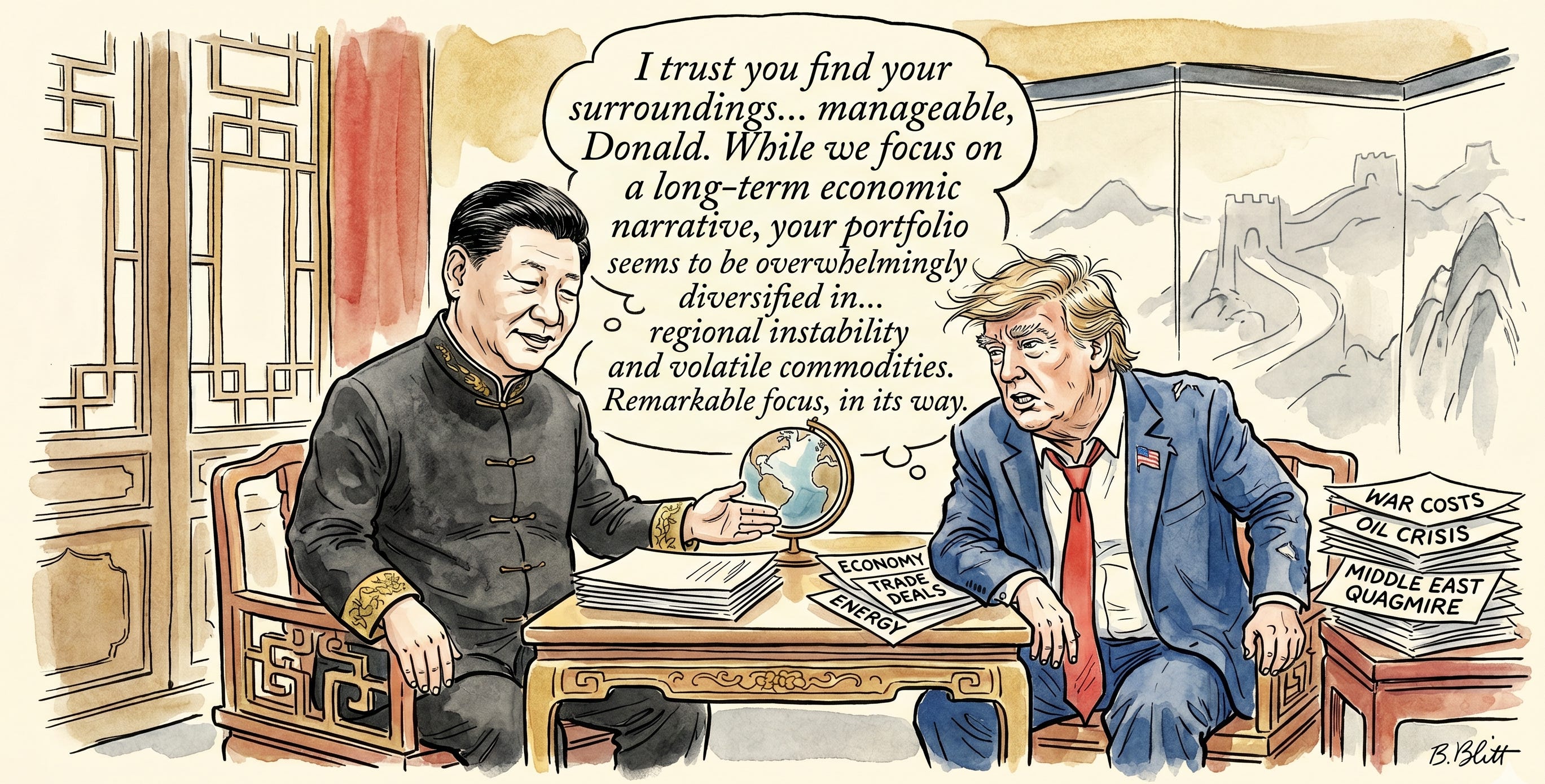
America’s Negotiating Debt
What Trump’s Return to Beijing Reveals About the Limits of Coercive Power
There is a Chinese proverb that Western commentators rarely quote when writing about this summit: 欲速则不达. The faster you chase, the further the destination recedes. Donald Trump has been chasing since January 2025. He arrives in Beijing on May 14 having run very fast in a direction that has left him further from his objectives than when he began.
I want to be precise about this, because triumphalism serves no analytical purpose and because the picture is more structurally instructive than a simple ledger of American failures would suggest. What the past fourteen months have demonstrated is not that China won a trade war. It is that the theoretical framework underpinning American coercive economic statecraft contains a fundamental miscalculation about the nature of interdependence, one that Beijing identified years before Washington acted on the assumption it had disproved.
The Miscalculation and Its Architecture
The American theory was this: China needs access to U.S. markets, U.S. technology, and U.S. financial infrastructure more than the United States needs China’s manufacturing base, mineral supply chains, or consumer market. Apply sufficient tariff pressure and Beijing will negotiate from weakness. The theory had respectable intellectual antecedents. It also had a flaw.
Interdependence is not symmetric, but its asymmetries do not necessarily favor the party that initiates pressure. They favor the party that can better calibrate the threshold at which the other side’s domestic industrial pain becomes politically unsustainable. China spent the years between 2018 and 2024 mapping that threshold with considerable precision. The rare earth export restrictions imposed on April 4, 2025, the day Trump announced his “Liberation Day” tariffs, were not improvised. They were the deployment of a capability that had been identified, developed, and held in reserve for exactly this negotiating context.
The United States sourced roughly 70 percent of its rare earth compounds from China between 2020 and 2023. Chinese state-backed monopolies control approximately 89 percent of global rare-earth refining. These figures were not secrets. The USGS published them. American think tanks cited them in policy papers for a decade. Washington knew the exposure and chose to apply maximum pressure anyway, on the assumption that China’s countermeasures would be insufficient or that the pain would be tolerable. Within weeks of the April restrictions, automotive manufacturing lines in the United States, Germany, and Japan were reporting supply disruptions. By summer, the administration had negotiated a 90-day truce that restarted exports while leaving China’s underlying leverage entirely intact. Trump announced it as a deal. In Beijing, it was read as a calibration confirmation: the threshold had been found.
Patient Capital and the October Lesson
The October 2025 episode deserves particular attention because it reveals the deliberateness of the approach.
As the 90-day truce expired, China reimposed restrictions. The timing was not incidental. A Trump-Xi meeting was scheduled in South Korea within days, which meant the reimposition arrived at the precise moment when the American president had the most political incentive to resolve the confrontation quickly and the least strategic space to absorb a prolonged escalation. Trump accepted the same terms a second time. The joint statement described progress. The customs data published in subsequent months described something else: American rare earth imports continued to decline, falling 11 percent year over year after the November easing, while European imports rose 60 percent over the same period.
This divergence was not a supply anomaly. It was a policy. European industrial interests were being managed as a strategic asset, a potential counterweight to American pressure, while American manufacturers remained under controlled uncertainty. Beijing was simultaneously conducting trade negotiations with Washington and demonstrating to Brussels, Tokyo, and Seoul that China was a reliable supplier when it chose to be. The message reached every government in the region that was watching. China kept its processing leverage in full. Both rounds of negotiations closed with the surface stability restored and the structural position unchanged.
Trump arrives for a third round of the same sequence.
The Iran File and the Limits of Unilateralism
The Gulf conflict complicates this summit in ways that are worth examining without satisfaction, because the consequences of a prolonged Hormuz disruption are not comfortable for China either.
Iranian Foreign Minister Araghchi visited Beijing before this summit, and China has maintained the position it has held consistently: it has legitimate trade and energy agreements with Iran, and it has warned Washington against interference with those arrangements. This is not a posture assumed for this summit. It is a position that reflects the actual architecture of China’s energy supply chains, which were deliberately diversified away from Gulf maritime exposure over the past fifteen years through strategic petroleum reserves, pipeline infrastructure, and long-term contracts with overland suppliers. The Hormuz disruption raises costs for Chinese manufacturing. It does not threaten Chinese industrial continuity the way it threatens the energy security of American allies in the region.
What concerns Beijing about the Iran conflict is not the immediate energy cost but the precedent it represents: a major power initiating a shooting war in a critical maritime corridor without a defined exit strategy, then declaring the peace terms unacceptable without reading them. Trump described Iran’s latest proposal as “a piece of garbage” and acknowledged publicly that he had not finished it. The war is ten weeks old with no stated American position on what acceptable terms would actually require. In the Chinese strategic tradition, this is not a negotiating posture. It is the absence of one.
The question this summit cannot escape is what role, if any, Beijing plays in creating the conditions for a Hormuz settlement. China has the relationship with Tehran that Washington currently lacks and the energy reserves to watch the crisis without urgency. Whether Beijing chooses to use that position as leverage in trade negotiations, as a demonstration of responsible great power conduct for regional audiences, or as a reason to do nothing while American credibility continues to erode is the unresolved variable. Each option serves a different Chinese interest. None of them require Trump to know in advance which one has been chosen.
What the Regional Architecture Has Absorbed
The view from Southeast Asia is instructive because those governments have no ideological investment in either outcome and every practical reason to read the situation accurately.
Vietnam, Malaysia, Thailand, and Singapore built export capacity on the assumption that American policy would maintain sufficient consistency to plan around. The tariff regime disrupted their exports. The Iran war disrupted their energy costs. The rare earth restrictions disrupted their manufacturing inputs. None of these governments were consulted when any of those decisions were made. The “China+1” manufacturing strategy, which assumed that U.S.-China decoupling would redirect investment toward Southeast Asian industrial capacity, has instead produced a situation in which those countries are exposed to disruption from both architectures simultaneously.
The question that governments from Seoul to Kuala Lumpur are now asking is structural, not rhetorical: which major power’s commitments are durable enough to build an industrial policy around? This question was not forced by Chinese diplomacy. It was forced by the observable record of American policy reliability over the past fourteen months. China’s positioning as a predictable regional partner is not a propaganda claim. It is what the evidence has demonstrated to every government in the region that was watching the sequence of tariff announcements, reversals, reimpositions, legal challenges, and Supreme Court rulings that characterized American trade policy across 2025 and into 2026.
In February 2026, the United States Supreme Court ruled that the International Emergency Economic Powers Act does not authorize presidential tariff authority. The primary legal instrument of the trade war was voided by Washington’s own judiciary before the negotiations it was designed to force had concluded. This matters not because it changes the immediate negotiating arithmetic, tariffs on China under Sections 301 and 232 remain in force, but because it demonstrates to every government constructing a China policy that the American coercive toolkit is legally contested at home in ways that Beijing’s equivalent instruments are not.
The Delegation as Document
The composition of the executive delegation accompanying Trump deserves a brief analytical note, because it has been misread in much Western commentary as a symbol of American commercial ambition.
Seventeen chief executives joined this trip. Their companies depend on Chinese manufacturing infrastructure, Chinese consumer markets, Chinese capital market access, and Chinese rare earth supply chains. Apple’s Chinese manufacturing base required two decades and hundreds of billions of dollars to build and cannot be relocated within a presidential term. Tesla’s second-largest market before the trade disruption was China. BlackRock and Blackstone require Chinese capital market access at a scale that no alternative market of equivalent depth exists to replace. These men did not lobby to join this delegation to demonstrate confidence in the administration’s trade strategy. They lobbied to join it because they needed representation in the room where the settlement will be reached.
Their presence communicates the actual state of American commercial exposure more precisely than any tariff schedule or policy document. Beijing does not need to draw inferences about American negotiating constraints. The constraints arrived on the plane.
What a Responsible Settlement Requires
This is the part of the analysis that Chinese commentators are sometimes accused of avoiding, so I will state it directly.
China’s strategic position at this summit is strong. The rare earth leverage is real. The Iran diplomatic relationship is real. The regional credibility advantage is real. The legal vulnerability of the American tariff architecture is real. None of this means that the outcome most favorable to China is one in which the summit produces nothing, or in which the Hormuz conflict extends indefinitely, or in which American domestic political dysfunction accelerates without constraint.
A global recession triggered by sustained Hormuz disruption damages Chinese export markets. A United States whose domestic institutions are under severe stress is an unpredictable actor in ways that a functional but constrained America is not. The $600 billion bilateral trade relationship, for all the disruption of the past fourteen months, remains a structural reality that neither economy has the capacity to exit cleanly on any near-term timeline.
What responsible statesmanship at this summit requires is the same thing it required in 2017, and in 2019, and in every round of engagement since: a settlement that stabilizes the surface sufficiently to prevent an uncontrolled escalation, while the underlying structural contest over technology, processing capacity, and regional order continues on its slower timeline. Beijing has never confused tactical stability with strategic concession. The distinction is the foundation of the approach that has produced the current position.
Trump will leave Beijing with an announcement. Both governments will describe it as progress. The question worth asking when the communiqué is released is not what was announced. It is what was not.
The deepest asymmetry between Washington and Beijing at this summit is not military or economic. It is temporal. One government is managing a four-year political cycle. The other is managing a century.


