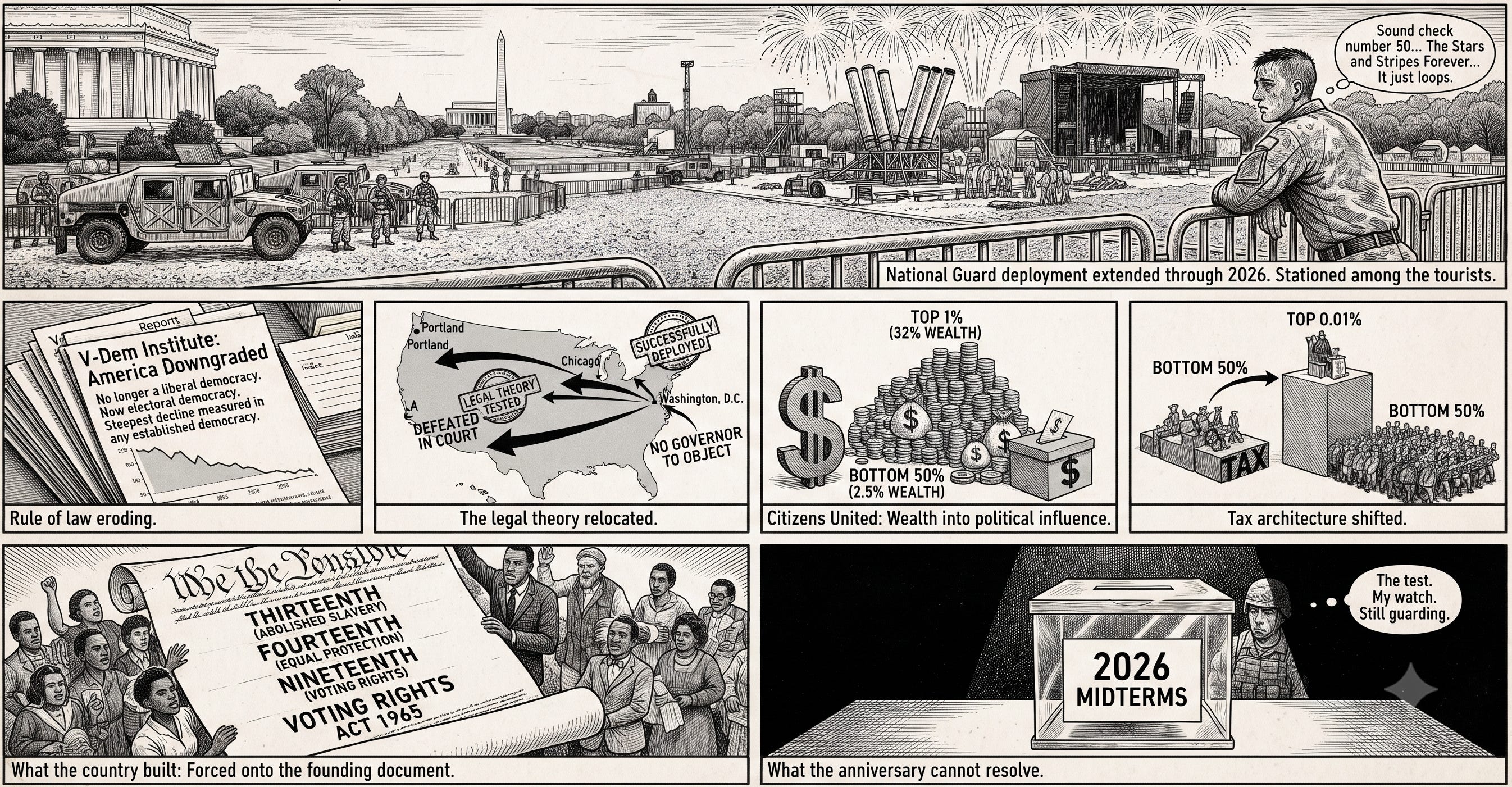
The republic marking its semiquincentennial this week is, by the measurement of the scholars who track such things, no longer rated a liberal democracy. The top one percent of its households now hold close to a third of its wealth, a concentration last seen the year before the Depression.
National Guard humvees have been parked along the gravel access roads behind the Washington Monument since August. They were still there in the last week of June, idling near the fireworks staging area while contractors from the National Park Service tested launch tubes for Saturday’s display. A soldier in fatigues, twenty-two years old according to the unit patch roster obtained by a D.C. news outlet in October, stood post near the Fifteenth Street barricade on a ninety-four-degree afternoon, close enough to hear the sound check for the Army band rehearsing “The Stars and Stripes Forever” for the two hundred and fiftieth time. The deployment that put him there was extended through the end of 2026 in December, the fourth extension since the President federalized roughly two thousand Guard troops in August 2025 under an executive order that armed them for patrols in the tourist core rather than the neighborhoods that actually generate the city’s violent crime statistics. He will be standing guard over the birthday party of a republic whose founding document he has sworn to defend, deployed under a legal theory that three separate federal courts have already found illegal in the three other cities where it was tried.
That is the physical scene into which the semiquincentennial arrives. The official one, the one printed on the Park Service programs and read aloud by the emcees booked for the Mall stage, describes two hundred and fifty years of self-government, expanding liberty, and a Constitution robust enough to have survived a civil war, two world wars, and a pandemic. Both scenes are true. Neither cancels the other. The distance between them is the story the anniversary coverage will mostly decline to tell.
The semiquincentennial messaging, coordinated through the congressionally chartered America250 commission, frames July 4, 2026, as a milestone of durability: the oldest continuously operating constitutional republic in the world, a nation that wrote its own rules and has largely lived inside them. The claim is not propaganda. It draws on a real record. What it omits is the record compiled in the same twelve months by the institutions whose entire function is to measure whether that claim still holds, and their filings do not support the omission.
The Varieties of Democracy Institute at the University of Gothenburg publishes the most granular democracy dataset in the world, built from five hundred and thirty-one indicators scored by country experts going back to 1789. Its 2026 report, titled “Unraveling the Democratic Era,” reclassified the United States out of the liberal democracy category for the first time in the study’s modern history, downgrading it to electoral democracy: a government that still holds real elections but no longer meets the threshold for genuine checks on executive power and rule of law. Before 2017, V-Dem consistently rated the United States ahead of every other G7 country on its Liberal Democracy Index. In the 2026 dataset, the United States sits below all six of its G7 peers. The American score has fallen twelve points since 2005. The average decline for a European Union country over the same period is four points. Staffan Lindberg, the institute’s director, has called the trajectory the steepest and fastest democratic decline the project has measured for any established democracy, and has named rule of law and checks on executive authority as the specific categories driving it, the same category, incidentally, that a Guard deployment executed over a governor’s explicit objection and later ruled illegal by a federal court sits squarely inside.
Freedom House’s Freedom in the World 2026 report recorded the twentieth consecutive year of global freedom decline and flagged the United States as one of the “free”-rated countries that fell furthest in a single year, citing an escalation in unilateral executive authority, a rise in reprisals against political speech, and a weakening of anticorruption enforcement inside the executive branch. Pew Research surveyed American adults in late March 2026 and found sixty-eight percent, spanning both parties, now say American democracy used to be a good example for the rest of the world but has stopped being one in recent years. Twenty-four percent say it still is.
None of these three institutions is describing the absence of a ballot. Americans still vote, the votes are still counted, and power has still changed hands through elections rather than force. What they are describing is the machinery that is supposed to surround the vote and constrain what happens between elections: a press that can report without fear of retaliation, courts insulated from the executive they are meant to check, a legislature that functions as an independent branch rather than a ratifying body, and an executive bound by the same laws it enforces on citizens. That last clause is the one the National Guard deployments test most directly, and it is worth tracing the mechanism rather than gesturing at it.
In June 2025, roughly two thousand members of the California National Guard were federalized and deployed to Los Angeles over Governor Gavin Newsom’s objection, the first time in sixty years a president had activated a state’s Guard against a sitting governor’s wishes. The legal basis cited was not the Insurrection Act, the eighteenth and nineteenth century statute historically used for this purpose and requiring a formal declaration of rebellion. It was 10 U.S.C. § 12406, a 1903 provision that had, until 2025, been treated by every prior administration as a mechanism for transferring administrative control of the Guard, not as an independent authority to deploy troops for civilian law enforcement over a state’s objection. A federal judge ruled on September 2, 2025, that the Los Angeles deployment violated the Posse Comitatus Act, the 1878 law barring federal troops from performing domestic policing functions absent explicit constitutional or congressional authorization. The administration deployed the same theory to Portland, Memphis, Chicago, and Washington through the fall. The Supreme Court rejected the administration’s emergency appeal of a lower court ruling blocking the Chicago deployment. By December 31, 2025, the administration announced it would end the Los Angeles, Portland, and Chicago deployments; by January 2026 the troops in those three cities had withdrawn. The Washington deployment, the one still standing post near the fireworks staging area in June 2026, was extended instead, through the end of the year, in the one jurisdiction where the President functions as the city’s own federal landlord and no governor exists to object.
The pattern is not a series of unconnected incidents. It is a single legal theory, tested serially across five cities, defeated in court in three of them, and preserved in the one location structurally immune to the check that defeated it elsewhere. That is what “rule of law deteriorating” looks like translated out of an index score and into an actual sequence of filings, deployments, and withdrawals. The courts held. The theory did not disappear. It relocated to the one jurisdiction where it could not be challenged by the mechanism that had stopped it everywhere else.
The honest accounting has to include what the founding document produced, because a significant amount of it was radical for 1776 and some of it remains radical now. A written constitution subordinating the government itself to enforceable rules was not standard practice in an age of hereditary monarchy. The peaceful transfer of executive power, tested first in 1801 when Federalists handed the presidency to Jeffersonian Republicans who had spent a decade calling them tyrants, held for two hundred and twenty years without interruption, through a civil war that killed three quarters of a million people, through the Depression, through a presidency that ended in resignation rather than removal by force.
The document itself was amended into something closer to its own stated promise than its authors had intended. The Thirteenth Amendment abolished the institution of slavery that the original text had protected in three separate clauses. The Fourteenth extended citizenship and equal protection to people the framers had counted as three-fifths of a person. The Nineteenth enfranchised half the adult population. The Voting Rights Act of 1965, passed after federal troops were sent to Alabama to protect marchers from state police on the Edmund Pettus Bridge, dismantled the literacy tests and poll taxes that a century of state legislatures had engineered specifically to nullify the Fifteenth Amendment. None of this was self-executing. Every one of these amendments and statutes was forced onto a founding document that did not include them at the outset, forced by people holding far less institutional power than the courts, the press, and the electorate that are the current custodians of the same fight.
The postwar order the country built after 1945 also represented something new in the history of great powers: a set of institutions, from the United Nations to Bretton Woods, constructed by the world’s dominant state to bind itself to written rules rather than simply dictating terms by force. That the United States frequently ignored those rules when convenient does not erase the fact that it was the first hegemon in the modern era to write them down and submit to them in public, even nominally.
Domestically, the New Deal built the closest thing to a broad-based middle class the country has produced. Social Security, the forty-hour week, the right to organize under the National Labor Relations Act, and deposit insurance that ended the bank runs which had defined the previous century of American capitalism were not gifts handed down from Washington. They were concessions extracted by a labor movement and an electorate that had watched the 1920s wealth concentration collapse into the worst economic catastrophe in the country’s history and refused to let it recur without a floor. For roughly four decades after 1945, productivity gains and wage gains moved together, and a single manufacturing income could support a family, buy a house, and fund a pension. That is the version of America the semiquincentennial marketing invokes. It existed. It is also worth being precise about how narrow its window was, how incomplete its inclusion of Black and Hispanic households, and how deliberately the arrangement that produced it has since been taken apart.
The dismantling has a start date, and it is not a mystery. Economic Policy Institute analysis shows wages for the bottom ninety percent of American earners rose forty-four percent between 1979 and 2024. Wages for the top one percent rose one hundred and eighty-two percent over the same period. The divergence begins almost exactly when the postwar wage-productivity link snaps, in the years following the 1970s oil shocks and the Volcker-era interest rate shock, and it has not reconverged in the four and a half decades since. Automation and globalization did not erode these jobs evenly across the income distribution. The record shows a specific class of American capturing the gains once the postwar bargain ended, consistently, across nine presidencies of both parties.
The mechanism accelerated in stages that can be dated the way any institutional capture is dated: by the ruling, the clause, the vote. Citizens United v. FEC, decided by the Supreme Court in 2010, removed the century-old restriction on corporate and union spending in federal elections, and the effect showed up in the money within a single election cycle. Americans for Tax Fairness found that one hundred billionaire families spent two point six billion dollars on the 2024 election cycle, sixteen and a half percent of all political contributions made that year. In 2000, billionaire election spending totaled eighteen million dollars, six tenths of one percent of the total. That ratio did not drift on its own. It was engineered by a single Supreme Court decision and then compounded, cycle after cycle, by donors who understood precisely what the ruling had handed them.
The tax architecture moved on a longer clock in the same direction. Institute for Policy Studies analysis of Saez-Zucman data shows the effective tax share paid by the top point zero one percent of Americans fell back to roughly its 1953 level by 2018, even as that same group’s share of national wealth nearly quadrupled across the same stretch, from two and a half percent to nine and a half percent. Every major federal tax bill since 1981, passed under presidents of both parties, has shifted the marginal burden further off the top of the distribution and further onto the payroll and consumption taxes that fall hardest on the bottom half. The extension debate over the 2017 Tax Cuts and Jobs Act, still unresolved through 2025 and into 2026, followed the identical template: temporary relief calibrated to middle incomes, paired with permanent structural cuts at the top, timed to expire in a way that guarantees the fight recurs every few years and the top bracket wins each round. Oxfam’s analysis projects the 2026 extension will reduce the tax bill of the top point one percent by three hundred and eleven thousand dollars in 2027 alone, while simultaneously raising taxes on households earning under fifteen thousand dollars a year.
By the third quarter of 2025, Federal Reserve Distributional Financial Accounts data put the top one percent’s share of American household net worth at nearly thirty-two percent, a record in a series that runs back to 1989 and a level economists now compare directly to 1929. The bottom fifty percent of American households, roughly sixty-five million families, held two and a half percent. Oxfam’s review of the same three and a half decades found that a household in the top point one percent gained an average of thirty-nine and a half million dollars in wealth between 1989 and 2022. A household in the bottom twenty percent gained less than eighty-five hundred dollars. The compensation share of GDP flowing to American workers fell during the same window to its lowest point in the more than seventy-five years the Bureau of Labor Statistics has tracked the measure, even as the economy it describes continued to grow. The top one percent now owns fifty percent of all publicly traded American stock and mutual fund holdings, up from forty percent in 2002. The racial dimension of the gap has not closed either: the average White household’s wealth grew seven point two times faster than the average Black household’s between 1989 and 2022, and six point seven times faster than the average Hispanic household’s, according to the same Oxfam dataset.
The wealth concentration and the democratic decline are not two separate anniversary stories that happen to be landing in the same season. Citizens United converted concentrated private wealth directly into concentrated political influence, and that influence has spent the fifteen years since protecting the tax and labor architecture that produced the wealth in the first place. A donor class that spent two point six billion dollars on a single election cycle is not a passive beneficiary of a widening gap. It is the mechanism sustaining it, financing the campaigns, the judicial confirmations, and the regulatory appointments that keep the effective tax rate at the top near its 1953 floor while the wealth share at the top approaches its 1929 ceiling.
A political system where checks on executive power are measurably eroding is a political system with fewer points at which that money can be intercepted before it becomes policy. The theory of law that put a National Guard humvee behind the Washington Monument was tested in five cities, defeated in court in three, and survived by relocating to the one jurisdiction structurally immune to that particular check. Watch that same relocation instinct across the tax record, the campaign finance record, and the deployment record, and it stops looking like three separate stories. It is one arrangement, viewed from three angles: a system engineered, cycle after cycle and ruling after ruling, to keep converting political access into wealth, wealth back into political access, and institutional resistance into a target to be routed around rather than a boundary to be respected.
Ordinary Americans have not misread this. The sixty-four percent who tell pollsters the wealth gap is too large and the sixty-eight percent who tell Pew that American democracy stopped being a global model overlap heavily. They are not describing two separate anxieties. They are describing one mechanism from the two vantage points available to them, the ballot and the paycheck, and arriving at the same finding from both.
The reversal case is not sentimental. V-Dem’s own dataset on autocratizing states finds that roughly seventy percent of countries that began sliding toward electoral autocracy later reversed course, typically through some combination of courts willing to check the executive, an organized civil society, and an electorate that punishes the slide in the first available election. Every element of that recipe is currently active inside the United States. Lower federal courts ruled against the National Guard deployments in four of the five cities where the theory was tested. Governors in the affected states sued and largely won. The Supreme Court itself declined to bless the Chicago deployment. None of that reversed the underlying democracy score, but all of it is exactly the machinery the comparative literature says has to function for a reversal to begin.
What it has not yet done is face an election. V-Dem’s election-specific indicators, the ones measuring whether ballots are counted fairly and whether the losing side concedes, have not moved in the American score, not because nothing has changed but because there has been no national election since the current decline began. That is not reassurance. It means the worst of the measured deterioration, the executive overreach, the press intimidation, the judicial confrontations, has accumulated without a single national election yet testing whether the mechanism built to reverse it still works when Americans go to the polls. The 2026 midterms are the test V-Dem’s own researchers have named as decisive.
The founders’ actual achievements were never automatic. Abolition, suffrage, the right to organize, the Voting Rights Act: every one of them was forced onto a Constitution that did not originally include them, forced by people holding far less power than the courts, the press, and the electorate hold today. That is the argument for believing the current trajectory is not physics either. It is also the argument for refusing to let a fireworks display stand in for an answer.
The soldier at the Fifteenth Street barricade will still be standing there in November, guarding a republic that has not yet told him whether it means to reverse what put him there or ratify it.


