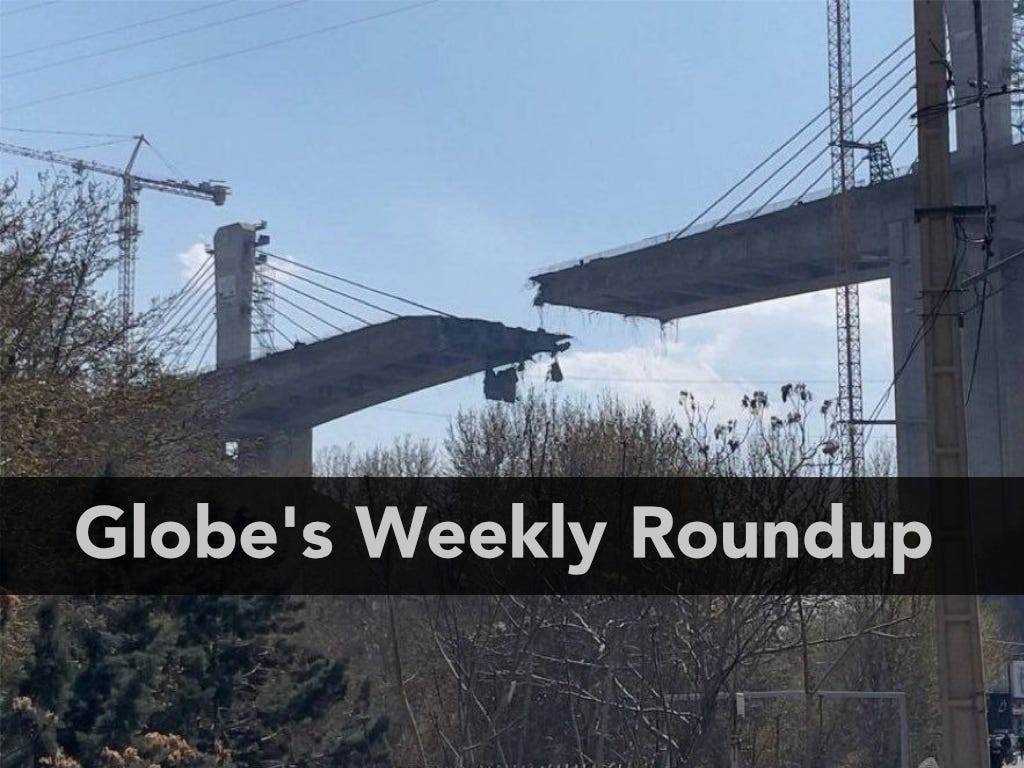
A bridge double-tapped on a public holiday. The Pasteur Institute destroyed. 244 children dead. The Hormuz deadline expires today.
The week began with Trump telling the Financial Times that U.S. and Israeli forces had struck 13,000 targets inside Iran since February 28, with roughly 3,000 remaining. It ended with a Hormuz deadline expiring today, the Strait still closed, and a week’s worth of bombing that destroyed a century-old disease research institute, double-tapped a bridge full of holiday-makers, bombed pharmaceutical factories that produced cancer and multiple sclerosis medication, struck the Bushehr nuclear plant for the fourth time, and killed at least five workers in a petrochemical zone that supplies 70 percent of Iran’s domestic gasoline. By April 4, the Human Rights Activists News Agency had confirmed 1,616 Iranian civilians killed since the war began on February 28. At least 244 of them were children.
THE BRIDGE AND THE HOLIDAY
On the afternoon of April 2, a Persian holiday, U.S. airstrikes hit the B1 bridge connecting Tehran to Karaj. The bridge, the tallest in the Middle East at 176 meters, had been under construction for two years and was weeks from opening. The victims of the first strike were civilians who had gathered along the riverbank beneath the structure for Sizdah Be-dar, the thirteenth day of Nowruz, a traditional outdoor holiday. Iranian state media initially reported eight killed and 95 wounded. The toll rose to 13 confirmed dead by April 3, according to Iran’s Alborz province martyrs foundation, cited by IRNA. According to Iran’s Fars News Agency, the second missile in the attack struck as first-responder teams were already on site working the wreckage. Roozbeh Yazdi, an Iranian engineer who had spent two years building the bridge, stood at the site the following morning as AFP reporters watched. “This bridge was like our child,” he said. “We worked morning and night. In the end, our efforts were destroyed in three hours.” Trump posted video of the explosion on Truth Social. “The biggest bridge in Iran comes tumbling down, never to be used again,” he wrote. He did not say what military purpose the bridge served. Iranian-American political scientist Vali Nasr described the week’s strikes as designed to “take Iranians back to the Stone Age.” Trump had used exactly those words in an address to the nation on April 1, threatening to bomb Iran “back to the Stone Ages, where they belong” if no deal was reached.
THE PASTEUR INSTITUTE AND THE PHARMACEUTICAL FACTORY
On April 2, the same day as the bridge strike, U.S.-Israeli warplanes destroyed the Pasteur Institute of Iran in Tehran. The institute was founded in 1920 in partnership with the Institut Pasteur in Paris, after World War I famine and epidemic spread across Iran. It has produced vaccines against smallpox, plague, cholera, diphtheria, and rabies; it runs Iran’s national immunization program; two of its departments work directly with the WHO. Iran’s Health Ministry spokesman Hossein Kermanpour called the strike “a direct assault on international health security.” WHO Director General Tedros Adhanom Ghebreyesus confirmed that the institute had been rendered unable to deliver health services and that two of its WHO-linked departments had been destroyed. He also confirmed that by April 3, the WHO had verified at least 20 attacks on Iran’s healthcare system since March 1, resulting in nine deaths among health and Red Crescent workers. Iran’s Red Crescent reported on April 1 that 316 healthcare and emergency centers had been damaged across the country since the war began. Save the Children calculated that healthcare systems in Iran, Lebanon, and Israel were coming under attack on average once every six hours. The attack on the Pasteur Institute had come two days after a U.S.-Israeli strike destroyed the Tofigh Daru pharmaceutical complex in Tehran, which produced treatments for cancer and multiple sclerosis. Neither the United States nor Israel has assumed responsibility for either strike.
THE UNIVERSITIES
THE NUCLEAR PLANT AND THE PETROCHEMICAL ZONE
On April 4, a projectile struck the perimeter of the Bushehr nuclear power plant, Iran’s only operational reactor, for the fourth time since the war began. One member of the site’s physical protection staff was killed by projectile fragments; an auxiliary building was damaged by blast waves and shrapnel. Russia, which built the plant and maintains a technical presence there, evacuated 200 more of its personnel. Foreign Minister Abbas Araghchi warned that continued strikes on Bushehr risked radioactive contamination across the entire Gulf region, and asked why Western governments who had spent years demanding protection for the Zaporizhzhia plant in Ukraine were silent now. IAEA Director General Rafael Grossi said he was “deeply concerned” and reiterated that nuclear power plant sites and their surrounding areas must never be attacked. Iran’s Atomic Energy Organization formally wrote to the IAEA requesting a war crimes designation for the attacks. No increase in radiation levels was reported, but Caesium-137, the isotope a breach would release, does not recognize the borders between Bushehr Province and its neighbors across the Gulf.
The same day, strikes hit the Mahshahr Special Petrochemical Economic Zone in Khuzestan Province, where the Bandar Imam complex, the Fajr 1 and Fajr 2 facilities, and the Karun and Amir Kabir plants were all struck. HRANA confirmed at least five killed and 170 wounded. The Mahshahr zone supplies approximately 70 percent of Iran’s domestic gasoline. The deputy governor of Khuzestan had told press before casualty figures were released that the probability of civilian death in the zone was “very high.” Netanyahu had boasted earlier in the week that Israel had destroyed 70 percent of Iran’s steel production capacity. Trump threatened during the same period to bomb Iran’s electricity generation plants and water desalination facilities simultaneously if Tehran did not reopen the Strait by Monday. Both categories of target are civilian infrastructure protected under international humanitarian law. On April 2, more than 100 international legal experts signed a statement expressing what the New Arab described as “profound concern” at mounting evidence of U.S. war crimes during the bombing campaign.
THE RESCUE MISSION AND THE QUESTION NEAR ISFAHAN
Read here for an alternative view on this subject.
On April 3, Iran shot down a U.S. F-15E Strike Eagle based at RAF Lakenheath over southwestern Iran, the first American combat aircraft lost over Iranian territory in this war and the first since the 2003 invasion of Iraq. One crew member was recovered within hours. The second, a weapons system officer of colonel rank, evaded Iranian forces for more than 24 hours in mountainous terrain in Kohgiluyeh and Boyer-Ahmad province while Iranian authorities offered a reward of $66,000 to any citizen who captured him alive. SEAL Team 6 extracted him in a firefight early Sunday morning. Trump announced the recovery on Truth Social: “WE GOT HIM!” U.S. officials told the New York Times the operation was among the most complex in American military history, involving hundreds of special operations troops and dozens of aircraft. The CIA ran a parallel deception campaign inside Iranian intelligence networks, spreading false information that both crew members had already been found, according to Axios. The IRGC claimed to have destroyed two C-130 transport aircraft and two Black Hawk helicopters during the operation. The Pentagon said the planes were destroyed by American forces after mechanical malfunction. Both accounts agree the C-130s reached the ground.
Fortune reported that the forward arming and refueling point established inside Iran for the operation was in the mountain corridor near Isfahan, and noted in the same article that such infrastructure would apply directly to “a potential operation to retrieve Iran’s highly enriched uranium.” Isfahan holds Iran’s primary uranium conversion facility, attached to the Isfahan Nuclear Technology Center. The airstrip where the C-130s landed is 37 kilometers from the complex’s underground tunnel network. The C-130J is a heavy-lift cargo transport, not a strike aircraft. Neither U.S. officials nor the Pentagon has provided a rationale for why heavy-lift assets staged in the mountain corridor adjacent to Iran’s uranium stockpile. The official account is a pilot recovery mission. The gap in that account has not been closed.
THE HORMUZ DEADLINE AND THE WEEK THAT PRODUCED IT
On March 30, Trump told the Financial Times that 13,000 Iranian targets had been struck, roughly 3,000 remained, and the U.S. would “conclude the war” by destroying all of Iran’s power plants and oil wells if the Strait did not reopen. On April 1, he gave a national address threatening to take Iran “back to the Stone Ages.” On April 2, he posted the bridge collapse video. On April 4, he issued a 48-hour deadline: reopen the Strait or face “all hell.” Iran’s joint military command responded the same night; General Ali Abdollahi Aliabadi called the ultimatum “helpless, nervous, unbalanced and stupid” and warned that “the gates of hell will open for you” if energy infrastructure strikes continue. Mohamed ElBaradei, the former IAEA Director General, posted in Arabic urging Gulf governments to “do everything in your power before this madman turns the region into a ball of fire.” French President Emmanuel Macron said reopening the Strait by force was “unrealistic.” The Strait carries 20 percent of the world’s oil and LNG. It has been effectively closed since February 28. The April 6 deadline expires today.
WEEK SIX: THE SIGNAL ITEMS
HRANA Confirms 1,616 Civilians Killed, 244 of Them Children — April 4 report; figures are minimums based on verified incidents; military casualty data from Iranian state sources is acknowledged to be substantially undercounted.
B1 Bridge in Karaj Double-Tapped on Sizdah Be-dar — April 2 strike hit civilians on a national public holiday along the riverbank below; second missile struck arriving first responders; 13 civilians confirmed dead, 95 wounded.
Pasteur Institute of Iran Destroyed — April 2 strike on Tehran’s 106-year-old disease research and vaccine production center; WHO confirmed it can no longer deliver health services; two WHO-linked departments destroyed.
Tofigh Daru Pharmaceutical Complex Bombed — March 31 strike on Tehran plant that produced cancer and multiple sclerosis treatments; US and Israel have not acknowledged the strike.
WHO: 20+ Verified Attacks on Iran’s Healthcare System — Nine killed including health workers and Red Crescent members; 316 healthcare and emergency centers damaged since February 28; one attack every six hours on average across the region.
Shahid Beheshti University Research Institute Struck — April 3 strike on the Laser and Plasma Research Institute in Velenjak, Tehran; Minister of Science confirmed 5 professors and 60+ students killed since war began; 30+ universities hit total.
IRGC University Ultimatum Unanswered — March 30 deadline for U.S. condemnation of university strikes passed without response; threat to target American and Israeli universities in the Gulf remains active.
Mahshahr Petrochemical Zone Struck — April 4; five killed, 170 wounded; Bandar Imam, Fajr 1 and 2, Karun, and Amir Kabir facilities all hit; zone provides approximately 70 percent of Iran’s domestic gasoline supply.
Bushehr Nuclear Plant Struck for the Fourth Time — April 4; one guard killed by projectile fragments; auxiliary building damaged; Russia evacuated 200 more personnel; IAEA chief says nuclear sites must never be attacked.
Iran Requests IAEA War Crimes Designation — Atomic Energy Organization of Iran formally wrote to Grossi asking for condemnation of Bushehr attacks as violations of international law.
Araghchi Warns of Radioactive Gulf Catastrophe — Foreign Minister drew direct comparison to Zaporizhzhia; noted Western silence on Bushehr in contrast to years of demands over the Ukrainian plant.
F-15E Strike Eagle Shot Down Over Iran — April 3; first U.S. aircraft downed over Iranian territory since 2003; crew from RAF Lakenheath’s 48th Fighter Wing; Iran’s new air defense system claimed responsibility.
SEAL Team 6 Extracts Missing Airman After 24-Hour Manhunt — Colonel-rank weapons system officer recovered April 5 from Kohgiluyeh and Boyer-Ahmad province; hundreds of special forces, dozens of aircraft involved.
C-130J Transport Aircraft Staged Near Isfahan — Forward arming and refueling point established in mountain corridor near Isfahan; airstrip 37 kilometers from Isfahan Nuclear Technology Center’s uranium complex; Fortune noted the location’s relevance to a “potential operation to retrieve Iran’s highly enriched uranium.”
CIA Ran Deception Campaign Concurrently with Rescue — Axios confirmed agency spread false intelligence within Iranian networks claiming both crew members already recovered.
IRGC Claims Two C-130s and Two Black Hawks Destroyed — Pentagon says aircraft were destroyed by U.S. forces after mechanical failure; both accounts confirm the planes reached the ground.
A-10 Warthog Downed on April 3 — Providing cover fire during rescue operations; pilot ejected safely outside Iranian airspace; aircraft crashed near the Strait of Hormuz.
Trump Issues April 6 Hormuz Ultimatum — 48-hour deadline issued April 4; Iran rejected it; Strait remains closed as of today.
Trump Threatens Electricity Plants and Desalination Facilities — Both are civilian infrastructure protected under international humanitarian law; White House spokeswoman said the threats showed Iran’s “best move is to make a deal.”
Trump: 13,000 Targets Struck, 3,000 Remaining — Told the Financial Times on March 30; IDF confirmed striking 170 targets in a single day on the same date.
100+ International Legal Experts Sign War Crimes Statement — April 2; expressed “profound concern” at mounting evidence of violations of international humanitarian law.
Red Crescent Worker Dehnavi Killed in Isfahan — April 4; fourth aid worker killed in U.S.-Israeli strikes since February 28; IFRC called the protection of humanitarian workers “an imperative international legal norm.”
Netanyahu Claims 70 Percent of Iran’s Steel Capacity Destroyed — Boast made the same week the Pasteur Institute and Mahshahr petrochemical hub were bombed.
Planet Labs Suspends Iran Satellite Imagery — April 5; commercial satellite company halted visuals of the conflict zone at the Trump administration’s request; independent civilian damage assessment of Iranian territory has gone dark.
Soleimani Family Members Detained in the United States — April 5; two relatives of the slain general arrested after State Department rescinded their residency permits.


