Bondi Beach Shooting: What Happened and Why the Framing Matters
A deadly attack on Sydney’s Jewish community – and the danger of turning tragedy into a license for wider anti‑Muslim sentiment
A mass shooting at Sydney’s Bondi Beach during a Hanukkah celebration has left a significant number of people dead and injured, in an incident authorities have formally designated a terrorist attack targeting the Jewish community. The violence has unleashed a massive security response and saturation coverage, and within hours the framing of the story began hardening around familiar tropes: Muslim names, “terror” labels and demands for more powers, more policing, more suspicion. The facts of the attack are horrific; the way those facts are mobilised politically is where the next layer of harm begins.
The attack at Bondi Beach
The shooting unfolded on a weekend evening along Campbell Parade, the coastal strip that frames Bondi Beach, as hundreds gathered for an outdoor Hanukkah event often billed as “Chanukah by the Sea.” Families, young people and elderly community members had come for music, prayer and public menorah lighting in one of the most recognisable public spaces in Australia. What should have been an open, festive space was, within minutes, transformed into a crime scene.
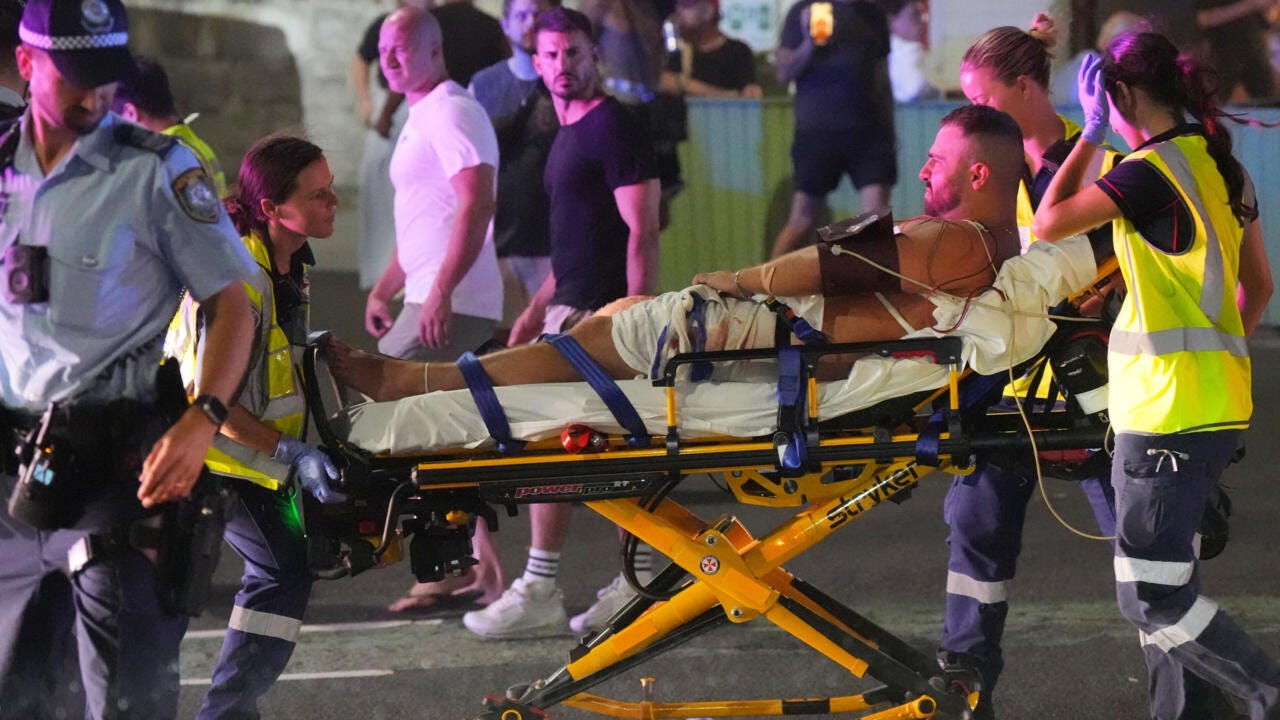
Witness accounts describe gunfire erupting without warning, sending crowds scrambling into beachfront restaurants, back alleys and stairwells. Parents shielded children, people took cover behind parked cars and shop counters, and bystanders improvised first aid on the sand and pavement as the scale of the attack became clear. Police and paramedics converged on the area, locking down the beach precinct, diverting traffic and instructing the public to stay away while officers searched for suspects and secured the scene.
Authorities have confirmed that multiple people were killed, including at least one of the alleged attackers, and that a substantial number of others suffered gunshot wounds and trauma injuries. Hospitals across Sydney activated mass‑casualty protocols as victims were transported in waves. According to police statements, two gunmen were directly involved; one was shot dead during a confrontation with armed officers, while another was critically wounded and taken into custody under guard. Specialist units, including bomb technicians, were deployed to examine suspicious items linked to a vehicle near the beach to rule out additional devices or secondary attacks.
Official narrative and early investigation
Within hours, senior officials announced that the attack was being treated as terrorism under Australian law, on the basis that a Jewish religious event had been specifically targeted. Political leaders at state and federal level issued condemnations, expressed solidarity with Sydney’s Jewish community and ordered heightened security at synagogues, Jewish schools and community centres nationwide. The images and language of a familiar script returned: cordoned streets, heavily armed officers, rolling news tickers, and the immediate hunt for ideological labels.
Local media quickly circulated the name of at least one suspect, emphasising a Muslim background. Police raided a property in western Sydney, seizing devices and documents and interviewing relatives and associates. Counter‑terrorism officers began reconstructing the suspects’ movements in the days and weeks before the shooting: their travel, online activity, potential contact with foreign networks, and any previous encounters with security agencies.
Yet even as this machinery whirred into motion, basic questions remained unanswered. How were the weapons acquired and transported into such a public, monitored space? Were there clear warning signs that were missed, or fragmentary pieces of intelligence that, in hindsight, might have pointed to a developing threat? What precise ideological mix – if any – drove the attackers: religious grievance, conspiracy content, foreign conflicts, or a more chaotic blend of personal crisis and borrowed slogans? Those questions will not be settled in the news cycle. They belong in courtrooms, inquiries and inquests where evidence can be tested rather than simply asserted.
From individual guilt to collective suspicion
The horror of what happened at Bondi is not in dispute. Jewish Australians have every right to expect safety at a religious celebration on a public beach, and communities are justified in demanding accountability and protection. The problem begins when the lens zooms out from individual perpetrators and fixed facts to the foggier realm of identity and collective blame.
In the immediate aftermath, coverage and commentary leaned heavily on the suspects’ names, background and presumed ideological orientation. The framing risk is obvious: a real crime committed by particular individuals becomes, by association, a story about Muslims in general – their “integration,” their “loyalty,” their supposed predisposition to violence. The victims of the shooting are overwhelmingly Jewish; the next wave of vulnerability, however, includes Muslim communities who will face the backlash in the form of harassment, hate crimes, workplace suspicion and intensified policing.
This is not a hypothetical danger. It is the pattern of the last two decades.
The long shadow of the “war on terror”
Since 2001, attacks involving Muslim or Muslim‑background suspects have repeatedly been used to justify an ever‑expanding architecture of war and surveillance. After 9/11, the invasion and occupation of Afghanistan were framed as a necessary response to terror, then followed by the 2003 invasion of Iraq on intelligence claims later shown to be hollow. Entire countries were turned into battlefields on the promise of security, stability and freedom. What they received instead were destroyed cities, sectarian bloodletting and generations marked by loss.
Drone campaigns in Pakistan, Yemen and Somalia normalised the idea that nameless, faceless “threats” in Muslim‑majority regions could be killed without trial, with civilian casualties written off as regrettable but acceptable collateral damage. In those same years, Western legislatures passed sprawling counter‑terrorism laws, expanded surveillance powers and widened the net of “suspicion,” measures which fell disproportionately on Muslim communities. The numbers of Muslim dead across Afghanistan, Iraq, Gaza and other theatres are measured not in the dozens or hundreds but in the hundreds of thousands and beyond, yet their names and faces rarely puncture the Western media cycle except as statistics or as “suspected militants.”
In London, Madrid, Paris and other cities, terrorist attacks were followed by cycles that are now horribly familiar: grief, outrage, emergency legislation, raids, and long commentaries about “Muslim integration” and the dangers of “extremist ideology.” Within this logic, Muslim life is doubly discounted. When Muslims are victims – in wars, occupations and sanctions regimes – their deaths are background noise to geopolitics. When a Muslim is a perpetrator, his crime is treated as civilisational evidence of a wider problem with an entire faith.
Why this history matters for Bondi
Bondi Beach must be understood inside this wider arc, not outside it. The fact that this was a real, lethal attack on Jewish civilians does not grant a blank cheque to repeat the same securitised reflexes that have already wrecked lives on a massive scale, particularly across the Muslim world. Nor does it justify allowing commentary to slide from “these individuals” to “these communities” as objects of suspicion.
A serious, rights‑based response should hold several lines at once. It must insist on justice for the victims and on the right of Jewish Australians to live freely and safely. It must insist, at the same time, that responsibility for this crime belongs to those who planned and carried it out, not to millions of Muslims who neither knew of it nor endorsed it. It should demand transparency and oversight over any new powers or policies demanded in the attack’s name, rather than letting grief be converted into permanent emergency.
Most of all, it should refuse the hierarchy of human value that has governed the “war on terror” era. The bullets at Bondi do not cancel out the bombs over Baghdad or the drones above Kandahar; nor do the wars in Iraq and Afghanistan make a single Jewish life on a Sydney beach worth less. What this history exposes is a system that routinely instrumentalises some deaths while rendering others invisible, and that repeatedly turns real atrocities into fuel for a politics of fear in which Muslims are the permanent suspects.
To honour the dead at Bondi and to protect both Jewish and Muslim communities in Australia, the response must break with that habit. That means clear facts, not rumours; individual guilt, not communal punishment; and a refusal to let yet another tragedy be pressed into the service of an already‑bloody narrative.


