


The summit gave eleven governments a common program for local-currency settlement and linked payment systems, but the dollar still commands the markets, assets, and legal infrastructure that BRICS has yet to build.
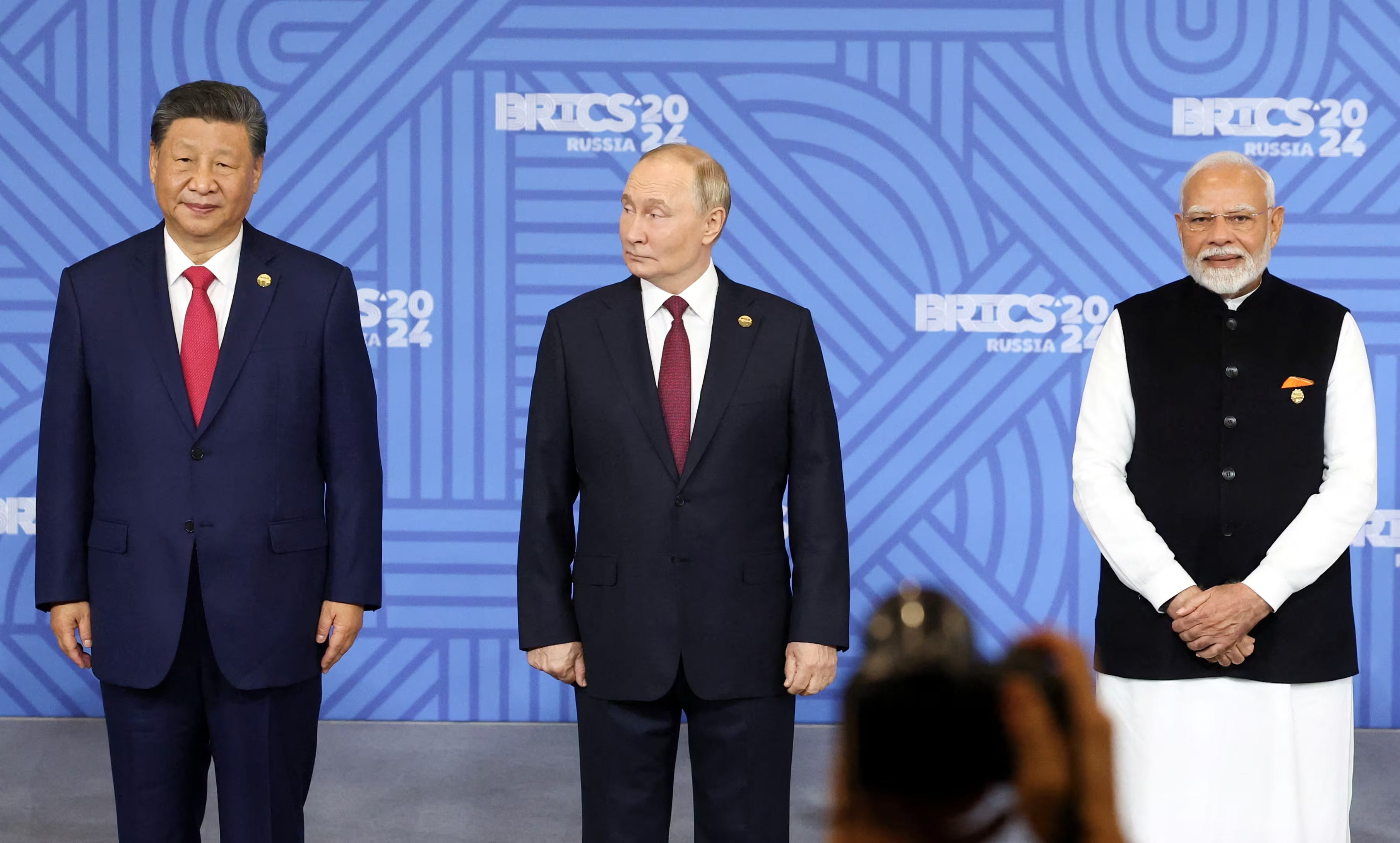
At Bharat Mandapam on September 12, Narendra Modi sat with Vladimir Putin, Xi Jinping, Masoud Pezeshkian, and the leaders of an enlarged BRICS whose members disagree on wars, borders, sanctions, trade, and the distribution of power within the group itself. The meeting arrived after a year in which expansion often looked like paralysis. India and China were repairing a relationship damaged by their 2020 border clash while still treating each other as strategic competitors. Iran and the United Arab Emirates belonged to the same organization as a regional war exposed their opposing alignments. Russia required financial channels that could survive Western sanctions, while Brazil and South Africa wanted more authority for developing states without accepting Moscow’s isolation as their own. India wanted to promote the rupee and its payment technology, and yet it had no interest in exchanging dependence on the dollar system for dependence on Chinese financial infrastructure. Agreement among these governments was always going to be technical before it became monetary.
The New Delhi Declaration gave that technical work a mandate. Paragraph 90 acknowledges studies on interoperability between national payment and messaging channels, supports further discussion of trade and investment in members’ currencies, and directs the BRICS Payment Task Force to pursue cross-border payments that are faster, cheaper, accessible, transparent, and safe. The language is cautious by design. It recognizes national priorities and says there is no single model for every member. The same declaration records work on settlement and depository infrastructure, a proposed insurance center, an Indian risk laboratory at GIFT City, and pilot transactions under a multilateral guarantee initiative. These provisions make the summit the most coherent BRICS statement on financial infrastructure in years, and yet they do not create the product often described as “BRICS Pay.” They authorize continued work without announcing a completed system.
That distinction protects the serious case for the project from the inflated one. BRICS did not establish a common currency, a central bank, a shared clearing house, a reserve asset, or a mandatory settlement system. It did not publish a launch date, governance charter, capital structure, operating rulebook, sanctions policy, dispute mechanism, or schedule of fees. India entered the summit after the Reserve Bank of India had proposed links among BRICS central-bank digital currencies, and Governor Sanjay Malhotra said in August that members were discussing connections between their fast-payment systems and official digital currencies. Indian officials presented those links as a way to lower cost and settlement time, not as a campaign to remove the dollar from world commerce. The declaration then adopted the broader and less binding formula of continued study.
The real project concerns whether national financial systems can exchange payment instructions and settle claims without sending every transaction through banks, currencies, and legal jurisdictions in New York or Europe. An Indian importer might pay a Russian supplier through connected domestic systems, with rupees converted into rubles under an agreed mechanism. A Brazilian exporter might receive reais for a sale invoiced outside the dollar. An Iranian company might seek trade finance that does not expose every participating bank to the same sanctions risk. None of these transactions requires a supranational currency. Each does require liquidity, an exchange-rate convention, compliance checks, settlement finality, data rules, and a counterparty willing to hold or convert the currency received. A phone interface can make a payment look immediate, but banks and central banks still have to reconcile the claims behind it.
The sanction that became a balance-sheet fact
The demand for alternatives grew after February 2022, when the United States, the European Union, and their partners immobilized Russian central-bank reserves following Russia’s full-scale invasion of Ukraine. The European Union now reports about €210 billion in immobilized Russian central-bank assets within its jurisdiction. Its rules direct most extraordinary revenue generated by those holdings toward repayment of the G7 loan program for Ukraine, while the underlying assets remain frozen until Russia ends the war and compensates Ukraine. The same European policy now bans transactions with more than one hundred Russian banks, restricts third-country institutions accused of assisting evasion, and prohibits EU entities from connecting to Russia’s System for Transfer of Financial Messages.
The sanction responded to an invasion that has destroyed Ukrainian cities, killed civilians, displaced millions, and violated the sovereignty of a neighboring state. Governments that seek payment autonomy do not have to endorse Moscow’s war to understand what the reserve freeze changed. A foreign reserve is both an asset on a central bank’s balance sheet and a legal claim housed within another state’s jurisdiction, and the second condition can govern the first during a geopolitical rupture. The United States and Europe demonstrated that access to reserves, correspondent banks, messaging services, securities depositories, insurance, and trade finance could be restricted in concert. Russia supplied the immediate case, and yet finance ministries far from Moscow absorbed the institutional lesson because their reserves also sit inside systems whose rules they do not write.
Washington has long used access to the dollar as an instrument of foreign policy, but the scale of the Russian action widened the audience. Iran already knew the mechanism through years of restrictions on its banks, oil revenue, and access to dollar clearing. Pezeshkian used the New Delhi summit to press for reciprocal settlement and protection against currency risk because Iranian firms confront this problem as a condition of ordinary commerce. Russia seeks channels that can continue under direct sanctions. China has an interest in increasing use of the renminbi and limiting the reach of American financial pressure. Brazil, India, South Africa, Indonesia, Egypt, Ethiopia, and the Gulf members occupy different positions: they trade heavily with the United States and Europe, often hold large dollar reserves, and have no reason to welcome the costs of financial rupture, but they also want the capacity to conduct lawful trade when American or European policy changes.
The declaration brought these positions together by condemning unilateral sanctions that lack United Nations Security Council authorization while leaving each member free to decide how far it will participate in alternative systems. That compromise matters more than a declaration of monetary revolt would have mattered because BRICS could not have implemented the latter. Russia and Iran want insulation from existing restrictions. India wants lower costs and wider use of the rupee. China wants a larger international role for the renminbi. Brazil has supported local-currency trade and reform of global financial governance while avoiding a binding monetary union. The Gulf members require access to every major market and retain currencies closely tied to the dollar. These interests overlap on additional payment routes, even when they diverge on the political purpose of those routes.
Modi’s consensus and its limits
India’s achievement was to make modest institutional progress possible among states that could not agree on a common currency and would not accept a payment structure controlled by one member. The summit declaration passed after negotiations that had to accommodate Iran and the United Arab Emirates during a regional conflict, India and China during a tentative bilateral thaw, and Russia alongside states that maintain large commercial relationships with the West. More than four hundred BRICS meetings took place in thirty Indian cities during the chairship, according to the declaration. That bureaucratic volume identifies the level at which the project must be built: finance ministries, central banks, regulators, commercial lenders, payment operators, securities depositories, insurers, and technical standards bodies must all agree on procedures that heads of government cannot settle in a group photograph.
Modi also used the summit to hold bilateral discussions with Putin, Pezeshkian, and Xi. Xi’s first visit to India in nearly seven years carried particular weight because no multilateral financial design can progress without the two largest BRICS economies. Their trade relationship supplies both a reason for cooperation and an obstacle to it. Indian firms depend on Chinese machinery, electronics, chemicals, and intermediate goods; China remains one of India’s largest trading partners; and India runs a large bilateral deficit. A system that settles more of this trade in national currencies must decide which currency absorbs the imbalance. If the answer is the renminbi, New Delhi could reduce its use of dollars while increasing financial exposure to Beijing. If the answer is rupees, Chinese exporters need assets, purchases, or investment opportunities in India that make accumulated rupee balances useful. Faster messaging cannot settle that political economy.
Security concerns add another constraint. India has promoted its Unified Payments Interface abroad because UPI demonstrates that public digital infrastructure can process high volumes at low direct cost, but connecting domestic systems across BRICS requires decisions about where data is stored, which regulator can inspect it, how identity is verified, and who can suspend a participant. New Delhi has been wary of payment proposals with Chinese corporate links for reasons that extend beyond technical performance. Beijing, for its part, will not place its financial data and settlement policy under Indian supervision. A workable BRICS design will therefore resemble a network of negotiated gateways, bilateral arrangements, and common message standards more than a single platform with one authority.
This fragmented form is often treated as evidence of failure because it lacks the elegance of a common currency. It may be the only form consistent with the members’ interests. The European monetary union required treaties, convergence rules, a common central bank, shared law, extensive intraregional trade, and political commitments that BRICS does not possess. Its members run different exchange-rate regimes and capital controls, face different inflation records, and offer different degrees of legal predictability. They also span rival security relationships. A phased system lets India connect selected payment corridors, Russia and China continue bilateral settlement, Brazil expand arrangements that serve its exporters, and Iran seek willing counterparties without asking every member to accept the same sanctions exposure.
What “BRICS Pay” would have to contain
The label joins several projects that solve different problems. A fast-payment link moves retail instructions between domestic systems. A central-bank digital-currency corridor transfers tokenized official money under rules set by participating central banks. A bank-messaging network transmits standardized information but does not itself supply the money used for settlement. A currency-swap agreement provides liquidity when one country needs another’s currency. A depository holds securities and helps transfer ownership. Trade finance supplies credit between shipment and payment. Insurance covers commercial and political risks. A market for forwards and swaps lets firms protect themselves against exchange-rate changes. BRICS needs enough of these functions to make a non-dollar transaction cheaper and safer than the established route, and no declaration can substitute for them.
The New Development Bank offers a partial example of what local-currency finance looks like in practice. In 2024 it approved fifteen loans totaling $4.5 billion, and 43.5 percent of approvals were denominated mainly in renminbi and South African rand, above the 30 percent local-currency target in its 2022-2026 strategy. The bank now proposes a target of 40 to 50 percent for its 2027-2031 cycle. It has issued bonds in member currencies and can match some local assets with local liabilities, which reduces exchange risk for borrowers whose revenue arrives in those currencies. It remains a development bank with a limited balance sheet, however, and its operations do not create the continuous liquidity, safe assets, or private hedging markets required for a global settlement currency.
Local-currency settlement also moves risk rather than removing it. An Indian refiner can buy Russian oil in rupees, but a Russian seller that cannot spend those rupees on Indian goods or invest them in liquid Indian assets accumulates a currency it may not want. Conversion into another currency then restores an intermediary and a price. A Brazilian firm paid in renminbi may welcome the arrangement if it imports from China, services renminbi debt, or can hedge at low cost. It may demand dollars if its obligations remain dollar-denominated. The commercial decision depends on the currency composition of each firm’s costs and liabilities, not on a summit’s preference.
Commodity pricing presents the same difficulty. Oil, gas, metals, freight, and insurance can be paid in one currency while their contracts still use dollar benchmarks. The dollar then remains the unit in which parties compare value and manage risk even when it does not cross the final payment channel. Shifting the payment leg is easier than shifting invoicing, financing, and hedging together. A durable BRICS system would therefore need active markets across multiple currency pairs, agreed collateral, reliable price discovery, and central-bank liquidity during stress. Without those supports, firms will use local currencies where sanctions or state policy require them and return to dollars where commercial choice governs.
The dollar’s measurable advantage
The latest global data imposes discipline on claims of an imminent dollar defeat. The Bank for International Settlements measured average foreign-exchange turnover of $9.6 trillion a day in April 2025, 28 percent above its 2022 survey. The dollar appeared on one side of 89 percent of all trades. The euro’s share was 28.9 percent and the yen’s was 16.8 percent, with the total exceeding one hundred because each transaction contains two currencies. The renminbi’s use increased, but growth from a smaller base does not equal replacement of the currency that anchors the market. Deep dollar trading makes conversion easier, spreads narrower, hedges more available, and emergency liquidity more credible. Each advantage encourages the next user to remain in the same system.
Reserve data points in the same direction. The International Monetary Fund reported that the dollar accounted for 57.13 percent of global foreign-exchange reserves in the first quarter of 2026, up from 56.42 percent in the previous quarter, although valuation changes caused about half of that increase. The longer series shows diversification from the dollar’s much higher share at the beginning of the century, but the beneficiaries include the euro, yen, pound, Canadian and Australian dollars, and smaller currencies rather than one BRICS substitute. The renminbi’s share remains close to 2 percent. Reserve managers require assets that can be bought and sold in very large volumes, held under predictable law, and used during a market panic. China has a large sovereign-bond market, but its capital controls and the state’s discretion over cross-border movement limit the freedom reserve managers expect from a primary safe asset.
Swift’s August 2026 Global Currency Tracker supplies a current measure of payments sent across its network. For July, the dollar accounted for 59.58 percent of global payments by value, the euro 13.36 percent, the pound 5.22 percent, the yen 4.87 percent, and the renminbi 2.34 percent. When Swift excluded payments within the eurozone, the dollar’s share was 50.99 percent and the renminbi’s was 3.10 percent. The Chinese currency had a larger 8.43 percent share of trade-finance messages, second to the dollar’s 79.86 percent. Swift cautions that its figures cover messages exchanged on its own network rather than the entire market, which means transactions moved to Chinese or Russian systems can fall outside the count. Even with that limitation, the gap between political discussion of de-dollarization and observed currency use remains immense.
The International Monetary Fund’s Dong He gives the strongest version of the dollar case rather than a dismissive one. In September 2026 he estimated that the dollar still accounts for more than 80 percent of trade invoicing and almost 85 percent of foreign-exchange settlement in the ASEAN+3 economies. Businesses use it because counterparties already price, borrow, insure, and hedge in it; central banks hold it because United States markets supply liquid securities and the Federal Reserve can provide liquidity at scale. IMF Finance & Development, September 2026 BRICS can object to the political power produced by this system, and yet its members cannot reproduce the commercial benefits by decree.
Jayant Krishna of the Center for Strategic and International Studies argues that BRICS lacks the integrated financial, institutional, and macroeconomic structure required to match the dollar’s liquidity and trust. Reema Bhattacharya of Verisk Maplecroft identifies the India-China rivalry as the main constraint on cohesion. Both objections describe the limits of a common-currency project, but the group does not need strategic harmony to connect selected systems or settle a portion of trade in local currencies. Monetary historian Barry Eichengreen has also shown that incumbent currencies possess advantages without being permanent: the dollar displaced sterling earlier than the conventional account once held, and a growing world economy can support more than one source of international liquidity. A BRICS unit issued without trusted assets would solve none of the underlying problems, while usable national-currency corridors could still reduce dollar use in defined markets. Russia and China have already shifted much of their bilateral settlement into rubles and renminbi under sanctions pressure, proving that state action can alter currency choice rapidly when access to the established route becomes costly. The price has included thinner liquidity, compliance risk, and dependence on Beijing. CNBC, September 16, 2026 Eichengreen and Flandreau, NBER Eichengreen, American Economic Association
American officials can therefore make two errors at once. They can overstate the threat by treating any local-currency transaction as an assault on the dollar, which encourages BRICS governments to frame ordinary payment modernization as resistance to Washington. They can also dismiss the project because no rival currency can match the dollar today, ignoring the reason governments pay for redundant infrastructure before a crisis. A second payment route has value even when the first remains cheaper in normal conditions. Sanctions policy increases that value every time it extends beyond a target state to banks, insurers, shipping firms, software providers, and third-country institutions.
Brazil, Iran, and the politics of different motives
Brazil’s position clarifies why de-dollarization is an imprecise name for a coalition whose members want different outcomes. Brasília has called for more trade in national currencies and greater authority for developing countries in the IMF, World Bank, and other institutions. It also conducts large trade with China and can see a commercial case for reducing conversion costs between the real and renminbi. Brazil has not supplied a credible plan for a BRICS currency governed across eleven states, nor would it benefit from a monetary arrangement that allowed China to set the terms through economic weight. Its interest lies in optionality, development finance, and a less concentrated system, not in replacing one distant monetary authority with another.
Iran approaches the same agenda from inside financial exclusion. Its banks and exporters face constraints that Brazilian firms do not. Tehran therefore favors settlement, depository, and insurance structures that can operate outside Western jurisdiction, and it can accept higher costs for access that remains available. This makes Iran a force for speed inside BRICS and a source of caution for members exposed to American secondary sanctions. A bank in India or the Emirates must still consider whether a transaction routed through a BRICS channel could restrict its access to the much larger dollar market. Technical interoperability cannot remove that calculation because the United States can regulate institutions through their American assets and business, not only through the route used for one payment.
Russia occupies a similar position with greater trade weight and a deeper financial relationship with China. Its need for alternatives gives Moscow a reason to sponsor ambitious systems, while its sanctioned status makes other members reluctant to place their banks at the center of them. China can absorb more Russian trade than any other BRICS economy and provide the principal non-Western currency, and yet that solution expands Chinese influence within a group whose members speak of sovereign equality. The payment project thus contains an unresolved distributional issue: each member wants less external control, but none of the largest members wants another BRICS state to acquire the authority that Washington now holds.
India’s formula in New Delhi postponed that conflict through voluntary, member-driven cooperation. It allows payment links to advance where national interests align and leaves the harder governance questions open. The method can produce a dense set of bilateral and regional channels rather than a single BRICS network. Such a system would be slower to announce and harder to measure, but it could also be harder for an outside government to disable because it would have no single switch, operator, or currency. Its weakness would be the same decentralization: inconsistent rules, shallow liquidity, duplicated compliance, and political bargaining at every connection.
The agreement now requires operating rules
The summit’s result should be judged against the stalled institution that entered New Delhi and the monetary program that its members formally proposed. Modi brought Putin, Xi, Pezeshkian, and the other leaders into a consensus that kept the payment agenda alive while protecting national control. The declaration moved beyond general support for local currencies by placing interoperability, messaging channels, settlement infrastructure, insurance capacity, and guarantee mechanisms within one continuing program. That is an institutional advance, although it remains far short of a finished challenge to the dollar.
The next evidence will come from operating decisions rather than summit language. Central banks must publish standards for connecting fast-payment systems or digital currencies. Governments must identify the currencies, transaction classes, and banks covered by pilots. Regulators must agree on customer identification, sanctions screening, data storage, cybersecurity, and final settlement. Currency-swap lines must be large enough to provide liquidity when trade is unbalanced. Firms need affordable hedges. Courts or arbitral bodies need authority over disputes. The New Development Bank and national development banks can support part of this structure, but private institutions will join at scale only when expected savings exceed compliance and exchange risk.
The dollar will remain central because BRICS has no common fiscal authority, no shared safe asset, no open capital market of comparable depth, and no political agreement on which member’s currency should lead. The same summit that advanced payment cooperation also displayed the interests that prevent monetary union. India and China can agree that cross-border settlement is expensive while disagreeing over data, security, and the currency used to settle their imbalance. Brazil can support diversification without accepting Chinese primacy. Iran and Russia can demand sanctions-resistant channels while other members protect their access to Western banks. Eleven governments can share dissatisfaction with concentrated financial power, and yet none has consented to transfer equivalent power to BRICS.
The New Delhi agreement still changes the calculation. It treats payment access as an element of sovereignty and makes redundancy a formal objective for a bloc that represents about half of the world’s population. It gives officials a mandate to connect systems that previously developed on separate national tracks, and it places the reserve freeze, secondary sanctions, and trade friction inside a program of institutional response. The result will not depose the dollar. If the task force converts the declaration into usable corridors, it will reduce the number of transactions for which the dollar system is the only available route, and that is enough to alter bargaining power at the margin. The task force now has to produce the first usable corridor.