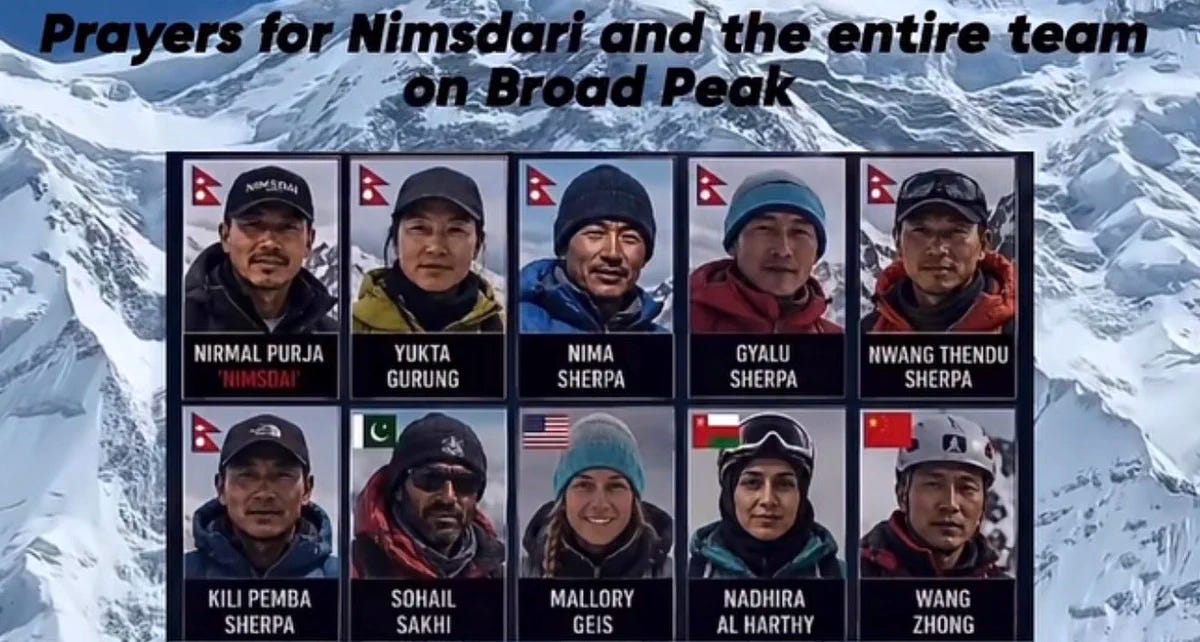
Broad Peak Took Ten Climbers
Nirmal Purja was the name the world knew, but the avalanche also took nine people whose work, ambition and love of the mountains carried no less weight.
Mallory Geis was making coffee at Broad Peak base camp when the Pakistani climbers returned from the summit. Sohail Sakhi stood beside her and applauded them as they came in. Mirza Ali, the Pakistani guide who remembered the scene for Le Monde, described Geis as “full of life” and recalled her making coffee for everyone. Nothing about the moment asked to be remembered. People had come down tired, two other climbers welcomed them home, and coffee was made.
Most of us have no language for what a body feels at 6,600 meters or for the calculation required to enter a steep gully after days of wind and fresh snow. The person who makes coffee for returning travelers is easier to understand. So are applause offered without ceremony and the relief of seeing people come back cold and tired. That ordinary knowledge is where Mallory Geis and Sohail Sakhi first become real to us.
A few mornings later, at about 9:20 on July 30, 2026, an avalanche struck a group moving between Camps 2 and 3 on Broad Peak’s western side. Snow carried ten climbers hundreds of meters down the mountain. Their satellite trackers recorded the sudden descent, drones later found bodies scattered through exposed terrain, and storms stopped helicopters and ground teams trying to reach them. Geis and Sakhi had been among the people waiting at base camp for others to return, and yet this time the people below waited for them.
The group included six climbers from Nepal, one from Pakistan, one from Oman, one from the United States and one from China. Their names were Nirmal Purja, Pur Bahadur Gurung, Nima Sherpa, Kili Pemba Sherpa, Nawang Thindu Sherpa, Gyalu Sherpa, Sohail Sakhi, Nadhira Al Harthy, Mallory Geis and Wang Zhong. They were moving through the same section of the same slope, they were caught by the same mass of snow and their families entered the same long wait for news, and yet one name rose almost alone into the international headline.
You can understand why. Nirmal Purja, known as Nimsdai, had given the public a story so large and clean that even people with no interest in mountaineering knew it. He had climbed the world’s fourteen 8,000-meter peaks in 189 days, joined the first all-Nepali team to summit K2 in winter, served in Britain’s Special Boat Service and starred in a Netflix documentary called 14 Peaks: Nothing Is Impossible. He was a record, a slogan and a face people recognized.
Grief always reaches first for the familiar face. The cruelty begins when familiarity determines whose life receives a history and whose life is left as a nationality in the fourth paragraph. Broad Peak took ten climbers, and the unequal way we learned their names tells us who modern mountaineering allows to become a hero, who it still treats as labor and who must die before anyone asks what he had already done.
The climbers began moving up the mountain on July 27 after weeks of bad weather. They reached Camp 1 on July 28 and Camp 2 the next day, then continued toward Camp 3 on the morning of July 30. Naila Kiani, the Pakistani mountaineer and Alpine Club of Pakistan official, placed the avalanche at about 9:20 a.m. between 6,450 and 7,000 meters. Other reports put the time close to 9:30. In a disaster measured through interrupted calls, tracker signals and what a drone can see against snow, ten minutes is the kind of uncertainty that remains.
The Alpine Club of Pakistan learned of the avalanche at around ten that night, according to Kiani’s account to Le Monde. Darkness had already closed the first rescue window. Pakistan Army aviation crews and local climbers left at about seven the following morning, entered terrain that could release again and began looking for bodies far below the climbing route. By August 1, Elite Exped, Purja’s company, had confirmed that all ten were dead; Associated Press reported that rescuers had found four bodies and recovered three while weather kept stopping the operation.
Mountain reports use the word “recovered” with bureaucratic calm. The word can mean that a rescuer has climbed through avalanche debris, found a person frozen into the slope, secured the body, moved it across broken ground and waited for a helicopter that may lose its chance to fly within minutes. A family hears that word at the other end of a telephone and learns whether the person can be brought home for burial, while on Broad Peak the recovery itself required another climb.
The families were spread across Nepal, Hunza, Oman, Texas and China. Some received confirmation while search teams were still trying to reach others. News moved in fragments because drone sightings are not identifications and a visible body is not yet a recovered one, and yet the world’s first complete account arrived almost instantly in the form of a famous man’s obituary. The speed of that transformation matters. Ten people were still being located, but the tragedy had already been given one protagonist.
Purja earned the attention his death received. Before his 2019 campaign, the fourteen mountains above 8,000 meters belonged to the scale of a lifetime. Reinhold Messner took sixteen years to complete them. The South Korean climber Kim Chang-ho held the speed record at seven years, ten months and six days. Purja said he would finish in seven months and did it in six months and six days, moving through Nepal, Pakistan and Tibet with bottled oxygen, helicopters, fixed ropes and a Nepali team capable of turning one audacious target into a working plan.
Some traditionalists disliked the method because it looked too organized, too public and too unapologetic. Their objection carried its own old dishonesty. Himalayan expeditions had always depended on porters, cooks, rope fixers, weather knowledge and local climbers, but Western mountaineering preferred the photograph in which one man stood against empty snow and described what solitude had taught him. Purja placed the logistics in full view, claimed the achievement in his own name and forced a culture that had treated Nepali expertise as background to watch a Nepali climber become the author.
His military past made the story travel. Purja spent six years with the Gurkhas before becoming the first Gurkha admitted to Britain’s Special Boat Service. He left the military before earning a full pension and turned the discipline of that life toward the mountains. A man from Nepal had entered an institution built from the old imperial relationship between Britain and Gurkha soldiers, passed into one of its most selective units and then beaten European climbing history at the thing it valued most, a satisfaction that reached far beyond people who cared about summit records.
He also went back for people. During the 2019 Annapurna expedition, Purja led a team toward Wui Kin Chin, a Malaysian doctor who had spent two nights alone near 7,500 meters. The team reached him and helped bring him down; Chin later died in a Singapore hospital. The rescue stayed with Purja’s public image because it offered more than endurance. The man asking the world to believe that nothing was impossible had spent his strength on someone else’s chance to live.
Fame gave Purja the power to build Elite Exped around Nepali leadership. Clients no longer had to reach Nepal through a Western operator that hired local expertise farther down the chain. They could buy a place directly from a company founded by the climber whose record had become the advertisement. Nepali guides stood at the front, Nepali logistical skill became part of the brand and money followed authority that had long existed without receiving equal recognition.
The old hierarchy still found a way back. A company needs a face, a documentary needs a central character and a headline needs the name most likely to make someone stop scrolling, and yet the first reports of Purja’s death repeated the erasure his career had challenged. The Nepali leader became the tragedy while the Nepali climbers beside him became “Sherpas,” as though the word were sufficient biography.
Purja’s public record also includes allegations that remain after his death. In 2024, the Finnish climber Lotta Hintsa and the American physician April Leonardo accused him of sexual assault and harassment in accounts reported by The New York Times. Hintsa described an encounter in a Kathmandu hotel in 2023; Leonardo described conduct during a 2022 Elite Exped trip to K2, where she was a client. Purja denied the accusations through his lawyer, who called them false and defamatory. His death resolved none of it, and an honest account can hold his courage, his historical achievement, the women’s allegations and his denial without sanding a human life into a monument.
Pur Bahadur Gurung was thirty-seven and came from Laprak in Nepal’s Gorkha district. People called him Yukta. He had summited 8,000-meter mountains more than twenty times, including Everest, K2 and Annapurna, and was working toward full mountain-guide certification. He also founded the Mission Community Help Foundation, which sought money for the education of children in his home community. Among the first bodies publicly identified after the avalanche was a climber whose work moved between the highest places on earth and the schoolrooms of the village where his life began.
Kili Pemba Sherpa had completed all fourteen 8,000-meter peaks twenty-seven days before the avalanche. He reached the summit of Nanga Parbat on July 3, finishing a project that only a small number of climbers in history have completed. He had also stood with Purja in the ten-man Nepali team that made the first winter ascent of K2 in January 2021. When reports identified him as one of the Sherpas accompanying Nims, they placed an accomplished climber beneath a man whose defining K2 achievement he had shared.
The public record is thinner for Nima Sherpa, Nawang Thindu Sherpa and Gyalu Sherpa. Elite Exped described Nima as one of Purja’s trusted climbing partners. The published accounts offer little more about the other two, which tells us something about journalism and nothing about the fullness of their lives. A thin archive requires a reporter to stop, state the limit and go looking for the people who knew them rather than turn three men into atmosphere around someone more famous.
“Sherpa” is the name of an ethnic community, but commercial mountaineering has spent decades using it as a job title for high-altitude workers, including some who are not ethnically Sherpa. The convenience of the word is part of its violence. It allows a client to have a name, a country, a goal and a reason for climbing while the person fixing the rope ahead of him becomes the function that made the climb possible.
That function demands extraordinary knowledge. High-altitude workers carry oxygen and tents, establish camps, test snow, fix lines across exposed slopes, guide exhausted clients, repair routes after storms and return upward when someone has failed to come down. They cross the most dangerous sections again and again because every load and every fixed line requires another passage. After an Everest avalanche killed sixteen Nepali workers in 2014, National Geographic reported that Nepali mountain workers had accounted for about forty percent of all deaths on Everest during the preceding century, and yet each death could still pass through the industry as the loss of “a Sherpa.”
Purja himself was Nepali, led from the front and exposed his own body to the route, which complicates the old picture of a Western client sending local men into danger. The deeper arrangement survived in the distribution of attention. Five Nepali climbers died beside the most famous Nepali mountaineer of his generation, all six entered the same avalanche and several carried records that would have led their own obituaries, and yet most readers were invited to mourn one man and acknowledge five others.
Sohail Sakhi came from Hunza and knew the Karakoram as home before it became his profession. He worked as a high-altitude guide and photographer. During the 2025 season, he was the only climber reported to have summited both Nanga Parbat and K2 without bottled oxygen, and on the descent from K2 he helped bring down an injured guide. He had the kind of record that would make a foreign climber interesting to international editors, but his first broad identification after the avalanche was “the Pakistani guide.”
Sakhi was guiding Mallory Geis through Moving Mountains, a Pakistan-based company. Geis was thirty-nine, came from San Antonio and was attempting her first 8,000-meter peak in Pakistan. Public reporting has supplied little else about her climbing life. That leaves Mirza Ali’s memory at base camp carrying an unusual amount of weight. She applauded people returning from the summit and made coffee for everyone, then began her own ascent with Sakhi.
The coffee cannot carry everything we do not know about Geis, and asking it to do so would turn a reported detail into borrowed sentiment. Kept at its proper size, the moment tells us that she noticed tired people arriving, helped welcome them and occupied a place among other climbers at base camp before a headline reduced her to “the American climber.”
Nadhira Al Harthy had already become a public figure in Oman. On May 23, 2019, she became the first Omani woman and the second Omani to reach the summit of Everest. She had trained with Khalid Al Siyabi, the first Omani man to climb Everest, failed on an earlier attempt at Ama Dablam, returned to high altitude and later climbed K2 and Nanga Parbat. Broad Peak was part of her pursuit of all fourteen 8,000-meter mountains.
Women who cross a national or cultural boundary are often described as inspirational, a flattering word that can erase the work required to get there. Al Harthy had to secure time, money, training, sponsorship and repeated access to some of the most expensive and dangerous expeditions in sport. She carried the expectations placed on an Omani woman into a climbing culture still dominated by men and Western ideas of who looks natural at altitude, and yet she kept returning after the first Everest photograph had already secured her place in Omani history.
Wang Zhong carried another unfinished project. He had climbed Nanga Parbat with Kili Pemba earlier in July, reaching his eleventh 8,000-meter summit, and later added Gasherbrum II. Broad Peak would have left only Shishapangma in his effort to complete the fourteen. English-language reports initially offered his name and nationality with almost no account of that pursuit. The information existed, but fame had already decided where the reporting time would go.
Look at the ten together and the labels begin to fail. The celebrity was also a guide and employer. The “Sherpas” included men who had climbed all fourteen peaks, built a foundation and shared the first winter ascent of K2. The Pakistani guide had summited K2 and Nanga Parbat without oxygen in one season. The Omani woman was pursuing the fourteen, the Chinese climber was one mountain away and the American client had crossed the world to enter their company. The avalanche joined people with different power, money and public standing, but it took no interest in the hierarchy constructed below.
A commercial expedition sells the possibility that terrible risk can be managed. One company advertised a full-service Broad Peak trip for $18,450 in 2026. Another listed the discounted government royalty fee at $7,200 for a group. The package can include airport reception in Islamabad, hotels, the flight or drive to Skardu, jeeps toward Askole, porters across the Baltoro Glacier, meals, base-camp tents, liaison services, fixed ropes, weather information and guides on the mountain.
The list is useful because it removes the fantasy of a lone person facing untouched wilderness. By the time a client reaches Broad Peak, government staff have processed permits, drivers have crossed difficult roads, cooks have fed the team, porters have carried equipment for days, local businesses in Skardu have supplied food and fuel, and high-altitude workers have begun building a route through the snow. Ancient rock and ice are reached through a contemporary supply chain.
Every part of that chain reduces uncertainty without removing danger. A guide can assess conditions, a forecast can identify a window and a fixed line can keep a tired person attached to the slope, but the package ends before the assurance every family wants because nobody can sell the return. Commercial mountaineering survives by keeping those two truths in the same brochure, promising professional control while requiring a signature beneath the possibility of death.
The money also creates pressure without anyone having to say “go.” A Broad Peak expedition can take seven weeks and consume years of savings, training and negotiation for time away from work. The operator has paid staff and moved supplies for one season; guides may depend on income or summit bonuses; clients may have sponsors, families and private ambitions waiting for a result. A decision to wait can become a decision to abandon the mountain, and the cost of turning around travels silently with the group.
Published evidence has not established how those pressures affected the July 30 ascent. Heavy snow and strong winds had hit Broad Peak during the preceding week. Several other climbers left or delayed their attempts because they believed the snow needed time to settle. Purja’s group and the other climbers caught with it continued toward Camp 3. Those facts belong beside each other, but a responsible account cannot insert a conversation that no surviving witness has reported.
The demand for a verdict comes quickly after a mountain death. People want to know whether the climbers were reckless, whether fame distorted judgment and whether a commercial schedule pushed the group upward. The available record cannot yet answer those questions. Snow moved through a part of the route that local climbers had considered relatively safe, and experience offered no final appeal once it did.
That uncertainty is harder to live with than a story about arrogance. A story of arrogance makes the world orderly because the dead person caused his death and the living can avoid the same fate by being wiser. An avalanche leaves families with a more frightening possibility. People can prepare, wait, hire expertise, read the mountain correctly and still disappear inside a force that does not know who they are.
When the tracker signals stopped, the international expedition became a Pakistani recovery operation. Army aviation crews prepared helicopters, Gilgit-Baltistan officials coordinated with the Alpine Club of Pakistan and local climbers moved toward the avalanche site. The clients and guides had come from five countries, the companies and insurers crossed several jurisdictions, and yet the immediate responsibility fell to people close enough to climb.
Body recovery is the part of mountaineering the beautiful films rarely linger over. A team goes upward without the possibility of a summit, enters the slope that has already killed someone, secures a body made difficult by altitude and cold and carries it toward ground where a helicopter can land or lift. The rescuer accepts risk so that a family may receive more than a location on a screen, while international attention follows the adventure and the recovery falls to nearby communities.
Gilgit-Baltistan tightened insurance and permit requirements in 2025 after Iftikhar Hussain Sadpara died while working as a high-altitude porter on an international K2 expedition. Operators must carry coverage for death, injury, rescue and repatriation for climbers and hired staff. The rule matters because a body at altitude can cost tens of thousands of dollars to bring down, and yet insurance enters only after local people agree to go back into danger.
By the end of 2025, at least thirty-nine climbers had died on Broad Peak, according to the Alpine Club of Pakistan. The July avalanche added ten in one morning. The mountain will open again, permits will be issued, clients will arrive in Islamabad and the trek across the Baltoro will begin. Somewhere in the briefing, someone will mention the avalanche and the place where the bodies were found, while the communities that carried out the recovery will recognize names the next group may know only as a warning.
Mountaineering calls the mountain a great equalizer, although every structure leading to the slope says otherwise. Money determines who can arrive, work determines who prepares the route, fame determines whose courage becomes public history and geography determines who must answer when the radios go silent. The avalanche exposed everyone on its path to the same snow, and yet almost every structure surrounding that moment remained unequal.
What would it take for us to learn the names before the avalanche? Pur Bahadur Gurung should not have needed to die beside Nirmal Purja for an international reader to discover his twenty-plus high-altitude summits and the education foundation he built in Gorkha. Kili Pemba should not have completed the fourteen peaks and then entered the news as one of Nims’s Sherpas. Sohail Sakhi’s record should not have waited for a foreign client’s death to become relevant, and Nima, Nawang Thindu and Gyalu should not remain the least reported people in the most reported disaster of the season.
The coffee at base camp offers no grand answer. Mallory Geis made it for the people who had returned, and Sohail Sakhi stood there applauding them. In that small moment, before the mountain sorted everyone into dead and living and before the news sorted the dead into famous and forgotten, the only thing that mattered was that the climbers had come home.


