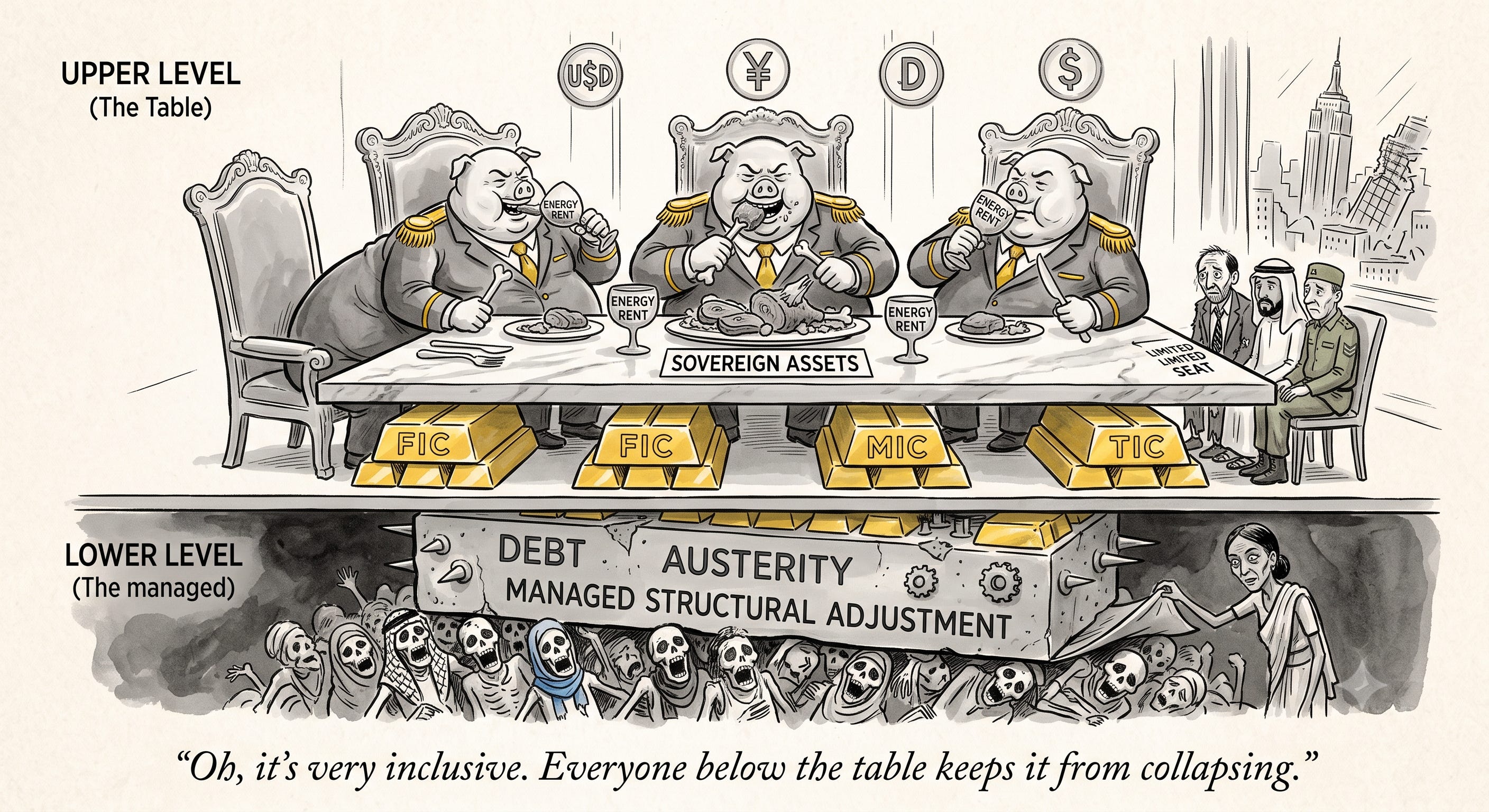
Capital War: The New Architecture: Who Gets a Seat at the Table and Who Gets Managed From Below It
Part 10 of 10
The post-Bretton Woods transition is a renegotiation between competing capital architectures, and the populations caught between them will pay its cost regardless of who wins.
Every few years, the foreign policy establishment invents a new phrase to describe the global landscape. In the 1990s, the buzzword was the “end of history”: the comforting illusion that liberal capitalism had won permanently and that all remaining political questions were just administrative details. After 2008, the language shifted to “multipolarity”: acknowledging that American unipolar dominance was slipping.
When Washington froze three hundred billion dollars in Russian central bank reserves overnight in February 2022 and disconnected Russian banks from SWIFT, the vocabulary became “de-dollarization” and the “collapse of the rules-based order.” And when Iran asserted control over the Strait of Hormuz in early 2026 while charging yuan-denominated transit fees, commentators declared the immediate “end of American hegemony.”
Each phrase catches part of the shift and misses its governing fact: this is a ruthless renegotiation. The Financial Industrial Complex that has governed international finance since Nixon ended gold convertibility in 1971 and Kissinger wired oil markets to U.S. Treasury debt in 1974 remains in place, and yet competing capital networks have grown large enough to demand their own terms instead of accepting Western mandates.
China is negotiating entry into a modified global financial system on terms that allow state capital to operate without routing through BlackRock, Vanguard, or IMF structural conditionality. Russia is using military deterrence to maintain sovereign control over its energy revenues. Saudi Arabia joined BRICS while deepening its security integration with Washington because it can still extract concessions from both sides while the bargaining is live. If you want to know whether this shifting order is more stable, the answer depends entirely on where you sit: it offers greater bargaining power to major powers with hard assets and military deterrence, and far greater danger for everyone else. The “stability” of the Cold War was built on the backs of populations in Korea, Vietnam, Angola, and Central America who absorbed superpower competition without ever being consulted, and the emerging multipolar order reproduces that arrangement with more competing players and less predictable rules, while people in Pakistan, Sudan, Yemen, and Palestine pay for a negotiation in which they have no seat and no voice.
Every Order Was Once a Settlement
The nineteenth-century global order rested on the British gold standard and the Royal Navy: a system where the pound was global money and British sea power secured trade routes, administered entirely for the benefit of London at the expense of colonized populations. Like every settlement imposed at a moment of concentrated power, it lasted only as long as the balance that created it. That balance died in the trenches of the First World War, and interwar attempts to rebuild it failed catastrophically, triggering the Great Depression and World War II.
Out of those ruins, the United States built the Bretton Woods settlement in 1944, replacing the pound with the dollar. That arrangement held until its own internal friction broke it in 1971, forcing Nixon to wire the dollar directly to Saudi oil and U.S. Treasury debt. The Plaza Accord of 1985 proved that Washington could force its allies to revalue their currencies whenever it suited American interests. Then the 1991 Soviet collapse produced the unipolar era, leading Western elites to mistake a temporary geopolitical advantage for the permanent end of history, until the 2008 financial crash shattered that illusion.
+-------------------------------------------------------------------------+
| HISTORICAL SETTLEMENT TRANSITIONS |
+-------------------------------------------------------------------------+
| |
| 1815-1914: Pax Britannica --> British Pound & Royal Navy Monopoly |
| 1944-1971: Bretton Woods I --> U.S. Dollar Gold Convertibility |
| 1974-2022: Petrodollar Era --> U.S. Dollar Oil & Treasury Debt Loop |
| 2022-PRES: Multipolar Split --> De-dollarization & Dual-Track CIPS |
| |
| * Every transition is managed by core financial nodes while peripheral |
| populations pay the structural conversion costs. |
| |
+-------------------------------------------------------------------------+
Core elites experienced these shifts as management problems, while peripheral populations absorbed them as disasters without consultation. The transition from British to American dominance ran through two global wars, and the creation and collapse of Bretton Woods ran through anti-colonial struggles and Cold War proxy conflicts, and yet the people bearing the cost never received a seat at the table where the rules were drafted or a share of the rewards distributed afterward. The same bargain is being written again.
What the Transition Actually Is
The conventional narrative about the demise of the “rules-based international order” mistakes its sales language for its operating instructions. The order routed global wealth through Western financial channels and gave that machinery the language of sovereign equality and impartial administration.
The institutions did the routing. IMF structural adjustment kept developing nations open to Western capital flows while restricting the domestic industrial capacity that might compete with Western firms. World Bank development loans routinely awarded Global South infrastructure contracts to Western corporations, leaving host nations with permanent debt loads and foreign firms with guaranteed revenue streams, while World Trade Organization rules blocked developing nations from using the subsidies, protective tariffs, and state-directed credit that Western economies had used during their own rise to wealth.
+-------------------------------------------------------------------------+
| THE ENFORCEMENT RULES DISPUTE |
+-------------------------------------------------------------------------+
| |
| WESTERN FINANCIAL ROUTING ---> BlackRock / IMF Debt / Petrodollar |
| |
| CHINESE STATE ROUTING ---> CIPS Clearing / BRI / Offshore Yuan |
| |
| * The battle over the "rules-based order" is a competition between |
| two capital allocation systems over strategic industrial heights. |
| |
+-------------------------------------------------------------------------+
China didn’t challenge this architecture through military revolution; it used selective non-compliance. Joining the WTO in 2001, Beijing deployed state subsidies, currency management, and state-directed credit to build an industrial engine at a scale the rules were meant to prevent. Western capital tolerated this for two decades because cheap Chinese manufacturing suppressed Western inflation and generated high investment returns for global asset managers.
That tolerance ended when Chinese companies began dominating the high-tech sectors essential for the Technological Industrial Complex: microchips, telecommunications, electric vehicles, and artificial intelligence. The hardware powering modern military weapons, algorithmic trading platforms, and surveillance networks relies on a microchip supply chain anchored by TSMC in Taiwan and ASML in the Netherlands, choke points Western capital cannot afford to lose.
The current conflict is a struggle between two capital allocation systems over who controls the commanding heights of the global economy: Western private-market routing through BlackRock and the dollar, or China’s state-directed routing through Belt and Road, the AIIB, and the offshore yuan. Democracy and autocracy supply the domestic sales copy.
Who Gets a Seat at the Table
A state can negotiate terms when it controls critical energy reserves, advanced semiconductor or manufacturing capacity, military deterrence capable of imposing unacceptable costs, or a market large enough to make exclusion more damaging than inclusion. Those assets buy a seat. Their absence leaves the state open to management.
China meets all four criteria and occupies the strongest negotiating position any challenger has held since the Cold War. Holding roughly 3.4 trillion dollars in foreign exchange reserves, manufacturing nearly 28 percent of global industrial output, and controlling critical supply chains for batteries and solar hardware, Beijing has built enough military capacity in the Western Pacific that any U.S. operation over Taiwan would carry staggering costs.
+-------------------------------------------------------------------------+
| THE ADMISSION CRITERIA FOR POWER |
+-------------------------------------------------------------------------+
| |
| CRITERIA FOR A SEAT AT THE TABLE: |
| - Hydrocarbon / Energy Choke Point Control |
| - Microchip & Advanced Manufacturing Infrastructure |
| - High-Cost Asymmetric Military Deterrence |
| - Large Market Scale & Foreign Exchange Reserves |
| |
| * States with these assets draft terms; states lacking them get managed|
| through structural debt and military intervention. |
| |
+-------------------------------------------------------------------------+
Russia secured its seat through military deterrence and control over energy supplies at a terrible human cost. The Ukraine war resulted in hundreds of thousands of military and civilian casualties while displacing millions. Russia didn’t achieve a clean military victory, but it proved it could sustain a grinding attritional conflict that Western electorates could not match indefinitely. The freezing of three hundred billion dollars in reserves failed to collapse the Russian economy because China, India, and alternative BRICS settlement channels absorbed Russian energy exports. Russia’s seat at the new table isn’t comfortable, but it is real.
India has executed the most sophisticated balancing act of any mid-sized power. It purchases discounted Russian oil settled in non-dollar currencies, participates in the Quad security dialogue with Washington, maintains membership in the Shanghai Cooperation Organisation, and courts Western tech investments while deepening trade ties with Moscow and Tehran. India’s strategic autonomy doctrine isn’t moral non-alignment; it is the ruthless maximization of bargaining power by a nation of 1.4 billion people positioned strategically between the Middle East and Southeast Asia.
Saudi Arabia’s strategy is equally explicit. Riyadh joined BRICS while maintaining its security integration with Washington, allowing its informal petrodollar commitment to evolve so it can accept yuan or euros for oil sales. Crown Prince Mohammed bin Salman isn’t confused; he is playing both capital architectures against each other to extract maximum security guarantees and investment terms. Controlling ten percent of global oil production gives Saudi Arabia the hard power required to command a seat.
Iran earned its position through sheer endurance. Lacking the economic scale for easy negotiation and subjected to decades of Western sanctions, Tehran demonstrated in early 2026 that it could disrupt trade through the Strait of Hormuz, clear payments in yuan, and absorb military strikes without regime collapse. Survival itself became the credential. Every global strategist calculating the absolute power of Western financial enforcement had to revise their models when Iran did not collapse.
Who Gets Managed Below the Table
Pakistan shows the trap in operation. IMF structural adjustment programs require fiscal austerity, energy tariff increases, and currency devaluations. These measures protect debt-service payments to international creditors while restricting the domestic growth that could reduce dependency. Over half of Pakistan’s federal budget is consumed by debt servicing, far outstripping spending on healthcare, education, and social safety nets combined.
On the other side, the China-Pakistan Economic Corridor (CPEC) has funneled over sixty-five billion dollars into state-directed infrastructure projects that generate returns for Chinese firms, create opaque debt obligations, and are managed through the Special Investment Facilitation Council, a body led by Pakistan’s military chief rather than elected lawmakers. Western capital manages Pakistan through debt conditionality; Chinese capital manages Pakistan through infrastructure opacity. The domestic population absorbs the crushing weight of both arrangements.
+-------------------------------------------------------------------------+
| DUAL-TRACK MANAGEMENT OF CLIENT STATES |
+-------------------------------------------------------------------------+
| |
| WESTERN CAPITAL NODE (IMF) ----> Demands Fiscal Austerity & Debt Pay |
| |
| CHINESE STATE CAPITAL (CPEC) -> Demands Infrastructure Debt Servicing |
| |
| * The client population (e.g., Pakistan) absorbs high energy costs |
| and tax hikes to service both capital management systems. |
| |
+-------------------------------------------------------------------------+
Sub-Saharan Africa carries this dual-track management at continental scale. For decades, Western financial institutions imposed structural adjustment that dismantled state industries, eliminated agricultural subsidies, and enforced primary-commodity export dependency. Chinese Belt and Road financing then offered roads, ports, and railways without political lectures, and governments accepted, but many loans brought high interest rates, opaque collateral terms, and imported Chinese labor. The lender changed, and yet the vulnerability remained.
The Personnel of the Architecture
Corporate executives, central bankers, defense board members, and government ministers administer these capital networks as professional managers executing institutional mandates. Their ordinary job titles help the arrangement endure.
The revolving door between public office and private capital is part of the system’s design. An official moves from a senior Pentagon post to a defense contractor board, joins an asset management firm overseeing energy portfolios, authors a threat brief for an influential think tank, and returns to government as cabinet secretary. No explicit bribe is needed because his career incentives already align with the institutional requirements of the three complexes.
+-------------------------------------------------------------------------+
| THE REVOLVING DOOR PERSONNEL |
+-------------------------------------------------------------------------+
| |
| [ Public Defense Post ] -------> Approves Procurement Contracts |
| | |
| v |
| [ Private Defense Board ] -----> Collects Executive Equity Dividends |
| | |
| v |
| [ Asset Management Chair ] ----> Directs Multitrillion Capital Portfolios|
| |
+-------------------------------------------------------------------------+
This institutional alignment explains why national policies remain identical across different political administrations. Electoral politics alters the public face of the state, but it doesn’t touch the sovereign loan covenants, the central bank framework, the defense procurement pipelines, or the intelligence sharing agreements.
Politicians are hired managers brought in to sell the policy to domestic voters. When a leader attempts to break out of this framework, the enforcement machinery responds swiftly through market pressure, currency runs, media campaigns, or direct political removal. The system tolerates changes in leadership; it does not tolerate changes in the balance sheet circuit.
The Circuit Closes
Across these ten analyses, the same circuit keeps closing: the Financial, Military, and Technological complexes operate as one machine; sovereign conflicts liquidate munitions, generate high-yield debt, and clear valuable assets; the petrodollar’s fracture intensifies competition between capital systems; an Installed Class enforces debt extraction inside client states; automated targeting and microchip supply chains industrialize state violence; and public relations departments package the arrangement in moral and religious language. Western workers are managed through wage stagnation, media framing, and deaths of despair, while populations without bargaining power carry the cost of a renegotiation conducted above them.
+-------------------------------------------------------------------------+
| THE UNIFIED CAPITAL WARS CIRCUIT |
+-------------------------------------------------------------------------+
| |
| 1. Sovereign Debt Issued to Fund Military Operations |
| 2. Munitions Consumed & Inventories Liquidated (MIC) |
| 3. Target Populations Cleared via Automated AI Targeting (TIC) |
| 4. Distressed Infrastructure & Energy Assets Acquired (FIC) |
| 5. Reconstruction Debt Issued to Post-War Client State |
| 6. Circuit Repeats Continuously |
| |
+-------------------------------------------------------------------------+
The architecture processes human suffering in Gaza, Ukraine, Sudan, Pakistan, and working-class Western towns into balance-sheet returns. Its speeches are marketing campaigns, its strategic briefings are sales pitches, and its ledgers are open.