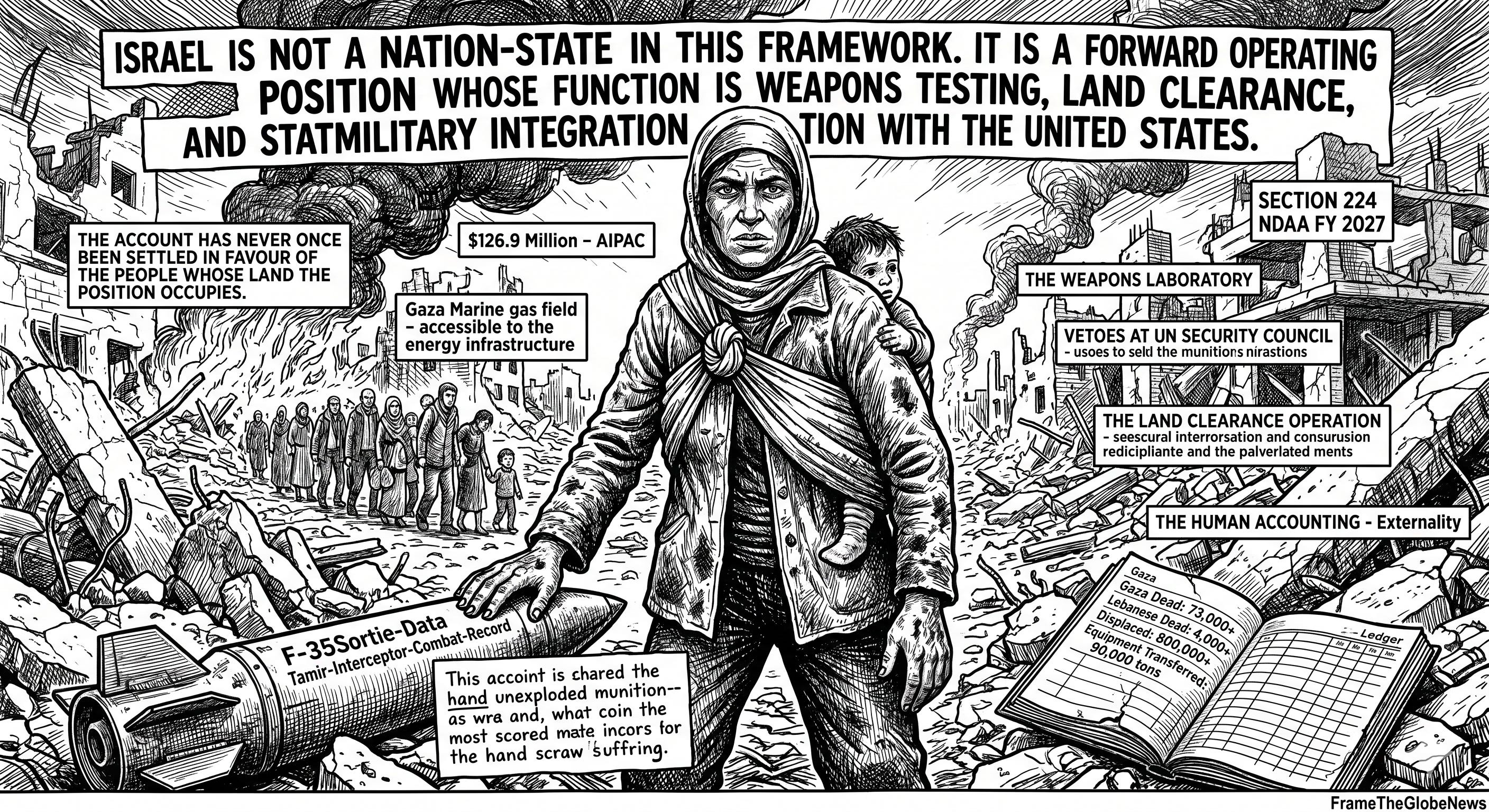
Israel is not a nation-state in this framework. It is a forward operating position whose function is weapons testing, land clearance, and statutory military integration with the United States. And the Palestinian and Lebanese dead are the price of that function, not its regrettable byproduct.
More than seventy-three thousand Palestinians are dead and the number is not a final figure because the killing has not stopped. Over eight hundred thousand Lebanese have been displaced from their homes under an Israeli campaign that has struck central Beirut, struck the southern suburbs of Dahiyeh, and killed more than four thousand people since the conflict escalated in March 2026, with Operation Arrows of Fire, launched specifically on May 31, intensifying strikes across more than seventy sites and pushing the toll past four thousand by June 20. The United States has vetoed six United Nations Security Council ceasefire resolutions since October 2023, transferred ninety thousand tons of military equipment to Israel across eight hundred transport planes and one hundred and forty ships, and approximately $126.9 million was spent by AIPAC and its affiliated political action committees in the 2023-24 election cycle alone to ensure the congressional alignment required to sustain those transfers. If you are waiting for the explanation that makes all of this cohere as a foreign policy with a strategic logic, you have been waiting in the wrong place. The explanation is not in the foreign policy literature. It is in the balance sheet.
Israel functions in this system not as a sovereign nation pursuing its national interest in the conventional sense but as a forward operating position of the Financial, Military, and Technological Industrial Complex: a permanently funded, statutorily integrated, ideologically insulated territory whose principal function is to test weapons under live combat conditions, clear land for post-war acquisition, and deepen the procurement and intelligence integration between the American military apparatus and the Israeli military apparatus until the two are institutionally indistinguishable. The Palestinian people are not the system’s target. They are in the territory the system requires, and the system has no mechanism for registering the value of a human life that stands between it and what it needs.
The Hundred-Year Lease
The forward operating position was not built in 2023. It was built over a century, and the century is the part the current coverage omits, because the century reveals the function. In November 1917, the British Foreign Secretary Arthur Balfour wrote a letter, sixty-seven words long, declaring his government’s support for the establishment in Palestine of a national home for the Jewish people, in a territory whose existing inhabitants were not consulted and were referred to only as the non-Jewish communities whose civil and religious rights were not to be prejudiced. Balfour was the foreign secretary of an empire promising a land it did not yet hold to one people while it ruled over another. The promise was an imperial instrument, a way of planting a dependent population in a strategically critical corridor between the Suez Canal and the oilfields of the east, and the strategic logic of that placement has never changed, only the identity of the power the position serves.
What followed is documented, and in the experience of the people it happened to it was catastrophic. In 1948, in the war surrounding the establishment of the state of Israel, more than seven hundred thousand Palestinians were expelled or fled from their homes in the event Palestinians call the Nakba, the catastrophe, and were never permitted to return. In 1967, Israel took the West Bank, Gaza, the Golan Heights, and Sinai in six days, beginning an occupation that has now run for more than half a century. Each expansion was met with the same international language of concern and the same material continuity of support, and the support hardened into architecture. After the Camp David accords of 1978, Israel and Egypt became the two largest recipients of American foreign aid on earth, a position they held for decades, and the aid to Israel was increasingly military, increasingly automatic, and increasingly insulated from the conduct it financed.
The Lebanese front in this series has a history as long as the Gaza one. In 1982 Israel invaded Lebanon, besieged Beirut, and presided over the massacre at the Sabra and Shatila refugee camps, where a militia allied to the Israeli forces killed hundreds and by some counts thousands of Palestinian and Lebanese civilians over three days while the surrounding Israeli army controlled access to the camps. An Israeli commission of inquiry found the defence minister personally responsible. He resigned the post and went on, two decades later, to become prime minister. In 2006 Israel and Hezbollah fought a thirty-four-day war that killed more than a thousand Lebanese, most of them civilians, and the doctrine that war refined, the deliberate destruction of civilian infrastructure to generate pressure on a population, is the doctrine being applied in Lebanon again now. None of this is a departure from the function the position was built to serve. It is the function, performed across a century, against whichever population stands on the ground the position requires.
The point of the history is not grievance. It is structure. A forward operating position that has been maintained through British imperial planning, American Cold War strategy, and the current FIC/MIC/TIC architecture, across more than a hundred years and through every change in the identity of its sponsor, is not a nation pursuing a national interest that happens to keep producing the same outcome. It is an instrument whose function survives every change of management, and the function is to hold a strategically critical corridor on behalf of whichever power dominates the global system, at whatever cost to the people who live there. The seventy-three thousand Palestinian dead of the present war are the latest entry in an account that was opened in 1917, and the account has never once been settled in favour of the people whose land the position occupies.
The Weapons Laboratory: What Live Testing Produces
The Iron Dome missile defense system entered operational service in 2011, and the Israeli Ministry of Defense has marketed it ever since as the proof that defensive technology can neutralize rocket attacks at scale. By 2026, the system has intercepted thousands of incoming projectiles and has been sold or licensed to countries including the United States, which received its first Iron Dome battery in 2020, as well as to partners across Europe and the Gulf. The selling price for a single Iron Dome battery is approximately one hundred million dollars, and a single Tamir interceptor missile costs roughly fifty thousand dollars. The system’s operational credibility, its market value, derives entirely from its live combat record. And that combat record was accumulated against rockets fired from Gaza, tested against Palestinian projectiles over Palestinian and Israeli territory, refined over fifteen years of intermittent conflict in which the Palestinian population of Gaza served as the involuntary adversary against whom the technology was validated.
This is not a metaphor. The F-35, manufactured by Lockheed Martin and operated by the Israeli Air Force, has flown more combat sorties in Gaza and Lebanon than in any other operational theater. Each sortie generates data: radar cross-sections, weapons delivery accuracy, engine performance under combat loads, electronic warfare effectiveness. That data flows back to Lockheed Martin and to the Pentagon’s acquisition programs. Raytheon’s precision-guided munitions kits, which convert unguided bombs into steerable weapons, have been tested at scale in Gaza. The targeting algorithms that Palantir Technologies provides to the IDF, which process signals intelligence, location data, and pattern-of-life analysis to generate strike recommendations, are being refined in real time against a live urban population. The Elbit Systems drone platforms that have operated continuously over Gaza for years are among the most operationally validated unmanned systems in the world, and they are sold to militaries across Latin America, Asia, and Europe on the basis of that validation record. The pitch is always the same: battle-proven. The battle is always Gaza.
The data is the other product, and it is the one the official accounting never mentions. Gaza is the most comprehensively surveilled population on earth, and the surveillance does not stop when the strike does. Every phone intercepted, every face captured at a checkpoint, every movement logged by a drone loitering over a refugee camp, every biometric record harvested at the gates of the territory becomes training data. The targeting systems that recommend strikes are refined on it. The facial recognition deployed across West Bank checkpoints is trained on it. The pattern-of-life models that decide which house is a target and which is merely adjacent to one improve every time the population moves, hides, flees, or buries its dead. A live urban population under sustained bombardment generates the richest behavioural dataset a surveillance system can acquire, because it captures human behaviour under the maximum stress the system will ever be asked to process. That dataset does not stay in Gaza. It is the intellectual property that makes the Israeli surveillance industry the most credible in the world, and it is sold, licensed, and exported to police forces, border agencies, and militaries across dozens of countries on the strength of having been proven against a real population in real conditions. The Palestinians are not only the involuntary adversary against whom the weapons are validated. They are the involuntary research subjects from whom the data is extracted, and neither the weapons revenue nor the data revenue assigns them any value, because in both ledgers they are the raw material and not a party with a claim.
Section 224 of the National Defense Authorization Act for Fiscal Year 2027, which passed the House in June 2026 and was subsequently renumbered as Section 219 in later drafts, makes the flow formally statutory. The provision integrates Israeli military research, development, testing, and procurement into the Pentagon’s acquisition pathways, covering artificial intelligence, autonomous systems, directed energy weapons, and cyber defense. What this means in operational terms is that the weapons Israel develops and refines in Gaza and Lebanon are now on the formal procurement pathway for the American military. The laboratory and the customer are connected by statute. The test subjects, the Palestinian and Lebanese civilians against whom these systems are operated, are not party to any of it.
The Land Clearance Operation: What the War Is Building Toward
In February 2025, Jared Kushner spoke at a Harvard Kennedy School event and described the Gaza waterfront as “very valuable real estate” and suggested that Gazans could be moved to the Negev desert while the territory was “cleaned up.” He referred to the process as offering an “opportunity to do something different” with the land. Kushner is not a fringe figure making fringe remarks. He is the former senior adviser to the current president of the United States, the architect of the Abraham Accords, and a fund manager whose investment vehicle Affinity Partners received two billion dollars from the Saudi Public Investment Fund. The Saudi fund that financed Kushner’s investment vehicle is managed by the government whose normalization with Israel was the diplomatic objective of the Abraham Accords and whose security guarantee from Washington depends on maintaining the alliance architecture that sustains the Gaza operation.
The Gaza Marine gas field sits approximately thirty kilometers off the Gaza coast and contains an estimated one trillion cubic feet of natural gas. The field was discovered in 2000 and has never been developed because Gaza’s political status made the legal and commercial framework for extraction unresolvable. A Gaza whose population has been removed or rendered ungovernable, whose coastal territory is under Israeli security control, and whose political status has been resolved by force rather than negotiation is a Gaza whose offshore gas is accessible to the energy infrastructure that the FIC requires. This is not speculation about intent. It is an observation about what the war produces structurally, independent of what any individual decision-maker consciously planned.
The Dahiyeh Doctrine, first articulated by Israeli general Gadi Eisenkot in 2008, holds that civilian infrastructure should be deliberately targeted in operations against non-state armed groups because the destruction of civilian life and services generates pressure on the population to turn against the armed group. The doctrine has been applied in Lebanon in every major Israeli operation since 2006 and is being applied in the current campaign. It has killed more than four thousand people in Lebanon since March 2026, displaced over eight hundred thousand from their homes, and destroyed residential neighborhoods in southern Beirut that took years to rebuild after the 2006 war. The doctrine is not a deviation from international humanitarian law in the view of its practitioners. It is a military strategy with a stated logic. The stated logic is pressure. The structural effect is land clearance, infrastructure destruction, and the systematic reduction of a civilian population’s capacity to remain in place.
The Statutory Merger: Making It Permanent
Every US presidential administration since Eisenhower has maintained military and intelligence relationships with Israel. What is new in the current legislative moment is not the relationship but its legal character. The relationship has been converted from a political arrangement, subject to executive modification, into a statutory one, embedded in the architecture of American law, and designed specifically to survive changes in administration, shifts in public opinion, and future presidents who might calculate differently about the costs and benefits of the arrangement.
Section 622 of the Intelligence Authorization Act for Fiscal Year 2027 mandates that the President of the United States expand and enhance intelligence sharing with Israel. It prohibits the suspension, reduction, or material limitation of that sharing except on the basis of a specific and identifiable national security concern, documented formally and submitted to congressional intelligence committees within fifteen days. No other country on earth has this protection. Not the United Kingdom, not Germany, not Canada, not any member of the Five Eyes intelligence-sharing arrangement that represents America’s closest intelligence partners. Not NATO as a collective body, not any individual NATO member. The statutory intelligence obligation to Israel is unique in American law and has no precedent in the history of the republic’s foreign relationships.
The Biden administration briefly considered reducing some intelligence sharing with Israel in 2024, following evidence that IDF operations were producing civilian casualties at a rate that raised questions under American law about whether the receiving party was meeting the required assurances of law-of-war compliance. The administration ultimately chose not to act, concluding that the political cost was prohibitive. Section 622 converts that political cost into a legal one. After Section 622 becomes law, a president who wants to pause intelligence sharing with Israel must formally document a national security justification, submit it to Congress, and absorb the political consequences of the notification in a Congress where AIPAC and its affiliated committees spent $126.9 million in the preceding election cycle to shape the membership. The pause becomes, in practice, impossible.
Section 224 completes the merger on the military side. By embedding Israeli military technology development into the Pentagon’s Future Years Defense Program, the provision creates a procurement dependency that runs in both directions: the Pentagon becomes a customer for Israeli systems refined in Gaza and Lebanon, and the Israeli defense industry becomes a formally integrated supplier to the American military. The relationship is no longer transactional. It is institutional. A future administration that wanted to restructure it would not be changing a policy. It would be unwinding a statutory architecture.
The Doctrinal Insulation: Why the Domestic Cost Never Registers
None of this would be sustainable politically without a mechanism that prevents the domestic cost of the arrangement from registering in electoral politics. The mechanism exists, and it is four hundred years old. The Christian Zionist theological tradition, which traces from seventeenth-century English Puritan commentaries on Hebrew scripture through John Nelson Darby’s dispensationalist theology, through Cyrus Scofield’s annotated Bible that placed dispensationalism in every seminary bookshelf in America, through the mid-twentieth century prophecy conference movement, through the founding of Christians United for Israel in 2006, has produced a domestic constituency of tens of millions of American evangelical Christians for whom support for Israeli territorial expansion is not a foreign policy preference but a theological obligation. The belief is structural: the return of the Jewish people to the biblical land is a precondition for the Second Coming, and any political position that limits Israeli territorial control is therefore a position against the fulfillment of divine prophecy.
Mike Huckabee, a Southern Baptist minister before he became Arkansas governor and US Ambassador to Israel, sat across from Tucker Carlson and was asked whether Israel should take all the territory God had promised Abraham: the land from the Nile to the Euphrates that would, on any honest map, encompass Lebanon, Syria, Jordan, large portions of Saudi Arabia and Iraq. Huckabee said it would be “fine if they took it all.” The sitting American ambassador to Israel said it would be acceptable for Israel to seize the territory of six sovereign nations. The remark produced no congressional response, no diplomatic incident, no demand for clarification from the State Department. Because within the doctrinal framework that governs a significant portion of the American electorate, the statement was not a foreign policy position. It was scripture.
The AIPAC architecture operates within this doctrinal context and amplifies it. The $126.9 million AIPAC and its affiliated committees spent in the 2023-24 election cycle was not spent to persuade members of Congress to support Israel. It was spent to remove members of Congress who showed signs of reconsidering their support and replace them with members who would not. The Pennsylvania race in which AIPAC spent significant resources attempting to defeat Chris Rabb, a Democratic state legislator who had expressed sympathy for Palestinian civilians, is a representative sample. Rabb won. But the strategic logic of the spending is not to win every race. It is to establish the cost of deviation so clearly that future members calculate the risk before speaking. The doctrinal infrastructure provides the ideological cover. The financial infrastructure provides the electoral enforcement. Together, they produce a Congress that has not altered its support for Israeli military operations regardless of the death toll, the ceasefire votes, the international court rulings, or the public opinion shift that, by NBC polling in 2026, shows 60 percent of Democrats and 50 percent of independents holding negative views of Israel. Public opinion has moved. Congressional behavior has not. The infrastructure between the two explains the gap.
The Human Accounting: What the System Does Not Calculate
The two-thousand-pound bomb that struck the Jabalia refugee camp in northern Gaza and killed hundreds of people in a single strike was manufactured by Boeing. The precision-guided kit that converted it from an unguided weapon into a steerable one was manufactured by Raytheon. The F-35 that delivered it was manufactured by Lockheed Martin. The targeting data that identified the strike coordinates was processed by software operating on a Palantir-designed architecture. The munitions were part of the ninety thousand tons transferred from American stockpiles to Israel, to be replaced by new orders from the same manufacturers, funded by a defense budget financed by debt instruments held by asset managers including BlackRock and Vanguard, which hold significant equity stakes in Boeing, Raytheon, and Lockheed Martin.
This is not a conspiracy. It is a supply chain. The people who made each decision in this supply chain made it within an institutional structure that gave them every incentive to make it and no institutional mechanism for registering the human consequence at the other end. Boeing’s board does not see the Jabalia dead when it reviews quarterly earnings. Raytheon’s shareholders do not see them when they receive their dividends. The congressional committee members who voted to approve the transfer did not see them when they cast their votes because the doctrinal and financial infrastructure I have described was specifically designed to ensure they would not have to.
The children who died in Jabalia were between the ages of zero and fifteen, because roughly half of Gaza’s population is under fifteen years old. They were in a refugee camp, which means their families had already been displaced once, already been reduced to shelter in a facility marked with UN designations that are supposed to confer protection under international humanitarian law. The protection did not function, and the reason it did not function is that the system that produced the strike has no architecture for valuing a Palestinian child’s life above the operational requirement that generated the targeting recommendation. The system is not cruel in the sense of taking pleasure in the death. It is indifferent in the sense that the death simply does not appear in any of the calculations that govern the decisions. It is an externality, in the precise economic meaning of the word: a cost borne by a party not represented in the transaction.
In Lebanon, the Dahiyeh Doctrine produces the same outcome through a different mechanism. The doctrine does not target individuals identified as combatants. It targets infrastructure: residential buildings, commercial districts, the electrical grid, water systems, the roads that allow people to flee. The intention is to make the territory ungovernable for any population that might provide support to Hezbollah. The effect is to destroy the accumulated investment of decades of civilian construction and to kill, displace, and impoverish the civilian population that built it. The four thousand people killed in Lebanon since March 2026 were not killed because they were combatants. They were killed because they lived in territory the doctrine designated as a pressure point. The system that produced the doctrine calculated the pressure it would generate on Hezbollah. It did not calculate the Lebanese dead because the Lebanese dead were not a variable in the calculation.
The Financial Closure: Who Holds the Post-War Contracts
Wars in this system have a financial arc. The arc runs from debt issuance to weapons procurement to destruction to reconstruction to new debt issuance, and the same institutions that appear at the beginning appear at the end. When Gaza’s active military phase concludes, and it will conclude at some point because even the most sustained military campaigns eventually reach their operational limit, what remains will be a territory of rubble, a displaced population in whatever arrangements have been made for them, and an offshore gas field whose development rights are, for the first time in the field’s history, effectively uncontested. The reconstruction contracts for Gaza will be issued by whatever authority controls the territory, and the financial institutions positioned to manage those contracts and the investment flows that follow them are the same ones that hold equity in the companies that manufactured the weapons that created the rubble.
BlackRock’s precedent in Ukraine is instructive. The company was announced as a primary manager of Ukraine’s reconstruction fund before the war had produced a ceasefire agreement, before the territorial settlement had been determined, before the final scale of destruction was known. The positioning happened during the conflict because the firms that manage these processes understand that post-war reconstruction is a capital deployment opportunity of enormous scale, and the competition for mandate is won before the fighting stops. The same logic applies to Gaza. The same firms are the likely beneficiaries. The dead are not party to any of it.
Kushner’s waterfront remark was not a slip. It was a statement of the post-war financial interest that exists alongside the military and political interests the war is serving. A Gaza with a cleared coastline, resolved territorial status, accessible offshore gas, and a population relocated to a less commercially valuable area is an investment opportunity. The remark was made by someone who manages a two-billion-dollar Saudi fund, whose fund is underwritten by the government most directly positioned to benefit from the regional normalization the war is designed to produce, and who described the opportunity in the plainest possible commercial language because, within the framework of the Financial Industrial Complex, that language is accurate.
The Arrangement Cannot Be Walked Back
The most important thing to understand about the current moment is that the arrangement between the United States and Israel is no longer reversible through normal democratic or diplomatic processes. Section 224 and Section 622 together represent a statutory architecture that embeds the relationship at the institutional level, below the reach of electoral politics. A new president with different views on Gaza could not suspend intelligence sharing without triggering the notification process designed to make suspension politically catastrophic. A new Congress with different views on arms transfers would have to repeal statutory provisions that have been built into the permanent architecture of the National Security Act and the National Defense Authorization Act. The political cost of that repeal, in a Congress shaped by AIPAC spending that reached $126.9 million in the most recent cycle, is not calculable in the abstract. It is prohibitive in practice.
The six vetoes at the UN Security Council are the international face of this domestic architecture. Each veto was cast by a US Ambassador whose government had made the calculation that the domestic cost of allowing a ceasefire resolution to pass exceeded the international cost of blocking it. That calculation is a product of the financial and doctrinal infrastructure I have described. It will continue to produce the same outcome as long as the infrastructure remains intact. The dead accumulate. The ceasefire resolutions fail. The weapons transfers continue. The procurement cycle runs. The reconstruction contracts are positioned.
The seventy-three thousand Palestinians in the ground and the four thousand Lebanese and the numbers still moving did not die because of a failure of diplomacy or a miscalculation by a particular leader or a flaw in an otherwise sound policy. They died because the system that produced their deaths was designed to produce exactly this outcome, and has produced it consistently across decades and across changes of administration on both sides, and has now been codified into law to ensure that it continues to produce it regardless of what any future electorate decides. The arrangement is permanent, and the dead are its proof.