Capital Wars: How the Iran War Was a Hydrocarbon Seizure Dressed as a Security Operation
Part 3 of 10
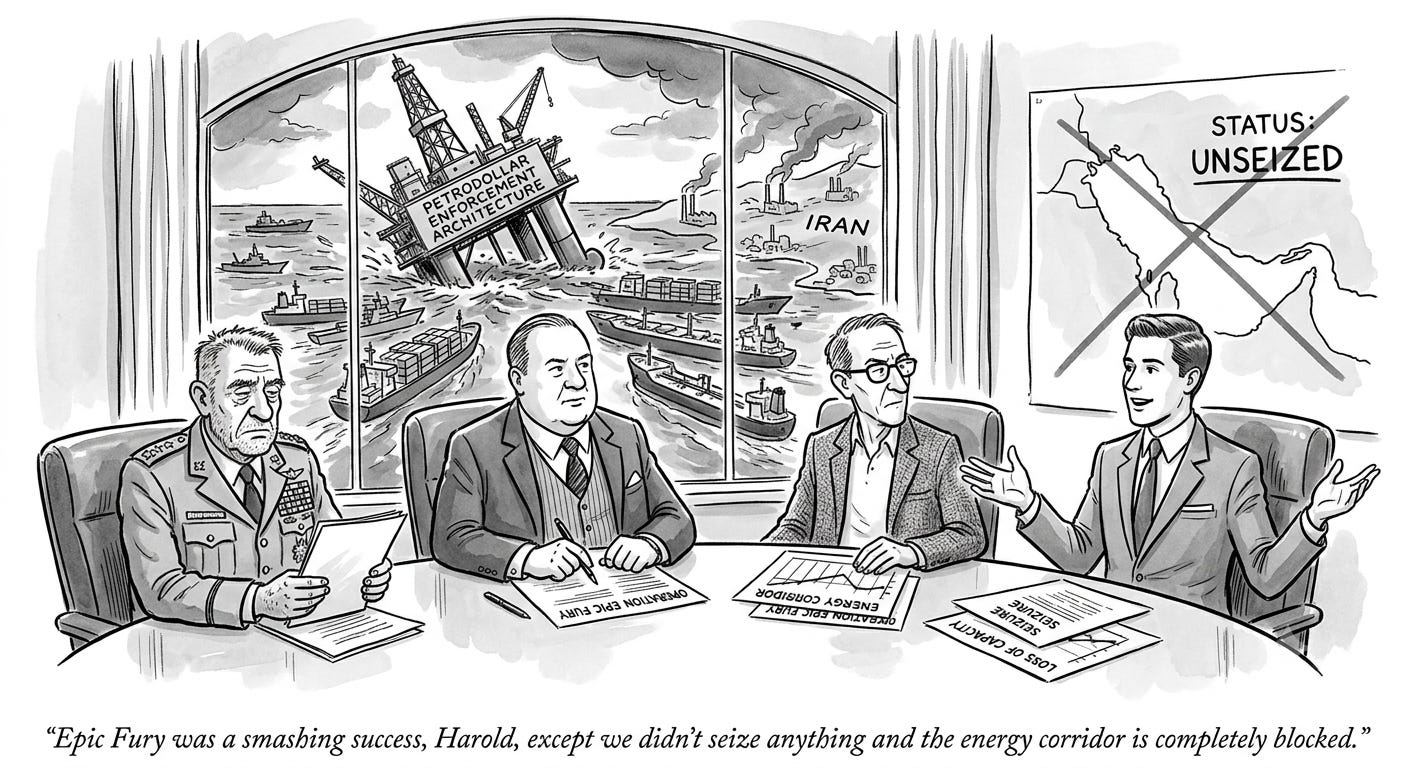
Operation Epic Fury was not launched to stop Iran’s nuclear programme. It was launched to seize control of the most critical energy corridor on earth before the petrodollar enforcement architecture lost the capacity to do so. It ended without seizing anything.
The document arrived without a press conference. The White House released “America’s Maritime Action Plan” in February 2026, the same month the bombs fell on Tehran, and nobody in the international press corps placed the two events side by side and asked the obvious question. The Maritime Action Plan outlined a comprehensive framework for American dominance over global shipping lanes: expanded naval escort protocols, new port infrastructure investment, bilateral agreements with Gulf states governing the movement of energy cargo, and a set of enforcement mechanisms for commercial vessels operating in waters the plan designated as strategically critical. It was the legislative blueprint for exactly the system the Iran war was designed to install. The bombs and the blueprint arrived together because the blueprint required the bombs, and the people who wrote the blueprint knew the bombs were coming.
That is the sentence the official narrative of the Iran war cannot accommodate and therefore consistently omits. Operation Epic Fury, launched on February 28, 2026, when US and Israeli aircraft assassinated Supreme Leader Ali Khamenei in the opening assault and struck nuclear sites across Iran, was presented to the world as a security operation: the culmination of decades of failed diplomacy over Iran’s nuclear programme, a decisive intervention to prevent a theocratic government from acquiring weapons capable of mass destruction. The frame was not invented from nothing. Iran’s nuclear programme is real. The diplomacy had failed, repeatedly, for documented reasons. The threat calculus was genuine. But the nuclear question was the official justification, and official justifications for wars run by the Financial, Military, and Technological Industrial Complex have a documented relationship with the structural reasons for those wars: they are true in the way a pretext is true, accurate in their details and misleading in their function.
The structural reason for Operation Epic Fury was the Strait of Hormuz. Twenty-one miles wide at its narrowest point, sitting between Iran and the Arabian Peninsula, carrying approximately a fifth of the world’s seaborne oil and a third of its liquefied natural gas, the strait is the single most consequential geographic chokepoint in the global energy system. For fifty years, the petrodollar architecture that has governed global finance since the Kissinger-Faisal arrangement of 1973 and 1974 depended on the free passage of that corridor. Gulf oil priced in dollars, recycled into American Treasury bonds, sustaining the dollar’s reserve currency status and Washington’s capacity to run permanent deficits: the entire circuit ran through those twenty-one miles. An Iran with the military capacity to close the strait, the political willingness to use that capacity, and a relationship with China sufficient to route alternative payment architectures through it, was not a nuclear threat to the Financial Industrial Complex. It was a structural threat to the entire dollar system. The nuclear frame was the acceptable public argument. The strait was the reason.
The Forty-Year Siege
Operation Epic Fury did not begin the campaign against Iran. It was the latest move in a siege that had been running, without serious interruption, for more than four decades, and the length of the siege is the part of the story that makes the present war legible. The Islamic Republic has been treated as a target for regime change continuously since the day it was born, because it was born by removing precisely the kind of installed government the system requires, and the system has never accepted the removal.
The original offence, from the architecture’s perspective, was 1979. In that year a mass revolution overthrew Mohammad Reza Shah Pahlavi, the monarch the United States and Britain had restored to power in the 1953 coup against the elected prime minister Mohammad Mosaddegh, who had committed the offence of nationalising Iranian oil. The Shah had been, for twenty-six years, the model of an installed client: he bought American weapons at scale, policed the Gulf on Washington’s behalf, recycled oil revenue through Western institutions, and suppressed his own population through a secret police the CIA had helped to build. The revolution that replaced him produced the one thing the architecture cannot tolerate, a large, oil-rich, strategically positioned state that exited the system entirely, and the punishment for that exit has been administered without pause ever since.
The instruments accumulated across four decades. When Iraq invaded Iran in 1980, the United States and the Gulf monarchies backed Saddam Hussein, supplying him with intelligence, credit, and the precursors for the chemical weapons he used against Iranian troops and against his own Kurdish population, in a war that ran eight years and killed something approaching a million people. When the war ended, the sanctions deepened. The nuclear programme, which Iran has consistently maintained is for civilian energy and which Western intelligence has never conclusively shown to be a weapons programme, became the organising justification for a pressure campaign that ran through every administration. In 2015 the Joint Comprehensive Plan of Action traded sanctions relief for strict and internationally verified limits on Iranian enrichment, and Iran complied with the terms, by the repeated certification of the international inspectors who monitored them. In 2018 the United States withdrew from the agreement anyway, not because Iran had violated it but because the agreement itself represented a normalisation the architecture would not accept, and reimposed the sanctions under the banner of maximum pressure. In January 2020 a US drone strike at Baghdad airport killed Qassem Soleimani, the commander of the IRGC’s external operations, an act of war against the second most powerful official of a sovereign state, presented to the world as the routine removal of a terrorist.
This is the sequence the nuclear framing of Operation Epic Fury erases. Iran’s nuclear programme is real, and the threat calculus around it is genuine, and it is also the latest in an unbroken line of justifications, each one accurate in its details and identical in its function, for a campaign whose actual object has never changed since 1979. The object is the reversal of the exit. A state that left the system and survived is an intolerable demonstration, and the demonstration has grown more intolerable with each passing year, because the longer Iran has survived outside the architecture the more it has proven to every other managed state that exit is survivable. The maximum-pressure sanctions did not break it. The assassination of Soleimani did not break it. Four decades of siege had produced a state that was battered, isolated, economically strangled, and still standing, still enriching, still arming the regional network that gave it strategic depth. Operation Epic Fury was the attempt to finish, with thirty-thousand-pound bombs, what forty years of financial and covert pressure had failed to accomplish. The bombs did not finish it either.
The Architecture Built Before the Bombs
S.1541, the Shipbuilding and Harbor Infrastructure for Prosperity and Security for America Act, was introduced in the Senate in April 2025, ten months before Operation Epic Fury began. Bipartisan. Largely unreported. The bill mandated expansion of American shipbuilding capacity, investment in port infrastructure capable of handling military and commercial cargo at scale, and a series of provisions governing the legal framework for naval escort of commercial shipping in contested waters. Paired with the Maritime Action Plan released in February 2026, it constitutes the legislative and executive infrastructure for a system of American control over global energy shipping that the Iran war was designed to make operationally necessary.
You do not build the infrastructure for a system and then create the crisis that requires the system. The sequence runs the other way: you identify the strategic objective, build the institutional architecture to pursue it, and then execute the operation that activates the architecture. The SHIPS Act and the Maritime Action Plan are the architecture. Operation Epic Fury is the activation. The sequencing is not ambiguous, and it was not discussed in any major Western newspaper in the weeks after the bombs fell, because discussing it would require acknowledging that a war presented as a response to a security crisis was planned as the implementation of an energy dominance strategy.
The Financial Industrial Complex had a specific interest in this outcome. The dollar’s share of global foreign exchange reserves had fallen from approximately 71 percent in 1999 to roughly 56.3 percent by late 2025, its lowest level since the IMF began comprehensive tracking. Saudi Arabia had allowed the informal petrodollar arrangement, under which Gulf oil was priced exclusively in dollars and surpluses recycled into American Treasury bonds, to lapse without renewal in 2024. Central banks globally were holding more gold than US Treasury securities for the first time since 1996, adding more than a thousand metric tons annually over the preceding three years. The enforcement architecture that had disciplined Saddam Hussein for switching to euros and Muammar Gaddafi for pursuing a gold-backed African currency was visibly degrading, and the FIC required a demonstration that it had not lost the capacity to enforce compliance. Iran, which had been building toward an alternative routing architecture for energy payments for years, was the demonstration target.
The Seizure
When Operation Epic Fury began, the official expectation in Washington and Tel Aviv was that the Islamic Republic would fracture. The assassination of Khamenei alongside his defense minister and the chief commanders of the Islamic Revolutionary Guard Corps in the opening wave was designed to produce a decapitation event: remove the leadership, trigger the internal contradictions of a system run by competing power centers, and watch the government collapse from within while the bombing continued. The expectation was wrong. The IRGC’s surviving second-tier commanders moved within days to install Mojtaba Khamenei, the Supreme Leader’s son, as his successor through the Assembly of Experts, bypassing the clerical establishment in Qom entirely and formalizing what had been a gradual transition toward a military junta. The Islamic Republic did not fracture. It militarized. And within seventy-two hours of the opening strikes, Iran did what the FIC’s energy strategists had modeled and hoped would not happen: it closed the Strait of Hormuz.
The closure was not a symbolic gesture. Iran attacked merchant vessels, laid sea mines across commercial shipping lanes, and established what amounted to a functioning alternative transit system. Ships from countries Iran designated as friendly, primarily those that settle energy transactions in Chinese renminbi, received passage and naval escort through a designated channel north of Larak Island. Ships from Western-aligned economies waited, paid, or found another route. Some operators were paying two million dollars per vessel for passage, denominated in Chinese currency or cryptocurrency, before receiving escorts. The petrodollar system’s core operational logic, that energy must be denominated in dollars and that the US Navy guarantees the passage through which it flows, had been inverted. The dollar was not required. The US Navy was not present in the primary channel. The passage was operational. It was just operating under different terms and a different payment architecture. Every day it ran, it demonstrated to every other government on earth that the system was optional.
The bond market absorbed this demonstration immediately and visibly. Ten-year Treasury yields climbed significantly from the war’s start as Brent crude surged more than 55 percent, US headline CPI jumped to 3.6 percent, and the Federal Reserve’s ability to manage rates was effectively frozen by an inflationary environment it had not created and could not address through monetary tools. Treasury auctions showed the stress directly: a seventy-billion-dollar five-year auction and a sixty-nine-billion-dollar two-year auction both recorded their weakest demand in over a year. The mechanism that makes a twenty-one-mile strait register within hours in the borrowing costs of the American government is not metaphorical. It is the Oil-Dollar-Wall Street circuit described in Article 1, conducting electricity at the speed of a market.
The Human Ledger the Financial Circuit Cannot Contain
While the financial markets processed the Hormuz closure in trading sessions measured in minutes, the human beings absorbing the consequences of the war processed it across months of compounding injury. In Iran, the opening bombardment killed Khamenei, his defense ministers, and IRGC commanders, and the strikes continued. Fourteen Massive Ordnance Penetrators, each weighing 30,000 pounds and designed to penetrate hardened underground facilities, were dropped on Fordow and Natanz. The enrichment facilities were damaged. They were not destroyed. The centrifuge arrays and enrichment stockpiles survived at depths the ordnance could reach but not eliminate. The declared military objective was not achieved. The civilian infrastructure around the strikes was not spared: power grids serving residential areas were targeted, water treatment facilities in Khuzestan were struck, and the blockade that the US Navy enforced after the opening phase cut off Iranian ports from normal commercial traffic, costing Tehran an estimated 435 million dollars per day in lost export revenue and driving food prices in Tehran up by as much as 40 percent.
The FIC does not calculate these costs. They do not appear on any income statement held by BlackRock, Raytheon, or Palantir. They appear in UN assessments, in World Food Programme emergency appeals, in the medical journal reports that document malnutrition rates in civilian populations under economic siege. The Financial Industrial Complex produces the siege and the Military Industrial Complex executes it and the Technological Industrial Complex targets it, and none of the three machines has a mechanism for entering “400,000 Iranians experiencing acute food insecurity” into their operating models as a cost. It is an externality, which in economic language means a cost that falls on parties who are not part of the transaction.
In Lebanon, the war’s human arithmetic was even more explicit. The April ceasefire that ended the direct US-Iran exchange was not extended to Lebanon, and Operation Arrows of Fire, specifically launched May 31, continued without interruption after the US-Iran ceasefire was signed, striking more than seventy sites across Lebanon, pushing the death toll past four thousand people by June 20, and displacing over eight hundred thousand from the southern districts. The ceasefire’s exclusion of Lebanon was not an oversight. It was the arrangement’s actual function: the US-Iran exchange paused to allow the financial markets to stabilize, but the Israeli campaign to dismantle Hezbollah’s military infrastructure, the last functioning deterrent Iran held in the region, continued without constraint. The Lebanese dead after the ceasefire were not covered by the ceasefire because the transaction that produced the ceasefire did not include them. Their lives were not a variable in the negotiation. They were the terrain.
For Pakistan, the war arrived as arithmetic rather than bombs. Pakistan imports 80 to 85 percent of its petroleum requirements from Gulf producers who ship through the strait. It receives approximately 3.3 billion dollars per month in remittances, with the UAE and Saudi Arabia contributing more than 1.3 billion dollars of that total, sent by nearly five million Pakistanis working in the Gulf. During the active phase of the Hormuz closure, analysts estimated potential monthly losses of up to three billion dollars across energy costs, remittances, fertilizer imports, and export disruption. Pakistan formally requested that Saudi Arabia reroute crude exports through the Red Sea port of Yanbu. The workaround has limited capacity. Petrol prices in Pakistani cities rose from Rs270 per litre to Rs415 per litre within weeks. Inflation, which had briefly stabilized, accelerated again. The five million Pakistanis in Gulf cities did not cause this war, did not design the petrodollar system, did not vote for Operation Epic Fury, and did not sit in the room where the Maritime Action Plan was written. They remit money to families in Karachi and Lahore and Peshawar, and when a twenty-one-mile strait closes because transnational capital is fighting over who controls its operating terms, those families absorb the price.
MBS and the Monopoly Calculation
Mohammed bin Salman’s role in the Iran war is the most precise illustration available of how a government functions as a portfolio manager for the FIC rather than as an actor with independent strategic judgment. The crown prince had spent three years after the 2019 Abqaiq drone strikes, which removed 50 percent of Saudi oil output overnight and produced no decisive American military response, recalculating the terms of the US security guarantee. The détente with Iran brokered by China in March 2023 was his conclusion: if Washington could not be relied upon to defend Saudi infrastructure, and if Iran’s short-range arsenal could make Gulf cities uninhabitable before a US carrier group cleared the horizon, then de-escalation was the rational choice. He made peace with what he could not defeat while he waited for conditions to change.
Conditions changed in early 2026 when Iran was domestically weakened by the largest protests since the revolution, its proxy networks degraded by years of Israeli strikes, its air defenses stripped in the June 2025 campaign, and its negotiating position apparently converging toward a historic agreement, with Foreign Minister Araghchi stating on February 25 that a deal was “within reach.” Three days later the bombs fell. Gulf leaders had known the Israeli strike was coming. The only surprise, according to a Princeton scholar with documented access to the Saudi court, was the timing and the scale of American participation.
What followed was the purest expression of the monopoly calculation. Saudi Arabia intercepted more than 575 Iranian drones and missiles over three weeks without retaliating against a single Iranian target. It opened King Fahd Air Base at Taif to American forces. It watched Ras Tanura, the refinery at the centre of Vision 2030’s entire investment thesis, struck by Iranian drones and shut down at 550,000 barrels per day while MBS was on the phone to Washington pressing the Americans to keep hitting the Iranians hard. His own infrastructure was burning. His calls continued.
The monopoly calculation behind this behavior is not difficult to reconstruct. For thirty years, Iranian power has been the structural ceiling on Saudi regional primacy. Iran projected political force across the Middle East without requiring the scale of financial expenditure that Saudi Arabia needed to maintain its influence, using the IRGC’s militia architecture in Lebanon, Iraq, Syria, and Yemen as a force multiplier that cost a fraction of what Riyadh spent on American weapons systems. An Iran decisively dismantled, its supreme leader killed, its proxy networks severed, its nuclear programme destroyed, does not simply remove a rival. It opens a vacancy at the centre of the regional order that MBS calculated only one power was positioned to fill. He was thinking about 2035 while his refineries burned in 2026.
The calculation contains an error that is now visible. Benjamin Netanyahu, during a press conference while Iranian strikes were still falling across the Gulf, proposed that Arab Gulf monarchs build new pipelines through Israeli territory to export their oil to global markets, avoiding the Hormuz dependency. The proposal was dressed as regional integration logic. What it describes is a structural veto: if Gulf oil exports route through Israeli territory, Israel controls the tap. The Arab states that helped dismantle the only regional counterweight to Israeli power would find themselves dependent on Israeli transit to sell their primary resource. Netanyahu was not offering a partnership. He was stating a price.
The IRGC State and the Structural Impossibility of Compliance
Washington’s demands, transmitted through Pakistani intermediaries after the ceasefire collapsed the direct diplomatic channel, have remained consistent throughout the conflict: complete shutdown of enrichment at Fordow and Natanz, limits on ballistic missile ranges to exclude regional capitals from Iran’s strike envelope, and termination of the regional security networks in Lebanon, Syria, and Yemen that constitute Iran’s strategic depth. These demands are described in American and Israeli briefings as reasonable: proportionate to the threat, consistent with international law, achievable by a government willing to make the necessary concessions.
They are structurally impossible for the government that now runs Iran to accept. After the assassination of Khamenei and the senior IRGC leadership in the opening wave of Operation Epic Fury, Iran is governed by the surviving mid-tier commanders of the Revolutionary Guards, formalized behind the figurehead of Mojtaba Khamenei. This is the first dynastic succession in the history of the Islamic Republic, produced not by the clerical succession process the 1979 constitution prescribed but by a military junta that needed a legitimate face for the governing arrangement it had already implemented. The IRGC commanders who control the state did not survive an American assassination campaign by concluding that disarmament was the appropriate response. They survived it by concluding that the missile programme is the only reason they are still alive, and that surrendering it is not a negotiating position. It is extinction.
The statutory architecture on the American side reinforces the impossibility from the other direction. Section 622 of the Intelligence Authorization Act for Fiscal Year 2027 mandates intelligence sharing with Israel as a statutory requirement, prohibiting any future president from reducing or suspending it without formal congressional notification and a documented national security exception. Section 224 of the National Defense Authorization Act for the same year embeds Israeli military procurement into the Pentagon’s Future Years Defense Program as a statutory integration. Any American president who negotiated a deal with Iran that Israel found unacceptable would be operating against the legal architecture of their own government. The statutory merger between Washington and Tel Aviv is not a presidential policy. It is federal law. A deal that Iran’s IRGC-run government could survive and that Israel found acceptable does not exist in the available solution space, and the architecture of Section 622 and Section 224 was designed to ensure it does not.
The Ceasefire, the MOU, and the Dispute Still Running
The April 2026 ceasefire stabilized oil prices, allowed Treasury yields to fall back from their conflict peaks, and permitted the US-China summit in Beijing to proceed without the constant interference of a live shipping crisis in the Gulf. Iran declared the strait open to commercial traffic provided the Israel-Lebanon ceasefire held. Markets processed the de-escalation and moved. Operation Epic Fury was formally declared ended on May 5, 2026.
What did not move was the architecture Iran had demonstrated. For weeks, a heavily sanctioned, extensively bombed state had closed the most critical energy corridor on earth, charged admission in a rival currency, and continued exporting its own resources throughout. The enforcement mechanism that had disciplined Saddam and Gaddafi had run into a target it could not destroy. Iran was not broken. It was not occupied. Its missile programme survived. Its IRGC-run government survived.
The demonstration, however, was not finished. A US-Iran Memorandum of Understanding was signed approximately June 14, 2026, as the framework for formal negotiations. Within days, Iran announced a new closure of the Strait of Hormuz, citing violations of the ceasefire by the United States and Israel, specifically Israeli airstrikes in southern Lebanon that killed dozens on June 20. The United States military denied the closure was effective, releasing data showing 55 ships had transited on June 20 carrying more than 17 million barrels. Iran’s military command maintained the closure was in effect. The situation as of June 21, 2026 is actively contested: Vice President Vance departed for Switzerland for talks with an Iranian delegation, while Trump publicly threatened to “hit Iran very hard again” if violations continued. The ceasefire is described across multiple major press outlets as “fragile” and “on shaky ground.”
The FIC needed the April ceasefire not because it had achieved its objectives but because the financial cost of sustaining the Hormuz closure was accumulating faster than the political cost of pausing. CPI at 3.6 percent, weakening Treasury auctions, frozen Federal Reserve rate policy: these are the mechanisms by which the FIC enforces discipline on governments, and they were running against the government waging the war rather than the government being bombed. The system paused when it started to hurt itself. The pause has not held. The contest over whether those twenty-one miles are dollar-denominated or not is continuing, now through diplomacy backed by the same military posture, and the populations that are not parties to the contest are absorbing the price of the negotiation on both sides of the strait.
What Was Not Produced
This is not a victory for anyone. The IRGC state that now runs Iran has no pathway to the economic normalcy its population requires without concessions it structurally cannot make. The Lebanese communities dismantled by ongoing Israeli operations under the cover of a US-Iran ceasefire have no mechanism for accountability in an architecture that excluded them from the negotiation. The Pakistani workers whose remittances fell and whose petrol prices doubled have no claim on the Maritime Action Plan that their conditions were used to validate. The Yemeni civilians who have been dying in a war since 2015 are still dying in a war in 2026, because the war’s continuation serves MIC procurement cycles and Gulf political calculations that have nothing to do with Yemen.
The Iran war is not over. It is in a contested pause, with diplomats in Switzerland and military forces at mutual readiness and the strait’s operating terms still a subject of daily disagreement between the government that claims to have closed it and the navy that claims to be keeping it open. The pause is the system recalibrating its enforcement tools, assessing which targets remain viable, and deciding whether the cost of resuming the campaign is lower than the cost of accepting that the corridor it was designed to control has demonstrated it cannot be permanently controlled. The twenty-one-mile strait will continue to be the most consequential piece of water on earth for as long as the global economy runs on oil, and the system that requires exclusive control of its operating terms will continue to fight over it by whatever means remain available after each pause ends.