Capital Wars: The Domestic Settlement: How the System Manages the Populations of the Core States
Part 8 of 10
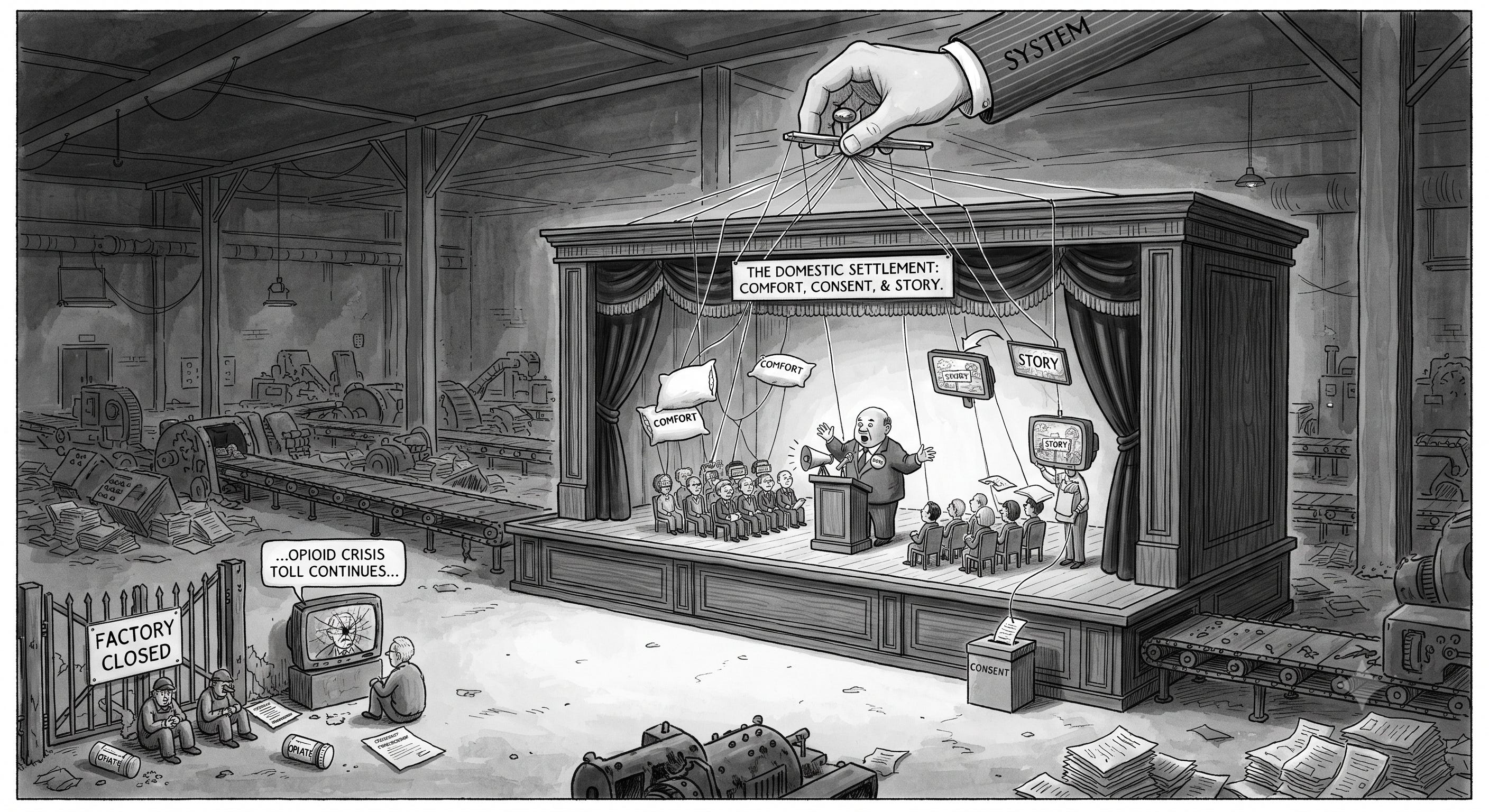
The citizens of the United States, Britain, and Europe are not the owners of the architecture that runs the world’s wars. They are its most cheaply managed population, held by consent rather than force, and they are an externality too. The system simply meters their deaths in overdoses, foreclosures, and shortened lives rather than in airstrikes.
I want to start with the dead at home, because if you live in the West, this is where the ledger touches you directly. Over a hundred thousand Americans die every year from drug overdoses, a toll that has held above six figures for several consecutive years, easily outstripping the total American casualties of the Vietnam War every twelve months. Life expectancy in the United States fell for three consecutive years in the late 2010s: the first sustained decline since the 1918 influenza pandemic, and it happened well before any virus arrived to explain it. Economists Anne Case and Angus Deaton named the phenomenon “deaths of despair” and traced it to a specific demographic: working-class people without a college degree living in towns where the factories closed down, dying from alcohol, opioids, and suicide. This isn’t a war zone. This is the imperial core. And the dead here don’t appear on any corporate balance sheet either.
You’ve been sold a comfortable story about how the world works. You’ve been told that the citizens of the United States, Britain, France, and Germany are the true beneficiaries of the global architecture I’ve spent seven pieces describing, that sovereign conflicts are fought to protect your freedom, and that resources are extracted so your communities can prosper. The story is structurally false. The citizens of the core states aren’t the owners of this system; they are a managed population, distinguished from the periphery only by the tools used to control them and the price at which that control is bought.
The periphery is managed by debt, comprador regimes, and when necessary, by bombs. The core is managed by consent, material comfort, and narrative. The first method is expensive and loud. The second is cheap and quiet. That makes consent the far superior tool, which is exactly why Western populations are usually the last to realize they’re being managed at all.
The Cheapest Population to Manage
Every management architecture seeks the lowest-cost path to compliance, and force is never the cheapest route. Force requires secret police, surveillance budgets, detention centers, and a constant battle against the resistance that coercion creates. The installed class in Cairo or Islamabad is expensive precisely because it has to coerce its people. The genius of the domestic settlement in Western capitals is that it produces compliance without visible force: by manufacturing a population that polices itself, votes for the continuation of its own management, and mistaking a narrow set of choices for the full horizon of political possibility.
The core public receives three things the periphery is denied: a ballot box, a wage sufficient for consumption, and a media ecosystem that frames the status quo as the natural law of the universe. The ballot box is the master key. A population that votes firmly believes it governs. That belief is the mechanism.
When national policy never shifts regardless of which political party wins an election, voters don’t conclude that real power sits outside democratic control. They simply assume they picked the wrong candidate last time and try again, and that endless electoral cycle absorbs the energy that might otherwise go into asking why the fundamental economic setup never changes. The officials running the government are personnel recruited from and returned to the very asset management and defense firms that run the machines. The core electorate is the part of the machine that doesn’t know it’s part of the machine. You are told you’re the customer. You’re actually the product.
Think about how that settlement held for half a century. For decades, the comfort was real. An American factory worker in 1965 could support a family on a single income, buy a home, and reasonably expect his kids to live better than he did. That worker wasn’t being tricked about his prosperity; he was prosperous because the post-war industrial surplus was large enough to fund it. Rising wages and an expanding social safety net bought a compliance so deep it didn’t feel like management. It felt like the American Dream. The question I’m asking in this piece is what happens to that domestic settlement when the surplus funding it gets redirected elsewhere, and the answer is written in the overdose statistics: the redirection happened decades ago, and the dead are already counting it.
Manufactured Consent: The Ideological Instrument
The media apparatus that keeps the core public inside the settlement is the domestic version of the installed class, and it operates through far gentler means. It doesn’t need to censor content. It simply establishes the boundaries of acceptable debate so effectively that those boundaries are mistaken for the edges of reality itself.
Look at how media ownership and funding work in practice. A small cluster of corporate conglomerates owns the vast majority of news outlets consumed by the public, and those conglomerates are owned by the exact same concentrated asset managers (BlackRock, Vanguard, State Street) sitting at the center of the financial machine. The think tanks supplying “expert” commentary on foreign wars are funded directly by defense contractors and foreign governments. Retired generals appear on television to analyze military operations while sitting on the boards of the defense firms profiting from those exact operations, a massive conflict of interest that broadcasters rarely bother to declare. The result is a coverage environment where every war is framed as a moral defense of values, every intervention as a humanitarian response, and the equity stakes of the weapons manufacturers are never mentioned on screen.
Remember the prelude to the 2003 Iraq War. Across the entire media landscape, news outlets transmitted claims about Iraqi weapons of mass destruction as absolute fact. The claims were entirely false. The corrections, when they were printed at all, appeared years later on inside pages after hundreds of thousands of people had died and defense contracts had cleared. No media institution suffered a setback for manufacturing consent for that catastrophe. The exact same networks and think tanks went on to manufacture consent for the next intervention, and a public lied to about Iraq believed them again, because the apparatus that produced the first deception also controlled the framework used to process the second. The deception isn’t a glitch in the system. It is the core function.
The Memo and the Turn
The dismantling of the domestic settlement wasn’t a natural accident. It was a deliberate political project, designed and executed by people who wrote down their intentions in plain English.
The master blueprint was drafted in August 1971 by corporate lawyer Lewis Powell, just two months before his appointment to the U.S. Supreme Court. In a confidential memorandum for the U.S. Chamber of Commerce titled “Attack on the American Free Enterprise System,” Powell argued that American business was under siege from hostile cultural forces and needed to organize defensively. He urged corporations to fund policy think tanks, endow university chairs, cultivate media influence, and deploy their economic muscle as a coordinated political force. Over the next decade, Powell’s memo was executed to the letter. The think tank infrastructure shaping modern public opinion was built out directly from that blueprint.
Then came the 1980s. Under Ronald Reagan in the U.S. and Margaret Thatcher in Britain, the post-war economic model was dismantled: top tax rates were slashed, financial markets deregulated, state assets privatized, and organized labor systematically broken. When Reagan fired eleven thousand striking air traffic controllers in 1981, and when Thatcher crushed the British miners’ strike in 1985, the message to working people was unambiguous. Once labor unions could no longer defend their share of the economic pie, the historical link between productivity gains and worker pay was severed.
The financial deregulation of the 1990s finished the job. The repeal of the Glass-Steagall Act in 1999 destroyed the firewall between commercial banking and speculative investment operations. Sold to the public as a victory for consumer freedom, it delivered the financialization of the real economy: shifting corporate priority away from productive employment toward high-frequency asset returns, while systematically transferring wealth from the workers who created it to the asset managers who held claims on it. The Powell memo wasn’t a secret conspiracy theory; it was a strategy document written in the open, and it worked flawlessly.
The Wage That Stopped Moving
The surplus that once funded domestic middle-class life didn’t vanish into thin air. It was redirected, cleanly and measurably, from the working population to institutional capital.
The economic data tells the story. From 1945 until roughly 1979, American worker productivity and compensation moved upward in tandem: as workers produced more per hour, their paychecks grew. After 1979, the two trajectories split. Productivity kept climbing while real worker pay flattened. Over the four decades that followed, U.S. productivity grew by over sixty percent while typical worker compensation rose by only a fraction of that figure. That widening gap represents the massive surplus siphoned away from labor to capital. The middle class wasn’t lost by accident; it was defunded to inflate equity yields for asset managers.
The primary engine of this redirection was global offshoring. Major trade deals like NAFTA in 1994 and China’s entry into the WTO in 2001 allowed Western corporations to move manufacturing to low-wage peripheral nations, pocketing the wage difference as profit while leaving entire domestic industrial regions hollowed out. Between 2000 and 2010 alone, the United States lost over five million manufacturing jobs.
Look at what happened in Europe when the Ukraine war broke out: European publics were forced to pay premium prices for American liquefied natural gas as their industrial base contracted under massive energy costs, absorbing the domestic burden of a conflict framed entirely as a moral stand for sovereignty. Workers in the periphery were exploited at low wages, workers in the core were discarded, and asset managers captured the difference. Capital was the only winner on the balance sheet.
Deaths of Despair: The Domestic Externality
When the jobs left, the dying accelerated, taking a form that readers of this series will recognize instantly: an externality. Mass human suffering that registers no entry on corporate accounting ledgers, affects no stock valuation, and is therefore treated by the system as zero cost.
Consider the paper trail of the opioid epidemic. In 1996, Purdue Pharma (owned by the Sackler family) launched OxyContin and aggressively marketed it as a non-addictive painkiller while knowing it was highly addictive. Millions of working-class people became addicted, and when legal prescriptions were restricted, the addiction shifted to illicit heroin and synthetic fentanyl, driving annual overdose deaths past six figures. McKinsey & Company advised Purdue on how to “turbocharge” sales, later paying over six hundred million dollars in settlements without admitting wrongdoing, while the Sacklers extracted billions before filing for corporate bankruptcy to protect their personal wealth.
This was the Financial Industrial Complex operating on its own domestic population through a pharmaceutical subsidiary. The structure is identical to what happens in Gaza or Pakistan: a product is sold, profits are booked, human beings die, and the dead do not appear in the accounting ledger because the system has no input field for human suffering.
The despair isn’t just chemical; it’s structural. Over two decades, U.S. suicide rates rose by roughly a third, with mortality rates spiking among non-college-educated white Americans in former factory towns. The system isn’t killing domestic workers out of active malice any more than it kills Palestinians out of malice. It is simply indifferent to whether they live or die, because their well-being was never the objective. Management was the objective, and a managed population dying quietly of despair is far cheaper to control than one organizing a political movement.
Austerity and Socialized Losses
When the financial system collapsed in 2008 after years of converting predatory mortgages into toxic financial derivatives, we witnessed the ultimate proof of who core states are actually run for.
The institutions that caused the crash were rescued immediately. Governments poured hundreds of billions through TARP while the Federal Reserve injected trillions in liquidity: recapitalizing banks, paying executive bonuses, and filing zero criminal charges against top Wall Street figures. The working families who were sold those mortgages got no such rescue. Millions lost their homes to foreclosure, only for those exact properties to be bought up at rock-bottom prices by giant asset managers like BlackRock.
Losses were socialized and passed to taxpayers; gains were privatized and concentrated at the top. This isn’t critical commentary; it’s the exact arithmetic of the bailout.
In Britain and Europe, this same logic was imposed as “austerity.” Bank rescue debts were presented as collective overspending requiring public sacrifice, and that sacrifice fell entirely on public services, healthcare, and infrastructure. The UK endured a decade of service cuts alongside the longest wage stagnation in two centuries, while central bank quantitative easing inflated asset values for the wealthy. The core public paid twice: first funding the corporate bailout, then absorbing the resulting austerity and inflation. The creditors’ interest dictated the outcome every step of the way.
Surveillance Comes Home
The Technological Industrial Complex doesn’t reserve its surveillance tools for overseas conflict zones. The digital tracking software used to monitor populations in the Middle East is deployed domestically across Western cities, softened only by consumer marketing and user agreements.
When Edward Snowden revealed in 2013 that the NSA was conducting mass surveillance on American citizens, harvesting phone metadata and internet activity without consent, the political establishment quickly reframed the scandal to focus on the whistleblower rather than the illegal spying. Meanwhile, targeting firms like Palantir supply predictive policing algorithms to domestic police departments and immigration agencies, directing law enforcement into low-income communities.
The difference between surveillance in Gaza and surveillance in Detroit is straightforward: the Palestinian is tracked to be targeted, while the American is tracked to be monetized. But the underlying hardware and software are identical, built by the same contractors and refined in peripheral test zones before being brought home. Western citizens surrendered their privacy not at gunpoint, but by clicking “I Agree”, and voluntary surrender is the system’s favorite model, because consent given is far cheaper to maintain than compliance forced.
Why Consent Holds and Where It Frays
The domestic settlement has endured for half a century, but it is now held together by media narrative rather than real economic surplus, and narrative is a fragile glue when wages are flat. People feel that something vital has been taken from them. The overdose deaths, the lost homes, the stagnant paychecks, the realization that their children will face a harder life than their own: all of these register deeply, even when people can’t pinpoint the structural cause. And when a managed population senses its mistreatment without understanding the mechanism, it produces a distinct political reaction: a revolt that misidentifies its target.
Look at the populist waves sweeping Western nations over the last decade. Votes for Brexit, the rise of insurgent political movements, the deep hostility toward established elites: these are the reactions of populations that correctly realize they are being managed against their interests, but have been manipulated into picking the wrong adversary.
The media apparatus directs their anger away from institutional capital and toward immigrants, foreign nations, or political neighbors. The economic grievance is real, but the outrage is redirected horizontally against other managed people rather than vertically against the capital nodes extracting the wealth. The political duopoly absorbs the anger by offering candidates who echo the public’s frustration while serving the exact same financial interest once in office. The surplus continues moving upward, while voters discover that changing the politician leaves the policy unchanged.
The Core Population Is an Externality Too
The central argument of this entire series has been that human life is treated as a structural externality by the global financial, military, and technological machine. I’ve demonstrated this reality across seven different geographic theaters, but the analysis would be incomplete without including the imperial core itself.
The dead in Gaza and the dead in Ohio are recorded in different currencies, but they share the exact same fate on the master ledger: they don’t register as a cost.
Western citizens are the cheapest population the system manages, controlled through material comfort and ballot boxes rather than military blockades. But comfort is being withdrawn as institutional capital claims an ever-larger share of the surplus. Wages flattened in 1979, manufacturing left, despair filled the void, banks were bailed out while homeowners were foreclosed, and surveillance moved from military zones to domestic smartphones.
The wars continue, paid for by public taxes and inflation, while all the financial returns flow straight to the concentrated asset managers owning the weapons, the debt, the infrastructure, and the surveillance platforms. The machine processes domestic decline as profit margin just as it processes overseas destruction as return on capital.
You were told you were the empire, but you were just its most efficiently managed subject. The proof is that it took you this long to see the architecture, and that the media apparatus built to keep you from asking is the very source you turned to for answers.


