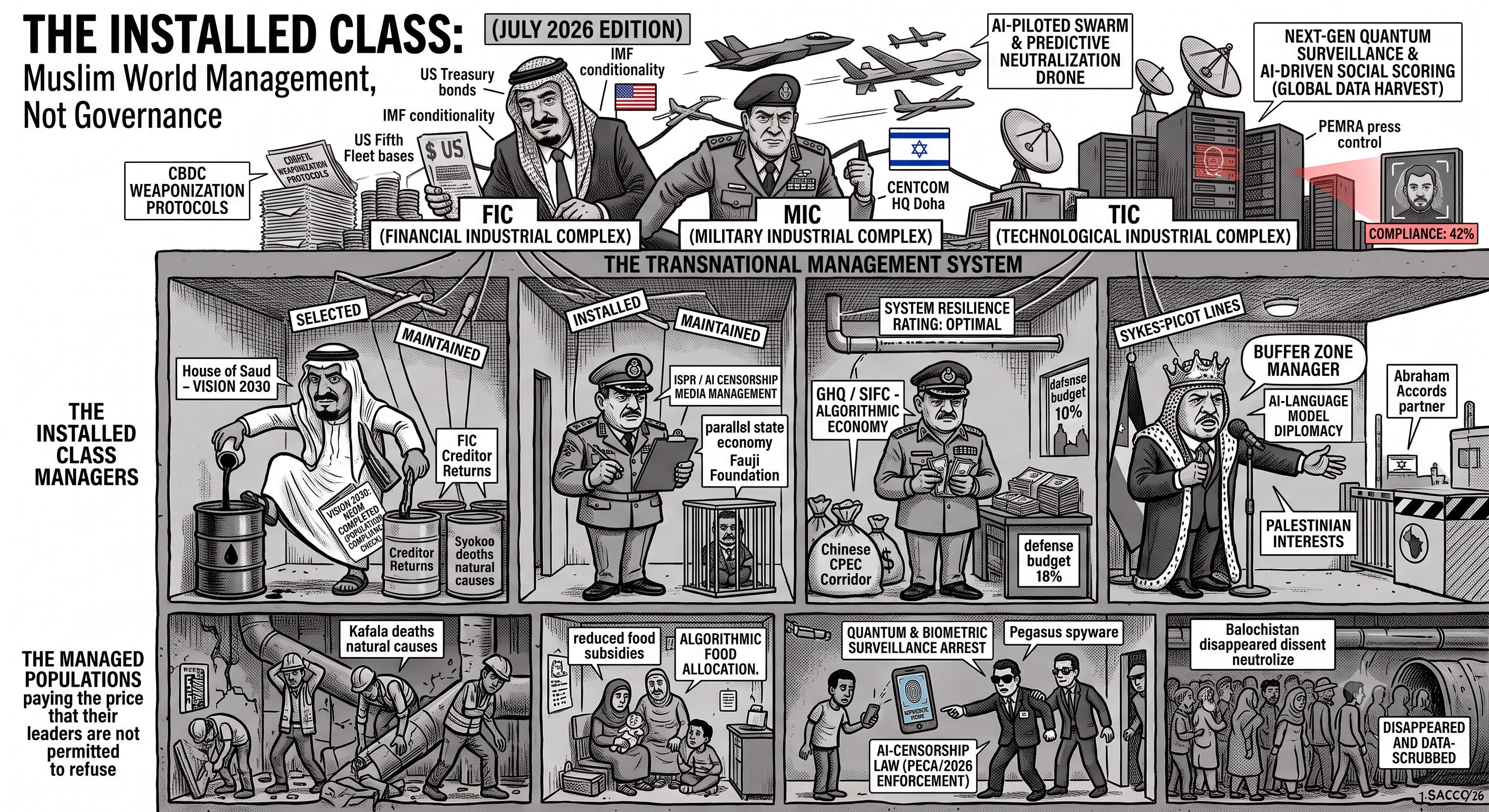
The leaders of the Muslim world were not chosen by their populations. They were selected, installed, and maintained by a transnational system that requires their populations to remain inside the FIC’s operating parameters. And the populations are paying for that arrangement with their lives.
There is a question no one asks in polite geopolitical company, and the refusal to ask it is itself a data point. The question concerns a civilisation of 1.8 billion people stretching from Morocco to Indonesia, from the Kazakh steppe to the Swahili coast, with more proven oil reserves than any other bloc on earth, with geography that controls four of the world’s critical maritime chokepoints, with a documented tradition of mass political resistance that brought down colonial empires within living memory. Why, across all of that, has not a single government in decades governed primarily in the interests of its own population? The answer cannot be Islam, because the populations asking for schools and hospitals and living wages and accountability are Muslim too. The answer cannot be underdevelopment, because the specific countries that are most comprehensively managed, Saudi Arabia, the UAE, Kuwait, sit on the largest hydrocarbon surpluses in human history. The answer is that these governments are not failures at governance. They are successes at management, designed not to serve their populations but to keep them inside an architecture that serves transnational capital, and they are, by that measure, performing exactly as intended.
This is the installed class. It is not a conspiracy in the sense of secret coordination. It is a structural solution to a structural problem, and the problem it solves is one the Financial Industrial Complex, the Military Industrial Complex, and the Technological Industrial Complex cannot solve through market mechanisms alone. The Muslim world is simply too large, too resource-rich, too strategically positioned, and too politically volatile to leave to the normal processes of electoral democracy. A Muslim world that governed itself according to its own populations’ interests would redirect petrodollar surpluses into domestic industrial development rather than US Treasury bonds. It would challenge Israeli occupation under the international law that the FIC’s own institutions nominally uphold. It would renegotiate IMF conditionality on terms that protect public services rather than creditor returns. It might close the Strait of Hormuz not as an act of war but as a sovereign assertion of control over passage through its own territorial waters. Every one of these outcomes is a threat to the architecture that has sustained Western financial hegemony for half a century. The installed class exists to prevent them. The populations pay the price that their leaders are not permitted to refuse.
The Architecture of Installation: How the System Builds Its Managers
Installation does not arrive with a pamphlet explaining itself. It arrives as aid, as weapons, as a security guarantee, as the promise of protection from the regional rival that the patron has usually helped to construct. The process is old enough to have a documented historical record that can be followed across specific cases without inference.
In 1953, the elected Prime Minister of Iran, Mohammad Mosaddegh, nationalised the Anglo-Iranian Oil Company, which had been extracting Iranian oil and returning a fraction of the revenue to the Iranian state under terms the Iranian parliament had spent years trying to renegotiate. The British government, which held a majority stake in Anglo-Iranian, approached the CIA. Operation AJAX, coordinated by the CIA and MI6, organised street violence, bribed military officers, and distributed cash to destabilise Mosaddegh’s government. He was removed in August 1953. Mohammad Reza Shah Pahlavi was restored to full power, which he had been constitutionally obliged to share with Mosaddegh’s government. Anglo-Iranian was restructured into a consortium that included American oil companies. Iran’s oil revenue continued to flow outward. The Shah was installed, and the installation held for twenty-six years, until the Islamic Revolution swept it away in 1979. The revolution happened not because Iranians are uniquely resistant to foreign management but because the management cost, paid in the currency of secret police, torture facilities, and enforced silence, accumulated to a level no installed class can sustain indefinitely.
Iran is the template that proves the rule by its exception. The Islamic Republic was born in resistance to installation and has spent every year since its founding paying the price of that resistance: sanctions that have compressed its economy for four decades, proxy conflicts that have consumed its resources, isolation from the global financial system, and, beginning in February 2026, a direct military assault that killed its supreme leader and has cost the lives of thousands of Iranians who had no voice in the policies being punished. The installed class in Tehran would have been cheaper for the Iranian population than the liberation that replaced it. That is a devastating fact, and it is not an argument for submission. It is an argument for understanding the full cost the system extracts from those who refuse it.
The Borders Were Drawn to Be Managed
The installed class did not appear with the petrodollar. The template was set a century ago, when the borders of the modern Middle East were drawn, in secret, by two European officials who had never governed the people whose world they were dividing. In 1916, while the First World War was still being fought, the British diplomat Mark Sykes and his French counterpart François Georges-Picot agreed a partition of the Ottoman Empire’s Arab provinces into British and French spheres, drawing lines across a map of populations they did not consult and in many cases could not name. The agreement was secret until the Bolsheviks found it in the Tsarist archives and published it in 1917, exposing to the Arabs who had been promised independence in exchange for revolting against the Ottomans that their independence had already been bargained away. The borders of Iraq, Syria, Lebanon, Jordan, and the rest were not the organic boundaries of nations. They were the administrative convenience of empires, drawn to be governed from outside.
The governing from outside required local managers, and the empires installed them directly. The British took the sons of the Hashemite dynasty, who had led the Arab Revolt, and made one of them king of Iraq and another emir and then king of Transjordan, placing foreign-sponsored monarchs over territories assembled for imperial convenience. On the Arabian Peninsula the British backed the house of Saud, and when the Saudi state consolidated its control over the peninsula’s oil in the following decades, the management contract passed smoothly to the Americans, who signed at the petrodollar’s founding the arrangement this series has described: security for the dynasty in exchange for the recycling of oil revenue through Western institutions. When the oil surplus was large enough, the management was comfortable and the population was compliant. When the surplus compresses, which it does whenever oil prices fall and whenever the monarchy’s obligations expand, the cost of the management surfaces. The Vision 2030 programme, Saudi Arabia’s $800 billion attempt to diversify the economy beyond oil, is the installed class trying to solve the problem the original installation created: an economy that produces nothing the world needs except hydrocarbons, a population with limited private-sector skills, and a social contract built on resource distribution that becomes unsustainable the moment the resource base shrinks.
This is the deep history the present management rests on, and it explains a feature of the Muslim world that Western analysis consistently mistakes for cultural failure. The absence of governments that serve their populations is not the expression of some defect in the people or the faith. It is the designed outcome of a state system that was built, deliberately and from the outside, to be managed rather than to be sovereign. The Sykes-Picot borders were an act of capital and empire before either word meant quite what it means now, and every installed government since has been a continuation of the same project: the conversion of a vast, resource-rich, strategically critical region into a set of administrative units whose managers answer to the architecture and not to the governed. The populations have understood this far better than the analysts who study them, which is why the most durable political demand across the Arab world for a century has not been for one ideology or another but for the simple thing the system was constructed to deny them, which is governments of their own.
The Gulf Model: Recycling Sovereignty Into Treasury Bonds
The Gulf Cooperation Council monarchies are the purest expression of the installed class in operation. Saudi Arabia, the UAE, Bahrain, Kuwait, Qatar, and Oman are not dictatorships in the sense of governments that seized power against their populations’ preferences. They are arrangements that predate any meaningful expression of those preferences, maintained by a combination of resource distribution, religious legitimacy, and external military guarantees that make any challenge structurally suicidal. The US Fifth Fleet is based in Bahrain. The largest US air base in the Middle East is Al Udeid in Qatar. Prince Sultan Air Base in Saudi Arabia hosts American forces. CENTCOM, the command structure responsible for all US military operations from Egypt to Afghanistan, is headquartered in Doha. The physical presence is not incidental to the political arrangement. It is the arrangement’s foundation. Remove the external military guarantee and the domestic political calculus in every Gulf state changes immediately.
The petrodollar architecture that Kissinger built with Saudi Arabia between 1973 and 1974 was never simply a trade deal. It was a contract between the installed class and the FIC that set the terms of its survival. Saudi Arabia would price oil in dollars, recycle surplus revenues into US Treasury bonds, and maintain the dollar’s reserve currency status. In return, the United States would provide a security guarantee that protected the monarchy from both external rivals and domestic challengers. The Saudi population, which received subsidised fuel, housing, and public employment from the oil surplus, was the managed variable in this arrangement rather than its purpose. Saudi Arabia allowed the informal terms of this arrangement to lapse in 2024, giving it flexibility to accept yuan or euro payment for some oil sales, though as of mid-2026 roughly 96 percent of Saudi oil sales remain dollar-denominated. The form of the arrangement is evolving. The security relationship and the managed character of the state remain intact. The Aramco IPO in 2019 was the most explicit statement of the model’s logic in recent years: Saudi sovereign oil wealth partially floated to transfer sovereign energy revenue into tradeable financial instruments held by BlackRock, Vanguard, and other major asset managers. The direction of the flow did not change. The certificate documenting it did.
The UAE represents a refinement of the Gulf model for the twenty-first century. Abu Dhabi’s sovereign wealth funds, the Abu Dhabi Investment Authority and Mubadala, manage assets exceeding one trillion dollars. The UAE hosts Israeli intelligence infrastructure following the Abraham Accords normalisation of 2020 and is now a statutory intelligence partner of the United States under Section 622’s Abraham Accords extension. The 88 percent of the UAE’s population who are non-citizens, primarily South Asian and Southeast Asian migrant workers, live under the Kafala system, which ties their residency status to their employment contract and their employment contract to an Emirati sponsor, creating a labour arrangement that human rights organisations have consistently characterised as a form of modern bondage. These workers remit billions annually to home countries, including more than a billion dollars a month to Pakistan alone, and when they die, from workplace accidents, from the heat of construction sites where temperatures exceed 50 degrees Celsius, from medical conditions that receive inadequate attention, the deaths are recorded as natural causes and their families receive neither compensation nor accountability. The UAE presents itself as a modern, cosmopolitan hub for global commerce and has spent billions on soft power: the Louvre Abu Dhabi, Manchester City Football Club, an aggressive public diplomacy operation. The soft power is the TIC’s ideological product. The Kafala deaths are the MIC/FIC’s labour cost, absorbed by families in Karachi and Lahore and Dhaka who have no legal standing to contest them.
Egypt: The Military Economy as Management Architecture
Egypt is the installed class in its most undisguised form and the case that makes the model’s logic most legible. Abdel Fattah el-Sisi came to power in July 2013 in a military coup against Mohamed Morsi, the elected president who had come to office a year earlier on the back of the Arab Spring and the Muslim Brotherhood’s electoral infrastructure. The coup was backed immediately and explicitly by Saudi Arabia and the UAE, which together transferred approximately fifteen billion dollars to the Egyptian government within weeks of Morsi’s removal. The United States, which has a law requiring it to suspend military aid following a military coup, declined to characterise what had happened as a military coup and continued the aid. The Egyptian military, which controls an estimated forty percent of the formal economy through a network of enterprises ranging from pasta factories to resort hotels to fuel distribution to real estate, had removed the only government in Egyptian history that had been chosen through a competitive election, and the response of the system’s major institutions was to fund the removal and continue the relationship.
The IMF’s subsequent engagement with Egypt tells the story with numerical precision. Egypt received a three billion dollar IMF programme in 2022 and an eight billion dollar expanded programme in 2024. The conditionality attached to both programmes required currency devaluation, reduction in food and energy subsidies, privatisation of state-owned enterprises, and fiscal consolidation that reduced government spending on public services. The Egyptian pound lost approximately two thirds of its value against the dollar between 2022 and 2024. Inflation reached 38 percent at its peak in 2023. Food prices rose beyond the reach of a significant portion of the population. The military’s commercial network was not privatised. The military’s budget was not subject to the fiscal consolidation requirements. The conditions that the IMF attached to its lending were conditions that fell on the civilian population and left the installed class’s economic infrastructure intact. This is not accidental. The IMF’s structural adjustment architecture, which has applied similar conditionality across Pakistan, Argentina, Nigeria, Sri Lanka, and dozens of other indebted states, consistently protects the security sector from the austerity it imposes on social services. The architecture is designed to service the FIC’s debt claims while maintaining the installed class that enforces the arrangement.
Jordan: The Most Managed State
Jordan is worth examining carefully because it is the least economically powerful of the major managed states and therefore the one whose management logic is most visible. The Hashemite Kingdom has almost no hydrocarbon resources, a small and import-dependent economy, and a population that is majority Palestinian, people whose families were displaced by the 1948 and 1967 wars and who live in a state that functions as a buffer zone between Israel and the Arab east. The United States provides approximately 1.5 billion dollars annually in aid, making Jordan one of the largest per-capita recipients of American assistance. The kingdom has a peace treaty with Israel, signed in 1994, and provides border security that Israel relies on for its eastern perimeter.
The Jordanian king cannot govern for his population in any meaningful sense because governing for his population would require confronting the displacement and occupation that defines half his subjects’ living experience. The Palestinians in Jordan, who constitute a majority of the population by most estimates, are not seeking abstract geopolitical solidarity with Gaza. They are the relatives of people currently dying under Israeli bombardment. The king issues statements of concern. He issues calls for restraint. He participates in regional diplomatic processes that produce communiqués and nothing else. The structural constraint is absolute: Jordan’s survival depends on its function as a buffer, its function as a buffer depends on the peace treaty, and the peace treaty depends on the king refusing to translate his population’s interests into policy. He is not a weak or cowardly man. He is a manager doing his job, and his job is to absorb his population’s grief and convert it into diplomatic language that changes nothing.
Pakistan: The Nuclear State That Cannot Govern Itself
Pakistan is the installed class operating in its most structurally complex form: a nuclear-armed state of 240 million people whose civilian government has never, in seventy-seven years of independence, controlled its own military. The generals of GHQ are not exactly an installed class in the external patronage sense: their power derives primarily from their institutional position within Pakistan rather than from Washington’s explicit instruction, and their relationship with the FIC is more a convergence of interests than a commission. But the structural function they serve is identical: they prevent the Pakistani state from governing in ways that would challenge the FIC’s architecture, and they are maintained in that function by a combination of American military assistance, Gulf petrodollar diplomacy, and IMF debt relationships that have operated continuously since the 1950s.
GHQ runs a parallel state economy. The Fauji Foundation, the Army Welfare Trust, and the Askari commercial network together constitute one of the largest corporate conglomerates in Pakistan, operating fertilizer plants, cereal brands, gas stations, housing schemes, and security services. The Special Investment Facilitation Council, established in 2023, formally places military officers in the governance of foreign direct investment decisions, including the Chinese CPEC corridor worth more than sixty-five billion dollars. Pakistan’s defense budget consumes eighteen percent of total government expenditure. Education receives 2.3 percent. Healthcare receives 1.2 percent. The twenty-six million children out of school are not a policy failure. They are the arithmetic outcome of a budget whose priorities reflect the actual hierarchy of institutional power rather than the nominal priorities of the elected government.
Pakistan’s IMF debt relationship, currently its twenty-fifth programme since 1958, approved in September 2024 for seven billion dollars, imposes conditionality that the civilian government must implement while the military’s commercial empire is untouched by the austerity requirements. Electricity prices have risen more than 150 percent since 2022 under IMF-required tariff adjustments. Food inflation peaked above thirty percent. The poverty rate has reached 28.9 percent, with more than ninety-five million Pakistanis below the poverty line. The remittance flows from Gulf states, 3.3 billion dollars a month, are not evidence of development. They are evidence of the management trap: a country that exports its labour force to Gulf states whose management the FIC maintains, receives remittances that substitute for the industrial development that would make those remittances unnecessary, and cannot challenge the Gulf arrangement because the remittances are too critical to its balance of payments. The management is self-reinforcing. The populations of Pakistan and the Gulf states are both trapped inside it, paying different portions of its cost.
The Muslim Brotherhood and the Limits of Electoral Legitimacy
The system’s management of democratic opposition is most clearly visible in its response to the Muslim Brotherhood. The Brotherhood, founded in Egypt in 1928, is the oldest and most institutionally developed mass political movement in the Arab world. Whatever its ideological limitations and internal contradictions, it demonstrated over decades that Islamic political organisation could compete in elections, build social service networks, and produce governing coalitions that were actually accountable to their constituencies. Mohamed Morsi’s election in Egypt in 2012 was the first competitive presidential election in Egyptian history. The Brotherhood had won elections in Jordan, participated in Kuwaiti and Bahraini politics, and built the infrastructure that became Hamas in Palestine.
Hamas won the Palestinian legislative elections in January 2006. It won. The electoral system the international community had insisted on for Palestinian governance produced a result the international community refused to accept. The response was immediate and structural: the United States, the European Union, and Israel cut off funding to the Palestinian Authority, imposed a blockade on Gaza, and facilitated a political split between the West Bank and Gaza that has never been resolved. An elected government was converted into a besieged administration over eighteen years, until the October 2023 attack and the subsequent military campaign transformed the siege into something closer to a systematic elimination of the territory’s governing capacity and civilian infrastructure. The lesson the Palestinian case teaches concerns not Hamas or its methods but the system’s tolerance for electoral results that challenge the management architecture, and that tolerance is exactly zero.
The Muslim Brotherhood’s removal from Egyptian governance in 2013 followed the same logic with more explicit financial instrumentation. Within weeks of the coup, Saudi Arabia and the UAE had transferred the fifteen billion dollars that stabilised the military government and signalled to financial markets that the new arrangement had external backing. The IMF subsequently engaged. Western governments that had deployed significant diplomatic capital encouraging Egyptian democratic transition in 2011 adjusted their positions to accommodate the new reality. The Brotherhood was designated a terrorist organisation by Saudi Arabia, the UAE, and subsequently by several Western governments, a designation that allowed its electoral success to be legally reframed as a security threat rather than a political outcome. The TIC’s role in this reframing was substantial: surveillance of Brotherhood members and affiliates, financial monitoring of its networks, and the production of analytical assessments that circulated through the think tank and intelligence apparatus describing Islamist electoral politics as inherently incompatible with stable governance. The analysis was produced by institutions funded by the same Gulf states whose governments the Brotherhood’s electoral success threatened.
The Surveillance Infrastructure: TIC as Population Management
The TIC’s contribution to the installed class’s stability is the surveillance architecture that makes dissent identifiable, trackable, and preemptively suppressed at a level no previous management system could achieve. NSO Group’s Pegasus spyware, developed in Israel and sold to more than forty-five governments, including Saudi Arabia, the UAE, Bahrain, Morocco, India, and Azerbaijan, converts any smartphone into a comprehensive surveillance instrument: extracting messages, emails, calls, contacts, photographs, and location data without the target’s knowledge or consent. When the Saudi government used Pegasus to monitor Jamal Khashoggi’s communications in the months before his killing inside the Istanbul consulate in October 2018, the TIC was performing exactly the function the installed class purchases it for: identifying the person whose continued public activity was a reputational cost the management could not absorb, and providing the technical capability to locate and track him. The kill order came from Riyadh. The targeting capability came from Israel. The transaction was mediated by the same post-normalisation intelligence relationship that Section 622 now codifies in US statute.
PEMRA, Pakistan’s broadcast regulator, produces press control through licensing requirements rather than direct censorship orders. The structure is the same: every broadcaster understands that its licence is contingent on avoiding content that the military’s media management arm, ISPR, finds threatening, and no explicit instruction is required to produce compliance. Pakistan’s cybercrime law, PECA, criminalises online content that the government characterises as defamatory or threatening to national security, with fifty-eight prosecutions documented in a single twelve-month period. The FIR itself is the punishment: the legal exposure, the arrest, the bail conditions, the drain of the legal defence, all without any conviction being required. Egypt’s Emergency Law, which was continuously in force from 1967 to 2012 and was reimposed in various forms after the 2013 coup, provides the same administrative detention capacity. The UAE’s cybercrime law imposes sentences of up to fifteen years for online content deemed to damage the state’s reputation. Each of these legal architectures produces the same outcome through different instruments: a population that understands the cost of public political expression and adjusts its behaviour accordingly. The TIC provides the technical surveillance that makes these laws enforceable at scale. Unmonitored dissent can organise. Monitored dissent is neutralised before it reaches critical mass.
The Normalisation Project and Its Contradictions
The Abraham Accords of 2020 were the FIC/MIC/TIC system’s most explicit recent attempt to formalise the installed class’s integration into the Israeli security architecture. The UAE, Bahrain, Morocco, and Sudan normalised diplomatic relations with Israel and committed to intelligence sharing arrangements that are now statutory obligations under Section 622. Saudi Arabia’s normalisation, which remains unfinished, is the system’s current project: the prize that would complete the Gulf’s formal integration into the US-Israeli condominium and foreclose any residual capacity for Arab state solidarity with Palestinian self-determination.
The contradiction at the centre of this project is not a diplomatic problem. It is a structural one. MBS has publicly stated that Saudi normalisation requires a credible pathway to Palestinian statehood. Netanyahu has made Palestinian statehood structurally impossible through settlement expansion, the application of annexation logic to the West Bank, and the elimination of Gaza’s governing capacity. The system is trying to simultaneously produce Saudi normalisation and maintain Israeli territorial maximalism, and these two objectives cannot both be achieved. What the system is actually negotiating is the minimum Palestinian concession that MBS can sell domestically as meaningful progress while delivering nothing that changes the territorial reality. This is the installed class managing a domestic population: the Saudi public, which polls consistently in strong support of Palestinian rights, must be given a sufficient narrative of Palestinian progress to absorb their government’s normalisation without destabilising political consequences. The Palestinian people whose rights are being narrated are not parties to the negotiation.
What Management Costs
The populations of the managed Muslim world are not passive. The Arab Spring of 2011 moved across Tunisia, Egypt, Bahrain, Libya, Syria, and Yemen with a speed that surprised every analyst who had been reading only the installed governments’ stability reports. The Iranian revolution of 1979 swept away an installed class in months. The Pakistani lawyers’ movement of 2007 forced a military president to restore the constitution. The JAAC movement in Azad Jammu and Kashmir in 2025 and 2026 produced strikes and demonstrations that the government suppressed with live fire and internet blackouts rather than political engagement. The installed class is not stable. It is maintained. Maintenance requires continuous investment in surveillance, in security force capability, in the suppression of political organisation, and in the distribution of enough resource surplus to keep the cost of daily life from reaching the threshold at which populations will absorb the cost of open resistance.
When the oil price falls, when the remittances slow, when the IMF’s conditionality raises electricity prices and cuts food subsidies, when the cost of daily life crosses the threshold that resource distribution had been suppressing, the management becomes expensive and the populations become volatile. The FIC does not model this cost in any way that accounts for the human reality of what happens when management fails. It models it as political risk, a variable that affects investment returns and sovereign debt spreads. The people losing their children to preventable disease, their relatives to Gaza bombardments and Kafala heat deaths and Balochistan disappearances, do not appear in the risk model as people. They appear as instability factors, discount rates, and sovereign creditworthiness adjustments.
The installed class is not a historical aberration. It is the system’s current solution to a management problem the system has no other means to solve. But the solution is generating the problem it was designed to prevent, because the cost of management is rising faster than the resources available to absorb it, and the populations paying the difference have stopped believing the management is permanent. The question the FIC cannot answer is what happens when the installed class can no longer install itself.
That question is already being asked in every managed capital from Islamabad to Riyadh to Cairo. Nobody in those governments wants to hear the answer.