Capital Wars: The Missing Lens: Why Western Analysis Cannot Read How the Muslim World Actually Works
Part 9 of 10
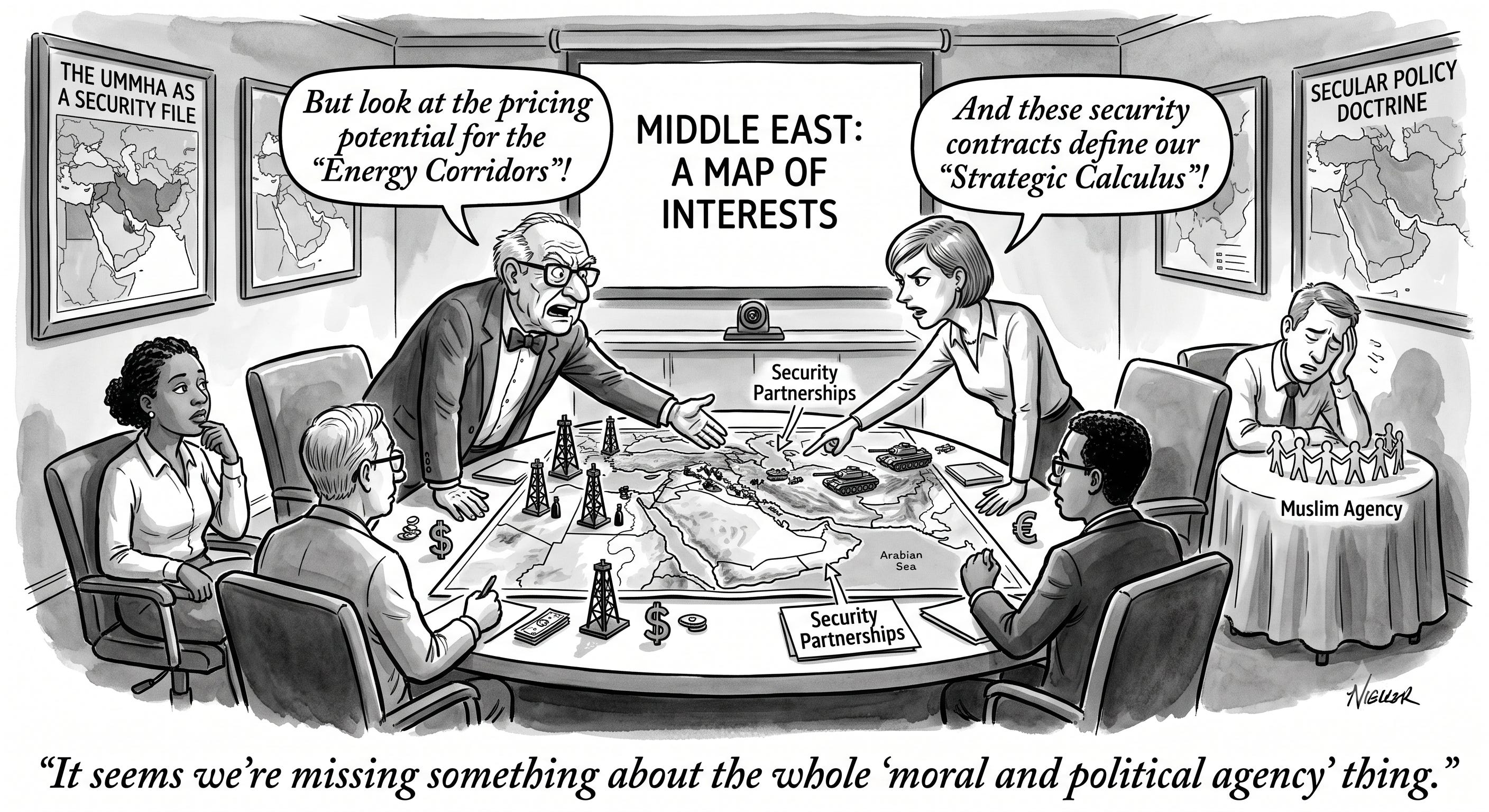
Eight pieces in this series followed the money through sovereign debt, weapons procurement, energy corridors, surveillance contracts, and reconstruction mandates. That sequence explains who profits when Gaza is bombed, when Lebanon is emptied south of the Litani, when Iran is sanctioned, and when Gulf rulers answer public insecurity with another American arms order. It does not explain why Muslims separated by language, class, school of law, and thousands of miles experience a child’s death in Gaza as an injury inside their own moral community, and yet Western policy treats that solidarity as foreign agitation until it can be filed under extremism.
The omission is political. Western institutions have spent a century hearing Muslims describe obligation, justice, community, sacrifice, and sovereignty in religious language, then translating those words into the categories the institutions already trust: competition for resources, elite manipulation, irrational grievance, or a cover for violence. The translation flatters the analyst and diminishes the subject. It grants full interior life to the official studying Islam and denies it to the Muslim living by it.
A pro-Muslim analysis begins at that point of refusal. It takes Muslims seriously when they explain their own motives, gives Islam the dignity of being examined as a living moral and political tradition, and refuses to make Muslim innocence contingent on passivity. It also rejects the Western conceit that Muslims naturally turn rulers and armed factions into sacred objects. Client states, subsidized clerical establishments, intelligence partnerships, and war propaganda manufactured much of that political confusion, then Western analysts cited the result as proof of an indigenous Muslim defect. Muslims deserve more than suspicion from their enemies and slogans from managers financed abroad.
The secular lens and its favorite Muslim
Modernization theory arrived in Muslim societies with a preferred ending already written. Daniel Lerner’s 1958 book, The Passing of Traditional Society, treated urbanization, literacy, media consumption, and economic development as a road toward a Western secular personality. The ideal Muslim in this account was legible because religion had retreated from public judgment. He could pray at home, work inside an imported economic order, accept the borders and rulers secured by outside power, and call the arrangement progress.
Policy institutions built careers on that expectation. Realists reduced Islam to state interest, political economists reduced it to oil and class, and rational-choice models treated belief as theatre performed over a material bargain. Each method caught part of the truth and yet each demanded the same price: a Muslim could enter the analysis only after his own account of moral duty had been ruled inadmissible.
The record kept refusing the theory. The 1979 Iranian Revolution displaced a monarch backed by Washington and armed with one of the region’s strongest security states. Islamist parties built durable constituencies through clinics, schools, unions, mosques, professional associations, neighborhood welfare, and opposition to dictatorship. Palestinian politics remained tied to waqf, exile, sacred geography, family memory, and communal obligation even as outside negotiators tried to reduce the question to police coordination and parcels of land. Secularization did occur in many lives and religious authority was contested everywhere, but development did not produce the obedient post-religious society promised by the model.
Western analysis answered these failures by changing the Muslim, not the method. When believers voted for an Islamist party, they had been manipulated. When they rejected an externally protected ruler, they were a mob. When they organized across borders for Palestine, they were importing a conflict. When they accepted prison, unemployment, or death rather than public submission, they had escaped rationality. The same policy world that treats an American soldier’s willingness to die as service has often treated a Muslim’s willingness to risk death for community as evidence of pathology, and yet it is the analyst’s hierarchy, not the Muslim’s humanity, doing the work.
The ummah is political memory
The ummah does not erase nationality, ethnicity, sect, or local loyalty. A Senegalese Tijani, an Indonesian traditionalist, a Turkish Hanafi, a Pakistani Barelvi, an Iraqi Shia, and a British Muslim teenager do not inhabit one political mind. Islam has no single worldly authority, and Muslims argue over scripture, law, state power, gender, class, resistance, quietism, and the limits of obedience with the intensity of a civilization that has been doing so for fourteen centuries.
The ummah joins this plurality through a moral claim that one Muslim’s suffering can impose a duty on another who has never met them. It lives in Friday sermons and family WhatsApp groups, in zakat collected for strangers, in legal arguments about obligation, in boycott campaigns, in funeral prayers, and in the anger of people whose governments normalize relations with the state killing Palestinians while police prevent them from marching for the dead. You cannot measure that community by counting diplomatic cables because much of its authority exists below and against the state.
Gaza has made the distance between Muslim public feeling and Muslim state policy impossible to hide. Governments issue cautious statements, preserve security agreements, protect trade routes, and police demonstrations, while ordinary Muslims donate, protest, document, pray, boycott, and carry Palestinian names into streets from Cape Town to Kuala Lumpur. Those acts differ in cost and consequence, and yet their shared language matters: Palestine is understood not as a remote territorial dispute but as a test of whether Muslim life can be destroyed in public without imposing a duty on anyone who survives.
That solidarity is often described as emotional, as if emotion disqualified political judgment. No analyst applies that standard to European solidarity with Ukraine or American identification with Israel. Muslims are expected to translate grief into the vocabulary of Western strategic interest before it becomes reasonable, and when they decline, the refusal itself becomes suspicious. The double standard protects a world in which some civilizational attachments count as alliances while Muslim attachment counts as radicalization.
The ummah has also been betrayed from within. Monarchies invoke Islamic custodianship while buying protection from Washington. Military governments quote faith while disappearing believers who challenge them. Parties use piety to discipline women, minorities, workers, and dissenters. Wealthy states advertise charity while migrant Muslims build their towers under coercive labor systems. A pro-Muslim position cannot excuse any of this, because loyalty to Muslims requires judging power by what it does to them, not by the scripture printed above the ruler’s chair.
A civilization larger than the security file
The security archive makes armed men appear to be the Muslim world’s principal religious actors. They are not. Most Islamic authority is exercised without a weapon: parents teaching children to pray, women sustaining charitable networks, jurists arguing over public duties, neighborhood committees distributing food, scholars issuing opinions that rulers would prefer them not to issue, and worshippers turning a mosque into the one institution in a district where people can still meet without buying entry.
Zakat and waqf are not decorative customs attached to belief. They are old arguments about the social claim on wealth. The prohibition on riba is not exhausted by the marketing department of an Islamic bank. It carries a moral suspicion of profit detached from risk and of debt used to dominate the vulnerable. The Qur’anic demand for justice, the obligation to care for the orphan and traveler, and the insistence that wealth must not circulate only among the rich constitute a language of political economy, and yet Western institutions are comfortable discussing “Islamic finance” when it creates a product while growing uneasy when Muslims apply the same moral reasoning to sanctions, occupation, labor, land, or sovereign debt.
The security archive grants the Muslim subject two approved roles, victim or threat. The victim may be mourned if he remains helpless and the threat may be studied if he carries a rifle, but the Muslim who reasons, organizes, votes, withholds consent, builds an institution, and names the power acting upon him disturbs both categories because he is a political equal rather than material for rescue or containment.
The distortion also removes Muslim women unless they can be recruited into an argument against Islam. Their labor holds families together through war, displacement, prison, sanctions, and migration. They teach, report, litigate, organize relief, preserve property claims, identify bodies, and keep the names of the disappeared from being erased, and yet the policy gaze repeatedly returns to a strip of cloth because it is easier to debate the veil than to confront the governments that jail the woman wearing it.
Muslim intellectual life fares no better. The standard genealogy jumps from medieval jurists to Hassan al-Banna, Sayyid Qutb, Ayatollah Khomeini, and armed movements, leaving readers with a religion that appears to think only when responding to the West. Jamal al-Din al-Afghani, Muhammad Abduh, Rashid Rida, Abul Ala Mawdudi, Ali Shariati, and the modern Islamist traditions matter, but so do the scholars, poets, feminists, trade unionists, anti-colonial organizers, quietist jurists, Sufi teachers, constitutionalists, and ordinary readers who have argued over Muslim freedom without agreeing on a state programme. The disagreement is not evidence of civilizational failure. It is political life.
Karbala beyond the Western death fantasy
Karbala matters far beyond a historical dispute over succession. In 680, Husayn ibn Ali, the Prophet’s grandson, was killed with a small group of relatives and supporters by forces of the Umayyad caliph Yazid near Karbala. For Shia Muslims, the event became a grammar of legitimate resistance: numerical weakness does not make submission just, worldly defeat does not settle moral authority, and power cannot turn obedience into truth.
That grammar has shaped revolutions, protest, mourning, literature, and political speech, but it should not be flattened into a Muslim appetite for death. The phrase “they do not fear death” is beloved by armies explaining why their deterrence failed. It converts conviction into fanaticism and clears the official from asking why people under bombardment, occupation, torture, or foreign rule judge submission to be another form of destruction.
Muslims fear death because they are human. Islamic law places extraordinary value on life, forbids suicide, binds combat with moral limits, and treats the killing of innocents as a grave crime. Martyrdom is not a blank cheque signed by anyone with a gun, and a movement’s religious vocabulary does not place its strategy beyond judgment. States and factions have exploited sacred memory, sent the poor toward danger while leaders remained protected, and called political failure a spiritual victory. Respecting faith requires taking those abuses seriously rather than imagining that credulity is a form of solidarity.
Najaf and Qom demonstrate the dispute inside Shia political thought. Grand Ayatollah Ali al-Sistani’s authority has rested on a quietist tradition in which the jurist guides public life without occupying the executive chair. Iran’s doctrine of velayat-e faqih places the jurist at the summit of the state. Both speak from Shia jurisprudence and both command serious constituencies, and yet they lead toward different arrangements of religious and political authority. Treating “the Shia” as an Iranian strategic instrument erases the very theological debate that shapes Iraq, Iran, Lebanon, and communities far beyond them.
Sunni political life is no more singular. It contains traditions of obedience intended to prevent civil war, traditions of resistance to unjust rule, mass electoral movements, Sufi orders, Salafi currents, local schools of law, anti-colonial networks, and state clerical establishments whose rulings track the palace with suspicious punctuality. The category “Sunni” can describe most of the world’s Muslims, but it cannot tell you what any particular Muslim believes a ruler, scholar, soldier, creditor, or neighbor is entitled to demand.
Sect was cultivated because unity was dangerous
The Sunni-Shia divide is historically deep, and sometimes politically lethal. Its modern weaponization was neither automatic nor inevitable. States selected doctrines, financed clerics, rewrote curricula, licensed pulpits, distributed satellite channels, and attached sectarian identity to access, employment, security, and patronage. The Safavid establishment of Twelver Shiism in Iran and Ottoman Sunni statecraft gave confessional boundaries imperial force centuries ago. Modern governments inherited those instruments and added oil revenue, intelligence services, broadcast networks, and imported weapons.
Washington and its allies did not invent militant Sunni currents during the Cold War, but they funded and armed networks useful against the Soviet Union and secular nationalism. The declassified American record is unusually plain. An April 1979 CIA memorandum records a White House decision to explore financial and material aid for Afghan insurgents through Pakistan. A November memorandum describes Pakistani intelligence as already supplying weapons, ammunition, and explosives, with Saudi intelligence ready to provide funds. By September 1980, the US secretary of state was telling President Carter that Washington and Zia ul-Haq maintained an “unusual two-tiered relationship,” public disagreement above and close covert cooperation below, and that Pakistan was indispensable for channeling arms and supplies. Pakistan’s military government tied Islamization to authoritarian rule, Afghan war mobilization, Saudi money, and American strategy, and yet the political religion built inside that war was later presented as something the West had discovered in the Muslim character.
The money trail is equally direct. A CIA-released 1986 report described a Swiss account administered by the agency into which the United States and Saudi Arabia each deposited $250 million for Afghan fighters, one installment in the Saudi matching arrangement. Gulf wealth also exported favored doctrines through schools and institutions across poorer Muslim societies. Iran later built its own transnational networks around resistance, state security, and Shia solidarity. These states claimed to defend Islam, but foreign patrons chose clients, intelligence services chose recipients, and rulers chose which clerics received reach, leaving Muslims in Afghanistan, Pakistan, Iraq, Syria, Yemen, and Lebanon to inherit the graves.
The arms market feeds on this managed fear. Iran is presented to Gulf publics and Western legislatures as an unlimited sectarian danger; Gulf purchases then enrich American and European manufacturers, deepen dependence on outside security guarantees, and leave Arab populations with expensive weapons they do not control. Iran points to encirclement, occupation, and Israeli power to justify its own security state and regional hierarchy. The threats are not imaginary, but the machinery built around them rewards rulers, foreign patrons, and armed organizations while Muslim civilians pay in sanctions, conscription, displacement, surveillance, and death.
The oldest imperial convenience is a Muslim world permanently at war with itself. Sectarian language makes intervention look like mediation, arms sales look like stabilization, and authoritarian clients look like the last barrier against chaos. It also permits Western officials to speak of protecting Muslims from one another while supplying the aircraft, bombs, prisons, and diplomatic cover that enlarge the killing.
Muslim unity therefore cannot mean enforced agreement or the silence of minorities. A unity built by coercing Shia, Sunni, Ahmadi, Ibadi, Sufi, secular, or dissenting Muslims would reproduce the management it claims to defeat. Political solidarity begins with equal Muslim life: no sect licensed for extermination, no ruler immunized by a holy title, no foreign power allowed to purchase a local elite and call the transaction stability, and no Muslim community required to surrender its dignity before its suffering is recognized.
Faith outside the norm
Capital can sell a sukuk, finance a mosque district, sponsor a Ramadan campaign, place Qur’anic calligraphy in an airport lounge, and hire a consultant to explain Muslim sentiment. It can monetize halal consumption, pilgrimage logistics, remittance flows, Islamic banking, war risk, reconstruction, and the security systems installed to monitor the same believers invited to shop. It understands Muslim faith very well when faith is a market segment.
What it cannot accept is faith as a source of judgment over capital itself. A believer may decide that profit does not cleanse exploitation, legality does not cleanse occupation, diplomatic recognition does not cleanse mass killing, and a ruler’s piety does not cleanse obedience to an outside power. Those conclusions threaten the installed class because they give ordinary Muslims a standard of legitimacy that the palace, bank, barracks, and embassy do not control.
Western governments understand this danger better than their analysts admit. They support religious establishments that preach order, finance “moderate Islam” programmes designed around state security, and tolerate Muslim public expression so long as it remains charitable, private, and politically harmless. They celebrate an Islam that feeds the poor after austerity and fear an Islam that asks who imposed the austerity, and they praise Muslim resilience after bombing while condemning the Muslim who names the bomber.
The answer is not to place Islam beyond criticism. Muslim societies contain tyranny, racism, patriarchy, class exploitation, sectarian cruelty, and intellectual cowardice, as every civilization does. The answer is to restore the moral equality denied by the security lens: Muslims can be faithful without being naïve, angry without being irrational, politically organized without being fanatics, and opposed to Western power without serving another empire.
This series has argued that the financial, military, and technological complexes treat human life as an external cost. In Muslim lands, that accounting trick depends on an earlier erasure. The dead must first become populations without credible motives, people whose politics can be explained away as manipulation and whose faith appears only as the cause of violence, never as a language of mercy, law, restraint, solidarity, memory, or refusal.
One question remains. What would Muslim political life look like if it no longer had to choose between rulers who instrumentalize Islam and foreign powers that pathologize it? The institutions built to manage the Muslim world have no interest in the answer, and yet nearly two billion people continue to ask it in their own words.


