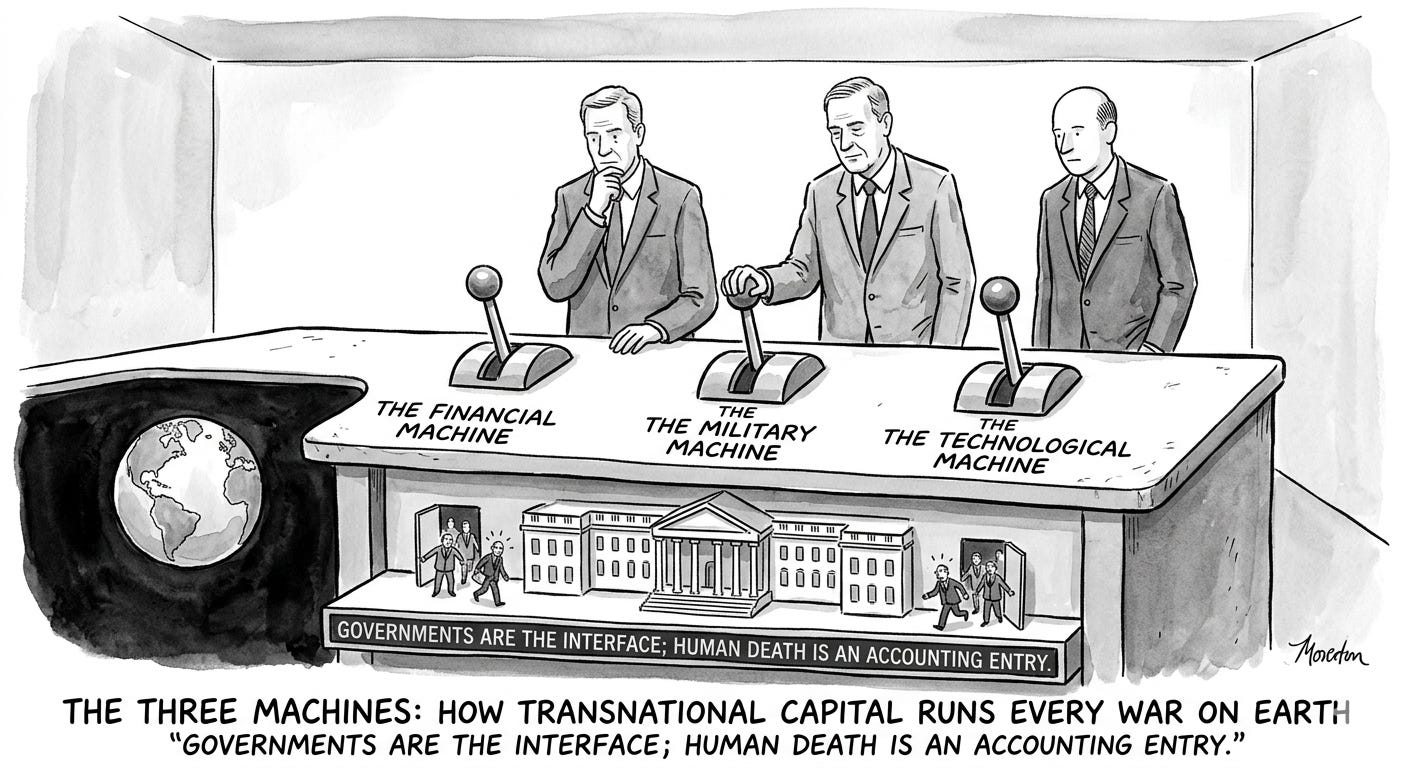
Capital Wars: The Three Machines: How Transnational Capital Runs Every War on Earth
Part 1 of 10
Every war you are watching is not a conflict between nations. It is a capital deployment event executed by a financial, military, and technological system for which human death is an accounting entry.
Start with the dead. Not as sentiment, not as moral framing, but as data. By the time this piece reaches you, more than seventy-three thousand Palestinians are in the ground and the number moves daily. Nearly two million have been displaced from northern Gaza alone. In Lebanon, Israeli operations have killed more than four thousand people and displaced over eight hundred thousand from the southern districts. In Ukraine, conservative estimates place the combined military and civilian death toll in the hundreds of thousands since February 2022, with total casualties approaching two million when the wounded are counted. In Sudan, a civil war the world stopped covering in 2023 has killed more than 150,000 people and produced the largest displacement crisis on earth, with over ten million people forced from their homes. In Yemen, a war that began in 2015 and never formally ended has killed an estimated 377,000 people, the majority from indirect causes: disease, hunger, the collapse of medical infrastructure.
You have been told these are different wars. Different causes, different actors, different histories, different failures of diplomacy. The Ukrainians are defending sovereignty against imperial aggression. The Israelis are conducting counter-terrorism operations against a listed terrorist organization. The Sudanese factions are fighting a power struggle between rival military formations. The Yemenis are caught in a regional proxy conflict between Saudi Arabia and Iran. Each war comes with its own explanatory frame, its own set of named governments, its own UN resolutions and ceasefire attempts and failed negotiations. The frames are not false, exactly. The named governments do exist. The histories are real. But the frames consistently omit the entity that finances all of it, profits from all of it, and requires most of it. That entity is not a government. It has no flag, no capital city, no elected leadership, and no interest in any of the national grievances being fought over on the ground. It is transnational capital, organized across three interlocked industrial complexes: Financial, Military, and Technological. Together, they are the actual architecture of every major conflict currently burning. Governments are their interface, not their author. And the people who run those governments are not principals either. They are personnel, recruited from the banks, the asset managers, and the defense firms that constitute the three complexes, installed in the offices that fund and regulate those same firms, and returned to them at higher pay when their term in office ends. The official who signs the contract and the executive who fills it are frequently the same person at different points in a single career. The final piece in this series follows that career to its end. For now the principle is enough: there is no level of this architecture, including the highest elected office, at which a human being is reliably acting for the public rather than for the system that employs him.
The Financial Industrial Complex: How Debt Becomes a War Machine
In August 1971, the United States president went on television and ended the Bretton Woods order. The dollar, which every major economy had been accumulating since 1944 and which every major currency was pegged to, would no longer be convertible to gold. It was backed by nothing except the continued willingness of the world to treat it as if it were worth something. Washington had roughly three years to figure out what that something would be. The answer Henry Kissinger negotiated with Saudi Arabia between 1973 and 1974 was precise: the United States would provide military hardware and a security guarantee, and in return Saudi Arabia would price its oil exclusively in dollars and recycle the surplus earnings into US Treasury bonds. Every OPEC member agreed to the same terms within two years. The dollar was no longer backed by gold. It was backed by the fact that you needed dollars to keep your economy running.
This is the Financial Industrial Complex at its founding moment: a system in which energy markets, financial markets, and military power were wired together so that the flow of money could not be separated from the flow of weapons or the threat of force. The petrodollar arrangement produced a world in which roughly two to three trillion dollars moves annually through global oil markets, a significant portion of which has historically been recycled into American government debt, suppressing Washington’s borrowing costs and locking the dollar into its position as the world’s reserve currency. What this meant in practice was that the United States could run permanent deficits, spend beyond its means, and export inflation to every economy that needed dollars to conduct trade. The French economist Valéry Giscard d’Estaing called it an “exorbitant privilege.” It was more than that. It was a structural tax levied on every country on earth, paid in the form of holding a currency issued by one government, backed by the military power of that same government.
The Financial Industrial Complex today is not headquartered in Washington. It is headquartered everywhere and nowhere. BlackRock manages approximately fourteen trillion dollars in assets as of early 2026, a historic high. Vanguard manages twelve trillion. State Street manages nearly six trillion. These three institutions alone hold significant stakes in every major defense contractor, every major energy company, every major pharmaceutical company, and the sovereign debt of most governments on earth. When a government borrows to fund a war, the FIC holds the bonds. When a weapons company wins a contract to supply that war, the FIC holds the equity. When the war ends and reconstruction begins, the FIC manages the funds and acquires the distressed assets. The circuit is complete, and it is the same circuit whether the war is in Ukraine or Gaza or Yemen or Sudan. BlackRock was announced as a lead manager of Ukraine’s reconstruction fund before the war had produced a ceasefire. The company that would profit most from rebuilding Ukraine was identified and mandated while the country was still being destroyed. That is not a coincidence. It is the system working as designed.
The Financial Industrial Complex does not care who wins. It does not have a preferred outcome in the territorial sense. What it requires is that the conflict be sustained long enough to run through the full circuit: debt issuance to fund the war, weapons contracts to conduct it, reconstruction mandates to close it, and new debt issuance by the post-war government to finance the reconstruction that the same financial institutions will manage. A short war that ends in a negotiated settlement with minimal destruction is the worst outcome for the FIC because it compresses the circuit. A long war that destroys infrastructure, displaces populations, hollows out institutions, and leaves a government dependent on external financing to rebuild is the optimal outcome. You can draw that circuit over Ukraine and it fits. You can draw it over Iraq after 2003 and it fits. You can draw it over Libya after 2011 and it fits. The specific national grievances being fought over are the fuel. The circuit is the point.
The enforcement mechanism for this system is what keeps it running. When Saddam Hussein announced in October 2000 that Iraq would accept euros rather than dollars for its oil exports under the UN programme, he was doing something the FIC could not permit: demonstrating that the petrodollar was optional. He did not survive the demonstration. Iraq was invaded in March 2003. After US forces took Baghdad, Iraqi oil sales were quietly converted back to the dollar. When Muammar Gaddafi was pursuing a gold-backed pan-African currency that would replace the dollar and the French CFA franc in African oil transactions, a leaked internal email from a US official cited the Libyan gold reserves and the currency plan explicitly as a concern. By the following year, NATO had intervened. Gaddafi was killed. The gold dinar ended with him. These are not conspiracy theories. The documentary record on both cases is substantial, and the pattern is consistent: a government that tries to route around the dollar system faces a military response whose official justifications accumulate and collapse in sequence but whose structural effect is always the same. The demonstration is suppressed and the architecture is restored.
The Military Industrial Complex: The Permanent Procurement Cycle
The Military Industrial Complex is the FIC’s enforcement arm, and it is also a profit centre in its own right. When the United States spends on defense, it spends at a scale that makes every other economy’s military expenditure a rounding error. The FY2025 base defense budget was $849.8 billion, with total DoD spending reaching $851.7 billion when supplemental funding is included. The FY2026 DoD request rises to $961.6 billion when reconciliation funding is counted, roughly equal to the combined defense spending of the next ten countries. Of that, an enormous portion flows through a procurement architecture that connects Lockheed Martin, Raytheon, Northrop Grumman, Boeing Defense, BAE Systems, and L3Harris Technologies in a web of contracts, subcontracts, and revolving-door employment relationships with the very government officials who approve the contracts. The Chair of the Joint Chiefs of Staff becomes a defense contractor board member. The Secretary of Defense comes from and returns to industry. The congressional committee members who vote on the defense budget receive campaign contributions from the companies whose budgets they are voting on. This is not corruption in the transactional sense. It is institutional design. The system produces this outcome because it was built to produce it.
The MIC does not need a war to function, but war accelerates the procurement cycle. In the six months after Russia’s invasion of Ukraine, Raytheon’s stock price rose significantly. Lockheed Martin’s backlog of orders grew to record levels. The Javelin anti-tank missile, manufactured by Lockheed Martin and Raytheon in a joint venture, was being delivered to Ukraine at a pace that required the manufacturers to expand production capacity. The United States sent Ukraine more than 8,500 Javelins, at roughly 175,000 dollars each, in the first year of the conflict alone. The weapons depleted from American stockpiles had to be replaced. The replacement orders went to the same manufacturers. The war in Ukraine was, from the MIC’s perspective, an inventory management opportunity.
Gaza and Lebanon have performed the same function for a different product set. Between October 2023 and June 2026, the United States transferred approximately ninety thousand tons of military equipment to Israel across eight hundred transport planes and one hundred and forty ships. This includes 2,000-pound bombs, precision-guided munitions, artillery shells, small arms ammunition, and the components for Iron Dome interceptors. Each transfer depletes American stockpiles, requiring replacement orders. Each replacement order funds the same manufacturers. The bombs that destroyed the Jabalia refugee camp in northern Gaza, killing hundreds in a single strike, were manufactured by Boeing. The precision-guided kits that converted unguided bombs into guided ones were manufactured by Raytheon. The aircraft that delivered them were manufactured by Lockheed Martin. When the United States Congress funds that transfer and then funds the replacement of the depleted stockpile, the money flows in one direction: toward the same handful of corporations whose major institutional shareholders are the same handful of asset managers who sit at the centre of the Financial Industrial Complex.
Human life, in this architecture, is literally an externality. It does not appear on the income statement. It does not affect the share price. It does not change the procurement cycle. Seventy-three thousand Palestinians killed produces no accounting consequence for Boeing or Raytheon or Lockheed Martin. Four thousand Lebanese killed produces no balance sheet entry. What produces balance sheet entries is the volume of munitions delivered, the replacement contracts awarded, and the next conflict that will require the next round of procurement. The MIC has a structural interest in an endless series of manageable conflicts and no structural interest in peace. Peace is the one condition under which the procurement cycle slows.
The statutory architecture that now governs the US-Israel military relationship makes this explicit in ways that are worth examining carefully. Section 224 of the National Defense Authorization Act for Fiscal Year 2027, which passed the House in June 2026 over a defeated amendment to remove it and was subsequently renumbered as Section 219 in later drafts, integrates Israeli military research, development, testing, and procurement directly into the Pentagon’s acquisition pathways. This is not a bilateral agreement subject to executive modification. It is a statutory merger between the military procurement architectures of two states. Israeli drone technology, targeting AI, missile defense systems, and cyber defense capabilities are now on the formal procurement pathway for the American military. What Israel tests in Gaza, what it refines in Lebanon, what it validates in live combat against civilian infrastructure, flows back through Section 224 into the procurement planning of the most powerful military machine in history. The laboratory is Gaza. The test subjects are Palestinian civilians. The customer is the Pentagon. The manufacturers profit on both ends: from the weapons sold to Israel to conduct the testing and from the refined systems sold to the United States after the testing validates them.
The Warning That Was Filed and Ignored
None of this was unforeseen. The architecture announced itself, on the record, at the moment of its construction, and the warning was filed and ignored in the same gesture. On the seventeenth of January 1961, three days before he left office, President Dwight Eisenhower, a former five-star general who had commanded the largest military force ever assembled, went on television and told the American public that a new thing had come into being. In the councils of government, he said, the nation must guard against the acquisition of unwarranted influence, whether sought or unsought, by the military-industrial complex, because the potential for the disastrous rise of misplaced power exists and will persist. He was not describing a conspiracy. He was describing a structure, a permanent arms industry fused to a permanent military establishment, that had not existed in American history before the Second World War and that he could see hardening into a fixture of the state. The man who named it was the man best positioned to know it was real, and the naming changed nothing, because the structure he described had already captured the institutions that would have been required to constrain it.
The financial half of the architecture was older and had been designed deliberately. In July 1944, while the war Eisenhower was fighting still had a year to run, the delegates of forty-four nations met at a hotel in Bretton Woods, New Hampshire, and built the postwar monetary order around the dollar, with the dollar alone convertible to gold and every other major currency pegged to the dollar. The International Monetary Fund and the World Bank were created in the same rooms. The arrangement was presented as a neutral framework for international stability, and for the United States it functioned as something more specific: an architecture that placed the dollar at the centre of global trade and placed the institutions that managed the dollar under American influence. When Nixon ended gold convertibility in 1971 and Kissinger wired the dollar to oil in 1974, they were not building the architecture from nothing. They were repairing the one Bretton Woods had built, after its original mechanism failed, and they were repairing it in the direction of greater American leverage rather than less.
Put the two founding moments beside each other and the shape of the thing is visible. The financial complex was designed in advance, at Bretton Woods, as the deliberate work of a state planning its postwar dominance. The military complex assembled itself in the same period and was named, at the moment of its consolidation, by the general who presided over it and could not stop it. Both were in place before any of the wars in this series were fought, and both were described accurately, in public, by the people who built them, decades before the dead in Gaza and Ukraine and Iran were added to the ledger. The system was not hidden. It was announced. The announcement was simply never assembled into a single frame and held in front of the public long enough to be acted on, which is the omission this series exists to correct.
The Technological Industrial Complex: Surveillance, Targeting, and the Data Extraction Economy
The Technological Industrial Complex is the newest of the three and the least publicly understood, which is precisely why it is the most dangerous. Its primary products are not weapons in the conventional sense. They are systems: surveillance platforms, targeting algorithms, population management tools, and data extraction architectures that allow the other two complexes to operate with greater precision and lower political cost.
Palantir Technologies, founded in 2003 with early funding from the CIA’s venture arm In-Q-Tel, provides data integration and targeting software to intelligence and military agencies across the Western world. Its systems have been used in US operations in Afghanistan and Iraq, in Israeli operations in Gaza, and in law enforcement across multiple democracies. The company’s founders describe their product as a tool for “helping the West win.” What it does in practice is allow military and intelligence agencies to process enormous volumes of data and produce targeting recommendations at a speed no human analyst team could match. When an Israeli airstrike kills a family in their home in Gaza because a targeting algorithm identified a phone associated with a Hamas operative in the vicinity, that algorithm is a TIC product. The family did not appear in the algorithm’s output as people. They appeared as acceptable proximity casualties in a targeting calculation. This is the TIC’s fundamental contribution to modern warfare: it industrializes the decision to kill, removing the human hesitation that previously functioned as a constraint.
NSO Group’s Pegasus spyware, developed in Israel and sold to governments across the Middle East, Africa, and South Asia, performs a different function: it converts a civilian population’s own communications devices into surveillance instruments against them. When the Indian government used Pegasus to monitor opposition politicians and journalists, when the Saudi government used it to track and ultimately kill Jamal Khashoggi, when multiple Gulf governments used it to monitor dissidents abroad, the TIC was performing population management. The technology does not distinguish between a security threat and a journalist or a political opponent. It identifies the target and extracts the data. What the purchasing government does with that data is its own business. The TIC sells the capability and collects the fee.
The semiconductor at the centre of all of this, the chip that makes targeting algorithms run, surveillance networks function, and digital finance move, is manufactured in a supply chain whose critical node is Taiwan. TSMC, the Taiwan Semiconductor Manufacturing Company, produces approximately 90 percent of the world’s most advanced chips. The entire TIC depends on the continued free operation of that supply chain. When Washington frames its Taiwan policy as a matter of democratic values and self-determination, it is not lying, exactly: democratic values are genuinely held by many of the people making the argument. But the structural reason the United States maintains the most significant military presence in the Pacific, including carrier strike groups, forward bases across Japan and South Korea, and a formal security commitment to Taiwan, is that losing operational control of that semiconductor supply chain would be catastrophic for the TIC and, by extension, for the FIC and MIC that depend on it. The Taiwan conflict, should it come, will be framed as a war for freedom. It will be a war for chips.
The Circuit in Full: How the Three Machines Interlock
The FIC, the MIC, and the TIC are not three separate entities that occasionally cooperate. They are three revenue streams of a single system, and their interlocking is structural rather than conspiratorial. You do not need a secret meeting to produce coordination between them. You need the right institutional incentives, and the right institutional incentives have been built into the governing architecture of every major Western democracy over the past fifty years.
The circuit works as follows. The FIC provides the capital: through central banks that hold government debt, through asset managers that hold corporate equity, through sovereign wealth funds that recycle resource revenues into financial instruments. That capital flows to governments, which use it to fund military operations and the procurement of the systems the MIC produces. The MIC produces weapons, logistics infrastructure, and intelligence systems, and sells them to governments whose military budgets are financed by the FIC’s debt markets. The TIC produces the targeting and surveillance architecture that makes the MIC’s weapons more precise and the FIC’s debt-dependent governments more capable of suppressing domestic dissent. The FIC then provides the reconstruction financing after each conflict, acquiring distressed assets and issuing new debt that the post-war government must service, re-entering the circuit at its starting point.
The human beings who live in the territories where this circuit runs are not participants in it. They are the terrain across which it operates. Gaza is not a strategic objective for any of the three machines: it has no significant hydrocarbon resources, no semiconductor manufacturing, no financial architecture worth acquiring. But it is the forward operating territory of a state, Israel, that sits at the intersection of all three complexes: the MIC’s most active testing ground for weapons that will be sold globally after live validation, the TIC’s most productive laboratory for urban warfare surveillance and targeting systems, and a political object whose security guarantee binds the US Congress through doctrinal and financial architectures that the FIC has spent decades building. The Palestinian people are not the target of the three machines in any purposive sense. They are simply in the way of the territory’s function, and the three machines have no mechanism for valuing human life that is in the way. It does not appear in their calculations. It literally does not register.
This is the most important thing to understand about the system, and it is the thing that official explanations of each individual conflict consistently fail to say: the indifference to civilian death is not a failure of the system. It is a feature of it. A system that treats human life as a cost to be minimized rather than a value to be protected will consistently produce outcomes in which civilian death is minimized only when doing so reduces political cost, not when it reduces suffering. When the political cost of civilian death is low, which it consistently is when the dead are Palestinian or Yemeni or Sudanese or Iraqi, the operational calculus produces mass death without hesitation. When the political cost is high, which it occasionally is when journalists are killed or when footage reaches a domestic audience that has been primed to care, the system produces temporary pauses, inquiries that go nowhere, and statements of concern that are withdrawn before the next weapons transfer is approved.
The Enforcement Architecture and Its Limits
The system enforces itself through several mechanisms, and understanding them is the only way to understand why it has persisted for as long as it has. The most obvious mechanism is military: governments that challenge the dollar system or the FIC’s routing architecture face the kind of consequences Saddam and Gaddafi faced. But military enforcement is expensive, politically visible, and subject to degradation when the target is capable of asymmetric response. Iran has spent four decades demonstrating that a determined regional power can absorb enormous military and economic pressure without collapsing. The Strait of Hormuz dispute of spring and summer 2026, in which Iran asserted closure of the twenty-one-mile passage through which roughly a fifth of the world’s oil flows and attempted to charge alternative-currency transit fees for friendly vessels, was the enforcement architecture running directly into its limit. Iran could not be destroyed by the means available, the means of enforcement became more expensive to sustain than the system could absorb without disruption, and as of June 2026 the situation remains unresolved, with US and Iranian negotiators meeting in Switzerland while Iran announces new closure declarations that the US military contests operationally.
The second enforcement mechanism is financial: governments that attempt to exit the FIC’s debt architecture face market pressure, currency crises, and the coordinated application of IMF conditionality that restructures their economies in directions the FIC prefers. This mechanism operates continuously across the Global South, where debt-to-GDP ratios have risen to levels that make sovereign fiscal policy a legal fiction. Pakistan is currently spending more on debt service than on education, health, and social protection combined. Nigeria’s debt service consumes more than 90 percent of government revenue in some fiscal years. Argentina has cycled through IMF programmes and sovereign defaults so many times that the IMF’s conditionality is now the de facto governing document of its economy. These are not policy failures in the sense of mistakes. They are policy outcomes in the sense of results the architecture was designed to produce. A government that cannot fund its own services without external financing is a government that cannot challenge the terms on which that financing is provided.
The third enforcement mechanism is ideological: the think tank system, the academic grant system, the media ownership structure that ensures the framing of every major conflict runs through a filter owned by the same concentrated capital that benefits from the conflict. The New York Times documented in 2014 that twenty-eight American think tanks had received at least ninety-two million dollars from foreign governments, primarily from Gulf states, in a funding architecture that likely violated the Foreign Agents Registration Act. The Brookings Institution, the Center for Strategic and International Studies, and the Atlantic Council were among the named recipients. The policy frameworks these institutions produce on Middle East conflicts, on energy security, on the terms of NATO expansion, on the appropriate response to Chinese economic competition, are not independent analysis. They are the ideological product of a system that funds the analysis it needs to legitimate the conclusions it has already reached.
The Multipolar Moment and What It Changes
Something is changing in this architecture, and it is important to be precise about what is changing and what is not. The dollar’s share of global foreign exchange reserves has fallen from approximately 71 percent in 1999 to roughly 56.3 percent by late 2025, its lowest level since the IMF began comprehensive tracking. Central banks globally are now holding more gold than US Treasury securities for the first time since 1996, adding more than a thousand metric tons annually over the preceding three years. Saudi Arabia allowed the informal petrodollar arrangement, under which Gulf oil was priced exclusively in dollars and surpluses recycled into American Treasury bonds, to lapse without renewal in 2024, for the first time since the Kissinger-Faisal agreements of 1973 and 1974. No formal treaty obligated this arrangement, but its practical effect was decades-long and its lapsing matters: Riyadh now holds the option to price some sales in yuan, euros, or other currencies, though as of mid-2026 approximately 96 percent of Saudi oil sales remain dollar-denominated. Russia, India, China, and Brazil are settling a growing share of bilateral trade in national currencies rather than dollars. Iran demonstrated that a heavily sanctioned, militarily pressured state can attempt to operate an alternative payment architecture through a twenty-one-mile strait and charge admission in a rival currency, even if the operational reality of that closure remained contested through June 2026.
None of this means the dollar is collapsing or the FIC is finished. The Bank for International Settlements’ most recent survey found the dollar involved in approximately 89 percent of all foreign exchange transactions, up from the previous survey. No alternative currency combines the convertibility, depth, and institutional infrastructure required to substitute for it at global scale. The yuan is not freely convertible, a deliberate Chinese policy choice that protects against the destabilizing capital flows that dollar convertibility enables but also limits the yuan’s function as a reserve asset.
What is changing is the enforcement architecture. The system that disciplined Saddam and Gaddafi for attempting to route around the dollar ran into a limit in Iran and has been running into limits in Russia since the SWIFT freeze demonstrated that dollar reserves are revocable. When Washington froze approximately three hundred billion dollars in Russian central bank assets in February 2022, it was the first time a major economy had used the financial system itself as a direct weapon of war against another major economy. The intended effect was Russian economic collapse. The actual effect, beyond the immediate ruble depreciation and inflation, was to tell every other government on earth that dollar-denominated reserves are not property, they are a revocable privilege conditional on political alignment with Washington. The governments that drew that lesson and began diversifying more aggressively are now substantial enough in number that the enforcement architecture has a credible competing model to contend with.
This is the context in which every war you are currently watching must be understood. The FIC/MIC/TIC system is not in decline, but it is under pressure, and conflicts that once served straightforwardly as enforcement actions are now producing outcomes the system cannot fully control. The Iran war has not produced the regime change and hydrocarbon seizure it was designed to produce. The Ukraine war has not produced the Russian economic collapse and asset transfer it was designed to produce. Gaza has not produced the Hamas elimination and territorial control it was designed to produce. Each of these failures costs the system political credibility and financial resource, and each failure accelerates the search for an alternative architecture by governments that are watching. The world is not becoming peaceful. The world is becoming multipolar, and multipolarity does not produce peace. It produces a competition between two enforcement architectures in which the populations caught between them pay the price that neither system bothers to calculate.
The human dead in Gaza, in Lebanon, in Ukraine, in Sudan, in Yemen are not the collateral of a political failure. They are the product of a system that processes human life as a variable with no fixed value, subject to reduction whenever the operational requirement demands it and the political cost permits it. The three machines have been running long enough that the language of geopolitics has fully absorbed their logic: we speak of “civilian casualties” as if casualties were a weather event rather than a consequence of specific decisions made by specific people in the service of specific financial interests. We speak of “complex conflicts” as if complexity were the obstacle to understanding rather than a framing choice that serves the system by preventing the question of who profits from being asked. The question is not complex. The answer is documented, specific, and consistent across every conflict currently burning. The three machines profit. The dead do not count.
Every subsequent piece in this series takes one conflict and runs it through this lens. The argument does not change. The evidence accumulates.
References
The Financial Industrial Complex / petrodollar
Nixon ends dollar-gold convertibility (1971): Federal Reserve History — “Nixon Ends Convertibility of US Dollars to Gold”
Bretton Woods (1944): Federal Reserve History — “Creation of the Bretton Woods System”
Petrodollar mechanism (Kissinger–Saudi, 1974): Investopedia — “Petrodollars”
Petrodollar “50-year treaty” myth / 2024 lapse nuance: AFP Fact Check — no 50-year petrodollar agreement existed and Reuters
“Exorbitant privilege”: Barry Eichengreen, Exorbitant Privilege: The Rise and Fall of the Dollar (Oxford University Press, 2011)
BlackRock / Vanguard / State Street AUM: BlackRock newsroom, Vanguard — Fast facts, State Street newsroom
The Military Industrial Complex
Eisenhower’s “military-industrial complex” farewell address (Jan 17, 1961): U.S. National Archives · Avalon Project, Yale Law School (full transcript)
U.S. defense budget figures: DoD Office of the Under Secretary of Defense (Comptroller) · SIPRI Military Expenditure Database
Javelin missiles to Ukraine (Lockheed Martin–Raytheon joint venture): Lockheed Martin — Javelin · CSIS — tracking U.S. aid to Ukraine
The Technological Industrial Complex
Palantir, founded 2003 with In-Q-Tel (CIA venture arm) backing: In-Q-Tel · company background via Reuters
NSO Group / Pegasus, the Khashoggi circle, and global targeting (the Pegasus Project, 2021): The Citizen Lab · The Washington Post — Pegasus Project
TSMC produces ~90% of the world’s most advanced chips: CSIS · Reuters
Enforcement and the multipolar shift
Iraq switches oil sales to euros (2000), reversed after 2003 invasion: The Guardian (Feb 2003)
Libya’s gold-backed currency plan in the 2011 record: 2011 email (Blumenthal to Clinton) released via U.S. State Department FOIA; see Wikipedia summary with primary-document citations (contested/secondary — treat as the documentary basis, not settled fact)
Think tanks and foreign-government funding ($92M): Eric Lipton, Brooke Williams & Nicholas Confessore, “Foreign Powers Buy Influence at Think Tanks,” The New York Times (Sept. 6, 2014) (2015 Pulitzer, Investigative Reporting)
Dollar’s share of global reserves (~71% in 1999 → ~56–57% in 2025): IMF COFER database · IMF COFER data brief, Oct 2025
Central banks’ gold buying (>1,000 tonnes/yr): World Gold Council — Goldhub
Dollar in ~88–89% of FX transactions: BIS Triennial Central Bank Survey 2022
2022 freeze of ~$300B in Russian central-bank reserves / SWIFT exclusion: Reuters · Council of the EU