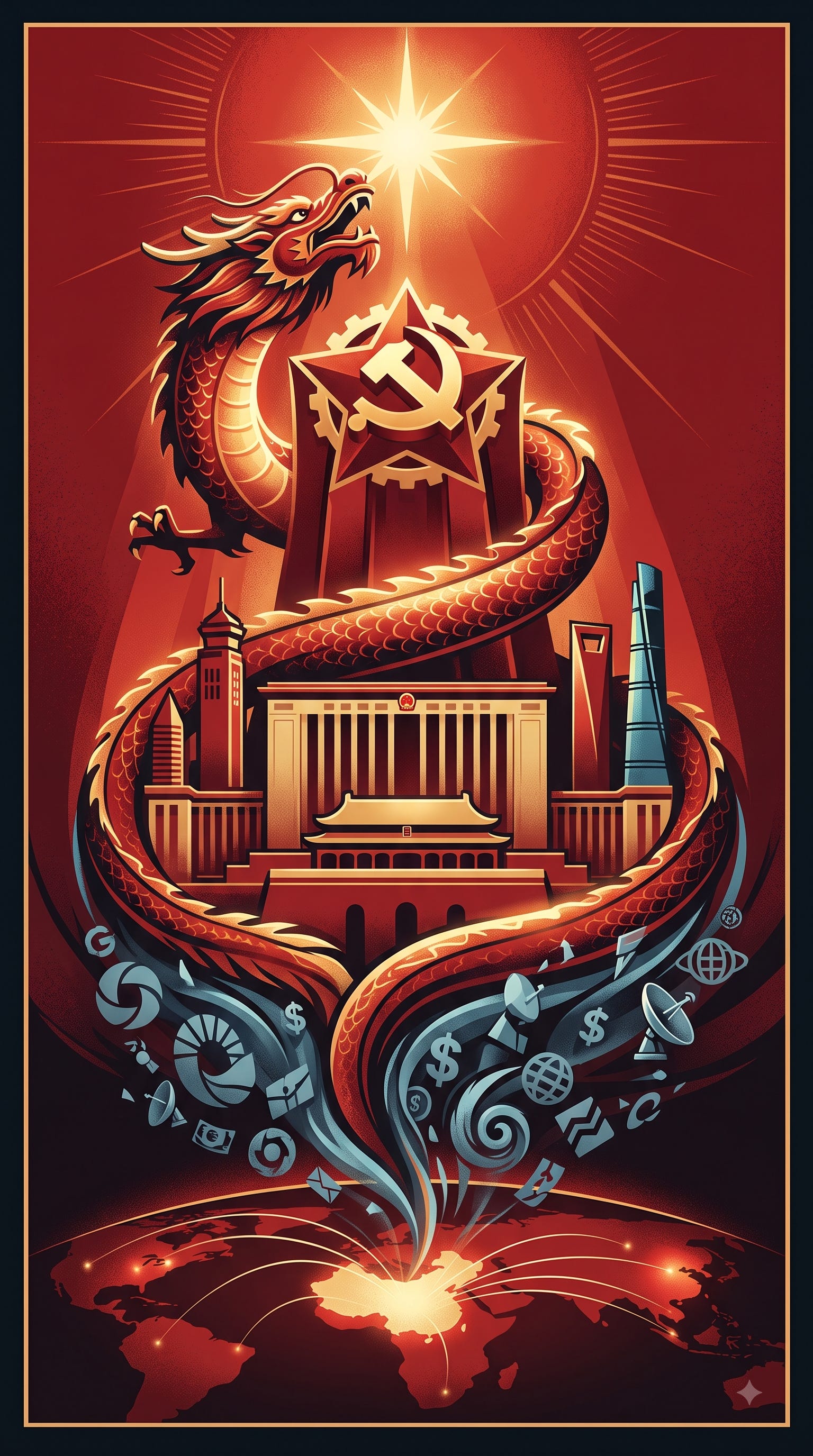
China In The New World Order
Most governments ask what markets will permit. Beijing asks what the Party requires, and the factories, banks and billionaires adjust.
Look around the room and China is already there. The battery inside the phone, the solar cells on a neighbour’s roof, the modem carrying the call, the steel inside the appliance and the container that moved all of it across an ocean belong to supply chains in which Chinese factories occupy the decisive stage. You may never have visited Shenzhen, Ningbo or Suzhou, and you may distrust Beijing’s politics, but parts of your ordinary life pass through an industrial system built there. China does not need you to admire it. It has made itself difficult for you to avoid.
That material presence is the outcome of a political decision most of the world was never permitted to make. Across the US-led order, governments were told that capital must remain free to choose where it invests, factories must justify themselves through private return, public industries must accept the discipline of competition and finance must be protected from political interference. The instructions sounded neutral because economists delivered them as technique. You lived the result as something less abstract: the railway that was never built because its social use could not satisfy a private balance sheet, the electricity network sold and resold while the bill rose, the medicine priced beyond the wage, the factory moved abroad and the government explaining that markets had spoken.
China listened to the same doctrine, took the investment, learned the production methods, entered the World Trade Organization and sold goods to every market willing to buy them. It never accepted the final commandment. Capital could operate in China, grow in China and become immensely rich in China, but it would not acquire the right to tell the Chinese state what the state was allowed to build. The bank would serve the industrial target. The billionaire would serve the political boundary. The army would serve the Party. If any of them confused economic size with sovereign authority, Beijing retained the instruments to correct the confusion.
This is why China feels so different from the rest of the world. The distinction lies deeper than communism against capitalism, public ownership against private enterprise or authoritarianism against democracy. China has stock exchanges, landlords, private employers, venture funds, speculative fortunes, harsh workplaces and some of the richest people on earth. Its break with the prevailing order is located in the chain of command. In most countries, the state negotiates with concentrated capital as a power it cannot afford to lose. In China, capital negotiates with a Party it cannot afford to defy.
There is an achievement inside that sentence and a warning beside it. China protected the political capacity to direct money towards production, infrastructure and technological independence, and the result is visible in the physical world at a scale no development slogan can counterfeit. The same Party controls courts, regulators, police, media and organised political life, and yet the worker, homeowner, journalist and entrepreneur possess no independent institution capable of ordering it to stop. China made capital obey. It did not give the public command.
You know the weaker arrangement because you have watched governments perform it. A new administration enters office promising housing, rail, healthcare or industrial renewal, then the explanations begin. Bond markets need reassurance. Ratings agencies expect fiscal restraint. Investors require predictability. Corporate taxes might cause capital flight. Public ownership could disturb competition. The programme survives the election and dies in the meeting where nobody elected has the power to say no.
The language changes by country. In Washington, procurement must preserve jobs across congressional districts and legislation must survive the industries financing the next campaign. In Brussels, competition rules and fiscal limits narrow national industrial choices. In Pakistan, the IMF programme, external creditors and domestic institutional estates decide how much sovereignty remains after debt service. In much of Africa and Latin America, the country exports ore, oil, crops or labour and imports the finished machinery at a price set somewhere else. The flag belongs to the state. The timetable belongs to capital.
This submission rarely requires a conspiracy. A pension fund seeks returns, a bank protects its exposure, a weapons company protects a programme, a pharmaceutical group protects a patent and an asset manager protects the value of its holdings. Each actor can claim it is fulfilling a narrow legal duty. Together they determine which public needs qualify as investable, which wars qualify as necessary, which industries qualify for rescue and which households must absorb adjustment. The state retains ceremonies, elections and uniforms, but it learns to present corporate confidence as national confidence because the consequences of losing the first arrive before the political system can defend the second.
The frustration is personal long before it becomes ideological. You pay tax for public transport and then finance a car because the bus never comes. You pay an electricity bill carrying the losses, debt and guaranteed returns of the power system and then buy a battery because the grid fails. You contribute to a health service and then purchase private insurance because the queue is longer than the illness permits. The state collects for the public duty, capital sells the private substitute, and yet every budget debate begins with the cost of providing the service rather than the cost already imposed by its absence.
China’s rulers recognised another danger inside this hierarchy. Economic power does not remain confined to commerce once it becomes large enough. It buys newspapers and platforms, finances political factions, recruits former officials, directs research, shapes law and eventually develops a theory of why its preferences constitute the national interest. The collapse of the Soviet Union gave the Chinese Communist Party the historical warning it needed. Beijing’s reading was unforgiving: once the ruling institution loses control over appointments, ideology, security and the commanding assets of the economy, the men who acquired property during the transition will acquire the state that protects it.
The Party’s answer was to welcome accumulation without permitting an independent capitalist class to mature into a rival political authority. Deng Xiaoping’s reforms allowed markets to set prices and private firms to grow, but the state kept the land, the banking core, capital controls and the strategic enterprises. Later leaders loosened and tightened the arrangement. Under Xi Jinping, the boundary became explicit again. The firm could become global. The Party would remain above it.
The ownership label tells only part of the story. China’s constitution protects lawful private property and calls the non-public economy an important component of the socialist market system, while giving the state the authority to encourage, guide, supervise and regulate it. The Communist Party’s constitution assigns Party organisations inside private businesses the work of implementing Party policy, supervising compliance, leading internal mass organisations and promoting the Party’s definition of healthy development. Chinese company law requires firms to provide the conditions in which those organisations operate. PRC Constitution CPC Constitution State Council Information Office
A Party branch does not need to approve every invoice to matter. Its presence tells the founder, workers and local officials that the company sits inside the political system rather than beside it. The relationship then runs through licences, state contracts, access to land, regulatory tolerance, bank credit, data rules and personnel. A company may remain privately registered and publicly traded, but every route needed to become nationally important passes through institutions answerable to the Party.
State ownership secures the sectors Beijing considers too important to leave exposed. At the end of 2025, the central enterprises supervised by the State-owned Assets Supervision and Administration Commission held more than 95 trillion yuan in assets. During that year they reported 2.5 trillion yuan in profit, invested 5.1 trillion yuan in fixed assets and spent 1.1 trillion yuan on research and development. Their investment in strategic new industries reached 2.5 trillion yuan, or 41.8 per cent of total investment. SASAC These groups occupy energy, telecommunications, rail, shipping, aerospace, nuclear power, mining, construction and heavy industry. They earn money, issue debt and compete, but their balance sheets also carry political instructions.
The difference appears in the investment horizon. A private fund can abandon a supplier, town or technology once the expected return falls below another opportunity. A state-directed enterprise can keep building because the return is measured in technical knowledge, employment, domestic supply, export capacity and strategic resilience alongside profit. That permission produces waste and protects failure, but it also allows a country to accumulate capability that no quarterly earnings call would tolerate. The railway reaches the city before passenger demand is mature. The port expands before trade fills it. The component factory survives while engineers learn. By the time the market recognises the opportunity, the industrial ecosystem already exists.
Banking makes the long horizon possible. The International Monetary Fund’s 2025 assessment described China’s financial system as bank-centred, largely government-controlled and highly interconnected. Five state-owned global systemically important banks and one other large bank held about 42 per cent of banking assets. IMF Financial System Stability Assessment Policy banks, state shareholdings, provincial influence and regulators extend that reach well beyond the largest six. Beijing can push credit towards electric vehicles, renewable energy, advanced machinery, semiconductors or infrastructure because finance sits inside the development strategy.
The rest of the world was taught to regard this as distortion. The word performs useful work. It turns a political choice made in Washington, London or Brussels into a natural price and a political choice made in Beijing into interference. China certainly distorts markets, subsidises producers, protects selected sectors and carries losses through public institutions. Western governments also purchase weapons through protected contractors, rescue banks, guarantee deposits, grant pharmaceutical monopolies, subsidise agriculture and design tax codes around chosen industries. Beijing’s offence was never intervention itself. It was using intervention to move industrial power towards China while refusing to let Western capital determine the limit.
Control of the capital account reinforces the refusal. China opened routes for trade and investment without granting money an unrestricted right to leave whenever public policy displeased it. The People’s Bank of China has described capital-account convertibility as a goal to be advanced under risk control, and its own account of reform says the renminbi remains convertible or partly convertible across most categories rather than wholly surrendered to free movement. People’s Bank of China The distinction can feel remote until you watch a country face a currency run. Investors sell, reserves drain, imports become more expensive, debt service rises and the government reverses policy. China constructed gates around that disciplinary route.
The military remains under the same roof. China’s Ministry of National Defense describes Party construction as the foundation of the armed forces and political work as their lifeline. The National Defense Law lists support for Communist Party leadership and the socialist system among the missions of the People’s Liberation Army. Ministry of National Defense National Defense Law The Party controls the Central Military Commission, the senior appointments and the state defence groups, then directs civilian research and commercial technology towards military requirements. A weapons company does not build an independent political base from which to pressure the purchaser. The purchaser, regulator, owner and political command converge.
Finance, industry and the military follow the same political command, and technology companies learn where disobedience ends by watching what happens to the firm that crosses it.
On 17 February 2025, Chinese state television showed Jack Ma standing in the Great Hall of the People at a symposium of private entrepreneurs. Xi Jinping was meeting founders and executives from technology, electric vehicles, batteries, agriculture and manufacturing as Beijing tried to restore private confidence. Ma’s presence carried its own history. Less than five years earlier, he had criticised China’s financial regulators in a Shanghai speech, Ant Group was preparing what was expected to be the world’s largest initial public offering, and the state stopped it.
Alibaba’s 3 November 2020 filing with the United States Securities and Exchange Commission announced the suspension in corporate language. Regulators had summoned Ma and other Ant executives, the financial-technology environment had changed and the company might no longer satisfy listing conditions. Investors had been preparing for an offering of roughly $37 billion, and yet the market never received the opportunity to price it. Alibaba SEC filing TIME
The intervention was not proof that Ant was innocent. Its lending operation connected data, technology and bank funding at a scale capable of transferring risk through the wider financial system. China had reason to regulate it. The meaning lay in final authority. Jack Ma could criticise, bargain and comply, but he could not use shareholders, courts, media allies, campaign donations or the threat of capital flight to make the state negotiate with him as a political equal.
Alibaba received an 18.228 billion yuan antitrust fine in April 2021, equal to 4 per cent of its 2019 domestic sales. The State Administration for Market Regulation found that the company had abused its market dominance by forcing merchants to choose its platform over competitors, using rules, data and algorithms to enforce the demand. State Administration for Market Regulation In another system, an antitrust case of that size would create years of litigation and lobbying while the firm’s public-relations operation turned monopoly into consumer freedom. In China, the legal case and the political demonstration arrived together.
Didi tested a second boundary. The ride-hailing company listed in New York in June 2021 and raised about $4.3 billion. Chinese authorities opened a cybersecurity review and removed its apps from domestic stores. Didi later told the SEC that it would seek no listing elsewhere before completing the required rectification. Its shareholders approved withdrawal from the New York Stock Exchange in May 2022 and the shares were delisted the following month. Didi SEC filing A private platform had accumulated the travel data of Chinese citizens and placed itself within an American financial jurisdiction. Beijing decided that the data mattered more than the flotation.
Then came the private tutoring industry. Families had been spending heavily to keep children competitive inside an education system that made one examination carry enormous weight. In 2021, the government forced companies teaching core school subjects to operate without profit, restricted foreign investment and erased the commercial basis of a vast sector within months. The order reduced some household costs and destroyed jobs, investments and businesses through a process those affected could not contest politically. The same authority that can rescue a family from corporate extraction can remove the family’s livelihood. You do not get one power without meeting the other.
By 2025, Beijing needed the entrepreneurs again. Private investment was weak, the property sector remained damaged and the technology confrontation with the United States required precisely the founders, engineers and manufacturers whose confidence the earlier campaigns had shaken. China adopted its first foundational law devoted to the private economy in April 2025. Its 78 articles promised fair competition, financing access, technological support and protection of lawful rights. When the law took effect on 20 May, China had more than 57 million registered private enterprises, accounting for over 92 per cent of all businesses, more than 60 per cent of GDP and 80 per cent of urban employment. State Council
The law reassures capital and preserves command in the same document. Private business receives protection because China needs what it produces. The Party remains the institution that defines the protection, interprets the boundary and decides when another national interest takes priority. Jack Ma’s return to the Great Hall of the People was therefore neither defeat nor rehabilitation in the Western sense. It was a recall. The state needed the entrepreneur, and the entrepreneur appeared.
The verdict on this system cannot be confined to the fate of billionaires because most readers will never become one. Its strongest claim sits inside the goods surrounding you and the industrial geography behind them. According to UNIDO’s 2025 Industrial Statistics Yearbook, China produced 32 per cent of global manufacturing value in 2024, up from 2.8 per cent in 1990. The United States produced 15 per cent, Japan 6.3 per cent, Germany 4.6 per cent and South Korea 3.3 per cent. China exceeded the next four combined. UNIDO Industrial Statistics Yearbook 2025
Thirty-two per cent means more than a league table. It means a solar project in South Asia depends on Chinese panels, an electric-vehicle manufacturer depends on Chinese battery supply chains, a telecommunications network prices Chinese equipment, a shipowner waits for Chinese yards and a Western industrial policy begins by asking how quickly a dependency on China can be reduced. The country that once supplied low-cost labour now occupies entire systems of production. It learned to make the component, then the machine that makes the component, then the port, grid and financing structure that allow the machine to dominate its market.
Cheap labour did not produce that outcome on its own. Countries across the Global South offered low wages, tax concessions, weak unions and raw materials, and many were rewarded with assembly plants that could leave as quickly as they arrived. China forced foreign investment into an environment shaped by domestic infrastructure, joint production, local suppliers, state finance and an immense internal market. The bargain often favoured foreign firms and exploited Chinese workers, but the technical capacity accumulated within the country. China sold labour and bought time to learn.
The lesson becomes uncomfortable because it exposes the difference between attracting investment and building sovereignty. A government celebrates when a foreign company opens a plant. The press release counts dollars pledged and jobs promised. Nobody asks who owns the patents, where the machinery came from, which bank financed the supplier, whether local firms can reproduce the product or how quickly the investor can leave. China asked those questions for decades. It made access to its labour and consumers part of an industrial exchange, and it broke agreements, coerced transfers and subsidised domestic competitors where its objectives demanded it. The methods deserve scrutiny. The result still stands.
Western industrial policy now carries an unintended confession. Semiconductor controls, domestic-content rules, battery subsidies, the CHIPS Act and the language of supply-chain security all accept that strategic production cannot be assigned to private cost calculations alone. Washington once told other countries to open, privatise and specialise according to comparative advantage. It now spends public money to recover capacity lost under that advice. Beijing did not discover an exotic economic law. It refused to forget an old one: the country that cannot make what it needs will eventually answer to the country or company that can.
The bill for China’s achievement is also reaching ordinary people. For years, local governments financed themselves through land sales, developers borrowed against rising prices, households placed savings into apartments and construction carried employment across an enormous chain of industries. Political authority could keep credit moving, manage defaults and prevent creditors from seizing the timetable. It could not make a young family buy another flat, persuade an owner that an unfinished apartment was safe or restore income confidence through an instruction.
China’s first-half 2026 data show the split. The National Bureau of Statistics reported GDP of 69.57 trillion yuan, 4.7 per cent higher than a year earlier. Manufacturing value added rose 5.5 per cent. Fixed-asset investment fell 5.7 per cent, state-holding investment declined 2.3 per cent and non-governmental investment dropped 8.5 per cent. Investment in intellectual-property products rose 9.4 per cent while construction and installation fell 8 per cent. National Bureau of Statistics GDP release National Bureau of Statistics investment release
The numbers describe a state still pushing money towards knowledge, equipment and strategic industry while private owners retreat from the broader economy. Entrepreneurs received a new law, a public meeting and promises of equal treatment, and yet they remember how quickly an industry can cross an unwritten line. Households hear appeals to consume while watching property values, employment prospects and local services. Command can allocate credit. Confidence has to be returned by the people who withheld it.
There is another failure that GDP cannot register. A system designed to make every institution report upward becomes poor at carrying unwelcome information in the opposite direction. Local officials learn which target must be met, banks learn which borrower must remain alive, executives learn which criticism is unsafe and journalists learn which fact will convert reporting into disloyalty. The centre receives compliance until the cost of compliance becomes too large to hide. The Party can move faster than a democracy because it has removed the veto points, and yet some of those veto points exist to tell a government that the policy is hurting people before the damage becomes national.
Workers do not acquire sovereignty because their employer answers to the Party. Independent unions remain constrained. A delivery rider facing an algorithm, a homeowner confronting a developer, a village resisting land acquisition and a parent whose child lost a tutoring job cannot build an autonomous political organisation capable of forcing the Party to negotiate. The public may benefit when Beijing disciplines a monopoly, directs a bank to maintain lending or orders infrastructure into an underserved region. It remains dependent on the Party deciding that the public benefit aligns with the Party’s own survival.
This is the point admirers of China evade. They see the billionaire subdued and imagine the worker elevated. Power does not move automatically from one to the other. The Party occupies the space between them, deciding when labour, capital, national security and growth deserve priority. It has often used that authority to build what private capital would not build and protect capacities a market would have sold. It has also used it to suppress the people whose sacrifice financed the achievement.
For a reader living in a country where creditors write the budget, corporations price public necessities and an entrenched institution protects its own commercial estate, China’s refusal carries an undeniable attraction. Here is a state that can tell a bank to lend, tell an energy company to build, tell a billionaire to sit down and tell foreign capital that access is conditional. Here is proof that financial markets possess only the authority governments surrender to them. After decades of being told that no alternative exists, the sight of capital obeying is powerful.
Imitation would answer the wrong question. Most countries do not possess China’s continental market, revolutionary state, administrative reach, manufacturing base or capacity to discipline foreign firms without losing the entire investment proposition. More important, replacing rule by corporations with rule by an unanswerable party does not return the state to its people. It changes the master of the machinery.
The useful lesson is narrower and harder. Political sovereignty requires the capacity to direct finance towards public purpose, protect strategic production, control essential infrastructure and prevent private wealth from purchasing a veto over elected policy. Democracy without that capacity becomes a ceremony conducted inside limits set elsewhere. China retained the capacity and removed the democratic claim. The rest of us are told to choose between a state too weak to confront capital and a state too strong for its citizens to confront, as though those were the only arrangements history permits.
China’s factories have already disproved one half of that instruction. Industrial dependence is made by policy and can be unmade by policy. Finance can be directed. Capital can be contained. A government can decide that the bridge, railway, grid, laboratory or shipyard will exist before the private return appears. The unanswered question is who gets to decide the purpose once the state has recovered that power.
You can hold the Chinese-made phone, draw power from the Chinese-made solar panel and watch governments across the world reorganise policy around the factories that produced them. The industrial achievement is in your hand. So is the warning: the Party taught capital to obey, and no institution remains above the Party to teach it the same lesson.


