Christian Zionism Part V: The Institutional Zenith, Obama Through Gaza (2009 to 2024)
Part 5 of 6
On June 4, 2009, Barack Obama stood in the Great Hall of Cairo University and told the assembled audience that the United States did not accept the legitimacy of continued Israeli settlement construction. “This construction violates previous agreements and undermines efforts to achieve peace. It is time for these settlements to stop.” The sentence was unqualified. It was stated in a venue and before an audience that gave it political weight beyond any previous American statement on the subject. And it was, in the professional assessment of everyone watching, the clearest direct challenge to Israeli settlement policy that a sitting US president had delivered in decades.
The Israeli government rejected it. AIPAC mobilised. CUFI issued action alerts. The congressional response was rapid and bipartisan: dozens of legislators signed letters and made statements insisting that the United States should not be conditioning relations with Israel on settlement freezes. Within months, the Obama administration had retreated from its demand for a complete freeze to a position accepting “natural growth,” the same formulation that had allowed the settlement enterprise to expand continuously throughout the Clinton years. By the end of 2009, the Cairo demand was effectively dead.
Obama spent the next seven years managing the consequences of that retreat. He maintained record levels of military aid to Israel, eventually signing a ten-year memorandum of understanding worth $38 billion in security assistance. He used the US veto at the UN Security Council to shield Israel from resolutions on settlements. He declined to impose any formal sanction on the settlement enterprise despite its continued and documented expansion. He made multiple attempts at renewed peace negotiations, including the intensive effort by Secretary of State John Kerry in 2013 and 2014, all of which collapsed.
The Public Deterioration
Obama’s relationship with Benjamin Netanyahu deteriorated into something unusual in the diplomatic record. Netanyahu lectured Obama on Zionist history during an Oval Office meeting in May 2011, speaking at length about why the 1967 lines were indefensible in a fashion that White House staff described as a dressing-down conducted before cameras. In October 2014, Jeffrey Goldberg published in The Atlantic a report in which unnamed senior Obama administration officials described Netanyahu as “chickenshit,” focused on his own political survival, and unwilling to make the decisions a serious leader in his position would be compelled to make. The vocabulary was extraordinary in the context of US-Israel relations. Its publication was a diplomatic incident.
The Christian Zionist world received all of this with consistent interpretation: Obama was a threat to Israel, a president whose instincts ran toward the forces historically aligned against the Jewish state, a man whose Cairo speech and subsequent behaviour had demonstrated that he could not be trusted to maintain the covenant alignment that Genesis 12:3 required. CUFI ran sustained messaging through its church and campus networks characterising Obama’s approach to Israel as dangerous. The Iran nuclear agreement became the defining confrontation.
The Iran Deal and the Largest Campaign
In July 2015, the Obama administration concluded negotiations with Iran and five other world powers on the Joint Comprehensive Plan of Action, which imposed international inspection regimes on Iran’s nuclear programme in exchange for relief from international sanctions. From the dispensationalist perspective, the agreement was not merely a foreign policy mistake. It was a theologically legible act of disobedience.
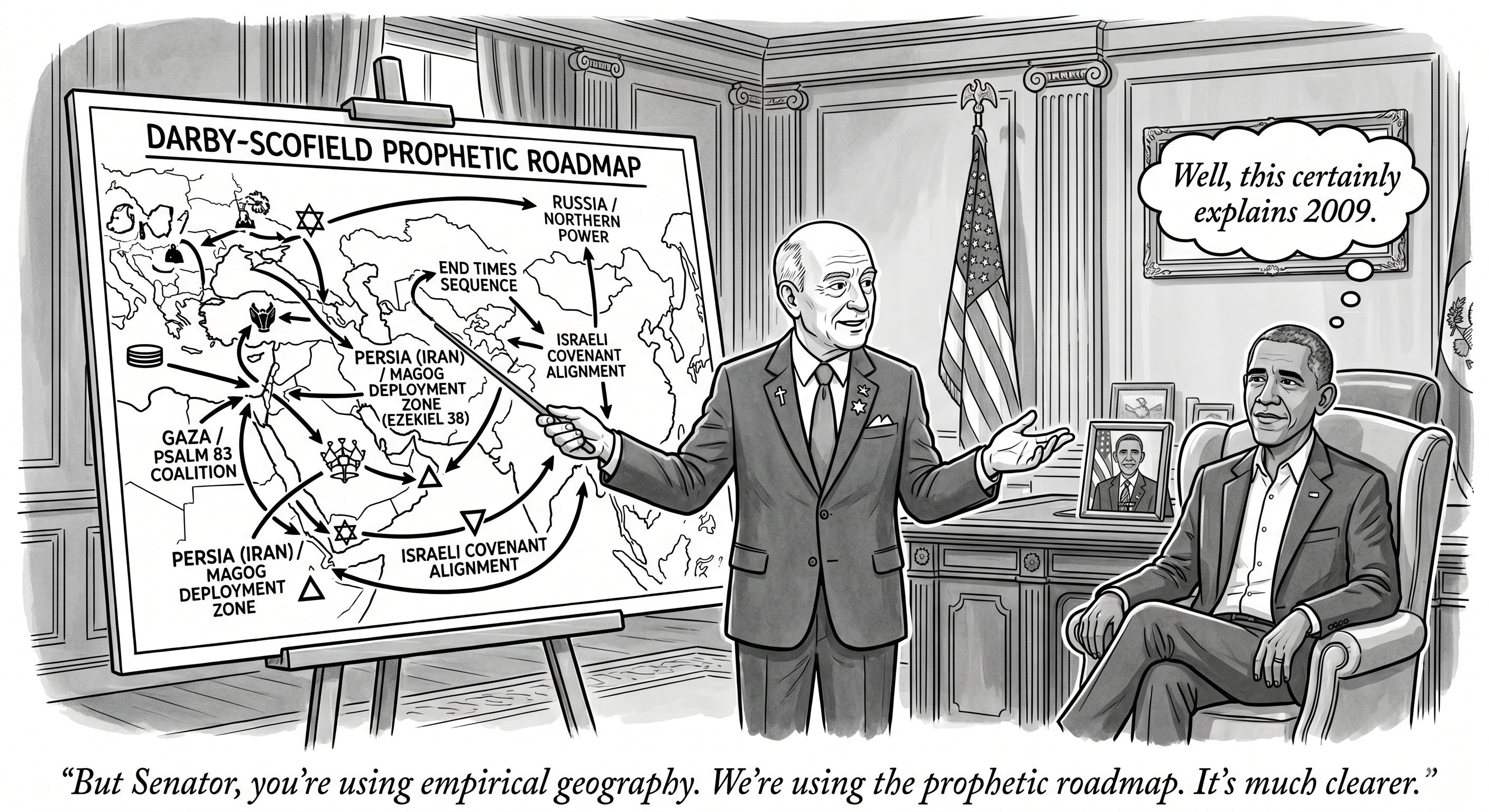
Iran figures in dispensationalist prophecy literature with considerable specificity. Ezekiel 38 describes a coalition led by “Gog of the land of Magog” that will gather against a restored Israel in the last days. The coalition includes a people associated with Persia, which is Iran, alongside forces from Libya and Ethiopia and a northern power universally identified with Russia. An agreement that removed sanctions, returned frozen assets, and constrained rather than eliminated Iran’s nuclear capacity was, in this reading, an agreement that delayed the prophetic confrontation between Iran and Israel that the end-times sequence required.
CUFI mounted the most extensive lobbying campaign in its history to defeat the agreement in Congress. Its members flooded congressional offices with calls and letters. It coordinated with AIPAC, which ran what its own leadership described as the largest legislative lobbying effort in the organisation’s history. Netanyahu appeared before a joint session of Congress in March 2015, at the invitation of House Speaker John Boehner and without coordination with the White House, a breach of diplomatic protocol sufficiently serious that the Obama administration lodged a formal protest, and delivered an extended argument against the deal directly to American legislators. CUFI treated the speech as an act of prophetic courage.
The agreement survived. Obama used the executive agreement mechanism to avoid the need for Senate ratification, acknowledging that he lacked the two-thirds supermajority to overcome the combined opposition. The campaign against the deal demonstrated the coalition’s full operational capacity: sustained mobilisation across multiple organisations, bipartisan congressional reach, and the ability to generate sufficient political pressure to force an administration into a constitutional workaround rather than a normal treaty ratification process. The movement could make a foreign policy deeply costly even when it could not ultimately defeat it.
Donald Trump withdrew from the JCPOA in May 2018. Secretary of State Mike Pompeo, an evangelical Christian who had publicly stated his belief that the end times might be unfolding in his lifetime and that his role in government might have a providential dimension, described the withdrawal as a strategic necessity. CUFI celebrated.
The Trump Deliverables
Donald Trump’s first term delivered to the Christian Zionist coalition the most concentrated list of substantive policy gifts in its history, and the sequence is worth recording in full.
December 2017: Trump recognised Jerusalem as the capital of Israel, reversing decades of formal US ambiguity on the city’s status. The decision was made over the objections of the State Department, the Defense Department, all US Arab allies, the EU, and the UN General Assembly, which passed a resolution demanding the US reverse the decision 128 to 9, with 35 abstentions.
May 2018: The US Embassy relocated from Tel Aviv to Jerusalem. The opening ceremony featured John Hagee, founder of CUFI and the man who had described Hitler as God’s hunter of the Jewish people, giving a blessing. It also featured Robert Jeffress, the Dallas megachurch pastor who had publicly stated that Judaism led people to hell, delivering the opening prayer. Two men with documented records of theological antisemitism opened the ceremony for the transfer of the US Embassy to the city that three Abrahamic faiths regard as sacred.
March 2019: Trump recognised Israeli sovereignty over the Golan Heights, territory captured from Syria in 1967 and formally annexed by Israel in 1981 in a move that no previous US administration had endorsed. The announcement was made in the Oval Office with Netanyahu present, four weeks before the Israeli election, in what was widely understood as a deliberate intervention in Israeli domestic politics on Netanyahu’s behalf.
August 2019: The US terminated its annual contribution to UNRWA, the United Nations Relief and Works Agency providing education, healthcare, and food assistance to Palestinian refugees. The funding cut eliminated a primary source of humanitarian services in Gaza and the West Bank.
September 2019: The PLO diplomatic mission in Washington was shuttered.
January 2020: The administration released its “Peace to Prosperity” framework, which accepted Israeli annexation of settlements and the Jordan Valley while offering Palestinians a non-contiguous political entity lacking sovereign control over its borders, airspace, or external relations.
Each of these decisions was taken over the formal objections of career State Department professionals. Each delivered something the Christian Zionist movement had been demanding, in its theological literature and its congressional lobbying, for years or decades. Mike Pence, who attended every CUFI annual summit and had described himself as a Christian first, a conservative second, and a Republican third, was the internal guarantor. Paula White-Cain, Trump’s personal spiritual adviser and White House liaison to the faith community, was posting as late as July 2024 that standing with Israel was “not about politics” but about “living in harmony with the WORD of God,” a government official characterising a foreign policy position as a matter of divine obedience.
October 7 and the Data
On October 7, 2023, Hamas-led forces killed approximately 1,200 Israelis and took around 240 hostages, that is what the media parrots in the absence of a legitimate independent investigation. The Israeli military response was the most intensive military campaign in Gaza’s history, eventually killing over 50,000 Palestinians, again, current numbers not accouting for the dead under the rubble where the number can skyrocket over 500,000; destroying the territory’s health and civilian infrastructure, and generating proceedings at the International Court of Justice that used language consistent with genocide charges.
CUFI’s response was immediate and total. It framed the attack through Psalm 83, the biblical coalition of enemies arrayed against Israel, and immediately began mobilising congressional advocacy for expanded military assistance, additional sanctions on Iran, and opposition to international bodies seeking to constrain Israeli military conduct. Its lobbying expenditures reflected the mobilisation: $240,000 in 2023, $260,000 in 2024, and $679,000 in 2025, nearly triple the pre-war figure.
Its annual Washington Summit in June 2024 attracted large-scale counter-protests for the first time in CUFI’s history. Activists from Interfaith Action for Palestine blockaded conference buses and managed to drop banners inside the Gaylord National Resort in Maryland where the event was held. In 2025, the hotel coordinated more closely with law enforcement, and the demonstration was pushed into a designated area across the street.
The polling data from the Gaza war was the clearest empirical measurement yet of the Christian Zionist coalition’s political durability in the face of moral challenge. The 2024 Chicago Council Survey, conducted in June and July, found that 64 percent of white Protestant evangelicals said Israel was justified in its military conduct in Gaza, roughly double the 32 percent of the overall American adult population who said the same. Among self-identified evangelicals or born-again Christians, 35 percent said Washington was not providing enough military support to Israel, compared to 10 percent of Americans with no religious affiliation. A Pew Research Center survey released in 2025 found that seven in ten white evangelical Christians maintained a favourable view of Israel. Another study found that evangelical support for Israel was essentially unchanged from pre-October-7 levels.
Ron Dermer had called evangelicals “the backbone of Israel’s support in the United States.” These surveys made clear that the backbone had not shifted even under the weight of documented mass civilian casualties, a destroyed health system, famine conditions, and genocide proceedings at The Hague. The theological framework that Darby had designed and Scofield had embedded in a study Bible was resilient to empirical challenge because it did not operate through empirical reasoning. It operated through prophetic necessity. What was happening in Gaza was, in the dispensationalist framework, part of the programme. The programme’s costs, paid by Palestinian civilians, were not the movement’s political concern.
The Generational Fracture
The movement has fracture lines, and its leadership is spending institutional resources to manage them.
The most significant is generational. A 2024 survey tracking evangelical attitudes found a measurable decline between 2018 and 2021 in the number of evangelicals who accepted the Abrahamic Covenant in its traditional dispensationalist form. The decline was concentrated among younger evangelicals, particularly those exposed to Palestinian Christian perspectives through institutions and voices that had no equivalent in previous decades.
The Bethlehem Bible College’s “Christ at the Checkpoint” conference series began in 2010, bringing Palestinian evangelical theologians into direct conversation with American evangelical audiences and systematically challenging the theological premises that Christian Zionism rested on. Palestinian evangelical scholars argued, with force internal to the tradition, that the dispensationalist reading of Old Testament land promises was not the only available evangelical reading, that the New Testament reconceptualised the land promises through Christ, that the church was genuinely continuous with Israel rather than parenthetically discontinuous, and that supporting Israeli state policy was therefore not a matter of biblical faithfulness but a political choice dressed in theological clothing.
Reverend Munther Isaac’s Christmas 2023 nativity scene, placing the Christ child amid rubble labelled with Gaza references, went viral on US social media within days of its unveiling at Bethlehem Lutheran Church. Isaac appeared in multiple US media interviews. His conversation with Tucker Carlson brought the internal evangelical debate to audiences far beyond the progressive Christian niche that alternative evangelicalism had previously occupied.
Whether these counter-currents will eventually produce a measurable political fracture in the Republican evangelical coalition is an open question. Older white evangelicals, who remain the organised base and who turn out in Republican primaries at rates that younger cohorts do not match, have shown no significant erosion in their support for Israel through the Gaza war. The institutional investment CUFI has made in campus chapters, social media infrastructure, and targeted outreach to younger evangelicals before alternative perspectives can establish themselves is designed precisely to slow the generational shift. The machine that has been building since the Niagara Bible Conference is not going to yield without a fight.
Part VI: Mike Huckabee and what his appointment represents, not an aberration but a destination. The February 2026 interview and its absence of consequences. The Christian Nationalist challenge to Christian Zionist dominance. And the structural conclusion on what vocabulary capture actually means as a mechanism of foreign policy.
References
Dan Hummel, Covenant Brothers: Evangelicals, Jews, and U.S.-Israeli Relations (University of Pennsylvania Press, 2019)
Jeffrey Goldberg, “The Crisis in U.S.-Israel Relations Is Officially Here,” The Atlantic, October 2014
Barack Obama, A Promised Land (Crown, 2020)
Ben Rhodes, The World as It Is: A Memoir of the Obama White House (Random House, 2018)
John Kerry, Every Day Is Extra (Simon and Schuster, 2018)
Christians United for Israel, Annual Lobbying Disclosure Reports, 2023, 2024, 2025 (US Senate Office of Public Records)
Chicago Council on Global Affairs, American Public Opinion and the Israel-Hamas War, Survey Report, July 2024
Pew Research Center, Views of the Israeli-Palestinian Conflict, 2025
International Court of Justice, Application of the Convention on the Prevention and Punishment of the Crime of Genocide in the Gaza Strip, Proceedings, 2024
Human Rights Watch, World Report: Israel and Palestine, 2024


