


The story that Israel is approaching civil collapse is a pro-Zionist distraction. It invites people who oppose the state’s crimes to imagine that an internal reckoning will do their work for them, and it offers Israel’s foreign supporters another way to defend the project: remove the worst politicians, repair the institutions and call the result peace. Palestinians are asked to wait while the people who govern their dispossession argue over the government. The attraction of the story is precisely what makes it dangerous.
I suspect Mossad hands in the promotion of this narrative. That is my suspicion, rather than a finding established by the published reporting. But an intelligence disclosure deserves scrutiny of its purpose, its route to publication and the audience it reaches. Too many people have accepted the forecast because they like the destination. A CIA assessment does not become politically innocent when it arrives through an outlet whose reporting they trust.
Drop Site News reported on October 5 that two American sources had described an August assessment by the CIA’s Red Cell, titled “Fracture From Within.” The unit tests assumptions through alternative analysis. Its reported assessment concerns the possibility that Israel’s political and social divisions could develop into civil conflict or state collapse. Military burdens, economic pressure and the return of traumatized soldiers figure in the account. Readers have received a description from sources, rather than the full document. That distinction gives us another reason to question the narrative being built around it.
An alternative scenario inside an intelligence agency can become a prediction of imminent collapse once it enters public circulation. Each repetition sheds a qualification, and soon people are discussing the state’s funeral as though someone has booked the room. Meanwhile, the question of what Palestinians need from the rest of the world slips out of view. The forecast supplies a consoling timetable with no obligation on the governments supplying Israel’s weapons to change anything today.
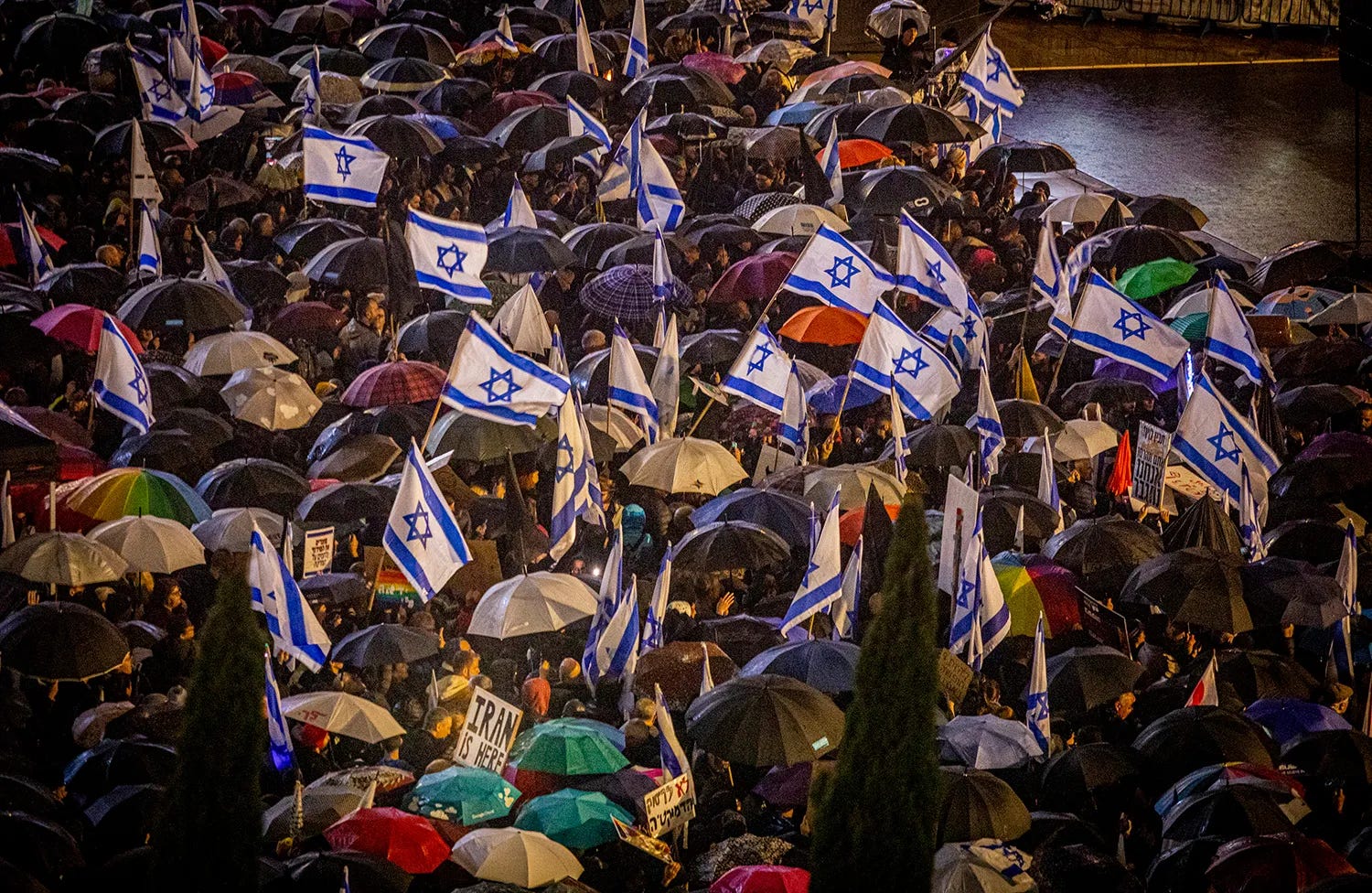
Israeli political factions have been warning of national disaster for years. The judicial confrontation of 2023 put large crowds in the streets, threats of refusal to serve entered the argument, and rival camps accused each other of endangering the state. The dispute was serious. Its seriousness did not make it a struggle for Palestinian freedom. A state can have a bitter fight over its courts while retaining broad agreement on the domination those courts administer.
The collapse narrative turns those domestic differences into a possible route to regional peace. Netanyahu becomes the explanation for everything, which means his removal can be sold as the solution to everything. You have heard the promise before: another prime minister, another coalition, another chance to negotiate. The settlements survive each promised opening, the military retains control, and yet the next election is presented as the moment when Palestinians should suspend their judgment again.
Netanyahu’s departure would change who occupies the office. It would leave the institutions that make Palestinian subordination possible unless those institutions themselves were dismantled. The occupation has outlasted governments led by different parties. Settlement construction, military rule and the refusal of Palestinian return are embedded in a state project that cannot be explained by one man’s appetite for power. Making him the whole problem gives everyone else an exit from responsibility.
The same evasion reaches beyond Palestine. A different cabinet could change a particular military decision or the timing of an attack on Iran. That possibility cannot carry the much larger claim that replacing Netanyahu would end Israel’s pursuit of regional military supremacy. Weapons, strategic partnerships and the assumption that Israel may dictate the security conditions of its neighbours survive a cabinet reshuffle. Peace requires those relationships of coercion to change; an election offers no automatic mechanism for changing them.
The confrontation over ultra-Orthodox military service shows how easily a dispute within Israel can be mistaken for opposition to what Israel does. Secular families resent repeated deployments and the deaths of their sons while yeshiva students receive exemptions. Ultra-Orthodox leaders defend Torah study and argue that military service threatens religious life. The anger is real on both sides, but its terms concern the distribution of obligations inside the state.
A draft compromise could send more ultra-Orthodox men into uniform and reduce the burden on other households. Palestinians would then face a military with a broader recruitment base. An unequal service arrangement would have been repaired without removing a checkpoint or restoring a demolished home. The reform could strengthen the institution carrying out the domination. That possibility disappears when every internal quarrel is treated as evidence that the whole project is coming apart.
The 2023 protest movement offers another example. Israelis defended judicial independence against a government trying to bring the courts under greater political control. Those courts had also authorized measures used against Palestinians, including home demolitions and administrative detention. Saving their independence did not require the movement to reject those powers. Palestinian freedom could remain outside the bargain while the defence of Israeli democracy received applause abroad.
There were Israelis who challenged that exclusion, just as there are Israelis who oppose the occupation and refuse to participate in it. Their existence gives no basis for attributing their politics to the movement as a whole. A minority’s courage cannot be used to certify the state that marginalizes it. The relevant question is which rights the successful reform would establish, for whom, and under whose authority.
The people missing from the collapse story make that question impossible to avoid. Palestinian citizens of Israel are roughly a fifth of the population. Palestinians in the West Bank and Gaza live with Israeli power over fundamental conditions of their lives. A forecast that centres Jewish Israeli political cohesion can describe the governing society’s distress while leaving the governed population outside the definition of the crisis. Palestinians enter as the location of military service, the source of danger or the background to returning soldiers’ trauma.
An occupying society’s distress can be real and still be used to displace attention from those it occupies. The soldier returns home with psychological wounds; the family whose home he helped destroy has no home to return to. Both facts belong to the account, and yet the collapse narrative asks the world to concentrate on whether the soldier’s society can absorb him. Palestinian survival becomes secondary to the stability of the state responsible for their suffering.
The legal hierarchy predates the latest warning of civil conflict. The Nation-State Law, passed in July 2018, reserves national self-determination in the state to the Jewish people and assigns Jewish settlement national value. The Knesset’s own text states the arrangement. Palestinians can be citizens and still be excluded from the collective right the state reserves for another population. The hierarchy is written into the constitutional order.
That order explains why I describe Zionism as fascistic. A state project organized around exclusive national entitlement requires the people outside that entitlement to accept a subordinate place. When they resist, the state treats their resistance as a security problem and mobilizes military force to preserve the hierarchy. A more courteous minister can administer the same arrangement. Better public relations can make it easier for foreign governments to support.
Public attitudes also complicate the comforting division between an extremist cabinet and a moderate society waiting to replace it. Haaretz reported a March 2025 survey commissioned through Penn State in which 82 per cent of Jewish Israeli respondents supported expelling Gaza’s population. Forty-seven per cent endorsed a question invoking the killing of all inhabitants of Jericho as a model for a conquered enemy city. The biblical framing belongs to the question, and the figures concern Jewish respondents. They cannot honestly be turned into a survey of every citizen.
They are nevertheless devastating evidence against the idea that expulsion is confined to a handful of politicians. The public backing described in the survey extends far beyond the cabinet table. A change in government cannot by itself undo attitudes that authorize the removal of an entire population. Those beliefs have to be confronted in political culture and education, in the account of history children receive and in the rights the state actually enforces.
An election can transfer office in a day. Undoing a society’s learned acceptance of another people’s dispossession requires sustained work. The claim that electoralism will solve the problem gives Palestinians another deadline to endure while leaving the beliefs behind their treatment intact. The reform promise becomes more dangerous when it asks outsiders to treat the election as a substitute for pressure on the system.
Israel depends on powerful foreign sponsors. That dependence should direct attention to those sponsors’ decisions, rather than encourage fantasies of automatic collapse. The United States’ 2016 military assistance agreement set out $38 billion over fiscal years 2019 to 2028, including annual military financing and missile-defence support, subject to appropriations. Its terms extend across administrations and Israeli cabinets. The relationship was designed to outlast the people signing it.
Britain supplies another example of institutional continuity. In September 2024, its government suspended about thirty arms export licences over the risk of serious violations of international humanitarian law in Gaza. It excluded components entering the multinational F-35 programme from the suspension, except those going directly to Israel. The government could acknowledge the risk and preserve a route through the international production system at the same time. Israeli political unity was unnecessary for that route to remain available.
Washington and London can criticize Netanyahu while maintaining arrangements that sustain Israeli military power. Their preferred reform would produce an ally easier to defend before their own publics. Palestinians are then asked to accept the survival of the structure as the price of removing its most embarrassing representatives. The bargain protects foreign policy as much as Israeli domestic politics.
The reach of the project also exceeds Israel’s borders. Zionist political influence operates through identifiable governments, advocacy organizations and strategic agreements. Public disgust at Gaza does not automatically cancel an arms contract, reverse a diplomatic commitment or change a legislator’s incentives. The distance between popular opposition and institutional action is where the project continues to operate. Confusing reputational damage with the loss of power gives that operation room to continue.
Latin America provides a concrete test. On June 12, 2025, Javier Milei and Netanyahu concluded a memorandum in Jerusalem linking Argentina and Israel through commitments framed around democracy, terrorism and antisemitism. Argentina’s government published the agreement. The Genesis Prize Foundation subsequently announced financing for Milei’s initiative to deepen Israel’s ties with Latin American states through the Isaac Accords. These were organized efforts to build relationships while Israel faced international anger over Gaza.
The foundation reported that Netanyahu and Milei signed the Isaac Accords in April 2026, and that a Brazil-Israel parliamentary caucus had signed their declaration of shared principles. Its account describes an effort to extend cooperation through economic and security relationships. Latin America contains strong opposition to Israel as well; the point is that expansion is being organized despite that opposition. An internal Israeli crisis has not prevented the project from acquiring partners abroad.
A government may face instability at home while its supporters build new diplomatic channels overseas, and yet that domestic instability is offered as evidence that Zionism is collapsing. The state can lose public sympathy and retain access to foreign weapons. You cannot measure the project’s strength by the temperature of the argument in Tel Aviv alone. Follow the agreements and the institutions willing to enforce them.
The choice of outlet deserves the same attention as the contents of the assessment. Drop Site has earned readers through reporting on Palestinian suffering and scrutiny of American power. A disclosure delivered there reaches people who would reject the same consolation from an Israeli government spokesperson. Trust in the publication’s journalism can become trust in a source’s preferred interpretation, even when the two deserve separate judgments.
That observation does not require accusing the journalists of knowingly serving an intelligence operation. Sources have their own reasons for talking, and reporters can publish information in the public interest while sources pursue other ends. The public still has to ask why this information was selected, why it was shared at this moment and what the sources wanted its readers to believe. Intelligence access is no exemption from that inquiry.
Who benefits when opponents of Israeli domination start waiting for Israeli collapse? Western governments gain time. Advocates of a reformed Israel gain a story in which the project can be rescued from its current managers. Palestinians receive another explanation for why decisive action should wait. The possibility of internal conflict is made to perform political work far beyond anything the reported assessment can establish.
My suspicion of Mossad involvement belongs here, at the point where the narrative’s usefulness meets the undisclosed circumstances of its circulation. The published material does not identify such involvement. The question remains open, and the lack of an answer is a reason to investigate the disclosure rather than grant it immunity from scrutiny. We should apply the same suspicion to a CIA-linked story that comforts us as to one that frightens us.
Peace requires the end of a state order that reserves supremacy for one population and subjects another to displacement and military control. Everyone living there must have equal rights and security, including Jewish people; Palestinian freedom cannot depend on anyone’s expulsion. Israel as a Zionist state must cease to exist because preserving its defining hierarchy preserves the conflict. Calling for a better custodian of that hierarchy leaves the people it excludes exactly where the report left them.
Western governments must halt arms transfers and impose sanctions now. The struggle concerns the institutions sustaining domination and the political ideology that justifies it, regardless of whether Israeli factions settle their differences or fight over them. A collapse forecast offers Palestinians no enforceable right and places no immediate cost on the governments enabling their dispossession.
Palestinians continue their suffering under a heavy genocide imposed on them on a daily basis.