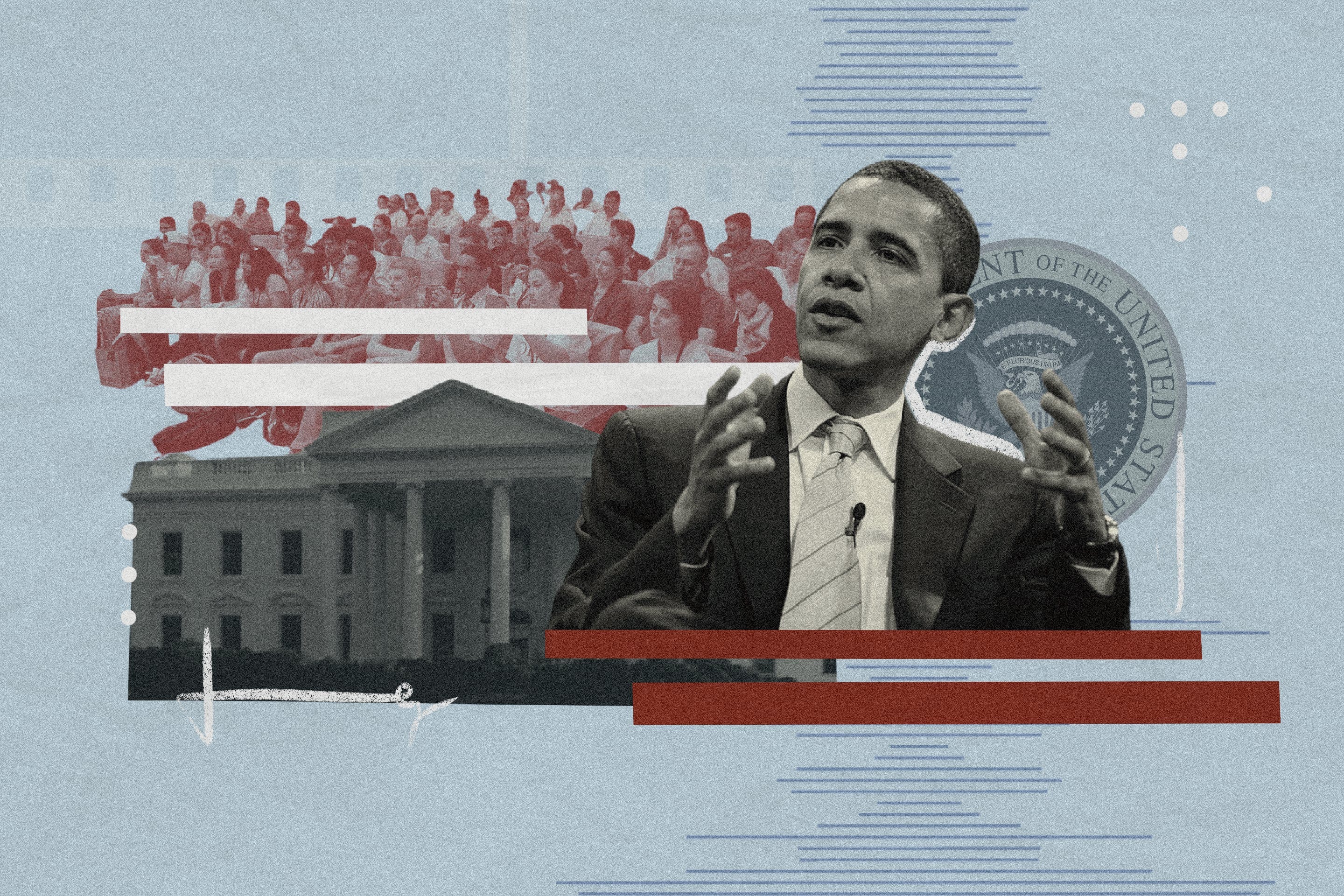
The University of Virginia’s Miller Center released the first installment of its Obama presidential oral history on Monday, March 23. Eighty Cabinet members and senior officials were interviewed over several years. Thirty-seven transcripts went public. The war in Iran, now in its fourth week, was not a variable the archivists planned for. It is the only variable that matters in reading what they collected.
One exchange has drawn the most attention, and it deserves to. Former Director of National Intelligence Dennis Blair described a White House meeting convened, he was told, to produce fresh thinking on Iran policy. He took the mandate at face value. When his turn came to speak, he addressed the president directly: “Mr. President, you really just have one decision to make. Are you going to tolerate Iran having a nuclear weapon or not?”
The binary was not rhetorical. Rejection meant building a covert and military campaign to stop the program. Acceptance meant building a containment and deterrence architecture around a nuclear-capable Iran. Both were real options. Either required a decision. Neither could be pursued without one.
Obama pulled Blair aside after the room cleared. “Denny, don’t ever put me on the spot like that again,” he said. Blair, by his own account, replied: “Yes, sir, Mr. President. I certainly won’t.” He added, in the oral history recording: “I was kept out of meetings from that time forward.” By May 2010, Obama had asked for his resignation.
Blair reflected on why it happened. “I had been told that it was an ideas meeting. The president was looking for fresh insights. I made the mistake of believing that guidance.”
The exchange, now archived at Charlottesville, is not a historical footnote. It is the moment at which American Iran policy chose its path for sixteen years. What followed was not strategy. It was avoidance of the question Blair posed, dressed as strategy.
The JCPOA, announced in July 2015 and implemented in January 2016, was presented as the resolution of everything Blair had pushed Obama to confront. The Joint Comprehensive Plan of Action required Iran to dismantle the heavy-water reactor at Arak, cap uranium enrichment at 3.67 percent, reduce its enriched uranium stockpile by 98 percent, and accept IAEA inspectors at declared sites. In exchange, the United States and the P5+1 lifted the nuclear-related sanctions that had squeezed the Iranian economy for a decade.
Obama announced the deal at the Rose Garden with a specific claim: “This deal is not built on trust. It is built on verification.”
The verification was real. The architecture underneath it was not what the announcement implied.
The deal contained sunset clauses. In October 2020, the UN arms embargo on Iran expired, freeing Tehran to purchase tanks and combat aircraft from Russia and China under international law. In October 2023, all UN restrictions on Iran’s ballistic missile and drone programs expired. In October 2025, the nuclear file was removed from the UN Security Council’s agenda entirely. The enrichment cap of 3.67 percent was set to expire in 2030. Limits on Iran’s stockpile of low-enriched uranium were set to expire in 2031. The restrictions on advanced centrifuge production were staggered across expirations running to 2026 and beyond.
Obama knew this and said so. In an April 2015 NPR interview with Steve Inskeep, weeks before the deal was finalized, he acknowledged that in years 13 through 15 of the agreement, breakout times would shrink toward zero. He framed it as a known cost of the deal’s benefits. The benefits were real. So was the cost. By November 2024, the US Office of the Director of National Intelligence assessed that Iran had accumulated enough fissile material, if further enriched, for more than a dozen nuclear weapons. By May 2025, the Defense Intelligence Agency assessed that Iran’s breakout time to produce enough weapons-grade HEU for one weapon had been reduced to “probably less than one week.”
This is not what the Rose Garden announcement implied.
The defenders of the JCPOA make a factual argument that holds. Before the deal, Iran’s breakout time was roughly two to three months. During the deal, it extended to twelve months or more. After Trump’s 2018 withdrawal, Iran resumed enrichment and the timeline collapsed back toward weeks. The withdrawal accelerated what it was intended to prevent. This is documented and true.
The harder argument, which the oral history archive now illuminates, is what the deal left untouched. The JCPOA placed no restrictions on Iran’s ballistic missile program. It placed no restrictions on Hezbollah’s weapons inventory, the Quds Force’s budget, or Tehran’s financial support to the Houthis in Yemen, the Popular Mobilization Units in Iraq, or Assad’s forces in Syria. Iran’s defense budget increased in the years following Implementation Day. Hezbollah’s weapons stockpile expanded according to subsequent Israeli military assessments. The Quds Force under Qassem Soleimani consolidated Iranian influence across Lebanon, Syria, Iraq, and Yemen between 2016 and his assassination in January 2020.
None of this was concealed. None of it was addressed in the deal. The Obama administration’s position was that you cannot negotiate everything simultaneously. That argument has a logic. It does not have a plan for what comes after the nuclear restrictions expire and the proxy infrastructure is fully built. The oral histories of senior officials describe a White House that understood the deal as time purchased, not a problem closed.
Ben Rhodes, Obama’s Deputy National Security Advisor for Strategic Communications, said in his Miller Center interview that the Iran nuclear interest was paramount because a nuclear-armed Iran would be “a huge issue for the U.S., not just about the region itself.” He described the deal as part of a broader regional framework intended to let Washington “diminish its commitment to this region in terms of resources and attention.” The phrase deserves to sit without annotation. The JCPOA was designed, by the people who designed it, to enable a withdrawal of American engagement from the Middle East. What filled the space was not a stable regional order. What filled it was the institutional expansion of the very structures now being bombed.
The sunset clause architecture is only one part of what the oral histories, read alongside existing documentation, make visible. The other part involves what the administration did between 2011 and 2016 to Iran’s financing networks while the deal was being negotiated.
Project Cassandra was a DEA operation launched in 2008 after federal investigators established that Hezbollah had built a global criminal enterprise running cocaine from South America through West Africa into Europe and back through Lebanon into IRGC-linked accounts. The DEA’s internal assessment, from an operation coordinating 30 US and foreign security agencies out of a top-secret facility in Chantilly, Virginia, was that Hezbollah was generating approximately $1 billion per year from drug and weapons trafficking, money laundering, and related criminal activity.
The operation tracked cocaine shipments, monitored Hezbollah operatives working with Venezuelan and Mexican cartels, and traced financial flows through a network of Lebanese money couriers using the hawala system to move hundreds of millions of euros in drug proceeds from Europe to the Middle East. By 2013, Project Cassandra had worked its way up the conspiracy to senior figures connected to Hezbollah’s leadership and its sponsors in Iran.
Then the requests for prosecution started being denied.
The Justice Department declined to file criminal charges against Hezbollah’s highest-ranking envoy to Iran. It declined to charge the leader of a US-based cell of the Iranian Quds Force. It declined to charge a Lebanese bank that investigators believed had laundered billions in Hezbollah drug proceeds. The State Department rejected requests to conduct sting operations against high-value targets in countries where they could be arrested and extradited. A senior Hezbollah arms dealer named Ali Fayad, who investigators believed was supplying weapons to Syria and Iraq and reported to Vladimir Putin, was arrested by Czech authorities in April 2014 on a US warrant after a sting in which undercover operatives had caught him agreeing to supply surface-to-air missiles and rocket-propelled grenades to what he was told were FARC narcoterrorists. He remained in Czech custody for nearly two years. The Obama administration declined to apply serious pressure on Prague to extradite him. Putin lobbied actively against extradition. Fayad was eventually released to Lebanon.
Katherine Bauer, an Obama-era Treasury official, testified in writing before the House Committee on Foreign Affairs in February 2017 that under the Obama administration, Hezbollah-related investigations “were tamped down for fear of rocking the boat with Iran and jeopardizing the nuclear deal.” That is not an accusation from opponents of the deal. It is written testimony from inside the administration.
David Asher, the Defense Department illicit finance analyst who helped establish and oversee Project Cassandra, named the mechanism directly. “They serially ripped apart this entire effort that was very well supported and resourced, and it was done from the top down,” he said. “This was a policy decision. It was a systematic decision.”
Former senior Obama national security officials, some of whom participated in the Iran negotiations, disputed the framing in interviews with Politico, arguing that intelligence considerations unrelated to the deal, including protecting CIA operations inside Hezbollah, may have driven some of the enforcement decisions. That explanation covers some cases. It does not explain Bauer’s testimony. It does not explain Fayad.
The cash transfer runs alongside all of this as a separate thread that the administration’s defenders and critics have spent a decade arguing past each other. In January 2016, on the same day Implementation Day was certified, the IAEA verified compliance, and nuclear sanctions were lifted, the Obama administration finalized a settlement of a decades-old arbitration claim at The Hague. The claim dated from before the 1979 revolution, when Iran had deposited funds in a US Foreign Military Sales trust account for arms purchases that were never delivered after the Shah fell. The settlement was $400 million in principal plus $1.3 billion in interest.
The $1.7 billion was transferred in cash, in non-US currencies procured from the central banks of the Netherlands and Switzerland, loaded onto unmarked aircraft. The Obama administration stated that US sanctions regulations made wire transfer through the American banking system unavailable. Congressional investigators, including Senator Lankford in a detailed letter to Obama in September 2016, argued that existing exemptions for tribunal settlement payments appeared to permit the transaction through formal channels, and that the administration had not adequately explained why cash was required. The administration did not provide a satisfactory resolution of that question publicly.
The timing was deliberate. State Department officials acknowledged that the payment was synchronized with the prisoner release to give Iran “something tangible.” The commander of the IRGC’s Basij paramilitary unit announced publicly that the $1.7 billion was “the price that America paid to free its spies.” The competing characterizations were never adjudicated. What is established is that $1.7 billion in untraceable cash arrived in Tehran, in Iranian state hands, on the day the broader sanctions architecture opened.
The JCPOA defenders are correct that the bulk of what Iran received was its own frozen money: foreign exchange reserves held abroad and inaccessible under sanctions. Treasury Secretary Jacob Lew testified before Congress that approximately $50 billion in liquid assets would become accessible following Implementation Day, with the remainder tied up in illiquid Chinese infrastructure projects and outstanding loans that could not be quickly monetized. Whether that $50 billion was Iranian money rather than American money does not alter the question that mattered operationally: where it landed inside the Iranian state.
Congressional testimony during the Obama years documented that the IRGC, estimated to control between 20 and 30 percent of Iran’s GDP, required liquid, untraceable cash to fund WMD procurement, missile acquisition, and external militia operations precisely because secondary sanctions constrained its access to formal financial channels. The JCPOA’s nuclear sanctions relief did not eliminate those secondary sanctions. But $50 billion in newly accessible foreign reserves flowing into an economy where the IRGC constituted nearly a third of productive activity did not pass through that institution without effect. Iran’s defense spending rose after Implementation Day. The missile program continued. The proxy infrastructure deepened.
A specific missile launched on the night of March 20-21, 2026, puts a number on what the architecture produced. Iran fired two ballistic missiles at the joint US-UK base at Diego Garcia, an atoll in the Indian Ocean nearly 4,000 kilometers from Iranian territory. One failed in flight. The second was intercepted. Neither struck the base. Weeks earlier, Iran’s Foreign Minister had stated publicly that Tehran had deliberately capped its ballistic missile range at 2,000 kilometers. The gap between that statement and the Diego Garcia launch is not primarily a military story. It is a documentary record of what Iran’s missile program, which the JCPOA explicitly excluded from its restrictions, became while the enrichment restrictions were nominally in place.
The arms embargo sunset in October 2020 permitted Iran to legally import advanced weapons systems. The missile program restrictions expired in October 2023. The Diego Garcia launch occurred in March 2026. The sequence is not ambiguous.
John Brennan, who served as Obama’s White House counterterrorism chief before running the CIA, spoke at a Washington conference in May 2010 about Hezbollah. He described the organization as having evolved from “purely a terrorist organization” into a militia and ultimately a political party, and said the administration needed to “find ways to diminish their influence within the organization and to try to build up the more moderate elements.” Project Cassandra was, at that point, two years into mapping Hezbollah’s billion-dollar criminal network. The DEA teams in Chantilly were tracking cocaine and weapons flows across four continents. The senior official responsible for counterterrorism strategy was asking publicly how to strengthen Hezbollah’s moderates.
The oral history archive has not yet resolved how Brennan’s framing connected to Project Cassandra’s operational slowdown. The Miller Center’s first installment covers thirty-seven officials. More transcripts will follow. What the existing record shows is a White House that, from the first year of the administration, identified the nuclear question as the organizing axis and treated every other instrument of Iranian power as secondary to preserving the diplomatic track toward a deal.
Blair understood what that meant. He understood it early enough that he put it as a binary in a meeting where he thought the president was asking for honest analysis. He was wrong about what kind of meeting it was.
The JCPOA’s defenders and critics have spent eight years fighting over whether Trump’s 2018 withdrawal caused more damage than the deal’s sunset clauses would have. That argument is no longer academic. The enrichment levels Iran reached, the centrifuge technology it developed, the missile range it concealed and then demonstrated over the Indian Ocean, the proxy networks it built from Lebanon to Yemen during the years the deal was in force: these are not projections. They are operational facts about what the war that started February 28 was fought against.
The Miller Center’s Barbara Perry, who co-chaired the oral history project, said on the day of the release: “It’s hard to find nuggets we didn’t already know. But what these do is give us an opportunity to speak to the people at the highest levels of power at time of crisis.” The nuggets were there. Blair’s account of being pushed out for asking the president a direct question about Iran is not a small detail. Bauer’s congressional testimony about Hezbollah investigations being tamped down was delivered in 2017 and registered barely any public response.
What the archive provides is not new information. It is named attribution for decisions that were documented but rarely spoken on the record by the people who made them. The gap between the official narrative and what the named officials now describe is the record.
That record has a timestamp. It begins in a White House meeting sometime in 2009, when a four-star admiral asked the President of the United States one question, and was told never to do it again.


