DR Congo’s World Cup Return
Fifty-two years after a dictator threatened to execute his own players over a football score, the country he ruled is trading its ground for security guarantees from the same capitals that put him there.
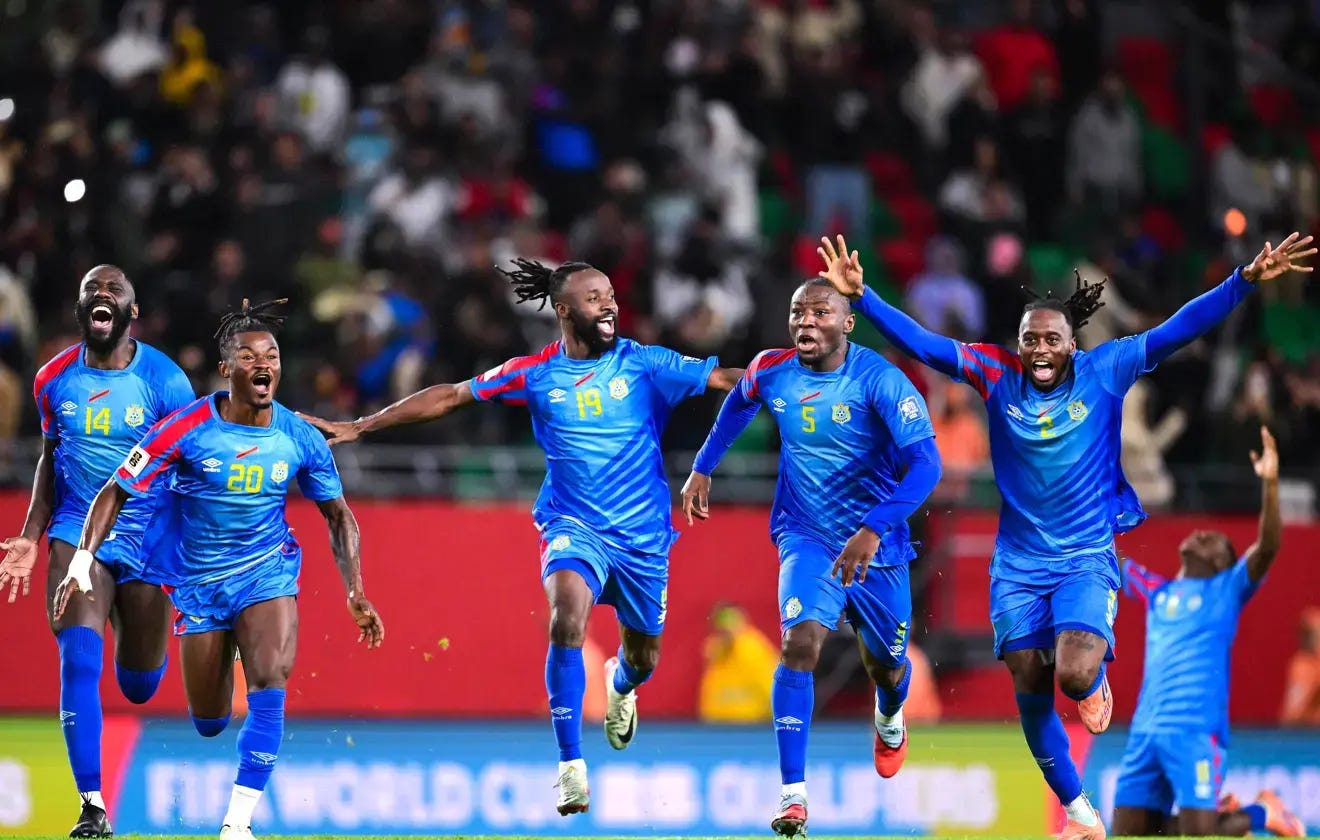
Yoane Wissa’s header found the net in the last minute of the first half, and 68,777 people inside NRG Stadium in Houston, most of them dressed for Portugal, went quiet long enough to hear the small, disbelieving roar coming from the away end. It was June 17, 2026. Cristiano Ronaldo, on his sixth World Cup, would spend the rest of the night running into a wall of green shirts that refused to break. The Democratic Republic of Congo held the reigning European finalists to a 1-1 draw in its opening match, on three weeks of preparation disrupted at home by an Ebola outbreak the squad had to train around. It was the best result of the day in the tournament, and it was also the first time in fifty-two years that a Congolese footballer had worn his country’s jersey at a World Cup at all.
The last time it happened, in West Germany in 1974, his predecessors were not worried about Ronaldo. They were worried about getting home alive.
What connects the two nights is not a comeback narrative. It is a piece of geography that has been worth killing over since the 1880s, when Belgium’s King Leopold II ran the Congo as a private rubber and ivory estate and killed an estimated ten million people doing it. The ground underneath both World Cup squads, the 1974 one and the 2026 one, has never stopped being worth more than the people standing on it to the powers deciding what happens there. That arrangement produced a death threat against eighteen football players in a Bavarian hotel room. It also produced the murder of the country’s first elected leader within seven months of independence, the assassination of a sitting UN secretary-general, and, as of this writing, a war in the eastern provinces that the United States, the same government that ordered the 1961 killing, has just spent a year converting into a minerals contract.
A Goalkeeper Changed by Telephone Call
Zaire, as the country was then called under the dictatorship of Mobutu Sese Seko, arrived at the 1974 World Cup as reigning African champions and the first side from sub-Saharan Africa ever to qualify for the tournament. Mobutu had given each player a house and a car after the squad won the 1974 Africa Cup of Nations in March, beating Zambia in Cairo, and he intended the World Cup as the international showcase for “Authenticité,” the cultural nationalism program he used to dress up a regime built on theft. The promised tournament bonuses never arrived. Officials traveling with the squad pocketed the money instead, and after Zaire lost its opener to Scotland 2-0 and learned there would be no payment at all, several players told later interviewers they simply stopped trying.
Against Yugoslavia four days later, four goals down by halftime, goalkeeper Kazadi Mwamba was pulled from the match on instructions relayed by telephone from Kinshasa to the touchline, even though none of the four goals conceded were considered his fault. His 5-foot-6 replacement, Tubilandu Ndimbi, let in a fifth within a minute of arriving on the pitch. The match finished 9-0, still among the heaviest defeats in World Cup history, and it provoked Mobutu into flying a delegation of his presidential guard to the team hotel in person. Defender Mwepu Ilunga later told the BBC the guards sealed the building to journalists and delivered the terms directly: lose to Brazil by more than three goals and the team does not come home, and neither do its families.
Ten minutes from the end of that final group match, with Brazil leading 2-0 and Rivelino standing over a free kick twenty-five yards out, Ilunga broke from the defensive wall and booted the ball away before the kick could be taken. For four decades the clip ran on highlight reels as a punchline, evidence that an African team had not learned the rules of the sport it was playing. Ilunga had captained club sides and played international football for years. He understood exactly what a free kick was. What the clip actually shows is a man manufacturing the only delay available to him on a scoreline that, by his own account, could get his family killed. Zaire lost 3-0, the threshold Mobutu had set. The players were allowed to fly home. The president withdrew all government funding for the national team the day they landed and never restored it. Striker Ndaye Mulamba, the tournament’s joint top scorer at the previous Africa Cup of Nations, was sent off in the same match for a foul the referee had actually seen committed by Ilunga, and the team that had been African champions three months earlier never reassembled at full strength again.
This is the episode Western football broadcasting spent four decades treating as a piece of comic folklore. It was a hostage situation conducted through a goalkeeper substitution, and the broadcasters narrating it as ignorance never asked who was holding the telephone in Kinshasa.
The Decree That Explains the Missing Bonuses
The bonuses Zaire’s players never received were not lost to ordinary disorganization. They disappeared into a system Mobutu had formalized seven months before the tournament, and that timing is not incidental to the story.
On November 30, 1973, Mobutu announced Zairianization, a decree seizing foreign-owned plantations, ranches, commercial enterprises, and real estate across the country and handing them to “sons of the country.” He framed the decree that day as restitution, telling the nation that no country had been exploited more thoroughly than his. In practice the sons of the country numbered roughly three hundred people: senior party officials, military commanders, and members of Mobutu’s own family, who received working farms and businesses they had no experience running and frequently stripped of inventory and equipment for quick cash rather than operated as going concerns. A second decree that December, the so-called Radicalization measures, extended the seizures further, nationalizing what Zairianization had left in foreign hands. The economic result was immediate and measurable. Zaire’s external debt rose from 763 million dollars at the end of 1972 to roughly three billion dollars by 1974, the same year its national football team was flying to West Germany on promises that had already stopped being backed by anything in the treasury. By early 1976 the country was confronting what its own finance ministry described to creditors in Paris as a near-bankruptcy, with debt servicing alone consuming close to thirty percent of export earnings for the following decade.
The mechanism is the same one that swallowed the players’ appearance money. A class of three hundred newly enriched officials, accustomed by November 1973 to receiving state assets without accountability, traveled to West Germany seven months later managing a national football budget the same way they had been managing seized plantations: as a personal allowance rather than public funds. Zairianization did not cause the theft of the 1974 bonuses in any narrow legal sense. It created the officials who did it, gave them the habit, and removed any institutional check that might have stopped them. The team that returned home to find its funding cancelled had, in effect, run into the same kleptocratic architecture twice in one calendar year: once as plantation managers who had never planted anything, and once as a delegation managing players who had never been paid.
Fifteen Seconds of Silence at the National Security Council
To understand how a Zairian president came to hold that kind of unaccountable power over his own population by 1973, it is necessary to go back to the man Mobutu replaced, and to the foreign governments that decided he had to go.
The Congo became independent from Belgium on June 30, 1960, after eighty years of colonial extraction that had already killed millions under Leopold II’s personal rule and continued, more bureaucratically, under direct Belgian administration after 1908. Patrice Lumumba, a former postal clerk from Onalua who had built a national movement from almost nothing, became the country’s first prime minister at thirty-four. Within days the army mutinied against the Belgian officers still commanding it, Belgian paratroopers landed unilaterally to “protect” Belgian nationals, and the mineral-rich southern province of Katanga seceded with quiet backing from Brussels and the Belgian mining conglomerate Union Minière du Haut-Katanga, which controlled the copper and cobalt deposits the secession was built to keep out of Lumumba’s reach. Lumumba appealed to the United Nations. Secretary-General Dag Hammarskjöld sent the largest peacekeeping mission the organization had yet assembled, and then declined to use it to force Katanga back into the country, a restraint Lumumba never forgave and that pushed him toward Soviet offers of support he had not previously sought.
Washington had effectively made its decision before that refusal mattered. On August 18, 1960, at a National Security Council meeting, President Eisenhower turned to CIA Director Allen Dulles in front of the assembled council and said, according to a colleague’s later testimony to the Senate’s Church Committee, something to the effect that Lumumba should be eliminated. The room reportedly went silent for fifteen seconds before the meeting continued. A month later Dulles cabled the CIA’s station in Léopoldville that Lumumba’s removal was an “urgent and prime objective,” authorizing station chief Lawrence Devlin to spend up to one hundred thousand dollars replacing him with a pro-Western government. The Agency’s head of technical services flew to the Congo with a vial of poison meant for Lumumba’s food or toothpaste, engineered to mimic a disease already present in the region so the death would not trace back to Washington. Devlin held onto it but never administered it, in part because by October the United States and Belgium had a faster instrument available: Lumumba’s own army chief of staff, Joseph-Désiré Mobutu, who staged a coup against his former prime minister that September with direct encouragement from both governments.
Devlin’s cable traffic that autumn reads less like diplomacy than a hunting log, because that is functionally what Washington was asking him to keep. When headquarters proposed a commando team to abduct Lumumba from the residence where UN troops were still guarding him, Devlin requested a high-powered rifle with a telescopic sight and silencer be sent by diplomatic pouch. “Hunting good here,” he wrote, “when light’s right.” Lumumba tried to flee toward his political base in Stanleyville on November 27, 1960. Mobutu’s soldiers intercepted him on the road and imprisoned him at Thysville. He was flown to Katanga on January 17, 1961, beaten en route by Congolese and Belgian personnel, and executed by firing squad that night alongside two of his ministers, Joseph Okito and Maurice Mpolo, with Belgian officers present and, according to declassified intelligence reporting, a Belgian officer of Flemish origin delivering the final burst of submachine-gun fire. A 2001 Belgian parliamentary inquiry, after reviewing telegram traffic the Church Committee never had access to, concluded that Belgian advisers in Léopoldville had played a more active role in tracking Lumumba down than they had admitted, and stated that the CIA’s role in the hunt was larger than the 1975 Church Committee report itself had been willing to acknowledge.
The Tooth in the Blue Box
What happened to Lumumba’s body afterward is its own piece of evidence, and it sat undisclosed for almost forty years.
Belgian police commissioner Gerard Soete oversaw the disposal. By his own later account, he resolved that there should be no trace left that could become a pilgrimage site. He and an assistant exhumed the bodies from their shallow grave, transported them roughly two hundred kilometers, cut them into pieces, and dissolved them in sulfuric acid. Soete kept one of Lumumba’s gold-capped teeth, and reportedly a finger as well, describing the theft decades later as taking “a kind of trophy.” His daughter displayed the tooth to a journalist in a 2016 interview, after which Belgian authorities seized it. It took until June 20, 2022, in a ceremony at the Egmont Palace in Brussels, for the tooth to be handed to Lumumba’s three surviving children in a small blue case. Prime Minister Alexander De Croo called the six-decade delay “not normal” and apologized for Belgium’s role in the killing. Belgium’s federal prosecutor acknowledged there was no way to confirm through DNA testing that the tooth was actually Lumumba’s, because the test itself would have destroyed it. It remains the only physical trace of the country’s first elected leader his family was ever given back, and its authenticity will never be verifiable.
King Philippe had separately expressed his “deepest regrets” for Belgian colonial abuses earlier that same month, language his government deliberately avoided escalating into a formal apology for the colonial project itself, a distinction Belgian diplomats have maintained ever since. The gap between regret and apology is not a matter of translation. It is a legal calculation about what an apology would expose Belgium to in the reparations claims still moving through its courts, including a civil case Lumumba’s son François filed in 2011 accusing the Belgian state of war crimes, torture, and conspiracy in his father’s death.
A Second Plane, Headed for the Same Province
Hammarskjöld did not survive the crisis his peacekeeping restraint had inadvertently prolonged. Fourteen months after Lumumba’s murder, the secretary-general was attempting one more negotiation in the same province that had killed him, this time trying to broker a ceasefire between UN forces and the Katangan secessionists directly.
On the night of September 17 to 18, 1961, Hammarskjöld’s chartered DC-6, the Albertina, crashed on its descent into Ndola in what was then Northern Rhodesia, on its way to meet Katangan leader Moïse Tshombe. All sixteen people aboard died, all but one on impact. Two Rhodesian government inquiries in 1961 and 1962 attributed the crash to pilot error. The United Nations’ own inquiry that year returned an open verdict, unable to rule out sabotage. Decades of subsequent investigation, including a 2025 report to the UN General Assembly by the body’s appointed Eminent Person, Tanzanian jurist Mohamed Chande Othman, found what investigators described as persuasive evidence that the aircraft had been subjected to some form of attack or threat as it circled to land, and accused both the United States and Britain of continuing to withhold relevant signals intelligence. Researchers combing through previously undocumented Zambian eyewitness testimony beginning in the 2000s located ten people, none of them interviewed by either the Rhodesian or the original UN inquiry, who reported seeing a second aircraft in the air near the Albertina that night. No government has released anything resembling a final account.
The secretary-general most committed to keeping the Congo’s mineral wealth inside a UN framework rather than a colonial or Cold War one died flying toward the exact province that wealth came from, on a mission to negotiate with the secessionist movement Belgian and American interests had quietly underwritten in the first place. Whatever brought the Albertina down, the airspace over Katanga in September 1961 was not airspace any disinterested party controlled.
Thirty-Two Years of the Guide
Lumumba’s murder cleared the path for the man who organized the coup against him to rule for the next thirty-two years as a Cold War client in continuous good standing in Washington and Brussels, regardless of what that standing cost the population underneath him. Mobutu renamed the country Zaire in 1971 and himself, progressively, “Founder-President,” “Guide of the Revolution,” and eventually “Mulopwe,” titles his own information ministry distributed to state media with the seriousness of scripture. American support did not waver through any of it, because Zaire’s location at the center of the continent, bordering nine other states, made Mobutu’s anti-communist loyalty worth more to Washington than his domestic conduct ever cost it.
Estimates of what Mobutu personally extracted from the state range from four billion to fifteen billion dollars across his rule, a spread that itself reflects how little outside auditing his patrons ever demanded. By the mid-1980s, US Treasury and IMF officials cited in contemporary reporting put his peak personal fortune at roughly four billion dollars, including at minimum twenty identified properties across Europe and Africa, while Zaire’s external debt, swollen first by Zairianization and then by two more decades of mismanagement, stood at approximately thirteen billion dollars by the time he fled in 1997. He did not survive a foreign intervention. He survived Cold War patronage for three decades and then collapsed within months once that patronage no longer had a strategic purpose, abandoned in the end even by an army he had stopped paying so consistently that it would not defend him against Laurent Kabila’s rebel column. The same unaccountable spending that cancelled a football team’s funding overnight in 1974 was, by 1997, the entire fiscal architecture of the state, and it could not survive contact with an actual military challenge.
The Same Ground, Signed Over Again in Washington
The Congo that sent the Leopards to Houston this June is not Mobutu’s Zaire. It has held elections, however imperfect, since 2006, and Félix Tshisekedi has governed under a constitution Mobutu never tolerated since 2019. But the extraction logic that put Lumumba in a Belgian acid bath, brought down a UN secretary-general over Katanga’s airspace, and let three hundred newly enriched officials treat a national football budget as personal cash did not retire with the dictator. It changed which minerals were worth fighting over, and which capital was doing the fighting.
The eastern provinces of North and South Kivu sit on the deposits the global battery and electronics economy now depends on: roughly seventy percent of the world’s mined cobalt, alongside coltan, copper, tin, and lithium. The M23 rebel movement, which UN investigators and the US State Department say receives direct backing from three to four thousand Rwandan ground troops Kigali has never formally acknowledged deploying, captured the regional capital Goma in an offensive in early 2025 that killed somewhere between 900 people, by UN estimate, and 2,000, by the Congolese government’s count. M23 forces went on to seize Rubaya, one of the world’s largest coltan deposits, and by UN accounting now earn roughly eight hundred thousand dollars a month taxing the mineral trade running through it. Human Rights Watch documented a monthlong M23 and Rwandan occupation of Uvira in South Kivu in early 2026 that included door-to-door searches targeting men and boys suspected of government sympathies.
Tshisekedi’s response to the collapse in the east was to write directly to Donald Trump in February 2025, while Goma was still falling, offering the United States preferential access to cobalt, lithium, copper, and tantalum in exchange for a formal security partnership against the militia dismantling his own army. A Washington Accord followed that June, brokered with Qatari mediation, establishing a framework for peace between Kinshasa and Kigali alongside bilateral commercial agreements granting American firms priority access to Congolese deposits. The arrangement was formalized on December 4, 2025, at a signing ceremony at the United States Institute of Peace in Washington, where Tshisekedi and Rwanda’s Paul Kagame both appeared alongside Trump, who told the room that “everybody’s going to make a lot of money.” Fighting in the eastern provinces continued through the ceremony and after it.
What that money looks like in practice is now documented with enough specificity to map. The US-backed Orion Critical Minerals Consortium signed a memorandum of understanding the day before the December ministerial to acquire a forty percent stake in Mutanda Mining and Kamoto Copper Company, two of Glencore’s largest copper and cobalt operations in the DRC, with financing partly underwritten by the US International Development Finance Corporation. KoBold Metals, a US mining exploration company, holds seven exploratory permits across sixteen hundred square kilometers of Congolese territory for lithium, coltan, and rare earths, signed the previous summer. A separate American venture, Virtus Minerals, has spent the past year working to acquire Chemaf, a Dubai-based copper and cobalt producer carrying heavy debt, after the Trump administration lobbied Kinshasa to sideline Gécamines executives who favored a competing Chinese offer from the state-owned firm Norinco, the same offer the Biden administration had pressured Kinshasa to block a year earlier. Former Blackwater chief Erik Prince’s private security firm, Vectus Global, was reportedly involved alongside Congolese government forces in the January 2026 battle for Uvira, placing an American security contractor inside the same contested mining corridor the minerals consortiums are simultaneously trying to formalize access to.
None of this is the first time a Western trading house has been caught monetizing instability in this specific supply chain rather than resolving it. Glencore pleaded guilty in 2022 to bribery and market manipulation across multiple African operations, paying over 1.1 billion dollars in penalties, after investigators documented 27 million dollars in bribes paid inside the DRC alone. A separate Global Witness investigation found that between 2013 and 2016, Glencore redirected over 75 million dollars in royalty payments owed to the state mining company Gécamines into Africa Horizons, an offshore vehicle controlled by Israeli mining financier Dan Gertler, who had partnered with Glencore on several major Congolese acquisitions. Zairianization’s three hundred plantation recipients in 1973, Gertler’s offshore royalty diversion four decades later, and the minerals-for-security framework signed in Washington in December 2025 are not three separate stories about Congolese misfortune. They are the same arrangement wearing three different commodities: whoever controls the paperwork around Congolese resources gets paid before the Congolese state does, and the people standing on the actual ground get told, as they were told in 1974, that the arrangement is for their own protection.
This is the inheritance Chancel Mbemba’s squad carried into NRG Stadium, whether anyone in the broadcast booth mentioned it or not. Mbemba captains a team built almost entirely from the European diaspora, players who grew up in Belgian, English, and French academies precisely because the country that produced them could not, for most of their lifetimes, offer a stable enough footballing infrastructure to keep them home. Aaron Wan-Bissaka and Yoane Wissa came up through England. Axel Tuanzebe, whose extra-time winner against Jamaica in March sealed qualification, plays his club football in the same country that financed the rifle Devlin asked for in 1960. The Leopards’ draw with Portugal will be remembered as redemption for 1974, and on its own terms it should be. What gets lost in that framing is the question of what is actually being redeemed, and whether the powers that turned a football team into hostages fifty-two years ago left the building, or simply changed which ministry they now negotiate through.
DR Congo plays Colombia in Guadalajara on June 23 and Uzbekistan in Atlanta on June 27, needing results from both to reach the knockout rounds for the first time in the country’s history. Whatever happens on those two nights, no presidential guard is waiting at the team hotel this time, and that is not nothing. The cobalt and coltan underneath the country the players represent are still being negotiated over, in a different language, by men who have never asked the Congolese what they think their own ground is worth.


