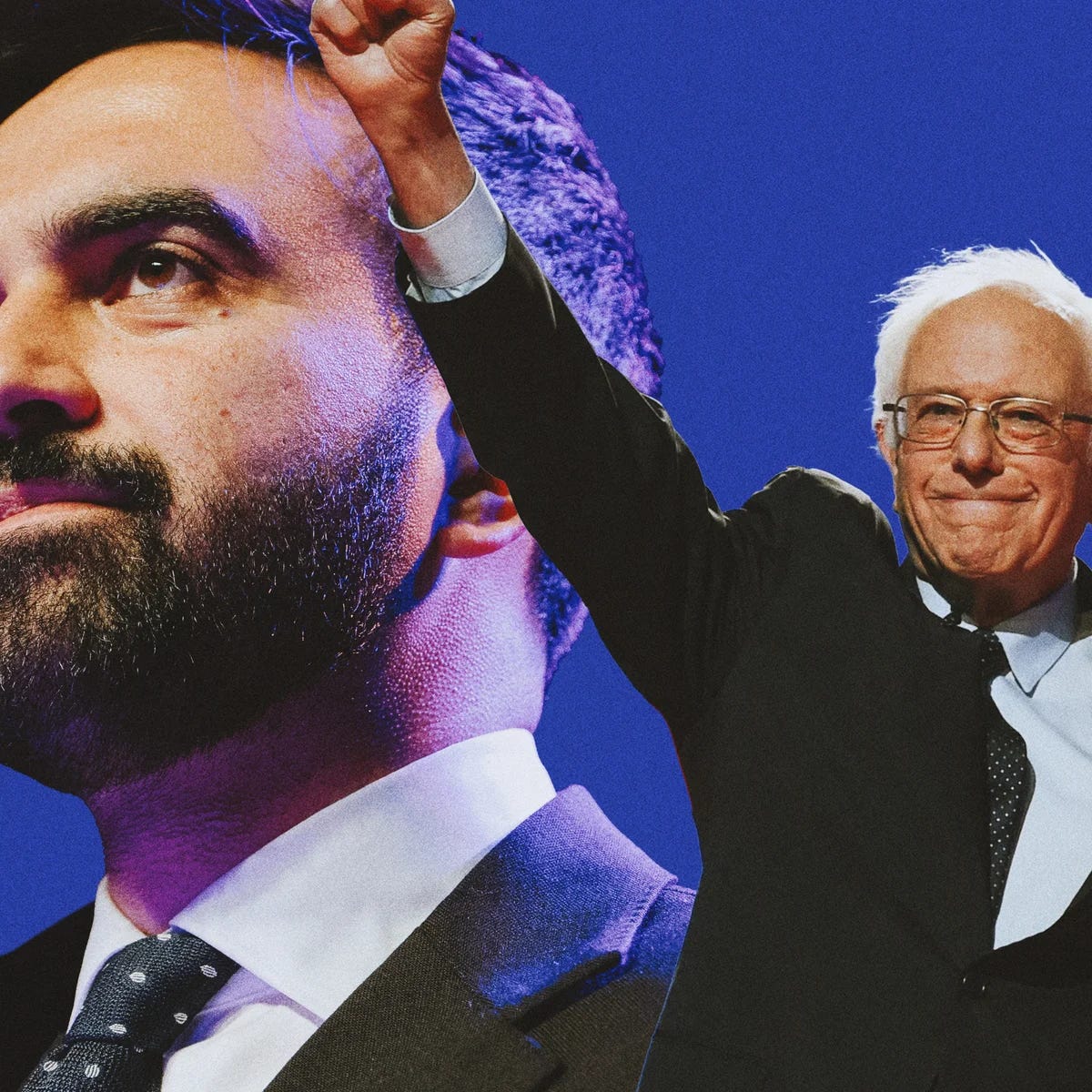
AOC, Bernie Sanders, Zohran Mamdani and Abdul El-Sayed have moved the argument on Palestine, but the party behind them continues to arm Israel and contain the revolt. Are these newly minted politicians just a rebranding exercise for the Democrats as they continue to support the State of Israel?
Alexandria Ocasio-Cortez had already pressed the button for no when Nancy Pelosi crossed the House floor. It was 23 September 2021, Congress was voting on another $1 billion for Israel’s Iron Dome system, and the bill was certain to pass. The cameras caught the conversation but not the words. Ocasio-Cortez changed her vote to present, cried in the chamber and later issued a long explanation saying she opposed the bill. The final count was 420 to nine, with two members present.
There was no legislative arithmetic to hide behind. Her no vote could not have stopped the appropriation and her present vote did not help pass it. What changed was the record attached to her name. Here was the most famous democratic socialist in America, elected after promising to confront the old machinery, facing a vote in which the machinery did not need her and folding anyway. You could see the pressure without hearing a word of the conversation.
That afternoon has followed Ocasio-Cortez because it exposed the bargain beneath the Democratic left. Bernie Sanders can call Israel’s conduct illegal and force a Senate vote on weapons. Ocasio-Cortez can call Gaza a genocide. Zohran Mamdani can defend Palestinian freedom in a city where the political class treats the phrase as a threat, then endorse Hakeem Jeffries for House leadership. Abdul El-Sayed can take on AIPAC and defeat nearly $30 million spent to stop him, and yet each insurgency travels through the Democratic Party, asks for its ballot line, returns its voters to the coalition and meets the same limit when Palestine ceases to be a speech and becomes a demand placed on power.
These politicians do not share one membership card: Sanders is an independent who twice ran for the Democratic presidential nomination, El-Sayed is a progressive Democrat, DSA’s national organisation withdrew its endorsement of Ocasio-Cortez in 2024 while its New York chapter stayed with her, and Mamdani came directly through New York City DSA. Their common project is electoral. Each promises that working people can enter the Democratic Party, beat its preferred candidates and use its machinery against the interests that own so much of it.
They have won elections, raised money from ordinary people, organised tenants, put Medicare for All into national debate and made the words occupation and genocide audible inside Congress, and yet the party takes their votes, enthusiasm and language while its leaders preserve the military relationship with Israel. Dissent decorates the big tent; an arms embargo is treated as arson.
Democrats and Republicans do not need matching speeches when they keep signing the same military account. Republicans invoke scripture, civilisation and Israel’s right to do almost anything it calls self-defence. Democrats talk about humanitarian law, civilian casualties and the peace process, a process now old enough to have grandchildren, and then the appropriations arrive with both parties’ votes.
Barack Obama’s administration fixed the current baseline in 2016. The ten-year memorandum of understanding committed the United States, subject to congressional appropriations, to provide Israel $38 billion in military assistance between fiscal years 2019 and 2028. The Congressional Research Service breaks it down into $33 billion in foreign military financing and $5 billion for missile defence, a commitment Trump inherited, Biden administered during Gaza and Trump accelerated on his return.
Congress made the arrangement plain in April 2024. The House passed the Israel Security Supplemental Appropriations Act by 366 votes to 58, Republican leaders moved the bill, Democratic leaders supplied the votes needed to carry it, and Biden signed the package. Billions went towards Israeli military procurement and missile defence while the same law stopped American funding for the United Nations Relief and Works Agency, which provides schools, medical care and food assistance to Palestinian refugees. The state dropping American-supplied explosives kept its military account while the refugee agency lost its money.
Biden’s officials told Americans they were pressing Israel to protect civilians. In December 2023, his administration used emergency authority to bypass the ordinary congressional review period for a munitions sale. Trump removed the concerned expression from the transaction. On 28 February 2025, Secretary of State Marco Rubio declared another emergency and approved a possible $2.04 billion sale containing more than 35,000 bomb bodies and 4,000 warheads. In March 2026, Sanders filed resolutions against another emergency transfer worth nearly $659 million, including 10,000 500-pound bombs and 12,000 1,000-pound bombs.
The administrations changed, the warnings changed, and the bombs acquired new signatures. Palestinians were still expected to experience the difference between a Democratic bomb approved with regret and a Republican bomb approved with enthusiasm.
There are domestic issues on which the two parties are far apart, and nobody living under an abortion ban, an anti-union government or an immigration raid needs an essay to tell them that elections carry consequences. Israel is where the phrase uniparty earns a narrower and more serious meaning. Republicans demand unconditional support. Democratic leaders sometimes delay a shipment, sanction a settler or criticise Netanyahu, but they protect the alliance, the financing and Israel’s military supremacy, mourning the civilian dead as Republicans sell impunity as strength and both replenish the arsenal.
Netanyahu is useful to this deception. His coalition is so openly vicious that American liberals can oppose him without examining the system he inherited. They can condemn Bezalel Smotrich, recoil from Itamar Ben-Gvir and speak warmly of an earlier Israel whose occupation was administered by men with better manners. The settlements, military courts, land seizures, checkpoints and American weapons all predate the present cabinet. Replacing the manager does not return the land.
Ocasio-Cortez’s record after the Iron Dome vote cannot be reduced to that afternoon. She has called the assault on Gaza a genocide, argued for an end to offensive weapons transfers and voted against wider defence legislation. In July 2025, when an amendment sought to cut Iron Dome funding while leaving the bombs used against Palestinians untouched, she opposed the amendment and then voted against the final defence bill. Her explanation was that Iron Dome is defensive and the amendment would not stop the weapons killing Palestinians.
By 31 March 2026, the pressure had moved her position. At a private NYC-DSA endorsement forum, Ocasio-Cortez was asked whether she would vote against every appropriation for Israeli weapons, including so-called defensive capabilities. She answered yes. She also said Israel should finance its own weapons. NYC-DSA re-endorsed her for the 2026 election days later, and the organisation that could not make her vote no in 2021 had at least forced a promise broad enough to include Iron Dome five years later.
The pledge is progress, but it has not yet faced the vote that would prove it. Ocasio-Cortez still described Iron Dome as critical for protecting civilians even as she said Israel should pay for it, leaving her moral defence of the system intact while changing her position on American financing. Israel’s military supremacy does not arrive in neat boxes labelled defensive and offensive for the convenience of an American roll call, and yet DSA’s immediate objective was narrower: compel its most famous elected ally to oppose American funding for the whole arsenal. She has now promised to do that.
The history explains why DSA members wanted the promise in public. The national political committee withdrew its conditional endorsement of Ocasio-Cortez in July 2024, citing her Israel votes and her appearance on a panel where anti-Zionism and antisemitism were conflated, while the New York chapter stayed with her. The 2026 re-endorsement repaired the local relationship after a direct concession from the congresswoman. It did not change the balance of instruments: the Democratic Party can remove committee assignments, deny campaign money, close access to leadership and fund a primary opponent, while DSA can withdraw an endorsement and publish its reasons. The first real test of the new pledge will arrive when another Israel appropriation reaches the House floor.
Sanders presents the stronger case for staying inside. In September 2024, he introduced joint resolutions of disapproval seeking to stop more than $20 billion in offensive weapons sales to Israel. The proposed sales included tank cartridges, mortar rounds and guidance kits attached to bombs. On 20 November, he forced three measures onto the Senate floor; one received 18 votes while 79 senators, including most of the Democratic caucus alongside the Republicans, opposed it.
Sanders used the only formal congressional mechanism available to challenge the sale and made senators put their names beside it. He tried again on 15 April 2026, and this time the votes were 40 to 59 on the sale of bulldozers and 36 to 63 on 1,000-pound bombs. Every Republican opposed him, but most Senate Democrats supported at least one of the resolutions. Chuck Schumer and Kirsten Gillibrand remained against them. Sanders had more than doubled his Democratic support in less than two years, and yet both transfers survived.
Sanders also raised hundreds of millions of dollars in small donations, filled arenas, won millions of votes and gave younger Americans a vocabulary for class power that the Democratic Party had spent decades removing from public life. After losing the nominations in 2016 and 2020, he endorsed Hillary Clinton and Joe Biden, and his organisation moved towards defeating Trump. The voters who had financed a revolt against Democratic leadership were returned to Democratic leadership because the Republican alternative was worse.
That fear is not invented. Trump is worse on immigration, labour, abortion, climate and Palestine, and the Democratic establishment has turned the threat into a standing collection notice against the left. Every presidential election arrives as the one in which independence would be irresponsible. Every betrayal must wait because the court, the border, the climate or the republic is at stake. The emergency changes its name while the instruction remains the same: organise against us in the primary, then come home.
Sanders can force an arms vote and expose the bipartisan majority, but he cannot make an embargo the price of access to the voters and donors mobilised in his name because those people were never organised into an independent institution capable of withholding its support. Democratic leaders enter every negotiation knowing where the left will stand in November. The right supplies the danger and the centre collects the votes.
Mamdani’s campaign looked like the best answer to that failure. He joined rent, buses, food prices and public power in one argument, defended Palestinian rights when New York consultants treated them as electoral poison, and took the nomination from a political establishment with money, celebrity and nearly every reason to believe the city still belonged to it. The reassurance began after the victory.
The two endorsements now run in both directions. After withholding his support for months, Hakeem Jeffries endorsed Mamdani in October 2025, and immediately before doing so he publicly praised Mamdani’s promise to retain Jessica Tisch as NYPD commissioner. In a CNN interview transcribed by his congressional office, Jeffries said he was “very pleased” with that commitment. No one had to leak the first accommodation from a private room because the House Democratic leader announced what pleased him on television.
Mamdani later kept Tisch. She had led the department under Eric Adams, had the approval of business leaders and centrist officials, and represented continuity at the head of an institution Mamdani once wanted to defund. His progressive supporters were told to understand the demands of governing. New York’s police establishment received the assurance before he entered City Hall.
The next accommodation protected Jeffries himself. In November 2025, City Council member Chi Ossé considered challenging the House Democratic leader in his Brooklyn primary. Mamdani told PIX11 that it was “not the time” for that fight, argued against spending DSA resources on it and helped deny Ossé the organisational support he said he needed to run. Mamdani had won Jeffries’s district in both the mayoral primary and general election, DSA had a young member willing to test that strength against the party leader, and yet the movement chose to preserve Jeffries before asking its voters to believe it was changing his party.
Tisch should be judged by her public conduct, not by a political position inferred from her religion or family. Under her leadership, the NYPD continued policing Palestine demonstrations and handed federal immigration authorities a report tied to a Palestinian woman’s sealed arrest in 2025. The document was used in the attempt to deport her, Tisch acknowledged that the department was investigating how it happened, and Mamdani retained her and has since praised their work together.
A New York mayor faces Albany, police unions, hostile tabloids, business pressure, federal grants and a governor who can make governing brutally expensive. Those constraints are the job, not an answer to the people who voted for structural change. Mamdani decided which fights to postpone and which institutions to reassure, and the people who built the insurgency were asked for patience while the commissioner inherited from Eric Adams kept her office and the House leader kept his flank clear.
On 24 August 2026, the circle closed in public. Jeffries had come under fire for meeting privately with Jared Kushner, Donald Trump’s son-in-law and outside adviser, to discuss how a Democratic-controlled House might work with the White House after the midterms. At a press conference in Dry Harbor Playground, a reporter asked Mamdani whether he would support Jeffries for Speaker if Democrats regained the House. “I continue to support Congressman Jeffries and his bid to become the leader,” Mamdani replied. The word continue mattered. This was not a reluctant acceptance of an uncontested result after the election; it was an existing commitment reaffirmed while Jeffries was being criticised by the party’s left for meeting a member of Trump’s family.
The next day, Mamdani said he remained in regular communication with Jeffries and described their conversations as work on delivering for New York. He also said Democrats needed a clear agenda after the midterms. The arrangement is now visible from both ends: Jeffries endorsed Mamdani after praising the retention of Tisch, Mamdani discouraged a socialist primary challenge to Jeffries, and Mamdani endorsed Jeffries for leadership after the Kushner meeting. The radical mayor and the pro-Israel party leader can disagree in selected primaries, speak to different constituencies and still protect one another when control of the institution is at stake.
Absorption does not require Mamdani to stop sounding radical. He can freeze rents, fight for buses and build public programmes that improve daily life while his administration passes through existing police, fiscal and party institutions, each with enough power to narrow the promise. Jeffries can welcome the socialist, the socialist can govern as a Democrat and then back Jeffries for Speaker, and the party can market the whole exchange as unity.
Abdul El-Sayed did something the usual theory of capture struggles to explain. On 4 August 2026, he won Michigan’s Democratic Senate primary after AIPAC and affiliated groups spent close to $30 million backing Haley Stevens. Senate Democratic leader Chuck Schumer supported Stevens. The spending gave El-Sayed’s opponent an enormous advertising advantage and reportedly set a record for pro-Israel intervention in a congressional race. El-Sayed made AIPAC part of the campaign and beat it.
He has called Gaza a genocide, supported ending offensive and defensive military aid to Israel and told Detroit public radio after the primary that he would not change his language. El-Sayed carried that position into an election, absorbed the money spent against him and won by fewer than 15,000 votes, which makes him a poor fit for any easy story about politicians inventing dissent for television.
His language after the attack on Temple Israel in West Bloomfield shows a different kind of retreat. El-Sayed immediately condemned the antisemitic attack, thanked law enforcement and affirmed the right of Jewish Americans to worship without fear. The next day he released a video that asked viewers to consider the attacker’s relatives, who had reportedly been killed in an Israeli airstrike, and said “hurt people hurt people.” He later argued that if people oppose violence, they must oppose “all violence.”
Jewish civilians in Michigan and Palestinian civilians in Gaza or Lebanon are equally entitled to live, but El-Sayed put unlike forms of violence into one moral container and removed the power governing them. The synagogue attack targeted Jewish people who do not answer for Israel. Israel’s campaign is state violence by an occupying power armed and protected by the United States, funded by the government El-Sayed seeks to join.
“All violence” sounds humane because it refuses an exception, and yet it flattens the very structure El-Sayed names when he talks about occupation, military aid and genocide. It asks the public to look at pain travelling in both directions when the political question concerns who holds the aircraft, who controls the border, who receives the American weapons and who has lived under military rule. Both-sides language does not always excuse Israel. Sometimes it protects a progressive politician from having to carry the full asymmetry of his own argument into a general election.
The general-election pressure became visible on 24 August. After Hasan Piker argued that institutions presenting American Jews as uniformly invested in Israel risked provoking violence against them, Jeffries and other Democrats condemned the remarks. El-Sayed responded that antisemitism was a scourge, said nobody outside his campaign spoke for it and redirected the conversation towards gas, groceries, schools and health care. He did not abandon his position on Gaza, nor did he completely cut ties with Piker, but he moved fast to separate his candidacy from language the party had declared unacceptable.
Schumer called El-Sayed after the primary and praised him as a strong candidate. El-Sayed asked Stevens and her supporters to join him. That is what nominees do, especially in a race that may decide control of the Senate, but the sequence places him inside the same machine he defeated: he beat the leadership’s candidate and its allied money, then needed the leadership’s fundraising, committees and turnout operation for November. His votes, if he reaches the Senate, will tell us whether the accommodation remained electoral or reached the policy itself. That question is still open.
AIPAC exercises power in public. Its money is reported to the Federal Election Commission, its endorsements are announced and its super PAC buys television time that voters can watch between pharmaceutical advertisements. American support for Israel also rests on strategic doctrine, weapons contracts, Christian Zionism, party loyalty and an imperial belief that Israel is the forward state Washington cannot afford to lose. The lobby works because the state already wants much of what the lobby demands.
The spending still disciplines dissent. In 2024, United Democracy Project, AIPAC’s super PAC, spent $14.6 million in the race that removed Jamaal Bowman and $8.6 million in the contest that defeated Cori Bush, according to OpenSecrets figures drawn from federal filings. Bowman and Bush had weaknesses unrelated to Gaza and their opponents had local support, and yet no honest account can ignore what the money was purchased to do. Two Black members of Congress who challenged support for Israel were removed in Democratic primaries after a pro-Israel organisation spent more than $23 million across their races.
At the Democratic National Convention that August, thirty uncommitted delegates arrived after hundreds of thousands of primary voters had protested Biden’s Gaza policy. They asked for a Palestinian American to speak from the main stage and offered a speech for vetting. Convention officials refused. The Israeli-American parents of a hostage had addressed the convention the night before, as they had every right to do, and Palestinian Americans asked for the same room to speak about families killed with American weapons. The party gave one family the microphone and directed the other towards a panel away from prime time.
DSA’s electoral strategy intends to conquer this institution from within. The organisation reported 120,000 members on 4 July 2026, an all-time high, and its New York candidates removed establishment incumbents in June while El-Sayed proved in Michigan that the wider left could survive a historic flood of outside money. Once elected, however, they hold office on the Democratic line, negotiate with Democratic leaders and face donors who can spend the price of a small hospital to remove one member of Congress. DSA can disapprove, withhold an endorsement and organise another campaign while the party keeps the ballot.
A rent freeze changes what a tenant can afford, a union contract changes a worker’s life and a blocked arms sale keeps bombs out of a military stockpile. The rebrand lies in selling those gains as proof that the institution itself has been captured by the left when the larger flow of power continues in the other direction.
You can measure that direction without trusting any politician’s self-description. Count the weapons notices, appropriations, vetoes, appointments and votes, then watch what happens after the insurgent wins and the party offers committee access, campaign money or an endorsement. AOC’s present vote, Sanders’s 18-to-79 defeat, Mamdani’s retention of Tisch and endorsement of Jeffries, and El-Sayed’s turn towards “all violence” are different records, and yet none has forced the Democratic Party to make Palestinian freedom a condition of governing.


