Egypt Wins First World Cup Knockout Match in History, Coach Dedicates Victory to Palestine
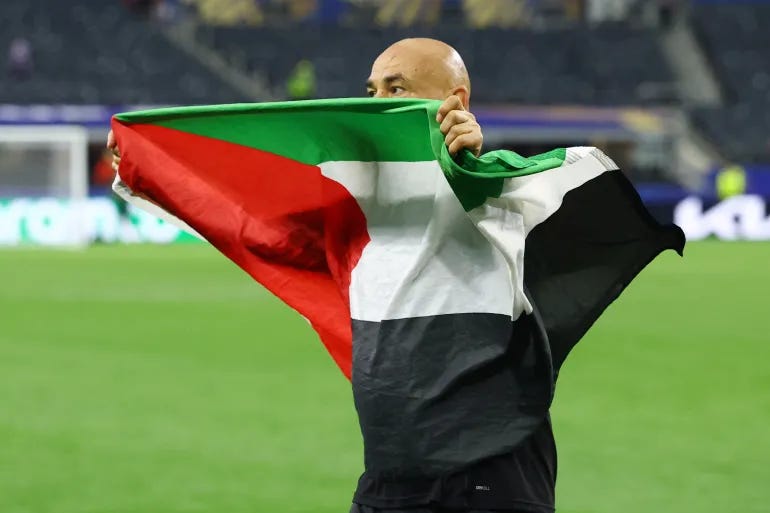
Hossam Hassan raised the Palestinian flag on a Texas pitch after ninety-two years and one penalty shootout delivered Egypt its first knockout win in World Cup history.
Hossam Abdelmaguid placed the ball on the spot at AT&T Stadium in Arlington with 70,244 people watching and Mohamed Salah already through his part of the job. Harry Souttar had blazed Australia’s opening penalty over a crossbar that seemed to rise to meet it. Eighteen-year-old Lucas Herrington had rattled the woodwork on Australia’s fourth attempt, the youngest man on the pitch left carrying the exit of a nation. Abdelmaguid needed only to be calm, and he was. The ball went low and hard past Mathew Ryan, the veteran goalkeeper thrown on eleven minutes from the end of extra time for exactly this moment and unable to do anything about it once it arrived. Egypt had won a World Cup knockout match. In the country’s entire football history, that had never happened before.
The number attached to that sentence is ninety-two. Egypt’s first World Cup appearance came in Naples in 1934, and their next competitive win in a World Cup knockout tie came in Arlington in 2026. Everything in between, three tournaments and five losses and four draws spread across eighty-six years, was preface.
The match itself did not unfold like history in the making. Australia started the brighter side, Cristian Volpato’s early strike skimming the crossbar inside five minutes, Jordan Bos threatening down the flank before Ramy Rabia intervened with a last-ditch challenge. Egypt settled and struck first: in the thirteenth minute, Karim Hafez floated a cross from the left and Emam Ashour rose above his marker to head past Patrick Beach at the far post, his second goal of the tournament. Egypt controlled the half that followed. Then, ten minutes into the second, Mohamed Hany turned a dangerous Australian free-kick into his own net, becoming the first player at this World Cup to score two own goals in a single tournament. The mistake looked, for a stretch of minutes, as though it might cost Egypt the match and not just the lead.
It nearly did. Beach produced a one-handed save to deny Rabia a stoppage-time winner, and Harry Souttar threw his body in front of a goal-bound effort from Haisem Hassan to force extra time. Salah, playing through a recent hamstring strain and quiet for most of the ninety minutes, fired over the bar from a promising position early in the additional half hour. Neither side found the breakthrough that would have spared everyone the walk to the penalty spot. Australia’s manager Tony Popovic gambled by sending on Ryan for the shootout, hoping experience would decide what ninety minutes of football had not. It did not work. Souttar missed. Salah, up third, rolled a Panenka down the middle with the calm of a man who has scored enough penalties in enough stadiums to know exactly how much daring the moment could absorb. Herrington’s shot came back off the bar. Abdelmaguid finished it.
“It’s history,” Salah said afterward, and for once the word was doing exactly what it claimed to do, not decoration but description. Egypt had qualified for four World Cups in ninety-two years and reached the knockout stage in exactly one of them. They had now won a match in it.
The near misses along the way have their own weight. In 1990, fifty-six years after Naples, Egypt returned to a World Cup and held the Netherlands and the Republic of Ireland to draws before Mark Wright’s header for England in the final group match ended the campaign a single goal short of the knockout round they had never seen. In 2018 in Russia, Salah arrived as the most famous Egyptian footballer alive and scored twice in defeats that eliminated his country in the group stage regardless, the second goal a lob against Saudi Arabia that meant nothing to the table and everything to a fan base watching a generational talent lose on the only stage that counted. Egypt’s goalkeeper that tournament, Essam El-Hadary, saved a penalty against Saudi Arabia at forty-five years and five months old to become the oldest player in World Cup history, a record earned in a match Egypt still lost. Every one of those tournaments produced a moment worth remembering and none of them produced a win once the group stage ended. Arlington did.
Here the record offers a detail that requires no interpretation, only proximity. Egypt qualified for that first World Cup, the one that ended in a 4-2 defeat to Hungary in Naples, by eliminating a team from Mandate Palestine in the qualifying round. Egypt won 7-1 in Cairo and 4-1 in Tel Aviv, an 11-2 aggregate that sent the Pharaohs to Italy and ended Palestine’s own attempt to become the first team from the region to reach a World Cup finals. In Naples, Abdulrahman Fawzi became the first African player to score at a World Cup, pulling Egypt back from 2-0 down to level at 2-2 inside the first half. He was denied what should have been a hat-trick and the lead when the referee, Rinaldo Barlassina, ruled a third goal offside after Fawzi had carried the ball from the center of the pitch past the entire Hungarian defense, a call Egypt’s players disputed for the rest of their lives. Hungary pulled away to win 4-2 anyway. Ninety-two years and one country’s dissolution and reconstitution under occupation later, the Egyptian head coach stood on a pitch in Texas having delivered his country’s first World Cup knockout win in history, and the flag he raised over his head was Palestine’s.
Hossam Hassan carried both flags off the pitch at Dallas Stadium as his players sank to the ground in prostration. In his post-match media appearance he set the football aside. “My heart and soul are with them,” he said of the Palestinian people, and he prayed for mercy on their martyrs before turning to the dedication itself: a win handed to Egyptians first, and then to what he called the good and generous people of Palestine. Egypt’s director of football, Ibrahim Hassan, and the winger Trezeguet had spent the hours before kickoff in an altercation with a Dallas police officer who shoved both men as they tried to take a photograph with a fan outside the team hotel, an incident the Egyptian federation confirmed and one that made the eventual celebration, flags raised, foreheads to the turf, carry an edge that had nothing to do with football.
The reaction traveled fastest to the place that could least afford to look away from it. In Gaza, people came out from tents and from what remained of demolished homes to watch the match on whatever screens could be found, gathering in the open air against a backdrop that needed no further description than the one it provided itself. Tamer Nahed, watching from inside the strip, wrote afterward that he was following a World Cup with more excitement than he had ever felt before. Social media footage circulating from the territory showed children with the Egyptian flag painted on their faces standing among people whose own flag had not made it into a World Cup finals since British Mandate rule ended the possibility for a generation, cheering for the team that ended their own country’s first World Cup bid in 1934 and now, in extra time of a different century’s history, had chosen to hand its own breakthrough back to them.
The scenes that circulated afterward showed faces lit up in a way that had little to do with the football itself: people stepping out from between tents and collapsed walls for what amounted to a few minutes of ordinary life, the kind of communal noise a penalty shootout produces anywhere else in the world, arriving instead in a place where the ordinary has been suspended for two years. Nobody organized the screenings. Nobody needed to. A shootout in Arlington, Texas, reached a besieged strip on the other side of the planet within minutes, and for the length of that broadcast the two locations were watching the same thing at the same time for the same reason.
Nothing about that arrangement was staged, and nothing about it needed to be. The Egyptian federation did not schedule the moment. Hassan raised the flag because he wanted to, on live television, in front of a global audience assembled for a football match and not for a statement, which is precisely what made the statement land.
Egypt’s flag was not the first of the tournament and it will not be the last. Neither Palestine nor Israel qualified for the expanded, forty-eight-team field, Palestine barred by circumstance from hosting its own qualifiers and forced onto neutral ground, Israel eliminated in its qualification group. Their absence from the field has not kept Palestine off the pitch. Turkish fans waved a Palestinian flag behind the goal for the full ninety minutes of their 3-2 win over the United States. Moroccan supporters gathered in Times Square before their opening match against Brazil and carried the flag into New York New Jersey Stadium, the venue that will host the final. Fans from Spain, Scotland, Bosnia and Herzegovina, Senegal, and Algeria have carried it into stadiums across the United States, Canada, and Mexico, and football federations from several competing nations have joined a public campaign demanding Israel’s suspension from international competition, citing more than a thousand athletes killed in Gaza over the course of the war and close to three hundred sports facilities destroyed. Outside the stadium hosting Egypt’s group match against Iran in Seattle, a woman dressed as the Statue of Liberty stood with the flags of Palestine and Lebanon and asked, in the only language the moment required, for freedom.
Neither absent country needed the other’s misfortune explained to a global audience that has spent two years watching the war in Gaza on the same screens now carrying World Cup coverage. The campaign asking football’s governing bodies to suspend Israel from international competition has drawn public backing from clubs and federations across several of the nations still playing in the United States, Canada, and Mexico, an unusual alignment for a sport that generally prefers to keep its politics off the broadcast. Hassan’s gesture arrived inside that wider wave of flags, but it did not need the wave to matter. A head coach who has just delivered his country’s first knockout win at a World Cup earns the exclusive right to decide what that win means, and Hassan decided it meant Gaza before it meant Egypt’s place in the round of sixteen, where Argentina now waits. He said as much himself, in that order.
Egypt has never played a second World Cup knockout match, so nobody in Cairo or anywhere else has a precedent for what comes next. The bracket now confirms Argentina, Lionel Messi’s side having survived a 3-2 extra-time scare against Cape Verde in Miami, a matchup that puts Salah’s generation against the defending champions with nothing left to prove about Friday night and everything left to prove about the round that follows it. What the record from Arlington does not answer, and was never built to answer, is what an Egyptian federation and an Egyptian coaching staff do with a platform this large once the tournament ends and the cameras move to the next country’s flag. Hassan raised his for one night. Gaza does not get the option of putting it back down.
Salah scored the calmest penalty of his career and called it history without needing to explain which part of it he meant. Nobody watching from a tent in Gaza needed the explanation either.


