


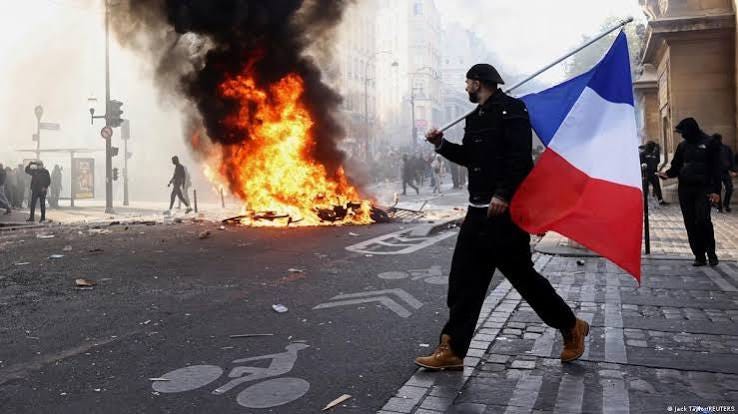
On a damp, smoke-choked Saturday in mid-October, the Place de la République in Paris looked like an open-air staging ground for a twenty-first-century Jacquerie. According to figures released by the French Interior Ministry, more than half a million people marched through the streets of France’s major cities that day. By nightfall, the familiar rituals of modern French discontent had escalated into something altogether more ferocious. Masked detachments on the margins of the marches stormed municipal buildings, torched town halls, and looted some fifteen hundred shops. They left behind hundreds of millions of euros in damage and the acrid, lingering perfume of burnt rubber and tear gas.
The immediate catalysts were decidedly terrestrial: runaway housing costs that have surged by roughly sixty-five per cent across the continent over the past decade, decaying public schools, and fuel prices spiked by geopolitical crises in which ordinary citizens feel they had no say. Yet the banners fluttering above the Parisian barricades pointed toward a more distant, clinical culprit. Again and again, in spray paint on bank façades and in chants echoing off Haussmannian stone, the fury was directed northward, toward the glass-and-steel ziggurats of the European Quarter in Brussels.
To listen to the insurgents on the streets of Paris, the farmers blockading highways outside Warsaw, or the populist firebrands commanding ever-larger shares of the vote from Milan to The Hague, is to hear a single, unifying diagnosis of Europe’s malaise. The European nation-state, the argument goes, has become a polite fiction. In its place stands a hollowed-out administrative shell, governed by a transient class of technocrats whose loyalty lies with a borderless, supranational consensus rather than the voters who elect them.
If one steps back from the burning Peugeots and looks at the crisis through the wider lens of world history, a darker, more ironic question begins to surface. For centuries, the powers of Western Europe perfected the art of governing distant populations through centralized bureaucracies, extracting wealth, imposing standardized legal codes, and subordinating local desires to the grand strategic imperatives of the metropole. Now, Europeans rage against their own perceived powerlessness, facing demographic shifts they cannot halt, economic strictures they cannot vote away, and an elite class that treats national capitals as mere stepping stones to global sinecures. Is Europe experiencing the boomerang of its own history? Have the administrative mechanisms of empire, having lost their overseas territories, finally come home to colonize the continent itself?
To understand the anatomy of this revolt, one must first grapple with what the seventeenth-century jurist Jean Bodin and the architects of the 1648 Peace of Westphalia meant by the word sovereignty. In the classical sense, a sovereign state is the ultimate arbiter of its own destiny. It controls its borders, mints its own currency, writes its own laws without appeal to a higher earthly authority, and answers solely to the polity it governs.
By that strict Westphalian yardstick, the twenty-seven member states of the European Union exist in a condition of voluntary, institutionalized twilight. Consider the mechanics of daily governance in a country like France, Italy, or Germany. If a national parliament wishes to subsidize a failing domestic industry, it must first seek the blessing of the European Commission’s Directorate-General for Competition. If a member of the Eurozone wishes to run a fiscal deficit to cushion its citizens against an energy shock or an aging population, its budget must pass muster under fiscal rules policed from Frankfurt and Brussels. Under the foundational doctrine of the primacy of EU law, established not by popular referendum, but by the European Court of Justice in the 1964 case Costa v. ENEL, whenever a domestic statute or even a provision of a national constitution conflicts with a European directive, the national law must yield.
In the polite parlance of Brussels seminars and political-science departments, this arrangement is known as “pooled sovereignty.” The theory, born in the rubble of the Second World War and championed by visionaries like Jean Monnet and Robert Schuman, was that by binding the coal and steel industries, and eventually the entire economies, of France and Germany together, war between them would become materially impossible. Moreover, in a twenty-first century dominated by continental behemoths like the United States, China, and India, what clout could a standalone Belgium or Portugal, or even a standalone France, hope to wield in trade negotiations or climate treaties? By pooling their sovereignty, European nations were supposed to regain at the continental level the clout they had lost at the national one.
“The tragedy of the European project is that it succeeded economically by failing politically,” a veteran diplomatic historian in Paris told me recently. “Monnet’s method was explicitly designed to bypass popular passions. You integrate by stealth through technical regulations, customs unions, and phytosanitary standards assuming that the citizens will be so grateful for peace and prosperity that they won’t notice the levers of democratic control moving out of their reach.”
For forty years, while the postwar economic miracle held and the Welfare State expanded, that wager paid off. Political scientists call this era the “permissive consensus.” Citizens stayed home or cast protest votes in European elections, content to let the mandarins in the Berlaymont building harmonize the curvature of cucumbers and eliminate roaming charges on mobile phones.
That consensus is now dead, killed off by a cascade of compounding crises: the Eurozone debt crisis of the twenty-tens, the migration waves of 2015, the pandemic, the shock of war on the eastern flank, and the current cost-of-living vise. When the European Union was merely a distributor of structural funds and Erasmus student stipends, its democratic deficit was an academic curiosity. Now that Brussels is perceived as the enforcer of green-transition mandates that shutter factories, agricultural rules that bankrupt smallholders, and defense-spending imperatives that require gutting social programs, the distance between the governed and the governors has become explosive.
In the French countryside and the peri-urban banlieues, the sense of disenfranchisement is palpable. A voter in Picardy or Provence can go to the polls, throw out a center-right government, elect a center-left one, or cast a ballot for Marine Le Pen and Jordan Bardella’s National Rally. Yet that voter will discover that seventy per cent of the regulatory framework governing their farm, their local hospital’s procurement, and their town’s energy grid remains unchanged, locked behind the bulletproof glass of European treaties that require the unanimous consent of twenty-seven nations to amend.
When local policies cease to reflect local political choices, elections feel like elaborate civic theater rather than exercises in self-determination. The ballot box becomes a pressure valve that isn’t connected to the boiler.
Nothing fuels the populist charge of “globalist capture” quite so effectively as the career trajectories of the men and women who preside over this system. In the classical republican tradition, a leader rises from the citizenry, serves a term at the helm of the state, and returns to private life, remaining tethered to the reputation and fortunes of their home country.
In contemporary Europe, however, national leadership increasingly resembles a regional audition for a global executive suite. To the cynical eye of a striking French railway worker or a Dutch farmer, the modern European centrist politician operates inside a closed, self-rewarding loop. You win a national election on a platform of domestic renewal; you spend your tenure enforcing the painful fiscal and regulatory orthodoxies demanded by Brussels and the international bond markets; and, when the domestic backlash renders you un-electable at home, you are parachuted into a prestigious, tax-advantaged post in the supranational archipelago.
The roll call of this velvet escalator is a matter of public record, visible on the organizational charts of the world’s governing institutions. After serving as Prime Minister of Portugal, José Manuel Barroso ascended to the Presidency of the European Commission for a decade, presiding over the harsh austerity regimes imposed on southern Europe, including his own homeland, during the financial crisis. Less than two years after leaving Brussels, he was hired as the non-executive chairman of Goldman Sachs International, the very investment bank whose complex currency swaps had helped mask the Greek debt crisis in the first place.
Then there is Mario Draghi, the quintessential technocrat. Draghi moved from the Italian Treasury to an executive role at Goldman Sachs, then to the Presidency of the European Central Bank, where he famously pledged to do “whatever it takes” to save the euro. From there, he was installed as the unelected Prime Minister of Italy in 2021 to oversee the country’s EU recovery funds, before returning to Brussels to author the bloc’s grand competitiveness strategy. Similarly, Christine Lagarde, having served as France’s Finance Minister, glided seamlessly across the Atlantic to run the International Monetary Fund in Washington, only to glide back to Frankfurt to succeed Draghi atop the European Central Bank, all without ever having stood for a popular vote.
Meanwhile, the Presidency of the European Council, the body that represents the heads of state, has become a reliable landing pad for prime ministers whose domestic coalitions have frayed or expired. The post has gone to Belgium’s Herman Van Rompuy and Charles Michel, Poland’s Donald Tusk (who uniquely used the post to bounce back into Polish domestic politics), and, most recently, Portugal’s António Costa, who stepped down as Prime Minister amid a domestic investigation in late 2023 and by late 2024 was gaveling in summits in Brussels.
Beyond the EU’s own institutions lies the wider galaxy of multilateral governance. Portugal’s former Prime Minister António Guterres sits atop the United Nations. Denmark’s Anders Fogh Rasmussen, Norway’s Jens Stoltenberg, and the Netherlands’ Mark Rutte have treated the Secretary-Generalship of NATO as a rotating Nordic-Dutch heirloom for fifteen years. Former British Prime Minister Tony Blair spent years heading the Quartet on the Middle East before building a sprawling global advisory institute, while dozens of lesser-known ministers populate the senior ranks of the World Economic Forum, the OECD, the World Bank, and the lucrative advisory boards of multinational defense and tech conglomerates.
Defenders of this ecosystem argue that no sinister cabal is at work here. International organizations require leaders who understand how states function, who know how to negotiate until four in the morning in windowless rooms, and who already have the cell-phone numbers of world leaders in their contacts. Who better to run NATO or the European Council than someone who has sat in the Prime Minister’s chair in The Hague or Lisbon?
Yet this defense misses the profound structural distortion that such a career path creates, a dynamic that economists call an agency problem. In any system, human beings respond to incentives. If a prime minister knows that their post-political future, their social standing, and their legacy depend on their reputation as a “reliable partner” in the eyes of Berlin, Brussels, Washington, and Davos rather than on the approval of the shopkeepers in Lyon or the pensioners in Calabria, their governing calculus subtly shifts.
When a clash arises between the unruly, populist demands of a domestic electorate and the smooth, technocratic imperatives of European integration, the domestic electorate is treated as an unruly congregation to be managed, educated, or bypassed, rather than a sovereign master to be obeyed. In France, President Emmanuel Macron, himself a product of the elite Inspection Générale des Finances and the Rothschild investment bank, has repeatedly used Article 49.3 of the French Constitution to ram through pension reforms and budgetary measures without a parliamentary vote. Those measures were designed in no small part to reassure Brussels and the credit-rating agencies that France remains fiscally disciplined. The street protests currently convulsing French cities are the direct, kinetic result of a citizenry that feels its government is performing for an audience in Frankfurt rather than answering to the voters on the Seine.
At this juncture, the narrative takes a turn that few on the European populist right, normally the loudest critics of Brussels, are willing to confront. If European states are being hollowed out, if their local economies are being subordinated to a distant metropole, if their borders have become porous and their traditional cultures are being reshaped by forces beyond their control, is this really an unprecedented historical crime? Or is it the ultimate, exquisite irony of modern history, with the chickens of five hundred years of European empire finally coming home to roost?
Asking whether Europe’s current predicament is “payback” for colonialism does not require invoking a mystical karma in which history balances its moral ledger out of a sense of poetic justice. History is rarely so neat, and it is never a morality play. Rather, the connection between Europe’s imperial past and its post-sovereign present is deeply, demonstrably structural. In at least three distinct ways, the crisis convulsing Europe today is the direct, linear descendant of the empires Europe built abroad.
First, consider the architecture of governance itself. The European colonial project was the first wave of aggressive globalization. From the sixteenth century onward, powers like Britain, France, Spain, the Netherlands, and Belgium went out into the world and systematically dismantled the sovereignty of local polities across Africa, Asia, and the Americas. They drew arbitrary borders that ignored ethnic and linguistic realities; they subordinated local agricultural and artisanal economies to the needs of an international market centered in London, Paris, and Antwerp; and they installed a class of Western-educated local elites whose job was to administer the territory on behalf of the metropole, and who were rewarded with titles, stipends, and seats in the imperial parliament for their loyalty.
When the European empires collapsed in the decades following the Second World War, from the French withdrawal from Indochina and Algeria to the British retreat from India and Suez, two things happened simultaneously. First, the European nation-states discovered that, stripped of their colonial possessions and captive markets, they were suddenly too small and too weak to compete with the new superpowers, the United States and the Soviet Union. As the historian Quinn Slobodian and others have documented, the turn toward European integration in the nineteen-fifties was, for countries like France and Belgium, a direct substitute for lost empire. Indeed, the 1957 Treaty of Rome explicitly included the remaining African colonies of France and Belgium in an associative framework dubbed “Eurafrica.”
Second, a vast generation of colonial administrators, legal scholars, and technocrats came home. Having spent decades perfecting the art of governing diverse populations from afar through indirect rule, regulatory harmonization, and technocratic decree without the messy interference of local democracy, they applied those exact same administrative techniques to the construction of the European Community. As Hannah Arendt famously observed in The Origins of Totalitarianism, the bureaucratic methods of rule forged in the laboratories of the overseas colonies boomerang back upon the mother country. Today, when a French or Polish citizen complains that their local laws are being overridden by an unaccountable commissioner in Brussels, they are experiencing a very mild, velvet-gloved version of the administrative subordination that Paris and London imposed on Algiers and New Delhi for generations.
A second structural link is the demographic and economic boomerang. One of the central grievances driving the current wave of protests and the rise of hard-right parties, such as the Patriots for Europe group in the European Parliament, is the transformation of European cities through immigration from the Global South, alongside the hollowing out of European manufacturing by Asian competitors. During the October 2026 unrest in France, right-wing MEPs across the continent were quick to link the burning cars in Paris to migration policies, with Polish lawmakers pointing to French streets as a cautionary tale against open borders.
Yet why are millions of people from the Maghreb, West Africa, the Middle East, and South Asia drawn to Europe, and why do they speak French, English, Spanish, or Dutch when they arrive? As the late sociologist Stuart Hall and the British activist Ambalavaner Sivanandan used to say of the post-colonial migration wave, “We are here because you were there.”
For centuries, European powers integrated the global periphery into their own economic and linguistic spheres. They reorganized the economies of Senegal, Algeria, the Congo, and the Indian subcontinent to extract raw materials and cheap labor, destabilizing indigenous political structures and tying the educational and aspirational horizons of those populations to the European metropole. When Europe needed cheap labor to rebuild its shattered cities in the nineteen-fifties and sixties, it actively recruited from its former colonies. Today, as Europe’s native populations age and shrink, creating severe labor shortages in everything from elder care to construction, and as climate change and instability rattle the former colonized world, the pathways carved by empire flow in reverse. Europe spent four hundred years kicking down the doors of the rest of the world to insist on the free movement of European capital, European goods, and European settlers. Its citizens can hardly act astonished to discover that a globalized world is a two-way street.
Third is the geopolitical squeeze caused by the loss of the imperial dividend. For generations, the comfortable European social contract with its thirty-five-hour workweeks, generous pensions, subsidized universities, and long August holiday was underwritten by two massive historical subsidies. The first was the lingering economic advantage of having written the rules of global trade and finance during the colonial era, allowing Europe to buy cheap commodities and energy from the Global South and sell back high-value manufactured goods. The second was the American security umbrella, which allowed European states to outsource their military defense to Washington and spend the peace dividend on their own welfare states.
In 2026, both of those subsidies have evaporated. The former colonies have grown up, industrialized, and refused to play the role of docile suppliers. China now outcompetes Germany in electric vehicles and clean tech; Gulf states and resource-rich nations in Africa and Latin America dictate their own terms to European buyers, as President Macron discovered during his urgent energy-diplomacy trips to Bahrain and the Gulf even as Paris burned. Meanwhile, a fractured international order and a demanding Washington have forced Europe to rearm at breakneck speed, pushing defense budgets past two and three per cent of GDP at the exact moment that public debt is at historic highs.
The rage in the streets of France is the rage of a continent going through withdrawal from its historical privileges. Young Europeans, facing housing prices that have risen by nearly two-thirds in ten years and saddled with the public debt required to fund a new era of military and energy security, are discovering what life feels like when your continent is no longer the master of the universe, but an aging peninsula trying to hold its own in a ruthless global market.
Still, any rigorous examination of the European crisis must pause to ask whether the populist indictment, which casts Brussels as an omnipotent leviathan crushing innocent nation-states, is entirely accurate, or whether it lets national politicians off the hook far too easily.
Spend a week in the corridors of the Justus Lipsius building in Brussels, where national ministers gather, and a very different picture emerges. The European Union is a creature of the member states themselves, not an alien occupying force. Its civil service is smaller than the municipal bureaucracy of a mid-sized city like Leeds or Lyon. Every major law requires the approval of the Council of the European Union, which consists of the elected ministers of the twenty-seven national governments, alongside the directly elected European Parliament. The most powerful body in Brussels is the European Council, where Emmanuel Macron, the German Chancellor, the Italian Prime Minister, and their twenty-four peers sit around a table and make decisions by consensus.
Why, then, do Europeans feel so utterly dominated by Brussels? For decades, national politicians have engaged in a cynical game of blame-shifting. When a French president or an Italian prime minister wants to pass an unpopular pension cut or a painful environmental regulation that they themselves know is economically necessary, they go to Brussels, vote for the directive behind closed doors, and then return to Paris or Rome, throw up their hands before the television cameras, and say, “Alas, my friends, I would love to help you, but Brussels is forcing our hand.”
“National capitals have used the EU as an alibi for forty years,” a senior European Commission official told me, with a mixture of exhaustion and bitterness. “Everything that succeeds is claimed as a national victory by the Prime Minister on the evening news. Everything that hurts, every factory closure, every budget cut, every migration quota, is blamed on ‘the Eurocrats.’ And now they are shocked to find that their voters believe them, and want to burn the house down.”
Furthermore, a glaring paradox sits at the heart of the sovereignty critique. Those who argue that European countries must reclaim their Westphalian sovereignty often point to Brexit as the ultimate act of liberation. Yet in the decade since the United Kingdom voted to sever its ties with Brussels in 2016, has Britain become a buccaneering, sovereign master of its own fate, immune to globalist pressures? Hardly. Post-Brexit Britain has faced the exact same cost-of-living crises, the exact same housing shortages, the exact same public-sector strikes, and arguably even higher levels of net migration than it experienced inside the bloc, all while suffering a measurable drag on its trade and GDP. Discovering that you are no longer bound by directives from Brussels is cold comfort when you remain at the mercy of the international bond markets, global supply chains, and Washington’s strategic whims.
In a world of continental titans, the classical sovereignty that protestors pine for may no longer exist for mid-sized nations of ten million or even sixty million people. As the recent EIR strategic assessment of the French unrest noted, Europe is caught in a profound strategic bind. To avoid becoming a mere vassal of Washington or an economic colony of Beijing, Europe must act as a unified, integrated power, pooling its defense, its capital markets, and its industrial policy. Yet doing so requires extracting more money and more authority from national voters who are already in open revolt against the integration that has occurred thus far.
Late on the Sunday night following the October marches in Paris, municipal cleaning crews moved through the Place de la République, hosing away the ash of burned-out scooters and sweeping up the shattered glass of bus shelters. By Monday morning, the commuters had returned, stepping around the charred patches of asphalt on their way to the Métro, while in Brussels, the European Commission issued a carefully calibrated statement defending the right to peaceful assembly while condemning the weekend’s arson and looting as “unacceptable,” pointedly noting that maintaining public order remained France’s national responsibility.
The response was a masterclass in bureaucratic detachment, with the metropole washing its hands of the province’s unrest while the province boiled over with grievances tied to the metropole’s grand design.
Europe today stands at a historic crossroads that no white paper from Mario Draghi and no riot-control cordon from the French Interior Ministry can easily resolve. For five centuries, the continent exported its internal rivalries to the rest of the planet, carving up the globe to feed the prestige and prosperity of the European nation-state. When that imperial era ended in fire and ruin, Europe attempted something genuinely radical: to abolish power politics on its own soil by replacing the passionate, blood-and-soil nation-state with a cool, post-national rule of law.
In doing so, however, the architects of modern Europe forgot a central truth about human politics, one that the colonized peoples of Asia and Africa taught the European empires in the twentieth century, and that the citizens of Paris, Milan, and Warsaw are now teaching Brussels in the twenty-first. People do not live by GDP points and regulatory efficiency alone. They want to know that the leaders who govern them belong to them, share their fate, and can be removed by them when they fail.
Until Europe figures out how to make its continental union genuinely democratic, severing the cozy revolving door of its globetrotting elite and restoring meaningful political agency to the towns and cities where ordinary people live, the smoke rising over the Place de la République will become the new European normal.
And, as a side ending note, Macron, who absolutely does not care about France, will end up at a prestigious and comfortable job for being loyal to the globalist agenda. The French people have this romantic notion of history and culture but the suits in Brussels simply do not care, and these leaders are loyal to the ring and not the people.