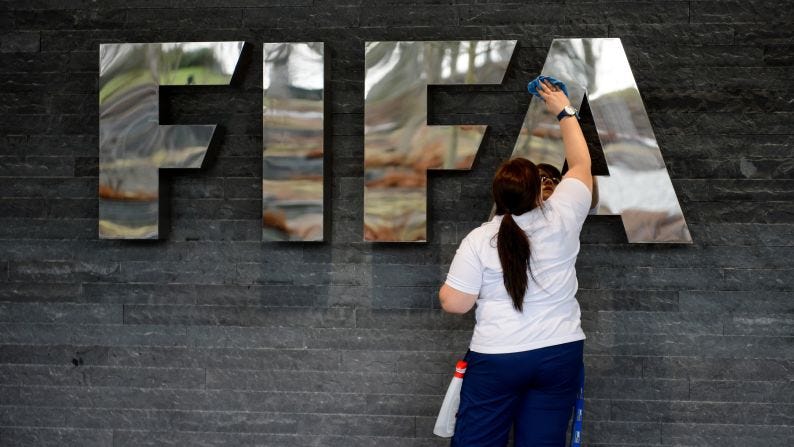
The cameras that morning in Zurich did not need a voice-over. Swiss police walked through the lobby of the Baur au Lac and led seven senior football officials out of a hotel that had long functioned as the unofficial annex of FIFA power, the kind of place where confederation presidents checked in for congresses and checked out with commercial futures already priced. It was May 2015. The United States Department of Justice had unsealed a racketeering indictment that described, in the patient language of federal prosecutors, a multi-decade arrangement in which football officials and sports marketing executives moved more than a hundred and fifty million dollars in bribes and kickbacks through media and marketing rights for tournaments that ordinary supporters still believed were governed by something closer to sport than to inventory. Chuck Blazer, the American former CONCACAF secretary general who had once kept apartments above the confederation’s offices in Trump Tower, had already become the investigation’s principal informant after agents confronted him over unpaid taxes on his share of the proceeds. The raid was not a metaphor. It was a physical seizure of men who had treated the sport’s commercial architecture as private stock. According to the Justice Department’s later accounting of the wider case, the scheme that followed produced twenty-seven individual guilty pleas, four corporate guilty pleas, and two trial convictions, with restitution flowing back to FIFA and the confederations in successive distributions that eventually included tens of millions of dollars more.
That was the scandal FIFA spent a decade trying to outlive. The organization that emerged under Gianni Infantino promised ethics machinery, compliance language, and a cleaner relationship with political power. It accepted victim status from American prosecutors. It expanded the World Cup to forty-eight teams. It projected record revenues approaching thirteen billion dollars for the 2023–2026 commercial cycle and sold the 2026 tournament to a North American triad that offered stadiums, airports, and the largest consumer market football had ever fully entered. What the post-scandal settlement never produced was a durable separation between the governing body and the governments that host, finance, and protect its flagship event. The distance that looked like reform has narrowed into proximity, and the proximity is now the story spectators can read without reading a single indictment.
You already know the shape of this. FIFA’s new problem is not the envelope under the restaurant table. It is access. Infantino’s public alignment with President Donald Trump, the invention and presentation of a FIFA Peace Prize to a sitting American president at the World Cup draw in Washington, and the July 2026 decision to suspend the implementation of Folarin Balogun’s red-card ban after the president telephoned FIFA have produced a sequence that fans, rival federations, and rights groups have treated as political capture. FairSquare, a London-based human-rights organization, filed a complaint with FIFA’s Ethics Committee in December 2025 alleging repeated breaches of the duty of neutrality in the FIFA Code of Ethics and later announced plans to take the matter to the International Olympic Committee, of which Infantino is a member. These remain allegations. They have not produced a public finding of misconduct. They have named a structure that no longer requires secret recordings to be visible.
Football has always lived beside politics. World Cups have been instruments of national image, soft power, and commercial extraction since the tournament became a global television product. What FIFA’s own statutes and ethics code claim to protect is a narrower line: the independence of the game’s governance from governmental instruction, and the political neutrality of its officials in the discharge of their duties. FairSquare’s complaint focuses on Article 15 of the Code of Ethics and on the argument that awarding a prize of this nature to a sitting political leader is itself a breach of that duty. The group also asked investigators to examine whether the decision to create the prize and to award it to Trump was taken by the FIFA Council or by Infantino alone. FIFA’s Secretariat of the Investigatory Chamber acknowledged receipt of the December complaint. FairSquare has said it has seen no indication that a formal investigation has begun.
The Balogun episode converted that abstract complaint into a competitive fact. After the United States striker received a red card, FIFA’s Disciplinary Committee imposed a one-match suspension and a forty-thousand-dollar fine. The committee then suspended implementation of the ban for a one-year probationary period under Article 27 of the disciplinary code, leaving the red card itself intact and allowing Balogun to face Belgium. FIFA said the decision was independent and that the red card had not been overturned. UEFA called the move unprecedented, incomprehensible, and unjustifiable, and said FIFA had crossed a red line that endangered the integrity of the competition. Belgium protested. FIFA later accused UEFA of hypocrisy and described its own measure as balanced and nothing new in the modern game. The public record includes the president’s call, the timing of the discretionary relief, and the absence of a published disciplinary report that would allow other federations to test whether comparable cases receive comparable treatment.
Discretion is not corruption by definition. Codes exist to allow committees to weigh circumstances, and FIFA’s public defense rests on that language. The problem is the appearance of selective discretion at the precise moment the host-country president intervenes for his national team. A rule that can be suspended when the White House calls is no longer a rule that smaller federations can trust when their governments lack equivalent leverage. FIFA has, for years, suspended national associations for political interference by their own governments. The statute that forbids such interference loses meaning if the prohibition runs only downhill.
To understand how the organization arrived here, you have to go back to the commercial and political geometry that followed the 2010 vote awarding the 2022 World Cup to Qatar. The American bid that lost that contest treated the outcome as a betrayal. Former U.S. Soccer Federation president Sunil Gulati later told French investigating judges that the rules then in place left a large margin for actions outside the lines. The United States launched a legal offensive that eventually produced the 2015 arrests. At the same time, FIFA’s commercial apparatus began preparing for a North American 2026 tournament years before any public vote, negotiating broadcasting arrangements with Fox, NBC, and Bell Media that included host-country contribution bonuses if the United States and Canada secured the rights. A FIFA lawyer later told Swiss authorities that the agreements effectively meant the World Cup would be held in the United States in 2026. Infantino himself, testifying before French magistrates in 2021, confirmed the existence of such bonuses and said that commercial negotiations should be separated from the host vote in the future.
Infantino’s own rise was entangled with American influence. After the Baur au Lac raids, Michel Platini’s path to the FIFA presidency collapsed under an ethics case involving a two-million-Swiss-franc payment from Blatter’s FIFA. Infantino, then UEFA’s secretary general, emerged as the European candidate. According to reporting by Le Monde, he sought support among CONCACAF federations, met with Gulati on the eve of the February 2016 elective congress, and benefited from American and Canadian efforts to rally second-round votes after Prince Ali bin Al Hussein exited. Blatter has said the United States helped Infantino get elected. FIFA has dismissed claims of a deal. What is not disputed is that the subsequent relationship between Infantino’s FIFA and American institutions deepened: cooperation with the Department of Justice, victim-status restitution, Miami offices for legal and compliance work, and later space associated with Trump Tower.
The 2018 host vote for 2026 was designed to look cleaner than the executive-committee ballots of the Blatter era. All two hundred and eleven member associations voted publicly. Morocco’s bid lost 134–65 to the United States–Canada–Mexico joint bid. FIFA’s evaluation criteria weighted commercial revenue heavily. Moroccan officials complained that the criteria and Infantino’s quiet preference favored the North American package. Trump, then in his first term, had tweeted a warning that countries the United States always supports should not lobby against the American bid. Infantino dismissed concerns about political interference. The commercial outcome was unambiguous: the largest tournament in history, co-hosted by the richest football market the sport had yet fully colonized, with projected cycle revenues that would make FIFA richer than at any previous moment in its existence.
That commercial success is the material foundation of the political problem. An organization that expects nearly nine billion dollars from 2026 alone, with ticket revenue more than triple the Qatar figure and broadcast rights approaching four billion, has every incentive to keep the host government close. Infantino attended Trump’s January 2025 inauguration. He publicly encouraged support for the president’s domestic agenda. He awarded Trump the inaugural FIFA Peace Prize at the World Cup draw, a ceremony planned with a secrecy that later drew criticism even inside football’s administrative class. FairSquare and Human Rights Watch had asked for the list of nominees, judges, and criteria before the award; they received no transparent accounting. Sepp Blatter, long removed from power, has said that FIFA’s political activity has reached a peak that violates its own neutrality statutes, and that Infantino’s relationship with Trump has helped the United States establish itself as a major football power.
UEFA’s language about a red line is the language of an organization that still has to answer to European clubs, leagues, and publics that will not accept a tournament whose competitive rules bend toward the most powerful capital in the room.
None of this requires inventing a conspiracy in which Trump dictates match results or Infantino sells outcomes for cash. The political corruption that spectators perceive is subtler and, in some ways, more corrosive. It is the conversion of personal access into institutional advantage. It is the erosion of the expectation that the same provision of the disciplinary code will be applied with the same severity to a player from a federation that cannot place a call to the Oval Office. It is the spectacle of football’s highest official treating the host government’s favor as an asset to be cultivated rather than a risk to be managed. When Infantino told Le Monde in 2018 that the World Cup must not become a political event, he was describing a boundary that his subsequent conduct has spent years dissolving.
The older corruption of the Blatter years was prosecutable because it left a paper trail of contracts, offshore companies, and bank transfers. Bank Julius Baer later admitted in a Brooklyn federal court that it had conspired to launder more than thirty-six million dollars in bribes connected to football officials. The Justice Department’s restitution program returned tens of millions of dollars to FIFA and the confederations as victims. Those numbers still matter. They established that the previous system was not a matter of rumor but of documented theft from the sport’s commercial bloodstream.
The new problem is harder for courts and easier for audiences. It lives in the gap between FIFA’s public claim of independence and the sequence of public acts that make independence look like a branding exercise. A disciplinary committee can lawfully exercise discretion. A president can lawfully meet a head of state. An organization can lawfully invent an award. Each act, taken alone, can be defended. Taken together, and timed against a World Cup hosted by the country whose president receives the award and places the call, they produce a single impression: that the rules are for other people.
That impression is fatal to the sport’s social contract. Football’s global public accepts vast inequality of wealth among clubs, federations, and host nations. It accepts that Qatar, Russia, the United States, and Saudi Arabia will use the tournament for national branding. What it has not accepted, and will not accept for long, is the sense that the competitive and disciplinary machinery can be bent by the personal relationship between the FIFA president and the host-country president. Once that sense hardens, every close call, every VAR review, every eligibility ruling arrives already under suspicion. The game does not need to be fixed for the audience to believe it is.
FIFA’s institutional response so far has been procedural and defensive. It has pointed to the independence of its judicial bodies. It has described the Balogun measure as balanced. It has accused European critics of hypocrisy. It has not published a full account of the Peace Prize selection process, nor a detailed disciplinary opinion that would allow other teams to understand the threshold for suspending a ban. FairSquare’s Ethics Committee complaint remains, by the group’s account, uninvestigated in any public sense. The IOC complaint, if filed and pursued, would place Infantino’s dual role as FIFA president and IOC member under a second set of neutrality expectations. None of these processes, even if they eventually produce findings, can restore in a single stroke the trust that has been spent.
The machinery that needs naming is not a single rogue official. It is the governance structure that concentrates strategic authority in a presidency whose political relationships are only weakly constrained by the Council, the Congress, or the ethics apparatus. FairSquare’s complaint put the point bluntly: FIFA’s governance framework has permitted Infantino to act in ways the group considers perilous and opposed to the interests of the sport. Whether one accepts that characterization or not, the structural fact is that the neutrality duty sits in a code while the incentives of a thirteen-billion-dollar cycle sit in a balance sheet. When those two forces collide, the balance sheet has so far won.
There is a deeper continuity between the old scandal and the new one. Both are stories about the conversion of football’s monopoly power into private or political advantage. In the nineteen-nineties and two-thousands, the advantage was cash paid for rights. In the Infantino–Trump years, the advantage is political capital paid for access, protection, and favorable public association during the most lucrative World Cup in history. The currency has changed. The underlying transaction has not. An organization that controls the world’s most popular sport will always attract governments that want the prestige and the revenue. The question is whether the organization retains enough internal resistance to refuse the terms that turn prestige into capture.
Consider what the statute book still claims to do. FIFA has suspended national federations when governments installed officials, dissolved boards, or directed selections. The public framing of those suspensions has always been the protection of football from politics. The mechanism, when examined against the Balogun sequence, looks different. Interference is intolerable when it arrives from a capital that cannot host the World Cup, cannot place a call that reaches the FIFA president within the hour, and cannot deliver thirteen billion dollars of cycle revenue. Interference becomes discretion when it arrives from Washington during a tournament co-hosted by the United States. These are not contradictory policies. They are the same policy, viewed from different angles of power.
The expansion to forty-eight teams was sold as inclusion and development. FIFA’s own internal analysis, according to reporting that has circulated since the decision, projected hundreds of millions of dollars in additional profit from the extra matches and the broader commercial package. Member associations voted for it because smaller federations gain a path to the tournament and because the revenue model distributes enough money to keep the Congress manageable. The inclusion language is real for the teams that qualify. The financial architecture is real for the organization that sells the rights. What the expansion also produced was a larger political surface: more hosts, more federations with grievances, more opportunities for a president who treats proximity to power as a governing style to demonstrate that proximity can alter outcomes.
Spectators already know the answer they are living through. They watch Infantino share stages with Trump. They watch a prize appear without a transparent jury. They watch a ban dissolve under the pressure of a presidential call. They hear UEFA say the red line has been crossed. They remember the hotel in Zurich and the promises that followed. The arc from cash corruption to political corruption does not require a conspiracy theory. It requires only the observation that FIFA has never successfully made its own rules more powerful than the relationships of the man who sits at the top.
The unanswered question the record leaves is simple and ugly. If the host-country president can obtain a review that ends in competitive relief for his national team, what exactly prevents the next host, or the next powerful federation, from expecting the same service? The statutes will still say neutrality. The ethics code will still say duty. The television contracts will still say billions. The spectators will still watch. They will no longer believe the field is more powerful than the office.
That belief, once lost, does not return with a press release. The Baur au Lac raid taught a generation that football’s commercial monopoly could be criminalized when American prosecutors decided the paper trail was thick enough. The 2026 World Cup is teaching another generation that the same monopoly can be politicized when the host president and the FIFA president share a stage, a prize, and a phone call, and when the disciplinary code yields at the exact moment power asks it to. The cash scandals produced indictments, pleas, and restitution. The political scandals produce something harder to seize and easier to feel: a public that has stopped assuming the game’s highest office will ever choose the rule over the relationship. The tournament continues. The revenue continues. The suspicion hardens into memory.


