


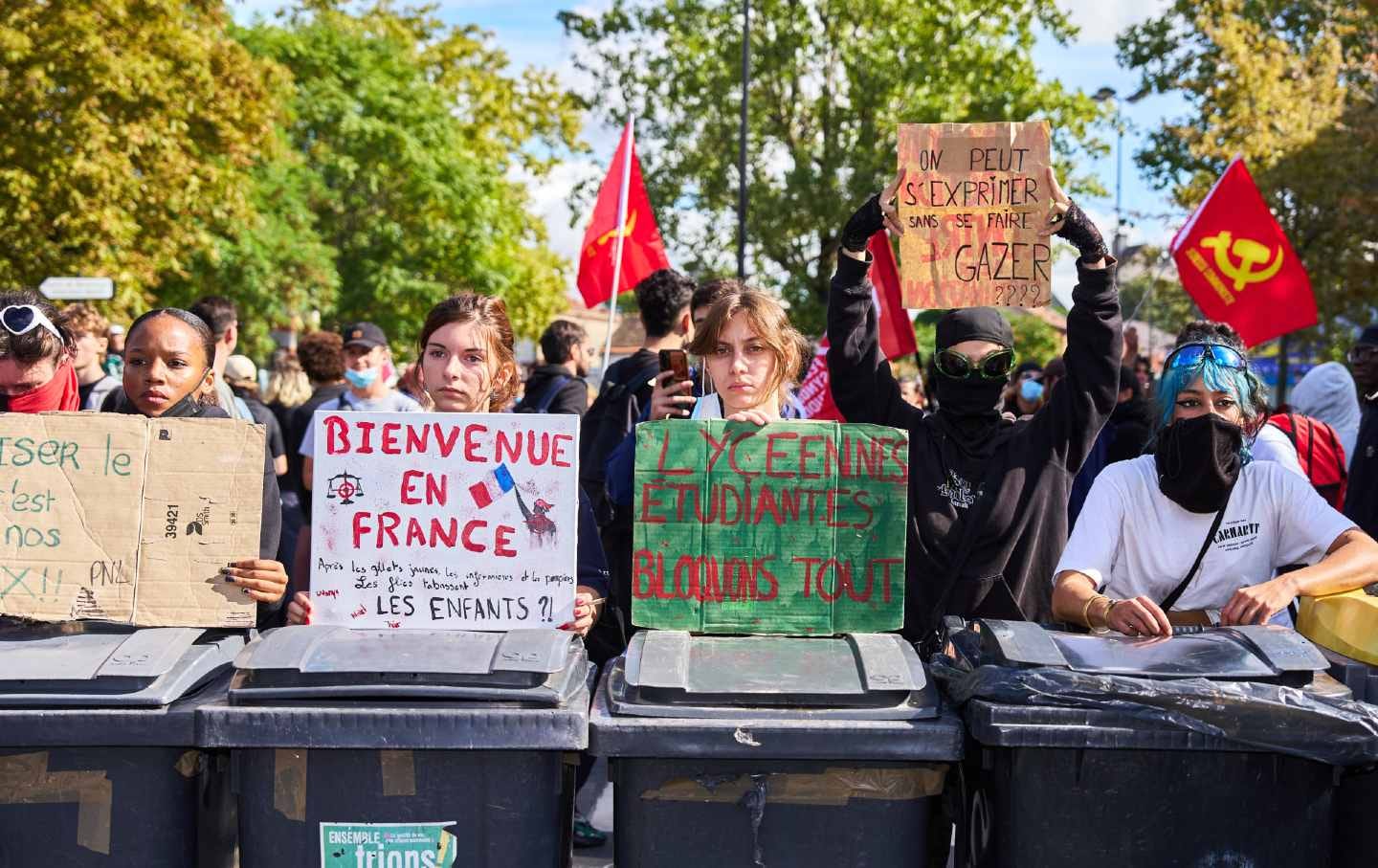
Student protests over missing teachers and failing schools have brought mass arrests and life-changing injuries while the French government blames the opposition and defends its police response.
Outside the Lycée Château d’Épluches in Saint-Ouen-l’Aumône on 28 September, a police officer fired a Cougar grenade launcher and the projectile struck a fourteen-year-old pupil in the face. His lawyer, Elsa Marcel, described a double fracture of the jaw and broken teeth. The student had come to a school blockade, and yet the encounter that would shape his week was with an officer’s weapon rather than a teacher.
In Tours, a sixteen-year-old injured during the protests on 30 September lost the use of his right eye. On Monday, 5 October, another pupil, aged fifteen, lost a hand after picking up a police grenade during a confrontation in Lens, according to the prefect’s account reported by Europe 1. A government calling its response proportionate owes an explanation of the damaged bodies through which that response is being experienced.
The mobilisation began at Lycée Saint-Exupéry in Créteil on 21 September amid complaints about missing teachers and conditions in schools. It spread as pupils demanded the education France had promised them. Ministers could coordinate a national response to the blockades, and yet the absence of teachers had been allowed to remain a problem pupils encountered in the ordinary course of attending school. The state proved quicker at confronting the interruption than at correcting what had caused it.
The communiqué Paris never writes
Imagine the statement. You have read its language a hundred times. It would come from the Quai d’Orsay, on cream letterhead, in the voice of a civilisation that proclaimed the rights of man and has never stopped invoicing the world for them. The foreign ministry would express its concern about children detained, call for restraint and ask the authorities to listen, and yet the country requiring the lecture would be the country issuing it.
The imagined communiqué might read like this:
France is deeply alarmed by reports that more than 5,000 people have been arrested in a week of unrest surrounding school protests, most of them minors. We call on the authorities to distinguish peaceful assembly from criminal acts, investigate allegations of excessive force and ensure that children receive the protection to which they are entitled. Restrictions on gatherings must not extinguish the right to protest. The demand for adequate education requires a political response, and accusations against opposition parties cannot discharge the government’s responsibility to provide it. The world is watching.
The world is watching, and the country is France. No such statement about its own conduct has been issued by the Quai d’Orsay. The rebuke came instead from Tehran, whose officials have ample experience dismissing grievances as disorder and foreign manipulation. France has provided them with an opportunity to return a familiar vocabulary to its sender, and the sender appears to find the delivery offensive.
The regime’s arithmetic
Let us describe France the way France describes others. It is only polite. A government confronting a spreading youth mobilisation has deployed riot police, restricted gatherings outside affected schools and summoned prosecutors to demand firmness. Ministers attribute a role to the opposition. The children are described through the language of security before their demands are answered through the language of education.
The scale is in the government’s own figures. On Thursday, 1 October, the education ministry counted 1,027 high schools affected, including 222 blockades. Nearly 2,000 arrests were reported that day. By the end of the week, according to Interior Ministry figures reported by the Associated Press, more than 5,000 people had been arrested and 85 per cent were minors. Between 400 and 500 schools were expected to remain wholly or partly closed on Monday. A dispute about the conditions of learning had become an exercise in administering detained children.
By 4 October, Education Minister Édouard Geffray reported 78 education staff injured and 24 schools burned or ransacked. Those are official counts for specified categories, not proof that every closed school was destroyed or that every person at a blockade committed an offence. Earlier reporting had put injured students at about 170; Le Monde’s account on 5 October put the number at 180. The changing totals need dates attached to them. The wounded do not become less real because the count is still being updated.
Interior Minister Laurent Nuñez rejects allegations of a disproportionate response and says police intervention protects pupils. By 4 October, AFP reported five investigations opened by the police inspectorate, the IGPN. Nuñez’s assurance must be tested against the footage, medical findings and testimony that have made those investigations necessary. The minister responsible for the police cannot settle a child’s complaint by announcing that the police acted correctly. He owes the child an answer based on what the officers did.
Justice Minister Gérald Darmanin brought together the country’s 36 prosecutors general by video conference and called for firmness. The government can make its expectations known across the prosecution system with admirable speed. A parent trying to establish who will teach a missing subject might reasonably ask whether the same administrative attention could be applied to filling the vacancy. The state has demonstrated that it can locate officials and give them instructions when it decides the task cannot wait.
Prefects have issued bans on gatherings outside specified schools, including establishments in the Paris region. These are restrictions attached to named places, not a verified nationwide prohibition outside every public school. The school gate is where pupils make visible the failure of the school; a prohibition at that gate removes their protest from the place that gives it meaning.
Closing a school must not give the prefect an automatic excuse to disperse the pupils outside it. The authorities owe an account of the danger each ban is supposed to prevent and how long the restriction will last. Without that account, the students lose the lesson they sought and the place where they can demand it, while the government gains an emptier pavement to photograph.
The injured pupils
The Saint-Ouen-l’Aumône case contains a recorded sequence that requires attention in full. Reporting by the Journal spécial des sociétés describes an officer using a baton as the pupil approached, the pupil kicking her, and another officer firing the Cougar projectile into his face. The prosecutor opened investigations into the shot and alleged violence against an officer. Investigators must establish what threat the kick presented and why the second officer answered it with a projectile to the face. The minister’s defence of proportion has to account for that decision.
The Cougar fires grenades. Its projectile struck the pupil’s face, a different incident from the suspected LBD shots being investigated elsewhere. The pupil’s lawyer’s account of broken teeth and a fractured jaw gives the minister’s defence of proportion a physical consequence against which to measure it. The minister should explain how that result served the protection of pupils.
In Tours, the injury requires a different formulation. A sixteen-year-old was hospitalised after the confrontation on 30 September. The prosecutor said his eye injuries were compatible with an impact from an LBD projectile, and AFP reported on 2 October that he had lost the use of his right eye. The IGPN is investigating whether a police shot caused the wound. The loss of vision is reported; the precise responsibility remains under investigation. The investigation may settle who caused it. It cannot give the pupil back the week before he lost his vision.
At Argenteuil on 1 October, another sixteen-year-old suffered an eye injury during a police intervention, prompting a further IGPN inquiry. Le Parisien reported the injury and investigation. The report did not establish the same loss of vision documented in Tours. It established another wounded pupil whose encounter with police required investigation.
Monday’s report from Lens extends the chronology. According to Pas-de-Calais prefect François-Xavier Lauch, a fifteen-year-old lost a hand after picking up a police grenade during the morning’s confrontation. The prefect’s account is an initial official explanation. It must be tested against the circumstances of the deployment and explosion, including the officers’ actions and the pupil’s. The immediate fact is a child with a catastrophic injury, in a protest movement that began with complaints about the conditions in which children were supposed to learn.
Elsewhere, the methods were visible without a hospital announcement. AFP reported tear gas at Kerichen high school in Brest as students threw projectiles, and batons and riot shields used against protesters in Aubervilliers. In Toulouse, protesters treated one another’s eyes after exposure to tear gas. The phrase public order cannot make the gas, the impact or the people subjected to them disappear.
The authorities have a duty to stop attacks. They also control weapons whose use can leave a child with injuries that last beyond the minister’s tenure. That power carries a duty to account for each deployment, especially when the crowd contains minors. A serious injury does not wait for the investigation to become politically convenient; the government should preserve the evidence and permit scrutiny while the child is still in hospital.
The violence ministers invoke
The attacks cited by the government must also be described. Officials reported that a teacher in La Ciotat was sprayed with petrol and assaulted. In Belfort, footage showed youths surrounding and kicking a lone police officer to the ground, according to the interior minister’s account. These acts injure people and provide no answer to a missing teacher. The people responsible must answer for them; students elsewhere do not become responsible through membership of the same age group.
On 2 October, fires damaged the entrances of two Paris high schools. Local reporting from Tours described fires at the Eiffel, Choiseul and Bayet schools that Friday, alongside damage and looting in the city centre. Burning a school destroys the facilities pupils are demanding. It also gives ministers an image through which they can discuss every blockade, including those whose participants have attacked nobody.
The government’s account groups the unrest under urban violence. That designation can place the teenager requesting a teacher beside the person assaulting a member of staff, and yet their actions impose different obligations on the state. An offence requires an investigation. A staffing vacancy requires a teacher. A pupil injured by an officer requires an account of that officer’s conduct. The government cannot discharge all three obligations by dispersing the crowd.
Nor can an aggregate injury count establish who caused each injury. Staff, pupils and officers have been hurt in different encounters; each case needs its own evidence. A minister invoking the wounded should be willing to publish how the count was compiled and what is known about the cause. The injured child must remain a person whose treatment requires an answer, rather than become a convenient entry beneath a heading chosen by the ministry.
France has rehearsed parts of this response before. In December 2018, footage from Mantes-la-Jolie showed schoolchildren kneeling in rows, their hands behind their heads, while police stood over them. Amnesty International condemned excessive force against protesters and high-school pupils during that period. In July 2023, after unrest following the police killing of seventeen-year-old Nahel, Emmanuel Macron floated restrictions on social-media tools. The proposed controls were discussed as an answer to unrest; their convenience for a government trying to control its account of events was equally apparent.
Mantes-la-Jolie remains available for viewing. The children kneel, the officers stand, and the Republic that teaches dignity has to explain the arrangement. France invokes its principles abroad with considerable confidence; at home, the filmed conduct of its own officers requires a defence that its diplomatic vocabulary would make difficult to write.
The hidden hand
Every embattled government appreciates a puppeteer. It spares the minister the indignity of admitting that people are angry for reasons of their own. La France Insoumise and allied groups may support the mobilisation, but support does not establish that the people mobilising have borrowed their grievances from the party. A pupil does not need an opposition organiser to notice that a lesson has no teacher.
Matignon has accused LFI of helping drive the unrest. Education Minister Édouard Geffray has denounced the political use of young people, and Bruno Retailleau has proposed banning the party. That proposal is a politician’s demand, not an enacted dissolution. It still tells us how readily a dispute over school conditions can be made to carry a larger argument about which opposition should be allowed to exist.
An opposition party’s interest in an unpopular government is hardly a discovery requiring a crisis meeting. Ministers campaign on education themselves, claim credit for improvements and invite young people to trust their programmes, and yet political participation becomes suspect when the young use it against the ministers holding office. The government would like education to remain political on the campaign platform and become apolitical at the school gate.
Nobody in LFI needs to put a leak in a classroom to make the leak politically useful. Reports from the protests describe deteriorating buildings and complaints about overcrowding and insufficient staff. The government can dispute particular accounts, publish inspection findings and show which vacancies are being filled. Accusing opponents of exploiting the complaints does none of those things. The pupils need a substitute teacher; a conspiracy theory delivered beside a police deployment will not take the class.
The accusation also places an unusual burden on the student. To be heard, the pupil must first prove independence from every organisation that might agree. A government can draw on its party, ministries and allies without compromising the legitimacy of its speech, while the pupil’s credibility supposedly diminishes as soon as someone helps amplify it. That arrangement rewards an isolated complainant who cannot inconvenience a minister.
When Tehran sees an enemy’s hand behind domestic dissent, Paris recognises the convenience of the explanation. It should recognise the convenience at home. The questions remain available without any theory of hidden direction: which classes lack teachers, what repairs are outstanding, and when will the responsible authorities complete the work? A minister’s answer should contain dates and resources. Naming LFI supplies neither.
Three words over the door
Liberté, Égalité, Fraternité appears above French school entrances. The motto asks the pupil to understand schooling as part of a common citizenship. The words remain over the doorway when the teacher is absent and the police arrive. A visitor might admire the stonework; the pupil has reason to pay closer attention to which part of the Republic has turned up.
Consider liberty through the current restrictions. A pupil’s right to peaceful protest cannot depend on whether the demonstration causes the government embarrassment. Nor does a large arrest total establish that a large number of crimes has been proved. The distinction between arrest and guilt should be elementary in a country that exports instruction on the rule of law, especially when most of those arrested are children.
Equality is harder to defend from a national spending total. Two pupils may sit the same examination while receiving different access to teachers and different conditions in which to prepare. Calling the qualification common does not make the preparation equal. The national promise has to reach the classroom in which the pupil is actually enrolled, rather than remain an aggregate in a minister’s presentation.
The baccalauréat and the police’s brigade anti-criminalité share the abbreviation BAC. France should take care about which one becomes the more reliable encounter in a pupil’s education. A student asking for the first should not have to become familiar with the second before the ministry provides an answer about staffing. The bureaucratic coincidence does not require much assistance from a satirist.
The 2027 school allocation rises to €65.53 billion, about €1.1 billion above 2026. Ministers can truthfully point to that increase. The government’s staffing plan nevertheless removes a net 1,588 teaching posts across public and private education, including 1,250 in the public system. A larger cash allocation and a smaller number of teaching posts can coexist, and the pupil waiting for a teacher needs to know which part of the budget will reach that classroom.
The ministry points to declining enrolment and investment in teacher training. It also plans additional staff for disability support and pupils’ welfare. Those are useful commitments. Declining pupil numbers, however, create a choice about the conditions offered to those who remain. The state can use a smaller cohort to reduce pressure in classrooms and rebuild staffing capacity, or take part of the demographic change as a saving. The staffing plan records a decision about that opportunity.
Training teachers is necessary, but a training place is not a lesson delivered this term. Ministers should publish the timetable connecting recruitment to vacancies in individual subjects and schools. Their national total cannot tell a pupil whether Monday’s class will take place. A government willing to count blockades should be equally willing to make the count of unfilled lessons visible.
Fraternity becomes less abstract in the accounts surrounding education. Lecornu’s proposed budget imposes a €54 billion fiscal effort. Housing aid would be frozen, including support used by students, while local authorities face a €5.5 billion effort of their own. Those authorities have responsibilities for school buildings. The education minister can defend a higher allocation and still leave the pupil dependent on support constrained in another part of the budget.
A freeze transfers the adjustment to the recipient when the bill being paid rises. The student must find the difference in rent from another source, and any additional paid work competes for time with study. The Treasury records restraint while the student has to rearrange a week around it. The saving appears in one set of accounts and the hours needed to cover it appear in another, and yet only the first is presented to Parliament as evidence of sound management.
One such decision proved remarkably easy to reverse. The budget proposed registration fees for non-scholarship students in higher technical courses and preparatory classes. On the evening of 1 October, Geffray withdrew them after discussions with unions and the prime minister. A charge presented with the morning’s budget had vanished by evening. Students should remember how quickly the supposedly difficult arithmetic changed when the government decided to change it.
Meanwhile, the proposed defence budget rises by €6.4 billion to €63.4 billion. France has security obligations, and a school cannot purchase an air-defence system by wishing away a threat. The allocation still requires a political defence from the government that makes it. Ministers are choosing the pace of military expansion alongside the staffing reductions and civilian restraint they ask others to accept, and yet only the latter are routinely presented as the hard arithmetic of affordability.
The broader European argument belongs beside this one without swallowing it. Across the continent, governments are enlarging military commitments while asking civilian claimants to adjust. In France, the pupil meets the decision at the beginning of adult life. The state asks for qualifications, patience and eventual tax payments while failing to provide parts of the education on which that bargain rests. A government cannot indefinitely spend the trust it has declined to earn.
The lecture circuit
France exports Rafales and moral instruction. The aircraft have identifiable buyers; the instruction is distributed more freely. It was therefore a rare pleasure to see the latter trade run in reverse when Iranian Foreign Ministry spokesman Esmaeil Baghaei addressed the French protests. His government had found the French diplomatic vocabulary available for use, and Paris had supplied the occasion.
On 2 October, according to the account published by Iran’s Tasnim news agency, Baghaei urged France to respect human rights and fundamental freedoms, called for examination of allegations of police violence and criticised its treatment of demonstrators. He also urged protesters to avoid violence and damage to public property. Even the appeal to restraint had returned with the package. The irony rests on the statement actually being made, rather than on an imagined conversation inside the Quai d’Orsay.
Tehran has no standing to present itself as a guardian of peaceful protest. HRANA’s report on Iran’s winter crackdown documents thousands of deaths connected with the unrest. French police have not killed protesters by the thousand, and Tehran cannot use a French school gate to conceal the deaths for which it must answer. Baghaei’s intervention gains its force from the recipient’s contradiction. Paris can establish that Tehran’s conduct is worse and still owe an answer to the French child who says an officer injured him.
The Quai d’Orsay knows how to ask for independent investigations. Its officials know how to distinguish the authorities’ assurances from evidence and how to insist that a state cannot investigate its way into innocence by announcing that it has opened a file. Paris should apply that competence to its own police. The vocabulary has come home; the obligations should come with it.
The schoolchild and the prefect meet the same principle from opposite sides of the order banning the gathering. A schoolchild learns that assembly is a right, then receives a prohibition at the place of assembly. A minister says police are protecting pupils, while injured pupils seek an investigation. The Republic’s reputation will neither restore the missed lesson nor establish what happened to the injured pupil. Ministers must answer for the conduct that produced both complaints.
Tuesday
The unions and students preparing to take to the streets on Tuesday, 6 October, should keep the original demand in view. A school requires teachers and usable buildings. The withdrawal of proposed registration fees has already shown that the budget contains decisions ministers can change. Students should demand the dates on which vacancies will be filled and the resources through which the promised repairs will be completed, rather than another account of who supposedly encouraged them to ask.
The response to the protests requires its own accounting. Children detained for peaceful participation should face no charges for that participation, and allegations of unlawful force should receive scrutiny independent of ministerial assurances. Restrictions around schools should be reviewed and lifted where their necessity cannot be demonstrated. Investigating violence committed during a protest does not discharge the state’s obligation to protect everyone else’s right to attend it.
Lecornu owes the public a defence of the budget’s distribution as well as its arithmetic. A government proposing fewer teaching posts and frozen housing aid while protecting a large military increase should have to explain the alternatives it rejected. Parliamentary opponents should make that explanation a condition of their support, and unions should refuse to let the staffing dispute disappear into a debate conducted entirely in the vocabulary of public order.
The open question is how long a Republic can demand confidence from young people who must disrupt a school before its deficiencies receive national attention. The injured pupils will live with the consequences after ministers have moved on to another briefing. Withdraw the police deployments that cannot be justified, investigate the officers’ actions and fill the vacancies that brought the students outside. Fund the schools.