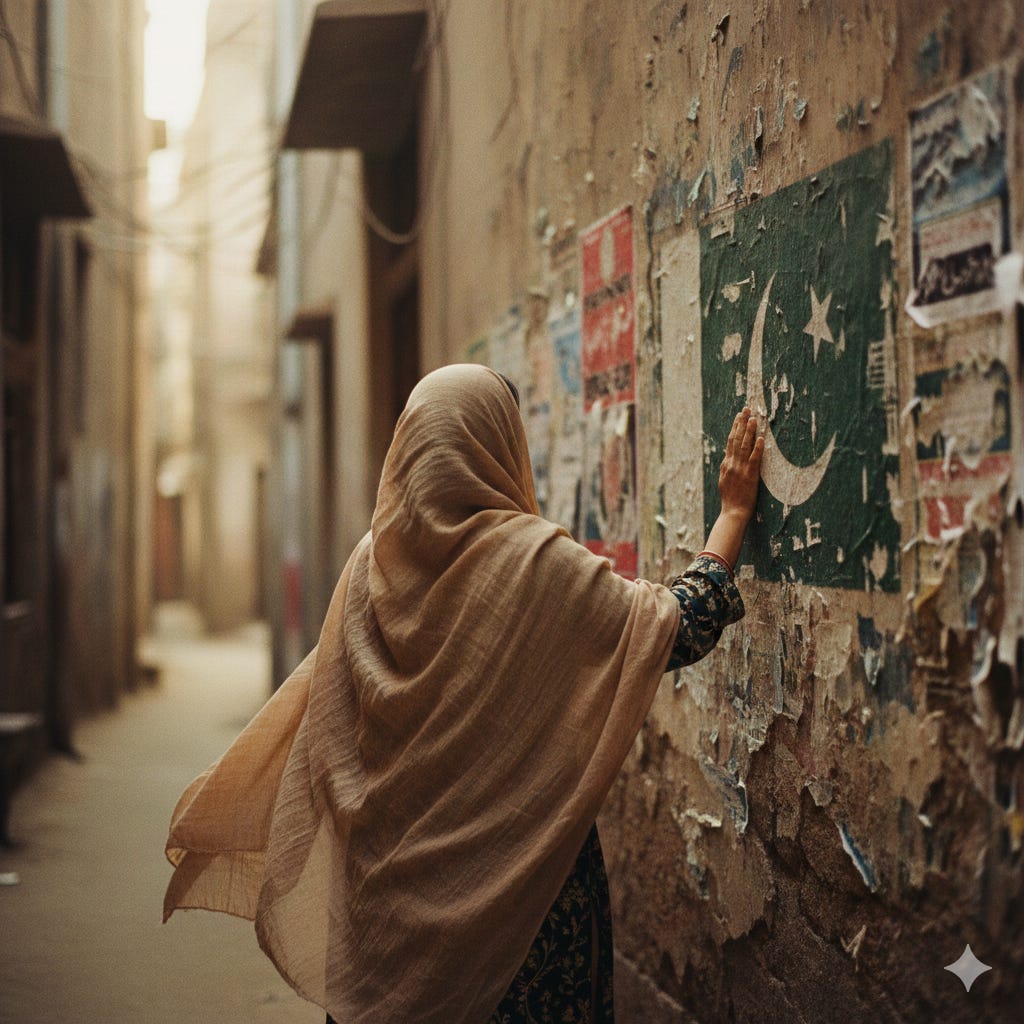
FRAUD IN THE LANGUAGE OF FREEDOM
How Pakistan’s fake liberal machinery became the ideological infrastructure of an illegitimate government
EDITOR’S NOTE
What follows is an investigation into one of the most corrosive forces in contemporary Pakistani public life: the deployment of progressive language as a political instrument. This piece does not argue against liberalism, feminism, or human rights advocacy. It argues that in Pakistan today, the vocabulary of these values has been systematically captured by an ecosystem of donor-funded organizations, aligned media voices, and political operatives who activate and deactivate their outrage on a schedule determined not by principle but by power.
The piece traces this machinery from its origins in Washington through its architecture in Islamabad and Lahore, and documents its most consequential function: providing moral legitimacy to a government that the February 2024 elections did not produce through a free or fair process. It examines who the machinery protects, who it abandons, and what it destroys in the process. The argument is structural, not partisan. The evidence is documented. The consequences are borne by the people this machinery has always claimed to serve.
Read it as a record of a system working exactly as designed.
In November 1983, Ronald Reagan stood before an audience in Washington and announced the birth of a new institution. The National Endowment for Democracy, he said, would support free press, free trade unions, free political parties, and free markets across the world. He called it a campaign for democratic values. Allen Weinstein, one of NED’s co-founders, later described the mission with more precision than Reagan intended. “A lot of what we do today,” Weinstein said, “was done covertly 25 years ago by the CIA.” Reagan himself had made the architecture explicit at the founding: the organization would do openly what American intelligence had previously done in secret. The Washington Post described NED as the “sugar daddy of overt operations.”
That is not a footnote. It is the operating manual for everything that followed.
What NED pioneered was a template: build an organizational infrastructure in target countries that performs accountability while delivering compliance, that wears the vocabulary of rights because that vocabulary grants access, credibility, and the ability to shut down criticism by rebranding it as bigotry. USAID subsequently implemented that template at scale across the Global South, including in Pakistan, where its programming is specific, documented, and traceable to individual organizations operating today. The line from Washington to Lahore runs not through conspiracy but through grant cycles, program disclosures, and the structural logic of donor dependency.
What grew from that foundation was not a liberation movement. It was an industry for managing acceptable politics. By the 1990s, Western governments and private foundations were funding thousands of civil society organizations across Asia, Africa, and Latin America in the name of democracy, women’s rights, press freedom, and good governance. The money came with architecture attached: adopt Western organizational models, hire professional staff, align advocacy with donor priorities, report quarterly results, and stay within the acceptable range of political outcomes.
In Georgia, Western donors spent two decades funding NGOs that operated inside government ministries, topped up officials’ salaries, and drafted legislation. When Georgia’s parliament passed a law requiring these organizations to disclose their foreign funding, Washington threatened sanctions and called transparency an assault on civil society. The funding opacity was freedom. The accountability requirement was authoritarianism.
Researchers studying South Sudan documented the same pattern: donor frameworks built civil society organizations shaped entirely by Western narratives, organizations that mimicked international NGOs while losing connection to the communities they claimed to serve. Legitimacy came through registration, donor compliance, and Western accreditation. The communities being represented had no vote in what those organizations actually did.
This is the system that arrived in Pakistan. It did not come with uniforms. It came with grant cycles, feminist frameworks, good governance workshops, and the vocabulary of rights. Over decades it built an organizational class: professional, English-speaking, internationally connected, donor-dependent, and available. Available to perform accountability when power needed the appearance of scrutiny. Available to perform silence when power needed protection.
The February 2024 elections produced a result the establishment had not fully planned for. Pakistan Tehreek-e-Insaf, running without its leader, without its electoral symbol after the Supreme Court stripped the party’s bat in the final days before polling, with candidates forced to contest as independents, still returned the largest number of seats.
The vote was not clean. Returning officers halted result announcements through the night in violation of Section 13(3) of the Elections Act, which mandates provisional results by 2am the following morning. Nearly all returning officers failed to meet even the secondary 10am deadline. FAFEN, Pakistan’s independent election observation network, documented systematic discrepancies between Form 45 polling station results, signed in the presence of candidates’ representatives, and the Form 47 consolidated totals that returning officers subsequently declared. In constituency after constituency the numbers did not match. In some cases they differed by thousands of votes. In Lahore, documented turnout figures exceeded 100 percent at certain stations.
The EU’s High Representative for Foreign Affairs called for a full investigation of all reported election irregularities. The UK Foreign Secretary recorded serious concerns about the fairness of the elections, noting internet restrictions on polling day, significant delays in reporting results, and claims of irregularities in the counting process. PILDAT, Pakistan’s independent parliamentary development organization, found that fairness scores for the 2024 election had fallen to their lowest level since 2013. The Commonwealth observer report, subsequently leaked, confirmed discrepancies in vote counts that in its own language may have resulted in candidates being unlawfully returned.
Legal challenges were filed. Petitions went to the courts. The process available under Pakistani law was pursued by affected parties through the available channels. Those petitions were dismissed in a judicial climate that the same international observers separately documented as lacking independence. The exhaustion of a compromised legal process does not validate the result it was designed to certify. It documents the depth of the problem.
What emerged was a coalition assembled through post-midnight negotiations, backed by an establishment that had spent two years dismantling the political force that had won the public’s confidence. The government needed legitimacy the ballot had not provided.
The fake liberal is not a genuine progressive who drifted or compromised. The fake liberal is an instrument. It was built to perform liberation while delivering compliance, to wear the vocabulary of rights because that vocabulary grants access, credibility, donor funding, and the ability to shut down criticism by rebranding it as bigotry.
The woman card. The misogyny card. The political correctness apparatus. These are not failures of principle. They are features of the instrument. They exist to be deployed when power requires cover.
In Pakistan today, that deployment is active, coordinated, and documented.
Maryam Nawaz Sharif became Chief Minister of Punjab in February 2024 on the back of that disputed coalition. Her government passed the Punjab Defamation Act 2024, documented by Amnesty International as granting sweeping powers to suppress speech critical of the administration. In March 2024, her government ordered the arrest of over a hundred PTI supporters in Lahore who had gathered to protest the disputed results. Women were among those detained. Police baton-charged protesters at GPO Chowk and Liberty Chowk. Videos of the crackdown circulated widely.
The organizations receiving EU funding to support democratic processes and government accountability in Punjab’s provincial assembly issued no significant public response.
The organizations receiving USAID and UN Women money to build civic participation in Punjab said nothing of substance.
Then in January 2025, AI-generated videos mocking Maryam’s handshake with the UAE President circulated on social media. The state responded with a national FIA cybercrime investigation and multiple arrests. The fake liberal ecosystem responded with a cascade of commentary on systemic misogyny, gendered character assassination, and the burden female leaders carry in patriarchal societies. The Thursday Times ran a piece headlined misogyny cloaked as criticism. International commentary followed within days.
A sitting chief minister commanding the FIA, Punjab’s law enforcement apparatus, the provincial budget, and a Defamation Act designed to silence critics had become a victim requiring protection. The machinery delivered on schedule.
The same machinery had been silent when her government arrested women protesters six months earlier. It produced nothing when the Defamation Act passed. It offered no comment when her administration filed FIA cybercrime complaints against PTI’s Shandana Gulzar for statements about the death of a PTI worker.
The machinery runs when the government needs cover. It stops when the government needs silence. This is not coincidence. It is the function the machinery was built to perform.
The structural dependency that makes this possible is in the public record.
The Aurat Foundation is one of Pakistan’s most consequential women’s rights organizations. Its legislative record is real: the domestic violence bill passed in three provinces, the Anti-Rape Criminal Amendment Act of 2015, child marriage legislation in Sindh. These are genuine achievements that required years of sustained advocacy work against entrenched opposition. That work deserves acknowledgment and it receives it here without qualification.
It also receives USAID, Oxfam, UN Women, and DFID funding. Per its own program documentation, it provides capacity-building and technical support to Punjab’s Provincial Assembly secretariat. It is institutionally embedded in the government it is supposed to hold accountable. An organization that builds its operational relationships inside a provincial government, trains its staff, supports its committees, and depends on continued ministerial access for its program delivery cannot direct its institutional credibility against that government when accountability requires it. This is not a personal failing of anyone inside the organization. It is a structural dependency that operates independently of individual intention and is documented in public grant disclosures.
The genuine legislative work and the structural constraint are not contradictory. They coexist. The organization does real things and is simultaneously prevented by its architecture from doing the most important thing: holding power accountable regardless of who holds it.
USAID’s $40 million Gender Equity Program for Pakistan, announced by Hillary Clinton in 2010, built an organizational class whose survival depends on donor approval, ministerial access, and staying within the political parameters that Western governments find workable. The Sharif family governments have historically occupied that zone. When they hold power, the ecosystem protects them. When they are out of power, the ecosystem waits.
The women of Punjab pay the price of that arrangement. Not Maryam Nawaz.
The test of a liberal framework’s integrity is not what it says about its enemies. It is what it does with its own side.
Nawaz Sharif provided the test in October 2023. At a public rally, he divided women into two categories: those who listen silently and those who dance and sing. The second category was a direct reference to PTI’s female supporters at political gatherings. Aurat March Karachi condemned the remarks. They were alone. The broader machinery looked at the patriarch of the dynasty it exists to protect and produced silence.
PML-N’s Rana Tanveer Hussain made vulgar remarks about Bushra Bibi from the floor of the National Assembly. At the time, she was a private individual, the wife of a jailed former prime minister, not yet the political actor she later became when she led the November 2024 dharna at D-Chowk. The remarks carried sexual innuendo and were made from a parliamentary podium, in the legislature of a country whose donor-funded civil society organizations had received millions specifically to combat gender-based violence in political spaces. Those organizations produced nothing substantive in response.
Dawn’s own columnists documented that liberals and conservatives in Pakistan find common ground when it comes to Bushra Bibi, that her piety and her association with the wrong politics placed her outside the protection zones of the educated, secular, donor-funded class.
The woman card is not a principle. It is a tool. It gets deployed for the women the machinery already protects and withheld from the women it has already decided do not qualify.
Now consider the case that makes the entire argument impossible to dismiss.
The international community’s response to the sentencing of Imaan Zainab Mazari-Hazir and her husband Hadi Ali Chattha deserves to be stated plainly and without qualification: it was the right response.
On January 24, 2026, a sessions court in Islamabad sentenced both human rights lawyers to 17 years in prison each under Pakistan’s Prevention of Electronic Crimes Act, for social media posts critical of state institutions. The posts had documented enforced disappearances in Balochistan and Khyber Pakhtunkhwa. The trial was conducted at extraordinary speed. The couple’s court-appointed lawyer refused to cross-examine prosecution witnesses, telling the court he could not ask questions that had been dictated to him. The judge’s written order declared that claiming state responsibility for forced disappearances constituted cyberterrorism, because there was, in his formulation, no proof that the state had forcibly disappeared anyone.
The EU condemned the verdict. The United Nations Human Rights Office condemned it. Amnesty International called the detention arbitrary and described it as the latest escalation in a sustained campaign of judicial harassment. The International Commission of Jurists, Lawyers for Lawyers, and the International Bar Association’s Human Rights Institute issued a joint statement calling it a chilling precedent for the entire legal profession. Pakistan’s Foreign Office called it a domestic matter.
The condemnation was warranted, necessary, and correct. Imaan Mazari and Hadi Ali Chattha spent years representing victims of enforced disappearances, custodial abuse, extrajudicial killings, and people falsely accused under blasphemy laws. The state spent years trying to silence them for it. Their imprisonment is an outrage that deserves every statement issued in its condemnation.
The question this piece is required to ask, with no hostility toward them and no minimization of what has been done to them, is structural.
Of the 85 civilians tried in secret military courts for their participation in the protests of May 2023, sentenced in proceedings Amnesty International documented as closed to the public, to independent observers, and in many cases to the families of the accused, Amnesty did issue a general condemnation. That condemnation was correct and necessary. It named the pattern. It did not name the people.
The distinction is the argument.
The international advocacy infrastructure that produced a named, coordinated, multi-organization campaign within hours of the January 2026 sentencing produced a general statement for the 85. Not a named campaign. Not a coalition of international legal bodies issuing a joint declaration. Not EU press releases. A general statement acknowledging a pattern.
The PTI workers from Rawalpindi and Faisalabad and Rahim Yar Khan who received sentences of two to ten years in military courts for attending a demonstration do not have international networks. They do not have profiles on Frontline Defenders. They are not English-speaking lawyers with contacts built over years of high-profile human rights work. They are ordinary people who went to a protest and are now in prison, and the difference in the quality of international response between their cases and the Mazari-Chattha case is not explained by the severity of the injustice. It is explained by class, language, and proximity to the donor ecosystem.
This is not an argument against advocating for Imaan Mazari and Hadi Ali Chattha. It is an argument about the criteria that determine who receives which quality of advocacy. Those criteria track institutional visibility and network proximity. They do not track the number of people affected or the severity of what was done to them.
The Baloch mother whose son has been missing for three years has no EU statement. The factory worker from Lahore sentenced in a military court has no UN press release. The ordinary Pakistani whose name appears on no international organization’s database is invisible to the machinery not because his suffering is lesser, but because the machinery was never built to see him.
That is the curse at full power. It protects the visible, mourns the presentable, and leaves everyone else to the silence that was always their inheritance.
The deeper damage the fake liberal curse produces is to the language itself, and this is where the word curse earns its weight.
Every time the woman card is played for a chief minister who commands the FIA, it becomes harder to play for the women who need it. Every time misogyny is invoked to protect a government from accountability, the word loses force in the specific cases where force is required. Every time progressive vocabulary gets deployed to insulate power from scrutiny, it becomes less available as a tool for the people who have no other tools.
This is the inversion at the center of the curse. A framework built to protect the vulnerable gets redirected to protect those who hold state power. The language of rights gets colonized by people who deploy it selectively, and in doing so degrade it for everyone who comes after. They make it available as a weapon and unavailable as a shield precisely when a shield is most needed.
Gulalai Ismail, a Pashtun feminist who documented military atrocities in Pakistan’s northwest and went into hiding when armed men raided her family home on sedition charges, received one careful institutional statement from the donor-funded ecosystem. Then silence. She was the wrong kind of woman, attached to the wrong politics, documenting the wrong institution. The machinery calculated and stayed in its lane.
This is how illegitimate power sustains itself in the modern world. Not only through arrests, though arrests happen. Not only through press suppression, though the press is suppressed. Through the colonization of the language of rights, the conversion of accountability into bigotry, and the deployment of progressive vocabulary to insulate a political arrangement from the scrutiny it cannot survive.
The February 2024 government did not earn its position. It was assembled after the electorate’s verdict was altered in the dark, through a coalition the public had no part in, backed by an establishment that had spent two years dismantling the political force that had won the country’s confidence. To govern without a legitimate mandate requires a substitute legitimacy. The fake liberal ecosystem is that substitute.
When criticism of this government gets rebranded as misogyny, the substance of the criticism disappears. When the governance failures of Punjab get buried under commentary about the historic significance of its first female chief minister, the poverty statistics stop mattering. When every accountability attempt gets converted into evidence of reactionary politics, accountability becomes structurally impossible.
Pakistan has received 24 IMF loans since 1958, the most recent being the $7 billion program approved in September 2024. The World Bank records a poverty rate of 40 percent. The government managing an economy producing that level of documented suffering, passing Defamation Acts to silence critics, arresting protesters in the streets and lawyers in their cars, trying civilians in secret military courts, is the government the fake liberal ecosystem exists to protect.
The organizations receiving foreign funding to build democratic governance in Punjab operate in harmony with an administration that arrived through a disputed election and governs through suppression. The women whose empowerment those organizations claim to advance are living inside an economic catastrophe their government has no serious intention of addressing while producing press releases about IT cities and the historic significance of female leadership.
The distance between what the machine claims to do and what it does is the measure of the curse.
What genuine liberalism would demand in Pakistan right now is not complicated.
It would demand an accounting for the February 2024 election. For the Form 47 discrepancies that FAFEN documented, that international observers confirmed, that the Commonwealth report described as potentially resulting in candidates being unlawfully returned. For the results that shifted while returning officers violated their statutory deadlines and internet access was cut across the country.
It would hold the first female Chief Minister of Punjab to the standard of governance accountability that every official holding that office must meet, regardless of the symbolic weight of her presence there. It would treat the Defamation Act she passed as what Amnesty International documented it to be. It would ask what the arrests her administration ordered, the FIA complaints filed against critics, and the laws deployed to suppress speech have in common with the democratic values the ecosystem claims to promote.
It would produce named campaigns for the factory worker in the military court with the same urgency it produces them for the human rights lawyer in the sessions court. Not because their cases are identical, but because principle does not come with a class requirement.
It would defend every woman regardless of which side she is on. Not because all political positions are equivalent, but because the woman card is either a principle or it is nothing.
The fake liberal curse survives because it has successfully disguised selectivism as principle. It built real institutional credibility through genuine work: child marriage legislation, domestic violence bills, legal aid clinics. It spends that credibility on political cover operations when donor interests and establishment preferences require it. The credibility is real. The cover operations are also real. The people who pay are always the ones the machine claimed to serve and never did.
The people running this machine know what they built. The people funding it know what they bought. In Washington, Brussels, and London the language is democracy promotion, civil society strengthening, gender empowerment. In Pakistan the people living inside it have known for a long time what to call it.
They call it the fake liberal curse.
They are not wrong.


