The Board of Peace converted a people’s political future into a foreign-administered development project, and the states that signed its charter supplied the consent Palestinians were never asked to give.
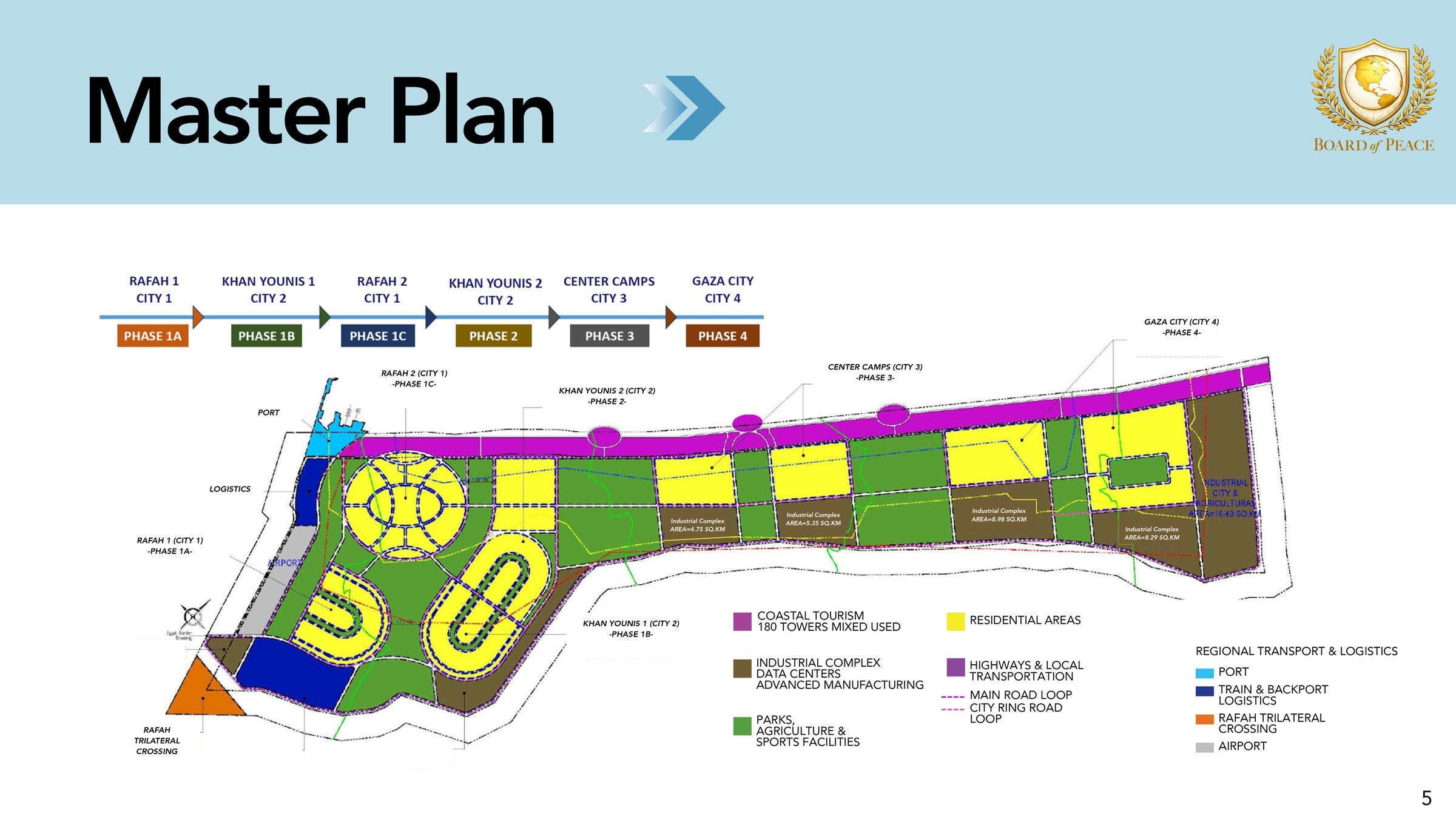
On January 22, 2026, Jared Kushner stood before political leaders and investors at the World Economic Forum in Davos and displayed ten slides for a place he did not own. The plans showed towers, tourist beaches, data centres, industrial zones, a port, an airport, and new cities arranged across Gaza as though an urban-planning firm had received an empty tract rather than the ruins of a Palestinian society. Kushner spoke of free-market principles and investment opportunities, and Donald Trump sat nearby as chairman of a new Board of Peace whose member states were invited to sign its charter that day. In Gaza, Israeli attacks killed at least eleven Palestinians around the time of the presentation, including two children and three journalists, while the body of three-month-old Shatha Abu Jarad, who medics said had died from the cold, had been carried through Al-Shifa Hospital two days earlier. The people living in tents beside the proposed waterfront had not approved the plan, Palestinian civil-society organizations had not taken part in designing it, and Palestinian voters had not elected the body that claimed authority over their land, and yet the room in Davos behaved as though the final obstacle to Gaza’s future was investor confidence.
Gaza was being sold while Palestinians were still being killed. The sale did not require a deed transferring every square metre, because modern control travels through administrative authority, security conditions, reconstruction finance, property registration, border access, and the power to decide when a displaced family may return to its neighbourhood. Kushner and Trump placed those powers inside an international structure chaired by Trump, staffed at its upper levels by his appointees, financed through a donor-governed fund, and supported by states whose signatures gave the arrangement the appearance of regional consent. Israel retained military control across much of Gaza and continued to decide what crossed its borders, while Palestinians were assigned a technocratic committee responsible for services inside a system whose strategic direction remained elsewhere. Homes would be rebuilt, ownership would be registered, police would be vetted, weapons would be surrendered, donors would supervise money, and Israel would withdraw only through a conditional sequence, but the foundational act of consent from the Palestinian people was missing.
The cruelty lies in that sequence. Palestinians endured the destruction, buried the dead, lost homes and hospitals and schools, and were left dependent on permission for food, medicine, shelter material, and movement, and yet Trump, Kushner, Israel, and the Board’s member states claimed the authority to determine the political price of rebuilding what had been destroyed. The board’s defenders call this realism because Hamas committed grave crimes on October 7, 2023, held Israeli civilians hostage, ruled Gaza without democratic accountability, and maintained an armed apparatus outside any legitimate national government. Those facts require an answer. They do not transfer Palestinian ownership to Trump, turn Israeli military control into a neutral security condition, or authorize foreign governments to accept a trusteeship that the affected population never voted upon.
The property claim came first
Kushner’s Davos presentation did not begin as a humanitarian response to a completed war. In an interview recorded on February 15, 2024, while Israeli forces were destroying neighbourhoods and Palestinians were being driven south, he described Gaza’s waterfront property as potentially “very valuable” and said that, from Israel’s perspective, he would try to move civilians out and then “clean it up.” The Associated Press reported those remarks in March 2024, when Kushner said he was focused on his investment business and had no interest in returning to government. His official status later changed, but the sequence did not: first came the value of the waterfront, then the removal of the people, then the clean-up, then the development plan. Gaza’s inhabitants appeared in that sequence as a population to be moved before the land could be reorganized.
Trump made the ownership claim explicit on February 4, 2025, during a White House news conference with Benjamin Netanyahu. He proposed permanently resettling displaced Palestinians outside Gaza, said the United States would take control of the territory, and described a “long-term ownership position” that would produce a “Riviera of the Middle East.” The Associated Press account of the announcement recorded that Trump would not rule out deploying American troops to support the plan. The proposal met resistance from Palestinians, Arab governments, legal experts, and members of Trump’s administration, and its language was softened over time, but the Board of Peace preserved its governing idea. Foreign authority would supervise Gaza’s transition, international capital would finance its reconstruction, security compliance would determine the schedule, and Palestinian statehood would remain a possible destination rather than the legal starting point.
By September 2025, the political apparatus supporting Israel in Washington had accepted Trump’s framework. AIPAC issued a public statement on September 29 thanking Trump and Steve Witkoff for negotiating the plan with Israel. That endorsement does not prove that AIPAC drafted the later charter or designed Kushner’s slides, and a serious indictment has no need to invent a private instruction where the public record is sufficient. The organization backed the political framework that led to the Board, supported the American-Israeli partnership governing it, and operated inside an electoral system in which opposition to Israeli policy had already become professionally expensive. The lobby did not need to own Gaza. It helped maintain the American political conditions under which Palestinians could be denied ownership of their own future.
The chronology also defeats the claim that development planning began only after mass violence had ended. In September 2025, the United Nations Independent International Commission of Inquiry concluded that Israel had committed genocide in Gaza, finding four of the five genocidal acts specified in the 1948 Convention and attributing responsibility to the Israeli state. Israel rejected the finding, and the International Court of Justice has not issued its final merits judgment, though it previously ordered binding provisional measures intended to protect Palestinians from irreparable harm under the Genocide Convention. Legal precision matters because the case is too serious for loose attribution: a UN commission made a genocide finding, Israel disputed it, and the ICJ case remains pending. It also matters that the governments assembling the Board had the commission’s conclusion before them when they signed in Davos, and yet none could claim ignorance of what was being done to the people whose territory they were preparing to administer.
The ceasefire truth
The October 10, 2025 ceasefire reduced the scale of killing and improved the flow of food. That reduction saved lives, brought Israeli hostages home, led to the release of Palestinian prisoners and detainees, and created space for a political agreement that did not exist during the full assault. Board officials, Israel, Hamas, the mediating states, and humanitarian agencies are right to resist a return to total war. A family that survives because an air strike did not occur gains something real, however defective the agreement around it remains. The Board’s strongest defense begins there, with fewer deaths, better food availability, the return of hostages, and a route for removing Hamas from civilian government.
The ceasefire never produced civilian safety. OCHA’s August 28 humanitarian report recorded 1,303 Palestinian fatalities and 4,336 injuries since the agreement was announced, based on figures from Gaza’s Ministry of Health. Forty-seven Palestinians were reported killed and 176 injured between August 12 and August 26 alone. OCHA reported that four children had recently been killed, that three UN warehouses in Deir al-Balah were damaged by a nearby air strike, and that nutrition supplies intended for children, pregnant women, and breastfeeding mothers at another warehouse were rendered unusable by debris, dust, and blast damage. A UNICEF-supported water well and desalination facility was also damaged, interrupting safe drinking water for more than four thousand people, including about two thousand children, and yet this was the period during which Gaza was formally described as being under a peace framework.
The newest daily medical count available on September 2 placed the cumulative Palestinian toll since October 7, 2023 at 73,470 killed and 174,540 injured. Those figures come from Gaza medical authorities and remain attributed as such, although UN agencies and independent specialists have generally treated the ministry’s detailed casualty records as reliable. OCHA estimated that 1.98 million people, or ninety-four per cent of Gaza’s population, required shelter assistance and essential household items. Fifty-eight per cent faced severe deficiencies in shelter conditions or access to basic services. These are current conditions under which Palestinians are being asked to accept an externally supervised political and economic order.
Nickolay Mladenov, the Board’s own High Representative for Gaza, acknowledged the distance between the agreement and the ground when he addressed the Security Council on August 26. He said Israeli strikes were still killing Palestinians and obstructing the transfer to civilian government, while warning that another war could leave nothing to rebuild. He had met Netanyahu and Kushner the previous week and said they had gone through Israel’s concerns “one by one,” narrowing the remaining disputes to technical work. Israel’s refusal to withdraw while continuing attacks was being processed as a set of technical concerns, while Palestinians had already been required to accept demilitarization, external verification, a vetted police service, and conditional reconstruction. Every Israeli concern received negotiation at the highest level, and Palestinian survival remained a humanitarian file.
The master plan
Kushner’s Davos plan promised a Gaza economy worth ten billion dollars by 2035, half a million jobs, modern transport, coastal tourism, and at least twenty-five billion dollars in public infrastructure and services. The White House quoted him saying that aid had accounted for eighty-five per cent of Gaza’s gross domestic product and that free-market principles would give its people dignity. No Palestinian objects to functioning hospitals, clean water, employment, electricity, schools, ports, or homes. The value of those promises depends on who wrote the plan, who owns the completed assets, who registers property rights, who receives contracts, who controls the crossings, who protects the investment from another Israeli assault, and who can remove the administrators if the promises fail. Any strategic plan that cannot answer those first-principles tests has confused construction with freedom.
The official damage account is far larger than the Davos sales figures. The final Rapid Damage and Needs Assessment prepared by the World Bank, United Nations, and European Union estimated $71.4 billion in recovery and reconstruction needs over a decade, including $26.3 billion during the first eighteen months. It placed physical infrastructure damage at $35.2 billion and economic and social losses at $22.7 billion, counted 371,888 damaged or destroyed housing units, found more than half of hospitals non-functional, and recorded an eighty-four per cent contraction in Gaza’s economy. The assessment stated that recovery required a sustained ceasefire, unimpeded humanitarian access, freedom of movement for people and goods, protection of housing and property rights, accountable Palestinian governance, and a credible path to statehood across Gaza, the West Bank, and East Jerusalem. Kushner’s presentation extracted the buildings and investment opportunities from those political conditions, and yet the institutions that calculated the cost said reconstruction could not succeed without them.
The Board’s May report to the Security Council described roughly eighty-five per cent of buildings and infrastructure as damaged or destroyed, seventy million tons of rubble requiring removal, and at least one million people needing permanent shelter. It projected more than thirty billion dollars in reconstruction investment, about 250,000 jobs within five years, and a reduction in unemployment from approximately eighty per cent. The same report said seventeen billion dollars had been pledged, though committed money and delivered money are different facts. The Gaza Reconstruction and Development Fund placed the World Bank in the role of limited trustee while strategic direction remained with the Board, the Palestinian technocratic committee, and the High Representative. Donors gained an organized channel for capital, the Board gained authority over priorities, and Palestinians gained no equivalent mechanism for dismissing the people who would decide how their country was rebuilt.
An investor can leave after a failed project, a donor can delay a payment, and a foreign government can revise its commitment when its interests change, but a Palestinian family whose property lies under the rubble cannot exit the consequences. If the rebuilt apartment carries disputed title, if the road serves a security perimeter, if the port remains subject to Israeli permission, or if a new conflict destroys the assets, the cost returns to the people who had no vote over the governing arrangement. Davos concealed this difference between money and power beneath its development forecasts. The market can price construction risk. It cannot manufacture legitimate political consent.
A constitution without an electorate
The Board’s charter reads less like a temporary humanitarian compact than a constitution written around one chairman. Member states serve terms of up to three years, subject to renewal by the chairman, while states contributing more than one billion dollars in cash during the first year escape that term limit. Board decisions require a majority of participating members and the chairman’s approval. The chairman may create, modify, or dissolve subsidiary bodies, veto Executive Board decisions, issue directives, determine the charter’s meaning when internal disputes occur, and designate his successor. Donald Trump is the inaugural chairman, and replacement can occur only through voluntary resignation or incapacity determined unanimously by the Executive Board.
The arrangement makes money a route to durable membership and personal authority a route to control. A government able to contribute one billion dollars can secure a position beyond the ordinary term, while the Palestinians whose land gives the Board its original purpose receive no sovereign seat through a national vote. Trump’s authority does not end automatically when his presidency ends, and the charter’s powers are not confined to Gaza. The United Nations Security Council authorized the Board as a transitional administration under Resolution 2803, but the Board’s own institutional ambitions and chairman-controlled rules go further than the narrow democratic legitimacy that supporters often imply from UN approval. Security Council authorization supplies international legal standing. It cannot substitute for the consent of the governed.
Ali Shaath leads the National Committee for the Administration of Gaza, a body of Palestinian technocrats expected to manage civilian services, public institutions, reconstruction priorities, and internal security. Its earlier concept grew from discussions among Palestinian factions in Cairo, its members are Palestinians, and its creation offers an alternative to continued Hamas rule. Shaath has thanked Trump for creating an opening and said that the next stage will determine whether the promise becomes real. Palestinian administrators retain agency even when they work inside a defective system, and their decision to serve cannot be dismissed as decoration.
Their position inside that system remains subordinate. The committee reports to Mladenov and through him to the Board, while the Board controls the international framework, oversees reconstruction finance, participates in verification, and operates under Trump’s charter. Reporting from Gaza after the Davos presentation found that civil-society groups and residents had not been consulted about the plan’s substance. Amjad Shawa of the Palestinian NGOs Network said official bodies and civil society were excluded from the discussions, while Palestinians interviewed from tents in Al-Mawasi asked why outsiders had produced images of their future without asking what they wanted. A Palestinian committee can administer services, and yet administration under authority designed abroad is not the same as a people deciding the constitutional future of their own land.
UN human-rights experts made the same legal objection on March 2. They condemned the Board’s structure and said decisions about Gaza’s reconstruction and development belonged in Palestinian hands, alongside the rights to remain, return, recover property, receive reparation, and exercise self-determination. Their statement also connected reconstruction to accountability for destruction rather than treating donors as benefactors entering a politically empty space. If the destruction involved unlawful conduct, reconstruction is not charity bestowed by the states that armed, protected, financed, or normalized the responsible power; it belongs within a system of rights, restitution, and liability.
The cabinet and the public
Responsibility begins with the Israeli government that ordered and sustained the military campaign. Netanyahu’s cabinet approved plans in May 2025 to seize Gaza, remain for an unspecified period, and move hundreds of thousands of Palestinians toward the south. Itamar Ben-Gvir promoted Palestinian “migration” and Jewish settlement in Gaza, while Bezalel Smotrich opposed ceasefire arrangements, demanded renewed war, and tied his coalition support to military continuation. The UN Commission of Inquiry later concluded that Netanyahu had incited genocide and said the statements of Ben-Gvir and Smotrich also required assessment for possible incitement. These were cabinet ministers exercising state power, not isolated provocateurs commenting from outside government.
The democratic defense of Israel often places every crime at the cabinet door and treats the wider public as a captive audience. Israeli polling makes that account incomplete. A March 2025 survey commissioned through Penn State and conducted among 1,005 Jewish Israeli internet users found that eighty-two per cent supported forcibly expelling Palestinians from Gaza and forty-seven per cent endorsed a question describing the killing of all inhabitants of a captured enemy city through the biblical example of Jericho. The study’s sample covered Jewish Israelis rather than all Israeli citizens, the wording of its most extreme question matters, and Arab Israeli opinion differed sharply. Those qualifications prevent a claim about every Israeli. They do not erase the scale of the answers.
The Israel Democracy Institute supplied a separate measure in July 2025. Seventy-eight per cent of Jewish respondents said Israel was making substantial efforts to avoid Palestinian suffering, and majorities in the Jewish centre and right said reports of famine and suffering in Gaza did not trouble them. That finding appeared alongside images and humanitarian documentation available inside and outside Israel. Public indifference did not issue military orders, and a survey response does not carry the legal responsibility of a cabinet vote, but the government’s freedom of action did not grow in a vacuum. A large portion of Jewish Israeli opinion accepted expulsion, discounted Palestinian suffering, or believed the military’s conduct remained defensible while the destruction continued.
By September 2025, the Institute for National Security Studies found that sixty-four per cent of Israelis, including fifty-seven per cent of Jewish respondents, believed it was time to end the war. The Israel Democracy Institute found broad support for a hostage agreement that included ending hostilities and withdrawing Israeli forces, and March 2026 polling from Tel Aviv University found majorities across several political camps who believed continued conflict harmed Israel. Israelis protested for hostage releases, challenged Netanyahu, documented abuses, refused military service, defended Palestinian rights, and faced political hostility for doing so. The country was divided, but division cannot be used to hide the constituencies that kept Netanyahu’s coalition viable or the public attitudes that made Ben-Gvir and Smotrich participants in government rather than marginal figures shouting beyond its gates.
The American political machinery
The phrase “Israeli lobby” becomes analytically useless when it substitutes insinuation for institutions, filings, expenditures, and public positions. The institutions can be named. AIPAC welcomed Trump’s September 2025 plan and thanked the American officials who negotiated it with Israel. Its affiliated super PAC, United Democracy Project, spent about fifty-six million dollars during the 2024 election cycle, according to FactCheck.org’s review of federal data, with more than thirty-five million dollars in independent expenditures and large sums directed toward Democratic primaries involving candidates critical of Israeli policy. AIPAC said after George Latimer defeated Jamaal Bowman that the group would continue supporting leaders who promoted the American partnership with Israel and opposing its detractors.
The presidential financing record runs through a separate network. Federal Election Commission tables show that Preserve America PAC received about $114.8 million during the 2024 cycle and spent about $112.3 million. Miriam Adelson contributed one hundred million dollars to the pro-Trump super PAC that year, according to FEC filings reported by Forbes and other outlets. Adelson’s representatives denied reports that her support was conditioned on Trump backing Israeli annexation in the West Bank, and no public filing proves a transaction in which a donor purchased the Gaza plan. A major pro-Israel donor supplied an extraordinary sum to the political operation that returned Trump to office, while AIPAC’s electoral organization imposed heavy costs on members of Congress who challenged the prevailing policy toward Israel.
This machinery does not absolve Trump or Kushner by turning them into instruments without agency. Trump announced American ownership, Kushner supplied the development model, Witkoff negotiated the framework, AIPAC endorsed it, and pro-Israel money reinforced the political environment in which serious conditions on Israel remained difficult to enact. Each actor performed a different function. The result was a Washington consensus able to debate the price and management of Gaza’s reconstruction while avoiding the prior question of whether an occupied and devastated people could be placed under that system without a direct mandate.
The members who supplied the signatures
Trump and Kushner could devise the structure, but they could not give it Muslim or regional legitimacy alone. Pakistan, Saudi Arabia, Türkiye, Egypt, Jordan, Qatar, the United Arab Emirates, and Indonesia joined the Board framework alongside Bahrain, Morocco, Argentina, Armenia, Azerbaijan, Belgium, Bulgaria, Hungary, Kazakhstan, Kosovo, Mongolia, Paraguay, Uzbekistan, and other participating states. Their leaders or representatives stood with Trump, signed the charter, and allowed the White House to describe the body as an international organization committed to dignity and prosperity for Gaza. The Board’s May submission to the Security Council reported twenty-eight member states and thanked them for political, financial, and security contributions.
The Muslim member states offered a defense that deserves a serious hearing. Pakistan said it joined to support a durable ceasefire, humanitarian relief, reconstruction, and Palestinian self-determination. Saudi Arabia, Qatar, Egypt, Türkiye, Jordan, Indonesia, and the Emirates publicly maintained support for Palestinian statehood, and several of them had mediated between Israel, Hamas, and the United States when absent diplomacy meant more deaths. Qatar and Egypt helped negotiate hostage releases and ceasefires. The UAE cited billions in humanitarian assistance. Diplomatic participation can provide access that denunciation from outside cannot, and any government responsible for protecting lives must weigh whether an imperfect seat can prevent immediate harm.
Participation still carries responsibility. These states accepted a charter that concentrated authority in Trump, joined a body without a directly elected Palestinian sovereign member, and supported a reconstruction sequence in which Palestinian disarmament had an enforcement mechanism while Israeli withdrawal depended on later verification and negotiation. They could have conditioned their signatures and money on an immediate end to attacks, a fixed withdrawal timetable, Palestinian control of reconstruction priorities, guaranteed return and property rights, and a binding route to statehood. The public record contains no collective ultimatum imposing those terms before accession. Their presence gave the Board breadth, their money gave it capacity, and their flags gave its decisions political cover, and yet the Palestinians living under those decisions had never supplied the one form of consent that could make the arrangement theirs.
The structure also allowed every member to divide moral responsibility into manageable pieces. Washington could say the Muslim states had joined. The Muslim states could say the United Nations had authorized the Board. The United Nations could point to the Security Council resolution. Donors could describe their role as humanitarian, administrators could describe theirs as technical, Israel could insist that security came first, Hamas could point to Israeli attacks, and the Board could treat the resulting deadlock as a matter for implementation committees. Everyone acquired an institutional explanation, while Palestinians acquired another authority above them.
The July test
The Board published a fifteen-point roadmap on July 30 that gave the arrangement its most credible chance of moving beyond slogans. Hamas and other Palestinian factions were to transfer civilian and security functions to the technocratic committee, surrender armed government, decommission heavy weapons and tunnels, and place remaining weapons under Palestinian institutional control. An International Verification Committee would certify compliance, an International Stabilization Force would separate Israeli troops from Palestinian-administered areas, and Israeli forces would withdraw in phases linked to disarmament. The document also prohibited forced removal and referred to a credible path toward Palestinian self-determination and statehood.
Hamas accepted the framework and agreed in principle to disarmament, subject to implementation terms that included a permanent ceasefire, Israeli withdrawal, sustained aid, and reconstruction. That acceptance answered the argument that Hamas would never relinquish armed rule under any circumstances. Netanyahu rejected the withdrawal sequence on August 9 and insisted that Israeli forces would not leave their positions until every category of Hamas weapon had been surrendered. Israel controlled roughly sixty per cent of Gaza at the time, continued to conduct strikes, and opposed the Palestinian state that the roadmap described as a future political horizon. Hamas’s commitments were written as acts to be verified, while Israel’s continuing military control became the security condition within which verification would occur.
Eight Muslim governments, including Pakistan, later condemned Israel’s rejection of the roadmap and its rejection of Palestinian statehood. The statement was necessary, but it exposed the limit of membership. The same states that had joined the Board to influence it from within could issue a condemnation after Israel refused the Board’s sequence, and yet the refusal did not trigger suspension, sanctions, financial conditions, or a collective security response. Mladenov criticized Israeli attacks at the Security Council on August 26, but described his discussions with Netanyahu and Kushner as progress through technical concerns. A Board with authority to supervise Palestinian disarmament remained unable to compel the occupying military power to stop killing Palestinians during its own ceasefire.
Makkah protected states, not Palestinians
Saudi Arabia, Türkiye, and Pakistan signed the Makkah Joint Defence Agreement on August 7, less than two weeks after the Board announced its roadmap. The agreement declares that an armed attack against one of the three states will be treated as an attack against all three, and it commits them to collective deterrence and expanded military cooperation under Article 51 of the UN Charter. On August 31, their foreign ministers, defence ministers, commanders, and chiefs of general staff met in Istanbul through a new Strategic Political and Defence Committee. The joint statement issued by the Saudi Press Agency promised further institutionalization, credible collective defense, regional stability, and a just and lasting peace.
The published statements contain no comparable guarantee for Gaza. Three governments that had spent years invoking Muslim solidarity proved they could draft a collective-defense clause, establish a high-level committee, convene military chiefs, and define an attack on one as an attack on all, and yet Palestinian civilians living through a genocide finding and continuing ceasefire deaths received no protection under that machinery. The pact may have legitimate state interests: Saudi Arabia faces missile and drone threats, Türkiye faces regional instability, Pakistan faces conflict on several borders, and all three seek greater strategic autonomy. Those interests explain the agreement. They also show that capacity was never the missing element when Gaza was being destroyed.
Pakistan’s government presented the Makkah pact as a high point of Islamic solidarity while remaining inside Trump’s Board of Peace. Türkiye condemned Israeli conduct while negotiating the regional order that would follow it. Saudi Arabia joined the Board, financed humanitarian relief, maintained its statehood language, and built a defense structure designed around sovereign members rather than the stateless population whose suffering dominated its public diplomacy. The three states can move from speeches to binding mutual defense when their own territory and regimes require protection. For Gaza, they accepted membership in an American-chaired administrative order and called access influence.
Sovereignty depends on who controls the land, who commands force, who appoints the administration, who holds the money, who registers property, and who can say no. Palestinians do not control those levers under the Board’s present design. Israel retains military power and border control, Trump holds exceptional charter authority, donors govern the financial channel, international bodies verify compliance, and the Palestinian committee manages daily administration beneath them. The Board members may intend to reduce suffering, and some have used diplomacy to save lives, but good intent cannot cure a governing structure built without a popular mandate.
Reconstruction requires ownership
Gaza needs immediate reconstruction on a scale beyond any presentation made at Davos. Its people need permanent shelter, functioning hospitals, schools, clean water, electricity, roads, farms, businesses, compensation, title protection, unexploded-ordnance removal, and access to the outside world. They cannot wait for every constitutional dispute to be settled before receiving food, medicine, or housing. Humanitarian aid must continue regardless of political disagreement, and the protection of civilians cannot be made conditional on the success of negotiations over Hamas’s weapons.
Political urgency does not cancel political ownership. Reconstruction can proceed through Palestinian institutions with independent auditing, international technical help, enforceable safeguards for minorities and political opponents, and strict controls against diversion by armed groups. Israel’s civilians are entitled to security, Palestinian armed factions must answer for attacks on civilians, and Hamas has no permanent entitlement to govern Gaza without elections. The same legal standard must bind Israel: no attacks on civilians, no forced displacement, no indefinite occupation, no destruction without liability, and no security doctrine that treats Palestinian freedom as a threat to be postponed.
The Board’s defenders will say that the July roadmap offers the only available route from armed Hamas rule and Israeli occupation toward civilian Palestinian administration. That may explain why Palestinian technocrats and regional governments continue working within it. The test now lies in enforceable acts rather than promises: whether attacks stop, whether Israel withdraws, whether the committee enters Gaza with real authority, whether property owners retain their rights, whether reconstruction money reaches communities, and whether Palestinians obtain a binding political future rather than another transitional period without an end date. If those conditions are delivered, the machinery can prevent deaths even while its founding structure remains open to criticism.
Davos supplied the prior evidence of what its architects valued. Kushner showed land use and investment before Palestinian consent, Trump chaired the institution after proposing American ownership, the charter gave wealthy states a route to durable membership, AIPAC welcomed the plan’s political foundation, and Muslim governments signed while the ceasefire continued to produce Palestinian funerals. The later roadmap corrected parts of the sequence, but Israel rejected the withdrawal terms while the Board processed its objections and Gaza absorbed more strikes. Makkah then proved that Pakistan, Saudi Arabia, and Türkiye could create binding protection when states were the beneficiaries, and yet no such guarantee reached the people whose suffering had furnished the diplomacy with its moral purpose. Gaza was never empty, its people were never political minors, and their future was never available for others to sign away. Their consent remains absent.