Gaza's Police Force, on Israel's Terms
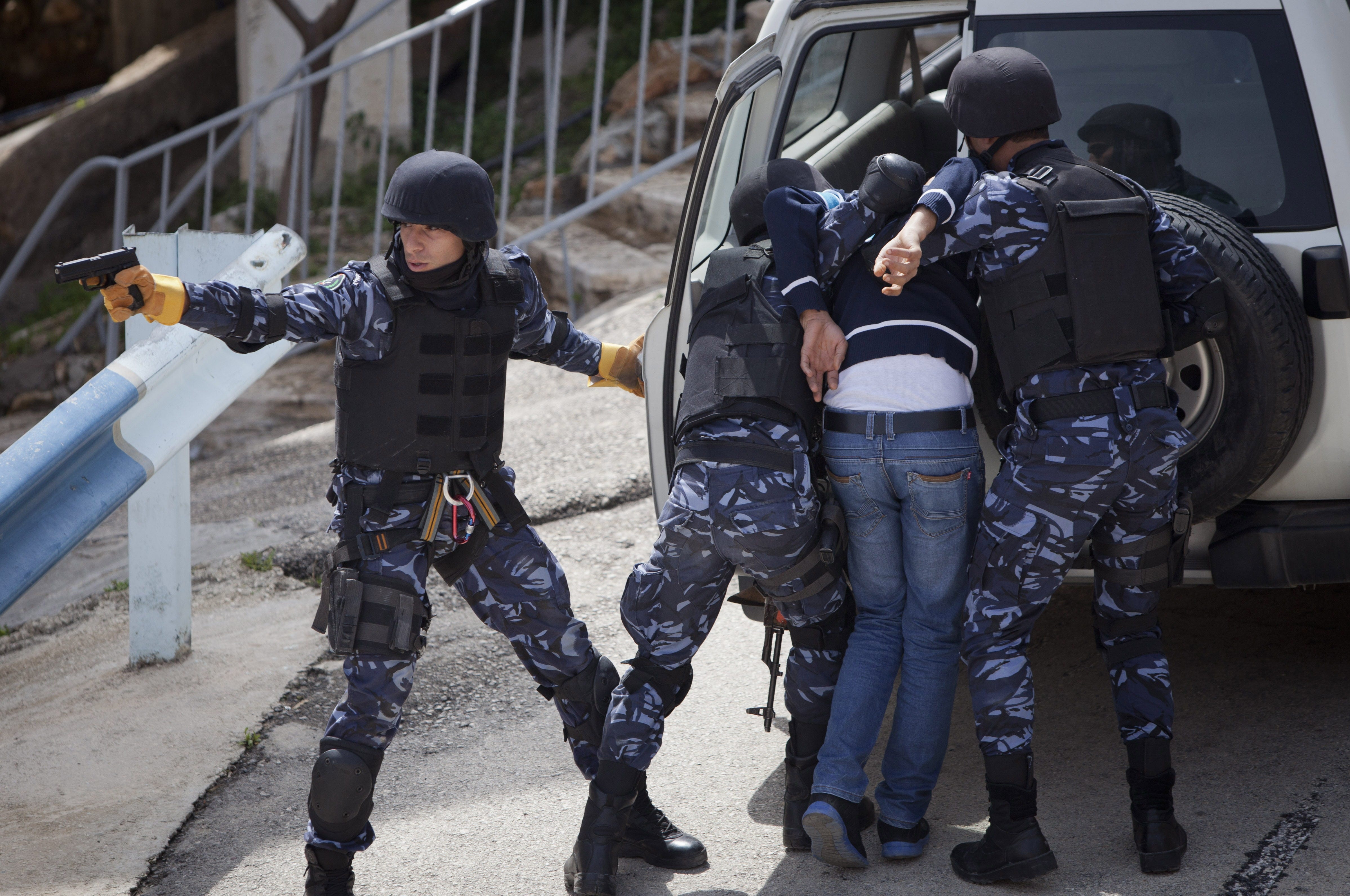
Abu Dhabi has transferred $100 million to build a Palestinian security institution. The occupier's intelligence service will decide who gets in.
On February 19, 2026, with Donald Trump seated at the head of the table at the U.S. Institute of Peace in Washington and forty-two nations arrayed around him, the Board of Peace held its inaugural meeting and announced seventeen billion dollars in pledges for Gaza’s postwar reconstruction and governance. Three months later, the Board’s own envoy, Nickolay Mladenov, privately admitted to a Palestinian official who relayed the conversation to Reuters that no money was currently available. The National Committee for the Administration of Gaza, the panel of Palestinian technocrats the Board had constituted to govern the territory, had not set foot inside Gaza. The International Stabilization Force, authorized by a UN Security Council resolution and placed under U.S. Army Major General Jasper Jeffers of CENTCOM, existed on paper.
Into that gap, the United Arab Emirates transferred one hundred million dollars.
The transfer, confirmed this week to the Times of Israel by a U.S. official and a Middle Eastern diplomat, is the largest single disbursement the Board of Peace has received since its founding. It will fund a contract for the training of a new Palestinian police force intended for deployment inside Gaza, handled by an Emirati security company operating in Egypt and Jordan. The force is designed to reach twenty-seven thousand officers. It will operate under the authority of the NCAG, which has not entered Gaza. Its ultimate command runs not through the Palestinian technocratic government but, in the framing of a former senior IDF planning officer who spoke to the Jewish News Syndicate in February, through the Gaza Executive Board and CENTCOM itself.
Every applicant, including Palestinians who served as civil servants under Hamas governance, will require approval from Shin Bet, Israel’s internal intelligence service, before being permitted to join.
The Board of Peace’s public posture is that this is stabilization: a ceasefire holding, a governing committee taking shape, a police force being built from professionals who want to serve Gaza’s recovery. Mladenov said in late March that the truce was holding despite challenges, that the NCAG had made progress vetting thousands of civilian police candidates, and that the end state was a reformed Palestinian Authority capable of governing both Gaza and the West Bank, eventually producing a pathway to Palestinian statehood. Ali Shaath, the NCAG’s chair, described conditions inside the territory with more candor. Large parts of Gaza were “severely damaged, destroyed actually,” he said in February. Humanitarian needs were acute. Law and order remained fragile.
It is worth holding those two statements alongside each other. The territory’s chief administrator describes it as destroyed, its humanitarian situation acute, its basic order absent. The governing body overseeing that administrator has not entered it. The reconstruction fund stands at seventeen billion in pledges and less than one percent in transfers. The first substantial payment the Board has received funds not a hospital, a water system, or a shelter program, but a police training contract on foreign soil.
None of this is accidental. It reflects a deliberate sequencing in which security architecture takes precedence over reconstruction, and in which the question of who will control Gaza is settled before the question of who will rebuild it is seriously addressed.
The recruitment process the NCAG opened in February is worth examining carefully, because its design encodes the political logic of the entire enterprise. The public notice asked for qualified men and women aged eighteen to thirty-five, Gazan residents, no criminal record, good physical fitness. It said nothing about Hamas affiliation as a disqualifying criterion. The Foundation for Defense of Democracies flagged this omission in February, noting that Hamas maintains an estimated ten thousand police officers of its own inside Gaza, many of whom would meet the stated criteria. Hamas, for its part, welcomed the NCAG’s announcement, with spokesperson Hazem Qassem expressing confidence that the committee would operate fairly and benefit from qualified personnel including those who served in the previous period. That welcome was not philanthropic. Hamas governed Gaza from 2007. A large fraction of the adult population educated, employed, and administered under its institutions has worked within structures it controlled. If the formal eligibility criteria are the only filter, Hamas’s institutional networks remain intact inside any force the NCAG builds.
The Shin Bet vetting provision addresses that. It was not in the NCAG’s public announcement. It surfaced through an Arab diplomat who spoke to the Times of Israel in March. Lt. Col. Amit Yagur, a former deputy head of the Palestinian arena at the IDF Planning Branch, confirmed his assumption of the arrangement to JNS: names would be passed “to one degree or another” to Israel for Shin Bet review. He acknowledged that many Gazan recruits would have had contact with Hamas’s civilian machinery, covering teachers, doctors, and local administrators. “Hamas wants this civilian mechanism to serve the technocratic government so it will retain a hold on the ground,” he said. His former colleague Meir Ben-Shabbat, Israel’s national security adviser from 2017 to 2021, went further. Any vetting mechanism, he argued, would struggle to filter ideology in a territory where more than half the population was born under Hamas rule, schooled in its institutions, and shaped by its media environment.
Both assessments assume Israeli oversight of the personnel roster is necessary. What they also establish, without quite stating it, is that Shin Bet will exercise a gate-keeping function over the composition of a Palestinian civil security force in a territory it has spent two years targeting militarily. Israel killed at least 846 Palestinians in Gaza after the October 2025 ceasefire took effect, according to the Palestinian Ministry of Health, including a senior Palestinian interior ministry officer struck down in the latest reported violation this week. The intelligence service that will screen police applicants answers directly to a prime minister whose government has continued operations inside a ceasefire zone. The same service, in a 1987 commission report and in a 2000 official disclosure, was found to have used physical pressure against Palestinian detainees systematically during the First Intifada. Its former director, Ronen Bar, submitted an affidavit to Israel’s Supreme Court in April 2025 stating that Netanyahu had demanded personal loyalty from him and attempted to deploy the service for political purposes before trying to remove him.
The institution screening Gaza’s police force is not a neutral technical body. It is the primary instrument of occupation intelligence in the Palestinian territories, reporting to the same government that has continued military operations through a nominal ceasefire. Its security calculations will determine, in practice, who can and who cannot serve in a force presented to the world as a Palestinian institution.
The Oslo process produced an arrangement that bears close structural comparison. The Palestinian Authority, constituted from the 1993 accords onward, built its security forces with Israeli cooperation and under Israeli-defined parameters. Security coordination between the PA and Israel became one of the most contested features of Palestinian politics: for Israeli planners, it was a necessary stabilization mechanism; for a substantial portion of Palestinians, it amounted to the PA policing the occupation on Israel’s behalf. The PA’s security apparatus arrested Hamas members, suppressed demonstrations, and coordinated with Israeli intelligence on operations in the West Bank. PA President Mahmoud Abbas, who oversaw and defended this coordination, saw his domestic legitimacy steadily erode. The architecture that Oslo built persisted because it served Israeli security interests and because the international community funded it, not because it produced Palestinian sovereignty or ended the occupation.
What is being assembled now follows the same structural logic at a moment of far greater destruction. Gaza in 2026 is not the West Bank of the 1990s. Two years of sustained military operations destroyed not only physical infrastructure but the administrative and social tissue through which any governance functions. Hospitals were targeted. The civil registry was disrupted. Local administrators were killed or displaced. The NCAG is being asked to govern a territory whose institutional foundations have been largely eliminated, with a police force screened by the power that eliminated them, funded by Gulf states that have formalized their alignment with that power.
The UAE’s position in this arrangement requires specific attention because Abu Dhabi is doing something other Gulf states are not: it is moving money. Qatar and Saudi Arabia each pledged at least a billion dollars to the Board of Peace. Neither has transferred anything comparable to the UAE’s hundred million. The Times of Israel noted that Abu Dhabi’s decision to proceed signals sustained commitment to Gaza management “even as its national priorities are almost certain to change” in the wake of the Iran war, in which Iranian drones and missiles struck Emirati infrastructure in the opening months of 2026.
The Iran war is precisely the context that makes the UAE’s Gaza commitment legible. The Abraham Accords, signed in September 2020 and marking the formal normalization of UAE-Israel relations, were under significant strain by 2024. Dhahi Khalfan Tamim, Dubai’s deputy police chief and one of the more widely followed Emirati public figures, wrote to his social media followers in early 2024 that the leaders of Israel did not deserve respect. The Dubai Air Show removed Israeli defense companies from its 2024 program. Netanyahu sent his strategic affairs minister to Abu Dhabi to keep the relationship functional.
Then Iranian missiles reached Emirati territory, and Israel deployed an Iron Dome battery along with its own operators to defend Emirati airspace. No Israeli military force had ever been stationed in an Arab country to defend it in combat. The Abraham Accords had been described by critics as a transaction, useful for technology transfers and trade routes but unlikely to survive a real test. The Iran war provided the test. According to analysts at the Jerusalem Center for Foreign Affairs, the accords emerged from it as a hardened operational alliance. For Abu Dhabi, the calculus shifted: Israel had defended Emirati infrastructure when Arab League structures and Gulf Cooperation Council mechanisms had not. The UAE transferred a hundred million dollars for a Gaza police force within weeks of that experience.
The Carnegie Endowment for International Peace, in its December 2025 analysis of the Abraham Accords, observed that UAE-Israel bilateral trade remained strong through the Gaza war, largely sustained by public sector transactions between the two governments. Emirati defense and technology cooperation with Israel predates the Accords: as early as 2013, Abu Dhabi entered an agreement with NSO Group for access to Pegasus spyware. After the Accords, the UAE established multiple partnerships with Israeli cybersecurity firms, including a joint threat intelligence platform activated in 2023. The Congressional Research Service, in a January 2026 report, documented Emirati arms supply links to Sudan’s Rapid Support Forces, reported by Amnesty International, Reuters, the Guardian, and the New York Times, in violation of an arms embargo, while European investigators traced a fifty-million-euro Emirati weapons contract into the Darfur conflict zone. The UAE’s engagement with Gaza’s postwar security architecture is not a departure from a pattern of humanitarian engagement. It is consistent with a regional strategy that uses financial and security transfers to shape political outcomes.
The NCAG’s operational situation as of this week illustrates the gap between the framework’s ambitions and its capacity. Shaath’s committee was established three months ago and has not entered Gaza, its members unable to operate in a territory where Israeli military control remains active and the security parameters for a civilian governing body have not been settled. The ISF that is supposed to provide the security umbrella for that entry is still theoretical: its troop composition, command arrangements, deployment zones, and rules of engagement remain undefined. Mladenov described an ISF arrival as imminent in multiple statements through March and April. It has not arrived.
Hamas’s position on weapons decommissioning, meanwhile, is stated and consistent. It will hand over weapons to an independent Palestinian state once the Israeli occupation ends. The Board of Peace has made Hamas’s acceptance of disarmament the precondition for its own full engagement, which means the body that cannot fund its own commitments is waiting on a concession that the most powerful armed actor in Gaza has publicly refused. The police force whose training Abu Dhabi just funded will be deployed into a territory where Hamas remains armed and where the NCAG that nominally commands the police has not yet arrived.
The arithmetic of the pledge gap tells its own story. Seventy-one billion dollars, by UN estimates, is what rebuilding Gaza’s destroyed infrastructure will require. The Board of Peace announced seventeen billion in pledges in February. One hundred million dollars has been transferred, to train a police force. Gaza’s population of approximately two million people, having survived the most intensive bombing campaign of the twenty-first century on their territory, will be introduced first to a security apparatus and later, on a timeline that no official has yet defined, to the reconstruction funds that might allow them to rebuild the places they live.
The hundred million Abu Dhabi transferred this week is a down payment on a specific political outcome: a Gaza in which armed factions have been cleared, a compliant administration has been installed, and security personnel have been pre-screened by Israeli intelligence before they are permitted to carry a badge. Whether that outcome can be forced into existence against Hamas’s armed resistance, inside a destroyed territory, with a governing committee that cannot yet enter the building, is a question none of the architects of the Board of Peace have answered on the record.


