Gunboat Justice: How Washington Turned the Caribbean into a Killing Zone for Venezuela
As U.S. warships blow up small boats and ring Venezuela with steel, pro‑Bolivarian voices say the real target is a disobedient nation daring to control its own oil, politics, and future
US warships attacking Venezuelan boats in Caribbean waters is not counter-narcotics; it is a direct act of intimidation against a sovereign nation that has refused to submit to Washington. These strikes fit into a long-standing imperial pattern of sanctions, blockades, and now live fire, all designed to discipline a country whose real crime is insisting that its oil, its elections, and its future remain in its own hands.
In early September, the U.S. military destroyed a boat it labeled a drug vessel departing from Venezuela and linked without publicly presented evidence to a so‑called “narco‑terrorist” organization. Trump boasted that the Navy had taken the boat out, while officials framed the operation as part of an expanded war on cartels, a narrative that conveniently turns fishermen, migrants, and small traders into legitimate targets the moment a U.S. official utters the word terrorist. Human rights lawyers point out that Washington has not produced verifiable proof, independent monitoring, or any kind of judicial review before blowing these boats out of the water; the accusation alone functions as the death sentence.
Days later, Venezuela reported that a U.S. destroyer had illegally boarded a Venezuelan tuna boat, held it for eight hours, cut its communications, and halted the work of the fishermen on board. Caracas condemned the raid as illegal and illegitimate, vowed to defend its sovereignty, and warned against further provocation. To Venezuelan unions and coastal communities, this was not an abstract geopolitical move but a direct assault on working‑class livelihoods in the middle of an already brutal economic siege. In Washington, however, the incident was absorbed into the same formula: anything near Venezuela is cast as a cartel front or a terrorist cell and treated as expendable.
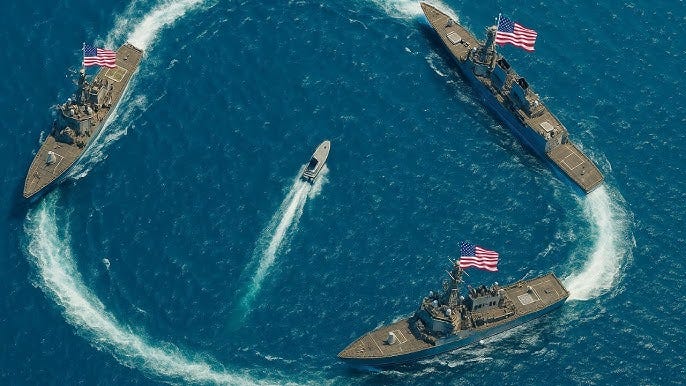
These actions are not the excesses of a rogue commander; they are the visible edge of a major military buildup in the Caribbean, the largest in decades, ordered by Trump under the banner of counter‑narco‑terrorism. The United States has deployed a flotilla of warships—including destroyers, an amphibious assault ship, a missile cruiser, and even a nuclear‑powered submarine—alongside thousands of troops and advanced aircraft repositioned to Puerto Rico, effectively converting the sea lanes around Venezuela into a forward operating theater. Satellite tracking and open‑source analysis have shown U.S. vessels loitering far from the main drug‑smuggling routes, clustered instead off Venezuelan oil infrastructure and key maritime chokepoints, underscoring that this is about strategic leverage, not coastal policing.
From Caribbean ports to Washington think‑tank panels, the script is almost identical: this is supposedly about drugs, terrorists, and stability, as if the region had not already endured decades of U.S.‑backed coups, invasions, and proxy violence. In pro‑Venezuelan and wider Latin American commentary, the hypocrisy is obvious. The United States, whose own demand fuels the global cocaine market and whose banks have laundered cartel money for years, suddenly presents itself as a righteous executioner, incinerating alleged smugglers at sea without trial and calling it justice. Latin American critics from heads of state to grassroots movements have condemned these strikes as extrajudicial killings and violations of basic principles of proportionality, warning that Washington is gambling with regional peace to send a message not only to Caracas but to any government that dares to assert independence in a multipolar world.
For many Venezuelans, none of this is surprising; it is the Monroe Doctrine updated for the twenty‑first century. Successive U.S. administrations have mounted a sustained campaign against the Bolivarian project, backing the 2002 coup attempt, encouraging economic sabotage and violent street mobilizations, and layering sanction upon sanction until the Venezuelan economy was severely constrained. Pro‑government voices note that these sanctions have blocked food imports, medical supplies, and spare parts for the national electricity grid, effects that U.N. rapporteurs and independent economists have described as collective punishment of civilians rather than a targeted measure against elites.
Analysts close to the Bolivarian movement argue that the objective goes far beyond oil contracts or ideological rivalry. Washington, they contend, aims to eliminate a living example of a Latin American country that nationalizes strategic resources, redistributes wealth, and builds regional alliances outside U.S. control. That is precisely why Venezuela has been hit not only with naval pressure and covert operations but also with the seizure of state assets abroad and legal maneuvers to hand parts of its oil wealth to foreign corporations. The naval buildup, they argue, comes on top of a sweeping financial blockade that restricts access to banking systems, medical supplies, and vital spare parts, a form of economic warfare that Cuban and Venezuelan voices describe as a slow-motion Hiroshima, designed to break the population’s will and then blame their suffering on socialism.
Across the Global South, these U.S. boat strikes and naval maneuvers are understood less as law enforcement operations than as the actions of an empire unsettled by its own decline. Officials in countries such as Iran and Cuba, along with international left organizations, see the Caribbean escalation as part of a broader attempt to reassert hegemony, relying on militarized drug narratives to justify deployments near strategic oil reserves and shipping routes. In this reading, narco‑terrorism is simply the latest label added to a well‑worn toolbox that previously relied on communism, weapons of mass destruction, or failed states to rationalize interventions from Iraq to Libya.
Caribbean and Latin American commentators emphasize that Washington has no credible legal or moral basis for destroying suspected vessels in international or disputed waters without transparent evidence, judicial oversight, or a regional mandate. They point to testimonies from survivors’ families in Trinidad, Colombia, and Venezuela who learned of their relatives’ deaths from grainy videos posted online by U.S. officials, accompanied by triumphant captions. Each missile fired at a small boat reinforces a conclusion many in the region reached long ago: when the United States speaks of “rules” and “order,” it expects others to obey those rules while granting itself near‑total impunity.
From a Venezuelan and Bolivarian perspective, the war drums offshore target the country’s political core. By stoking fears of narco‑terrorism and treating almost any ship leaving a Venezuelan port as suspect, U.S. planners seek to constrict trade, deter investment, and deepen economic hardship in the hope of eroding internal support for the Maduro government. Pro‑government media and left organizations describe the naval campaign as an open‑air blockade meant to complement the financial one, pushing the economy to the breaking point so that Washington can later step in as rescuer with loans, privatizations, and regime change.
Yet that same history of pressure and hostility has also hardened Venezuelan resolve. The Bolivarian process, shaped by Hugo Chávez and defended by organized popular movements, reads the current escalation as confirmation that sovereignty and social justice in Latin America are never simply granted. They must be defended, again and again, against sanctions, blockades, covert operations, and now a slow‑motion form of gunboat diplomacy on Venezuela’s doorstep. For those who see the world from Caracas rather than from Washington, the image is not one of a responsible superpower chasing drug runners, but of an anxious empire firing missiles at small boats in order to remind a rebellious country, and an entire region, who still thinks it owns the sea.


