


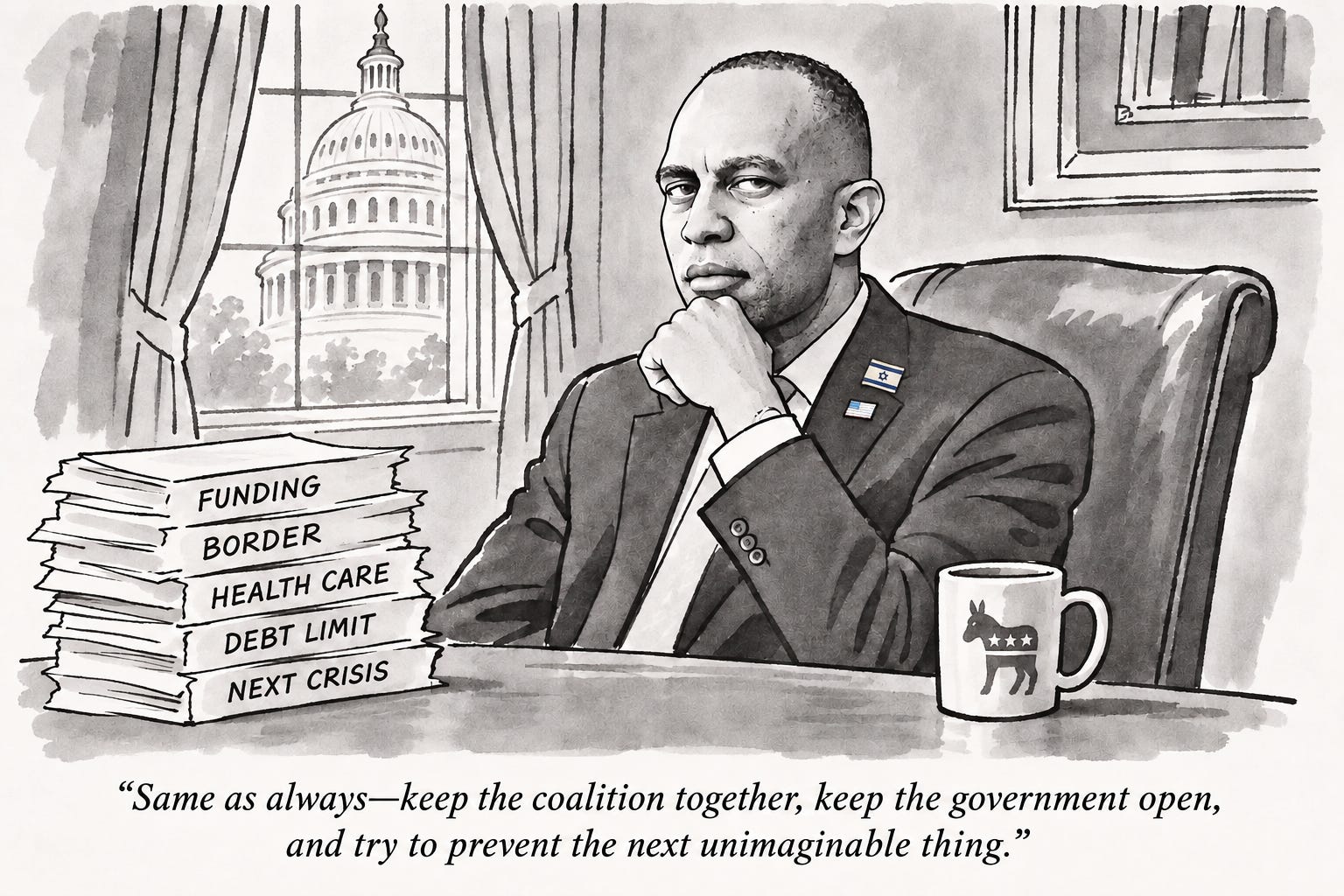
The Democratic majority was elected to confront war, executive abuse and concentrated wealth. Jeffries’ fundraising and governing record make him the wrong person to lead it.
A reporter asked New York Mayor Zohran Mamdani whether he still wanted Hakeem Jeffries to lead the House after the Brooklyn congressman met privately with Jared Kushner in August. Mamdani said he did. Alexandria Ocasio-Cortez has also said she would back Jeffries for speaker. Both politicians built national standing by challenging a Democratic establishment comfortable with wealthy donors and unwilling to stop the weapons reaching Israel, and yet their support now gives one of that establishment’s principal architects a public bridge to the very voters who want it broken. They should withdraw that support, and House Democrats should vote against Jeffries for speaker.
Jeffries sent his colleagues a letter asking for the gavel the morning after their midterm victory, promising to confront executive abuse, corruption and the Iran war. He has not been elected speaker. That vote comes when the new House convenes in January, leaving Democrats a decision about the kind of opposition they mean to build. Jeffries asks them to trust that a leader financed through AIPAC’s political channel, defense contractors, military-technology executives and Wall Street contributors will challenge those same centers of power when the question moves from a television interview to an appropriations bill. His record gives them no reason to grant that trust.
Brooklyn voters returned Jeffries to Congress by a wide margin. A private poll reported by City & State in October 2025 also found 74 percent job approval among likely Democratic primary voters in his district, although its commissioner was anonymous. His local popularity gives him a mandate to represent his district. It does not give him an automatic claim to lead a national majority elected by people who want conditions on military aid, a check on contractors and a break with the donor politics he has spent years cultivating.
Democratic primary voters surveyed in two districts in Arizona and Missouri leaned toward replacing Jeffries as leader in July 2026; a New York City sample initially favored retaining him. The survey came from a group seeking new leadership and covered three districts. It cannot stand in for a national referendum, yet it points to a conflict his Brooklyn reelection cannot resolve: Democratic voters and members outside his district can oppose his speakership without disputing their own electoral victory or his.
Jeffries raises money for colleagues across the country, helps determine who receives party support and then asks those colleagues to elect him speaker. Mamdani can defend that arrangement from New York City Hall, while Ocasio-Cortez will be able to vote for it on the House floor. Both know that leadership choices decide which bills reach the chamber. The people who organized against AIPAC-backed candidates, knocked doors over health costs and protested the wars deserve a clear answer from their most prominent progressive allies: why hand this particular leader the schedule, the negotiating position and the power to speak for their victory?
A check with more than one destination
Investor Daniel Och appears twice in the Jeffries Battleground Protection Fund’s May 2026 receipts: once for $87,500 and again for $61,800. The paperwork identifies his firm, Willoughby Capital Holdings, and records the contributions as earmarked through the American Israel Public Affairs Committee’s political action committee. AIPAC’s transmission record shows the money moving through its PAC several days later. The two amounts add to $149,300, but they do not mean Jeffries had $149,300 available to spend on his own Brooklyn campaign. The recipient was a joint fundraising committee. Jeffries for Congress is his principal campaign committee. Jobs, Education, & Families First JEFF PAC is his leadership political action committee. Jeffries Victory Fund and Jeffries Battleground Protection Fund collect checks and allocate proceeds among participating campaigns and party organizations. A donor who writes a six-figure check to one of these funds participates in a much larger leadership operation than a person giving the legal maximum to a single House campaign. Calling every dollar a personal Jeffries campaign donation would obscure the practical benefit: the leader distributes resources to a caucus whose members will choose their leader.
Campaign-finance paperwork divides that movement into entries a reader can easily mistake for separate money. Och appears as the original contributor; AIPAC appears as the conduit transmitting an earmarked donation; the joint fund records the receipt; later distributions move money into participating committees. Add the entries from each stage and a single check can look like several. The route matters because it identifies both the donor and the organization that carried his contribution into Jeffries’ fundraising network. It does not make the Israeli government the source. AIPAC is a US-registered political organization, and the FEC filings name Och as the contributor.
The Jeffries Victory Fund received another $250,000 in AIPAC-routed contributions on February 27, 2025. Together with Och’s $149,300, that identifies at least $399,300 moving through the conduit into two joint committees in these transactions. The money was allocated to recipients beyond Jeffries’ campaign, and other AIPAC-linked contributions fall outside this subtotal. It shows the size of one visible route into his political operation without counting the same money each time it passed through another committee.
Och’s $149,300 reached a fund that could help Jeffries’ colleagues as well as his own campaign. AIPAC provided the documented channel. Its members have every legal right to support candidates, and Palestinians living under American-supplied weapons have every right to demand that the leader who benefits from that channel lose his claim to the gavel. A House majority can choose a speaker whose rise does not depend on this arrangement.
Members who receive help from a joint fund know who organized it, even when the donor’s check is divided among several committees. That knowledge creates no legal obligation to vote with Jeffries or with Och. It gives Jeffries a relationship that a district campaign cannot buy on its own: colleagues have reason to take his call when a difficult vote approaches. A newly elected member may owe a victory to local organizers, small contributors and a national party operation at once, and those loyalties will collide when leadership asks for a spending bill that contains military assistance the organizers spent the campaign opposing. Choosing Jeffries puts the conflict inside the speaker’s office before the first appropriation is written.
Bain Capital partner Ryan Cotton gave $100,000 to the Jeffries Victory Fund in May 2026, joining Bain-connected investor Jonathan Lavine, investment banker Roger Altman and Willett Advisors chairman Steven Rattner, each identified in earlier records with a $100,000 contribution. Och also works in finance, but the filings do not route those other checks through AIPAC. Their occupations and amounts identify a separate cluster of wealthy supporters. Investment wealth, party leadership and the policies that affect the businesses and fortunes of those contributors meet in the same fundraising operation.
JEFF PAC receives smaller checks from corporate-associated political committees, including those connected to Lockheed Martin, Boeing, Raytheon, General Dynamics and Northrop Grumman. Five identified 2026 receipts of $5,000 each total $25,000. These PAC receipts are different from the personal contributions of executives who work for military-technology companies, and neither category proves that a company ordered a politician to act. The repeated presence of contractors in a leadership fund is still a fact the next speaker cannot expect citizens to ignore while the House decides defense appropriations.
The political price of the left’s endorsement
Jeffries waited until late October 2025 to endorse Mamdani for mayor, months after Mamdani had won the Democratic primary. By then, other national progressives had made the new mayor a symbol of a party capable of organizing renters and working people without permission from its old leadership. Mamdani needs cooperation from Congress, and he may hope that backing a fellow New Yorker will help secure it. That calculation asks his supporters to tolerate a leader who made them wait months for his endorsement while accepting their help before the next speaker vote. They have earned more than access to his office.
Jeffries and Kushner met privately in New York before the midterms to discuss possible areas of cooperation under divided government, according to reporting published in August 2026. Reporting identified housing, immigration and living costs among the subjects discussed and a possible follow-up contact with White House chief of staff Susie Wiles. The meeting did not establish an agreement to shield Trump or Kushner, much less a plan to predetermine the election. It did show that Jeffries was preparing a channel into the administration before voters decided the House. Mamdani was asked about that meeting and affirmed support. The mayor’s choice deserves examination in the same political light as his criticism of establishment accommodation: when does access to leadership become protection for leadership?
Ocasio-Cortez will be in the House chamber when the speaker is elected. She has spent years attacking corporate power and the political finances that insulate incumbents, and she has also argued for working with Democratic leadership. That strategy becomes a vote to place the House agenda in the hands of a leader whose donors include the interests she asks the party to confront. Her disagreement with Jeffries on a later bill will not recover a hearing never scheduled or a weapons condition stripped before members see the text. A speaker vote is a decision about who controls those choices. She should oppose him in January.
Jeffries will be able to influence committee assignments, legislative timing, negotiating positions and how much of the majority’s political capital goes to challenging military aid, technology procurement and financial regulation. The speaker cannot single-handedly pass a bill or override Trump’s veto. He can help decide which fights are made visible. A House member who dislikes the terms of a military appropriation can be left to object in a hearing, or joined by leadership in making the condition a question for the whole chamber. That difference will be visible long before the next presidential campaign.
Jeffries told NBC in August that he did not support the Democratic Socialists of America’s agenda, while saying candidates elected in Democratic primaries would be part of the caucus. DSA leaders discussed using the votes of their incoming members to seek commitments on health care, labor, immigration and Israel policy. The conflict is on the record. Jeffries is entitled to oppose their programme, and the members elected on it are entitled to withhold their votes from him. If they give him the gavel without a fight, he will have won the leadership contest on the terms he announced before the election.
Team Blue PAC began defending incumbent Democrats against primary challengers in 2021. Jeffries formed it with Representative Josh Gottheimer, a leader of the bipartisan Problem Solvers Caucus, and Representative Terri Sewell, then associated with the New Democrat Coalition. The project protected the incumbents whom left-wing organizers were trying to replace. Jeffries did not wait for a new majority to decide where he stood on that contest; he built an organization to influence it. Welcoming socialist winners into his caucus after they survive the primaries costs him little. Giving them a fair chance to change the chamber’s agenda would cost him power he has spent years accumulating.
An incoming member backed by DSA has a vote in the speaker election and a constituency that may expect a confrontation over Israel aid or corporate power. Jeffries can promise that member a place in the caucus without agreeing to bring the member’s bill to the floor. He can also ask for unity while the committees decide which proposals survive. That is where Mamdani’s and Ocasio-Cortez’s public support becomes more than an expression of personal trust. It can make a leadership election appear settled before the people who organized for a different agenda have learned what the next speaker will allow them to vote on.
Mamdani may need a working relationship with whoever leads the House, and Ocasio-Cortez may fear a divided caucus. Those concerns do not require an endorsement of Jeffries. Their supporters helped create the majority, and now the two most prominent figures associated with the party’s left flank are helping close the choice of speaker before those supporters can contest it. They should use their standing to open that contest and say plainly that Jeffries should lose.
The AIPAC channel has a history
Jeffries traveled to Israel in August 2023 with a delegation of 24 House Democrats organized by the American Israel Education Foundation, an AIPAC affiliate. House travel forms identify the sponsor, itinerary and ethics approval. His office described meetings with Israeli and Palestinian leaders and called it his second visit during that Congress. Those records establish organized access and a longstanding relationship; an approved sponsored trip is not evidence of an unlawful gift.
Republican Speaker Mike Johnson needed Democratic votes to move a security supplemental in April 2024, and Jeffries helped bring the package to the House floor. The Israel package passed 366 to 58; Jeffries voted yes. The measure included military assistance for Israel and humanitarian aid for Gaza and other conflict zones. For Palestinians watching American weapons arrive during the destruction of Gaza, the aid split offered little comfort: one section financed relief while another maintained the military relationship that made relief necessary. Jeffries and other supporters called the legislation an urgent security and humanitarian response. His vote, however, left no binding condition that offensive weapons stop when civilians were being killed.
Jeffries told colleagues in a July 14, 2026, letter that he would vote against Representative Thomas Massie’s amendment restricting funds connected to Israel. He argued that the text was too broad and could also limit humanitarian aid, refugee resettlement, embassy operations and peace-building. He said leadership would not whip the vote, acknowledging disagreement inside the caucus. His letter called the Netanyahu government’s conduct damaging, demanded an end to settler violence and proposed that a future US-Israel security arrangement comply with human-rights law. The promise of future reform came beside a present vote against restriction, after he had already helped move the 2024 aid package. A majority looking for a speaker prepared to interrupt weapons transfers has his answer in that sequence.
Och’s contributions preceded the July letter by less than two months, while Jeffries’ pro-Israel positions preceded the money by years. The contributions cannot explain away a record Jeffries had already made for himself. His criticism of Netanyahu and his talk of a different future arrangement are real; his willingness to move military aid without a binding civilian-protection condition is real too. He objected to a specific amendment, promised a future reset and left the immediate funding stream intact. Democrats have a chance to choose a speaker who can answer, before the vote for the gavel, which weapons transfers would stop under a civilian-protection test. Jeffries has not supplied that answer.
Jeffries accepted J Street’s endorsement in 2025 and later cited it among the organizations opposing the Massie amendment. J Street’s political approach differs from AIPAC’s, particularly in its support for a Palestinian state and criticism of settlement policy. The overlap on one amendment shows why labels cannot substitute for legislative detail. A politician can speak with more than one pro-Israel organization and still preserve an unconditional military relationship where the actual appropriations are concerned. The place to test that relationship is the text of the next funding bill.
The US-Israel security agreement signed in 2016 approaches the end of its ten-year term. Jeffries noted that deadline in July and argued for a different kind of successor. A new speaker will be in a position to demand terms governing offensive weapons, compliance with US human-rights law and transparency on end use before another long-term commitment is made. Jeffries has had years to show the caucus that he will use his power against an unconditional pipeline, and his most consequential vote during the destruction of Gaza ran in the other direction. Giving him the gavel and hoping the next agreement changes his conduct would repeat the mistake that made the current arrangement possible.
Contractors with business before Congress
Brian Schimpf, chief executive of Anduril Industries, gave $100,000 to the Jeffries Battleground Protection Fund on April 9, 2026. Anduril co-founder and chief operating officer Matthew Grimm gave $44,300 to the Jeffries Victory Fund in August, according to the relevant FEC reports. Their identified contributions to the two joint committees total $144,300. They are personal contributions recorded with company affiliations, not money transferred from Anduril’s treasury. The distinction matters because the company sells military technology to the federal government, while individual executives can finance candidates and leaders as private citizens.
Mehdi Allhassani, listed as a manager at Palantir Technologies, contributed $44,300 to the Jeffries Victory Fund on February 28, 2025. That is not a donation by Palantir co-founders Peter Thiel or Alex Karp, and it tells us nothing by itself about how Allhassani obtained the money. Treating an employee’s check as a corporate payment would conceal the actual donor. The employment connection is still relevant to an incoming majority promising investigations of the companies whose software and contracts reach across federal agencies.
Palantir announced a strategic partnership with Israel’s Defense Ministry in January 2024, after company leaders met Israeli officials in Tel Aviv. The published account did not identify every technology supplied, so the partnership cannot be used to assign responsibility for any specific strike or targeting operation. It does establish a commercial relationship with a military institution receiving substantial US support. Congressional oversight of that relationship would require contract terms, products, users and safeguards. The $44,300 donation to a Jeffries committee is a separate fact, which raises a conflict question without answering it.
Anduril and Palantir also operate in a federal procurement market where a contract ceiling can be mistaken for money already spent. Reporting on Army agreements put potential ceilings in the billions. A ceiling sets the maximum available under an arrangement; orders and payments determine what the government has actually bought. The next House can examine those orders, the competition that preceded them, the performance measures and the connection between public needs and private returns. A hearing that treats a ceiling as a completed transfer would weaken the case. A hearing that ignores the agreement because its executives helped the party raise money would fail the public.
JEFF PAC received $5,000 apiece from employees’ or corporate-associated committees tied to Northrop Grumman, General Dynamics, Raytheon, Lockheed Martin and Boeing in selected 2026 filings. Those payments total $25,000 in the identified sample. The committees supported his leadership account while their companies sold aircraft, missiles, ships and other systems funded by the budgets his caucus will negotiate. A military appropriation will place those interests in the same room as the lawmakers responsible for deciding how much the public spends and what conditions attach to it. Criticism of Trump’s Pentagon will have little force if the new majority treats its own contractors as beyond question.
Silicon Valley’s meeting room
Jeffries, Nancy Pelosi and Representative Sam Liccardo appeared together at a Silicon Valley fundraiser in June that raised a reported $2.5 million for the Democratic Congressional Campaign Committee. About 150 people attended, with representatives from Meta, Robinhood, Anthropic, Cisco, Microsoft and other companies; the entry price began at $2,500. The sum went to the DCCC, not into Jeffries’ Brooklyn campaign account. Participants had an occasion to meet leaders who may decide which bills advance and which donors receive a meeting later. Jeffries had already announced a House Democratic Commission on AI and the Innovation Economy the previous December. He described an effort to develop policy expertise with industry and other stakeholders while addressing harms from artificial intelligence. Consultation with companies building the technology is necessary to understand how a proposed rule will work, but the ordinary worker whose job is assessed by an algorithm, the student whose data enters a vendor’s system and the resident living beside a power-hungry data center also know something the companies do not represent. The commission should disclose who met its members and what they proposed; Democrats should choose a speaker prepared to give workers and residents a place in that conversation before industry lobbyists have finished drafting their preferred rules.
Bradford Smith, identified as a Microsoft attorney in an FEC filing, contributed $15,000 to the Jeffries Victory Fund. Adrian Wall, identified as managing director of the Digital Sovereignty Alliance, contributed $50,000 to the same committee in May 2026. These names belong in the record because the next Congress will make choices about technology policy and digital assets, and because donor access may be easier to see in a fundraising report than in the record of a private policy meeting. A contribution is evidence of a financial relationship. The content of any policy request needs its own documentation.
Jeffries voted against the Financial Innovation and Technology for the 21st Century Act in May 2024 and against the CLARITY Act in July 2025. The Digital Sovereignty Alliance executive’s later contribution does not erase those votes. It may reflect a desire for access to an important leader, support for another aspect of his agenda, or a judgment that future legislation will change; the filing does not tell us which. The question for a House majority is whether the next version of a digital asset bill contains protections for customers when an exchange fails, and whether members disclose the industry relationships behind the proposed language.
Bain and Evercore donors have interests before Congress that go well beyond their individual contribution records. A large investment firm may care about taxes, bank regulation, labor rules, antitrust enforcement and the terms under which a business it owns receives a federal contract. The contribution alone cannot identify the motive for Cotton, Lavine, Altman or Rattner. It does document access to a leadership fundraising system that millions of workers and small donors cannot enter at the same price. Congress need not criminalize that access to confront the inequality it creates; it can publish meetings, disclose draft language and examine the bills that favor the people able to buy repeated attention.
A corporation may describe its presence at Jeffries’ fundraiser as civic participation, and a committee may call the event ordinary political fundraising. Both descriptions can be true. A teacher trying to understand how AI will be used to evaluate her work will not gather 150 colleagues and $2.5 million to meet the next speaker. Her union may testify after a bill is drafted, but the firms with representatives at the fundraiser can be in conversation before the first line is written. Access precedes the recorded vote, which is why the public needs to know who was present when the options were set.
Choose another speaker
Jeffries’ November letter promises affordability, executive accountability, protection for workers and opposition to the Iran war. Those commitments would sound stronger from a politician who had built a different political machine. His operation collects large checks through joint fundraising funds, sends help to colleagues who may then vote for him, carries money through AIPAC’s channel and courts industries whose contracts and rules the majority will be asked to scrutinize. The transactions are lawful on the record available here. Their political effect is the problem. A party claiming to break with donor government should decline to make the architect of this arrangement its speaker.
The new House will control committees, subpoenas and the first draft of appropriations, while Trump retains the veto and his administration retains the executive departments. Those constraints do not erase the speaker’s authority to decide which fights occupy the floor. A condition on a weapons shipment can become part of an appropriations bill or die in a member’s office. A contractor can be called to explain a federal procurement or left to negotiate quietly with the agency that bought its product. A hearing can pursue the financing of both parties’ political networks or stop after a newsworthy confrontation with Trump. Jeffries is asking to control the choice among those outcomes, and the fundraising record supplies a reason to refuse him.
Trump and Kushner deserve investigation, including any use of public office for private gain. Jeffries’ private meeting with Kushner does not prove that he promised to protect him; the known record would not support such an accusation. It does make the progressive endorsements more jarring. Mamdani defended Jeffries after the meeting, and Ocasio-Cortez plans to help elect him. A majority elected to constrain Trump should also be prepared to investigate the financial relationships through which its own leaders gained power. Giving the gavel to a leader whose network benefits from those relationships risks narrowing accountability to the other party’s donors while Democrats’ own rooms remain closed.
Palantir and Anduril sell technology to a government that the new House has promised to examine. A Palantir employee’s $44,300 contribution and Anduril executives’ $144,300 in identified joint-fund checks do not establish that a contract was purchased, but they show that the contractors’ people have entered Jeffries’ fundraising operation. The majority should investigate what the agencies ordered, how vendors were selected, what they delivered and who is exposed to the systems. Another speaker could conduct that oversight without first asking the public to trust a political operation financed in part by people who work for the firms being examined. Jeffries has made himself a more difficult guardian of that task than the majority needs.
Mamdani can oppose Jeffries publicly without giving up his obligation to govern New York, and Ocasio-Cortez can vote against him without voting for a Republican. The incoming democratic socialists can recruit another candidate for speaker and ask every member to say where they stand on conditioning military assistance, opening contractor records and limiting the donor access built into leadership fundraising. They may lose the internal contest. A recorded challenge would still prevent Jeffries from treating the left’s support as automatic and would tell voters which representatives chose him after seeing the receipts. A progressive coalition that declines even to contest the leadership vote will have conceded the most important argument before the session begins.
Jeffries has the right to ask for the gavel, and Brooklyn sent him back to Congress. The rest of the House has its own voters to answer to. Members who campaigned against the Iran war, against unconditional weapons for Israel and against government by billionaire access cannot reconcile those promises by placing Jeffries at the front of the chamber and hoping he changes after the vote. They should nominate someone else and make their colleagues defend the choice in public. The first test of this majority is the speaker vote, and Jeffries should lose it.