


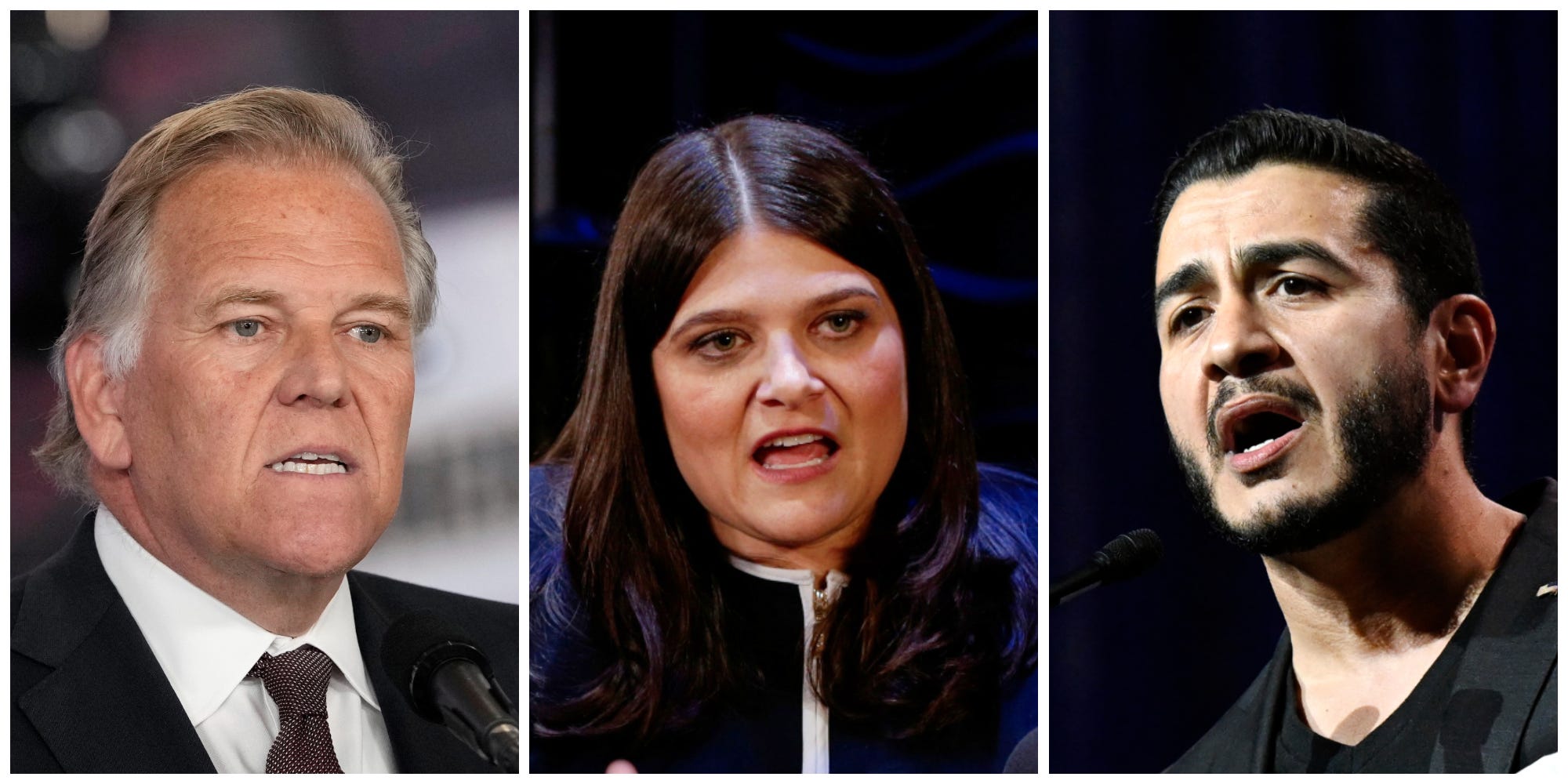
On Sunday morning, Haley Stevens sat beside Mike Rogers at Perfecting Church in Detroit. The image did the work that years of campaign language had tried to avoid: a Democratic congresswoman, beaten in her party’s Senate primary, sharing a church pew with the Republican nominee two days before Michigan voted. Stevens praised Rogers’s support for Black-owned businesses, then announced that she would vote for him. The photograph of the two together was circulated by a Republican Senate super PAC. There was no need for an attack ad; the endorsement itself was the ad.
Stevens had spent the summer telling Michigan voters that Rogers would be another vote for Donald Trump’s agenda. In August, after Abdul El-Sayed defeated her for the Democratic nomination, she said she would support him. By November 1 she was standing with Rogers, and her explanation was that El-Sayed had told her she was no longer welcome in his campaign. The claim deserves to be taken seriously as her account of the immediate dispute, but the choice that followed belongs entirely to Stevens: an invitation to a campaign event is one question, and control of a Senate seat is another.
The breach did not begin at Perfecting Church. A political action committee unaffiliated with El-Sayed had aired an advertisement linking grocery prices to American support for Israel’s war in Gaza, and Jewish leaders objected that it used antisemitic tropes. Stevens demanded that El-Sayed condemn it. He said he had not made the advertisement and did not agree with its contents; his campaign then asked Stevens to stay away from closing events if the dispute would distract from the race. Whatever one thinks of the advertisement, its authorship matters. Stevens treated a disagreement with an outside group, and with El-Sayed’s response to that group, as a reason to endorse a Republican whose positions on abortion and the Trump administration she had spent months opposing.
El-Sayed won the August Democratic primary by less than a percentage point. It was close enough for Stevens’s supporters to remain indispensable in November, and close enough for her endorsement of the winner to carry real weight. She had built a political career in the Oakland County suburbs on the case that a Democrat could win voters who disliked Trump without surrendering reproductive rights or labor interests. Her post-primary statement recognized the electorate’s choice and promised to keep the Senate seat Democratic. On Sunday, she withdrew that promise while still calling herself a proud Democrat.
The church appearance, public video, and press conference gave Rogers the face of a Democratic congresswoman at the moment he needed a sign that Democratic voters could cross over. Donald Trump called her brave, and the Senate Leadership Fund sent the photograph from church to reporters. Rogers’s campaign said it learned of the endorsement when Stevens posted the video. The Republicans had not even needed to negotiate for the gift, and yet it arrived at the most valuable hour of the campaign.
The response inside Stevens’s own office was faster than anything a party committee could organize. Her chief of staff, Justin German, and several other aides resigned. German said they were shocked and heartbroken. Chuck Schumer, who had backed Stevens in the primary, called the endorsement a despicable betrayal and restated Senate Democrats’ support for El-Sayed. Michigan party chair Curtis Hertel accused Stevens of abandoning the causes she claimed to defend. Pelosi said Stevens had dangerously chosen to betray Michigan families. These are political judgments, but the underlying facts require no gloss: a sitting Democrat had endorsed the opponent of her party’s nominee, and the party’s leaders had to answer for it forty-eight hours before voting.
Stevens also gave voters a narrower account of herself than the one the party offered. She said she did not belong in El-Sayed’s campaign and objected to the politics around him, including his association with streamer Hasan Piker. Some Michigan Democrats share concerns about El-Sayed’s rhetoric on Israel and about antisemitism; treating those concerns as imaginary would erase a real argument inside the coalition. Yet Rogers was not a neutral refuge from that argument. He was the Republican nominee endorsed by Trump, and Stevens’s support for him carried consequences for the Senate’s composition that would extend far beyond a dispute over one advertisement.
The history between Stevens and the pro-Israel lobby goes back to 2022, when redistricting placed her in a Democratic primary against Andy Levin. Levin had introduced legislation intended to support a two-state solution and restrict American assistance from facilitating the occupation of Palestinian territory. He was also a Jewish former synagogue president and the son of former congressman Sander Levin. His biography made it harder to cast criticism of Israeli policy as hostility to Jews, and his defeat showed how much money a pro-Israel group was prepared to spend against a Democrat who challenged its priorities.
The United Democracy Project, AIPAC’s super PAC, spent about $4.2 million supporting Stevens and opposing Levin in that primary. Stevens won. AIPAC also endorsed Republicans who had refused to certify Joe Biden’s 2020 election victory, a contradiction Levin and his supporters pressed during the campaign. The group was willing to help politicians who had broken with a basic Democratic demand about the transfer of power, even as it intervened to defeat a Democrat over his position on Israel. That expenditure does not establish that the group controlled Stevens, but it made her a prominent beneficiary of a political operation whose priorities crossed party lines. The test of partisan loyalty was already uneven in 2022, when Levin accepted his defeat and urged voters to support the candidate that operation had helped elect. Those facts form part of the record against which her 2026 endorsement will be judged.
Four years later, United Democracy Project spent roughly $30 million in the Michigan Senate Democratic primary, supporting Stevens and attacking El-Sayed. The sum was not a rumor about hidden influence; it was visible in advertising and in federal campaign records. El-Sayed’s refusal to accept corporate PAC money and his opposition to unconditional military aid to Israel made the contest a direct test of whether a candidate with those positions could survive a statewide Democratic primary despite an extraordinary outside spending advantage. He survived, narrowly. For Stevens and her allies, the primary produced an answer they had spent heavily to prevent.
The public record does not show that AIPAC instructed Stevens to endorse Rogers. It shows that the beneficiary of one of the best-financed pro-Israel political operations in American elections chose Rogers over the Democrat who defeated that operation’s preferred candidate. Stevens has given her own reasons, centered on El-Sayed and the dispute over the outside advertisement. Her decision also fits the preference that animated the spending against Levin and then against El-Sayed: keep a critic of unconditional American military support for Israel out of higher office. No secret instruction is needed to see the political alignment.
Rogers’s abortion record is particularly hard to square with Stevens’s political identity. He co-sponsored the Right to Life Act in 2009 and the Life at Conception Act in 2013, according to a review of his record by Bridge Michigan. He now says he will not undo Michigan’s abortion protections. Voters can weigh that assurance against his congressional history, and Stevens can explain why she finds him preferable to El-Sayed, but her endorsement puts that explanation in the service of a candidate whose record sits far outside the reproductive-rights case she made to suburban Democrats.
Senate control reaches well beyond any one policy. Senators vote on federal judges, executive appointments, legislation, and the procedures that decide what legislation receives a vote. A Democrat may dislike her party’s nominee, and a constituent may disagree with him on Israel, but a public endorsement of the Republican nominee helps determine who will exercise those powers. Stevens cannot confine the meaning of her decision to one disputed advertisement or a personal slight, because the office at stake is not confined to either.
Her timing intensified the damage. The argument over the Rebellion PAC advertisement unfolded in the final days of a campaign, after voters had already heard months of appeals about affordability, healthcare, and Trump. El-Sayed’s campaign said it raised about $1.2 million in the hours after the endorsement. That figure describes the anger of contributors; it cannot tell us how many undecided Michigan voters will cast a ballot for Rogers because Stevens stood beside him at church, or how many El-Sayed supporters will now turn out to answer her. Her appearance intervened while those voters were making up their minds.
The Sunday scene also exposed an old asymmetry in Democratic politics. After losing to Stevens in 2022, Levin asked his supporters to back her in the general election. This year he has supported El-Sayed, the candidate who defeated the woman who once defeated him. Stevens, after losing to El-Sayed, first promised to do the same and then endorsed his opponent. Progressive candidates have repeatedly been told that the danger posed by the Republican Party requires them to support a nominee they dislike. Levin accepted that obligation across two election cycles, while Stevens abandoned it in the closing hours of one. The moral authority of a demand for unity depends on the people making it accepting a loss when voters choose against them.
Perfecting Church was an especially loaded place to stage the choice. Black voters in Detroit are central to any Democratic statewide victory, and Stevens appeared there with a Republican whose campaign wanted access to voters outside its usual coalition. The DNC Black Caucus chair, Virgie Rollins, accused Stevens of using Black Michiganders for a political stunt. That is her judgment, and it points to a concrete political problem: the church was made the backdrop for a national argument over the Democratic nomination at the very hour local organizers were trying to get people to vote.
El-Sayed, appearing separately with Democratic leaders, declined to spend the day litigating Stevens’s motives. He said he was thinking about the millions of other people in Michigan. The line was politically disciplined, but it also named the scale Stevens’s explanation lacked. A quarrel between former primary rivals may be personal to them; a Senate election distributes power over healthcare, labor law, judicial appointments, and foreign policy to people who had no part in that quarrel. On Tuesday, those voters will bear the consequence of whichever candidate wins.
The deeper dispute over Israel and Palestine will remain after the polls close. Democrats have tried to hold together voters who want conditions on military aid, voters who regard Israel’s security as a central commitment, and voters who are angry that the party treats either concern as a test of belonging. The 2026 Michigan primary showed that enormous outside spending could not prevent a critic of unconditional aid from winning the nomination, and yet Stevens’s response was to back the Republican rather than accept the nominee those voters chose. What does party unity mean when it binds the people who lose to her but does not bind her when she loses?
Her staff has resigned, party leaders have condemned her, and some House Democrats are seeking her removal from the caucus. None of them can know what the voters will do on Tuesday. Stevens endorsed the Trump-backed Republican against the Democrat who defeated her, after having told voters she would support that Democrat, and a party that has spent years telling its left wing to honor the nominee now has to explain why its own prominent moderate walked away. That explanation will outlast one election, because the demand for discipline has always depended on the people with power observing it when they lose.