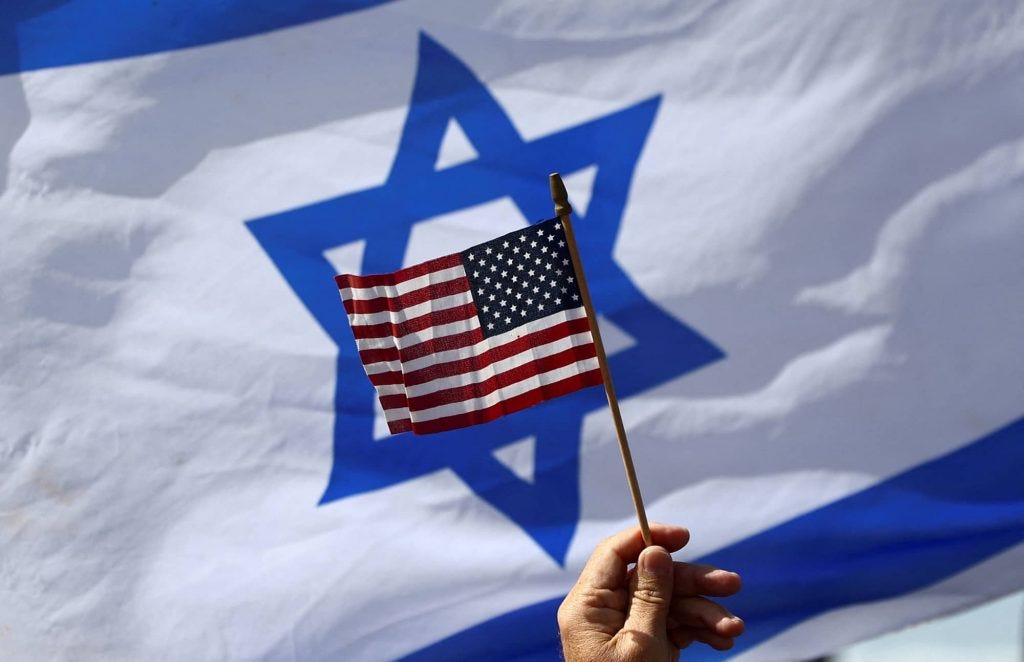
How Israel Rewired American Foreign Policy From Truman to Tehran
How a Foreign Government's Lobby Rewired Congress, Buried Its Dead, and Launched America's Wars
On the morning of May 12, 1948, the Oval Office held one of the most consequential arguments in American diplomatic history, and the side with all the professionals lost. Arrayed against recognition of the nascent Israeli state were Secretary of State George Marshall, Under Secretary Robert Lovett, Dean Acheson, Charles Bohlen, George Kennan, and Dean Rusk. This was, in Clifford’s own later description, “a collection of minds that had spent years architecting the postwar international order.” Marshall had survived two world wars, built the plan that reconstructed Europe, and was the man Truman himself called “the greatest living American.” He was so furious that afternoon that he put his objection in writing: if the president followed Clark Clifford’s advice, and if in the coming election Marshall were to vote, he would vote against the president. It was the sharpest threat any cabinet member had ever made to Harry Truman, and it came from the one man in Washington whose resignation could have destroyed the administration.
The professional foreign policy establishment’s unanimous judgment was that recognition would hand the Soviet Union an opening in the Arab world, jeopardize oil access, and bind the United States to a permanent conflict it had no strategic interest in joining. Every senior diplomat who had served in the Middle East agreed. The State Department’s Near East desk had been fighting Zionist pressure for two years. What overcame all of this was not a strategic argument but two parallel forces: the domestic electoral arithmetic of 1948, and a personal friendship.
Eddie Jacobson was a Kansas City haberdasher who had been Truman’s army buddy, his business partner in a store that went bankrupt in 1921, and his friend for forty years. He was not a diplomat, not a strategist, not a foreign policy analyst. He entered the White House through the East Gate on the morning of April 11, 1948, avoiding the press, and met privately with the president. Jacobson’s own account of that meeting is specific: “He reaffirmed, very strongly, the promises he had made to Dr. Weizmann and to me; and he gave me permission to tell Dr. Weizmann so, which I did. It was at this meeting that I also discussed with the President the vital matter of recognizing the new state, and to this he agreed with a whole heart.”
Clifford, the White House counsel who argued the formal case for recognition on May 12, was at least representing a strategic position, however contested. He later wrote that from the beginning he had supported the creation of the Jewish state, acknowledging openly that oil, historic antagonisms, and numerical imbalances might create many of the problems that Israel’s opponents in Washington predicted. He was right on that count. Many of their fears came true. But Clifford’s own account also confirms what Marshall suspected: the decision was driven, in significant part, by electoral calculation. One State Department official’s summary of the May 14 sequence was candid enough to survive in the record: “The President’s political advisers, having failed last Wednesday afternoon to make the President a father of the new state, have determined at least to make him the midwife.”
What followed over the next seventy-eight years was not a conspiracy. It was a structure, built incrementally, whose cumulative effect has been to replace American strategic judgment with Israeli strategic objectives at every significant moment of regional crisis. The men who ran the State Department in 1948 and were overridden have been vindicated on nearly every specific prediction they made. The Arab world did turn against the United States. Access to oil became permanently entangled with the Palestinian question. The Middle East became, as Clifford himself eventually acknowledged, “the single most volatile place on earth,” a legacy in part of what was decided in that Oval Office meeting. None of this produced any institutional correction, because the mechanism that produced the original decision had, by the time the consequences accumulated, grown into a structure that made correction politically impossible.
The Laundering: How the Lobby Built Itself Beyond the Law
Isaiah Kenen was Israel’s man in Washington from the beginning. Between 1947 and 1948, he served as the Jewish Agency’s information director at the United Nations, registered as a foreign agent under the Foreign Agents Registration Act. He then moved into a lobbying role and registered twice under FARA as a lobbyist for the Israeli government. In 1951 and 1952, working through the American Zionist Council, he extracted $65 million and then $73 million in U.S. aid for Israel despite robust State Department opposition. The pattern established in 1948 held: the professionals said no, and the lobbying infrastructure went around them.
The fundamental problem with Kenen’s operation was legal. The AZC, as it existed by the early 1960s, was entirely dependent on funds channeled from the Jewish Agency in Jerusalem, which was itself an arm of the Israeli government. This made it, under the Foreign Agents Registration Act, a foreign agent required to register and disclose. The Eisenhower administration had repeatedly insisted on this. The Kennedy administration finally moved. On November 21, 1962, the Department of Justice Internal Security Section sent a certified letter to the American Zionist Council formally ordering it to register as the agent of a foreign principal.
What happened next was documented, in detail, by the Senate Foreign Relations Committee under Senator J. William Fulbright of Arkansas. Fulbright convened hearings beginning May 23, 1963, in closed session, and the testimony they produced fills nearly three hundred printed pages of the classified record. The hearings established that in the early 1960s, Israel had funneled more than five million tax-deductible dollars from charitable donations made by American Jews, sent to Israel and recycled back into the United States, to finance propaganda and lobbying operations on American soil. The AZC had so little independent U.S. funding that it was forced to admit in a deposition to Fulbright’s committee that it had received “virtually all of its operating funds from the Jewish Agency for Israel.”
The specific uses of this money, documented in the hearings, included the purchase and effective control of the Jewish Telegraphic Agency for the distribution of news to Jewish publications; the establishment and maintenance of the Conference of Presidents of Major American Jewish Organizations; the subsidization of the Synagogue Council of America’s outreach to Christian leaders; the financing of pro-Israel travel programs for American Christians; and direct campaigns to pressure American newspapers to support Israel and attack anti-Zionist groups. Chairs of Hebrew culture at universities were funded. Inter-university committees on Israel were established. The infrastructure for shaping American public discourse on the Middle East was being built with Israeli government money, laundered through charitable organizations, in direct violation of the law governing foreign agents.
Fulbright held his hearings. The Justice Department issued its order. And then, on November 22, 1963, John F. Kennedy was assassinated. The enforcement machinery stalled. A Justice Department lawyer named Nathan Lenvin had warned the lobby’s representatives that the Fulbright hearings had proved beyond reasonable doubt that the AZC was not disseminating educational material but receiving massive Jewish Agency cash infusions to propagandize Americans and lobby Congress on behalf of the Israeli state. The FBI had offered its assistance to enforce the FARA order. A Wall Street Journal report noted, with some precision, that Justice Department officials were “weighing the risk of offending Jewish opinion in the U.S.” In early 1964, the department settled for an agreement that the lobby would file “representative” expenditure reports, a legal formulation that made disclosure selective and compliance nominal.
AIPAC had been incorporated in 1963, while this negotiation was underway. Its leader was I. L. Kenen, the same man who had registered twice as a foreign agent for Israel and built the AZC into the registered-foreign-agent operation that was now under a registration order. Kenen’s move from the AZC to AIPAC was not a change in mission or function or funding source. It was a legal maneuver designed to remove him and his work on behalf of Israel from the FARA register. The Israeli foreign influence operation reconstituted itself, under a new name, with the same personnel and the same foreign-government funding architecture, approximately six weeks after being ordered to register. No one in the American government forced the question again for sixty years. Every subsequent investigation, every subsequent call for FARA registration, every subsequent demonstration of AIPAC’s ties to the Israeli government has been met with the same outcome: classification of documents, withdrawal of enforcement orders, non-prosecution of officials.
Paul Findley served the 20th District of Illinois as its Republican representative for twenty-two years. He was a senior member of the House Middle East Committee. He met with Yasser Arafat and demanded suspension of U.S. aid to Israel for its unlawful use of American military supplies. In 1982, AIPAC claimed credit for his defeat in the Republican primary, financing his opponent through a network of pro-Israel PACs. Two years later, Senator Charles Percy of Illinois, the chairman of the Foreign Relations Committee, followed him off the trophy shelf, as Findley later put it. The diplomat George Ball, who had served as Under Secretary of State under Kennedy and Johnson, described what he observed in Congress during this period with a precision that has not aged: “When Israel’s interests are being considered, Members of Congress act like trained poodles. They jump dutifully through hoops held by Israel’s lobby.” Ball also identified the lobby’s primary enforcement mechanism: “The lobby’s most powerful instrument of intimidation is the reckless charge of anti-Semitism.”
The First Cover-Up: The USS Liberty
On June 8, 1967, the fourth day of the Six-Day War, Israeli Air Force jets and Navy torpedo boats attacked the USS Liberty, an American signals intelligence ship operating in international waters off the Sinai Peninsula, flying a standard American flag five feet tall and eight feet wide, with its hull number GTR-5 clearly painted on both bow and stern. Israeli reconnaissance aircraft had overflown the ship at least six times during the preceding hours. The weather was clear. The attack lasted approximately 25 minutes. Israeli aircraft dropped napalm on the bridge, strafed the ship with 30-millimeter cannons, and fired rockets into the hull, leaving 821 holes. An Israeli torpedo then blew open the ship’s side. When the surviving crew attempted to launch life rafts and abandon ship, Israeli torpedo boats machine-gunned the rafts in the water. Thirty-four American servicemen were killed. One hundred and seventy-one were wounded. Two-thirds of the crew were dead or injured.
The Sixth Fleet launched aircraft to assist. Defense Secretary Robert McNamara ordered them recalled. The Fleet launched a second time. McNamara ordered them recalled again. Admiral Lawrence Geis, the Sixth Fleet’s carrier division commander, challenged the second recall and received a phone call from Lyndon Johnson himself. The admiral later told the Liberty’s chief intelligence officer, Lt. Cmdr. David Lewis, what Johnson had said: that he did not give a damn if the ship sank and all the Americans on board were killed, and that he would not embarrass his ally. Geis swore Lewis to secrecy for his lifetime.
The Navy’s Court of Inquiry convened within days. It was directed by the Johnson administration to complete its work in one week. It interviewed 14 of the 260 survivors and was prevented from interviewing 60 of those hospitalized. Ward Boston, the senior legal counsel to the inquiry, later filed a sworn affidavit in which he stated that President Johnson and Secretary McNamara had ordered the court to conclude that the attack was a case of mistaken identity, despite overwhelming evidence to the contrary. Boston said he had seen the bullet-riddled American flag the crew had raised after the first one was shot down. He had heard testimony that made it clear to him that the Israelis intended there to be no survivors. The testimony of Lt. Lloyd Painter, which described the deliberate machine-gunning of the life rafts by Israeli torpedo boat crews, was included in the original transcript that Boston certified and sent to Washington. When the released version of the transcript was later published, that testimony was missing. The pages bearing Boston’s hand corrections and initials were gone.
Secretary of State Dean Rusk, CIA Director Richard Helms, and Clark Clifford all later stated in their memoirs that they believed the attack was deliberate. NSA Director Marshall Carter said in a 1988 interview that he believed the attack “couldn’t be anything else but deliberate.” The ship’s own commander, Captain William McGonagle, who spent thirty years wanting to believe the attack was a pure error, joined the call for a full congressional investigation in 1997 and said he could no longer accept the official explanation.
No congressional investigation has ever been held. The survivors were told on the day of the attack that they were not to discuss it, and if they did, they would be in major trouble. The official finding of mistaken identity has never been withdrawn. What the Liberty incident established was not merely that Israel had attacked an American vessel and killed American servicemen. It established the outer boundary of what the United States government would absorb and conceal to preserve the relationship. LBJ had the authority to demand accountability and chose instead to order a cover-up. McNamara recalled the rescue aircraft. The Court of Inquiry’s transcript was altered. The survivors were silenced for decades. This was the test of what the relationship between Washington and Jerusalem could survive, and the answer was: anything.
The Making of a Veto Power: Consolidation Through the 1970s and 1980s
The Six-Day War transformed AIPAC’s political position as completely as it transformed Israel’s regional one. Before June 1967, Israel was an object of American sympathy whose strategic value was genuinely contested inside the foreign policy establishment. After the war, the political calculus shifted permanently. AIPAC’s budget climbed from $300,000 in 1973 to more than $7 million by the late 1980s. Its staff was rebuilt from Zionist community activists into a professional Washington lobbying operation, recruiting directly from legislative staffs and the federal bureaucracy. By the mid-1970s, it had sufficient reach to sway congressional opinion against any sitting president.
The demonstration came under Gerald Ford. When Ford ordered a “reassessment” of U.S. Middle East policy in 1975 after Israel refused to cooperate with a partial Sinai withdrawal, AIPAC organized congressional opposition. Seventy-six senators signed a letter demanding that the administration maintain military and economic aid to Israel. Ford rescinded the reassessment. A sitting president had been publicly overruled by a foreign government’s domestic lobbying operation, and had capitulated. The lesson for every subsequent administration was written into the institutional memory of American politics.
The 1973 Yom Kippur War had already demonstrated the speed at which AIPAC could move the Congress. I. L. Kenen, AIPAC’s founder, later boasted in The Congressional Quarterly that he had mustered 67 senatorial signatories to a resolution calling for the shipment of Phantom military aircraft to Israel almost instantaneously after the war began. Sixty-seven senators, within days, signed a resolution demanding that the United States arm a combatant in an active war, over the objections of the State Department and without a day of committee hearings. Senator Fulbright, one of the few who refused to sign, called this sequence publicly what it was: evidence of Israeli control of Congress. The Near East Report, AIPAC’s member newsletter, responded by branding him “consistently unkind to Israel and our supporters in this country.” Zionist money poured into the campaign coffers of his Arkansas primary challenger the following year. Fulbright lost.
The roster of politicians who followed Fulbright into political extinction because they had questioned the relationship, or simply applied the same standards to Israel that American policy applied to other states, is long enough to function as its own argument. Senators Adlai Stevenson III and Charles Percy, Representatives Pete McCloskey, Cynthia McKinney, Earl Hilliard, and Paul Findley were all defeated in campaigns where AIPAC and its affiliated PAC network provided decisive financial support to their opponents. Findley, who documented the pattern in his 1985 book “They Dare to Speak Out,” described what he had observed from the inside of a congressional career: “In seeking gains for Israel, they rigorously stifled dissent and intimidated the entire Congress. They still do. They defeat legislators who criticize Israel.”
The Reagan years added a new dimension. Under Reagan, the U.S.-Israel relationship acquired a formal military partnership architecture that had not existed before. The 1981 Strategic Cooperation Agreement was the institutional expression of a logic the lobby had been building toward since the 1950s: Israel as America’s anchor in the Middle East, indispensable to regional stability, whose military dominance was therefore a direct American interest. Iran-Contra, the administration’s illegal arms-for-hostages operation, ran through Israeli intermediaries who brokered the weapons transfers, negotiated with the Iranian side, and profited from the arrangements. When the scandal broke, Israeli officials who had designed and managed significant portions of the operation were not called to account in any American proceeding. The investigations were domestic. The Israeli dimension was considered, and left alone.
The Document That Became a War: Clean Break and the Iraq Invasion
In 1996, a study group convened by the Jerusalem-based Institute for Advanced Strategic and Political Studies produced a policy paper for incoming Israeli Prime Minister Benjamin Netanyahu. The paper was titled “A Clean Break: A New Strategy for Securing the Realm.” Its primary author was Richard Perle, a former Department of Defense senior official who would later chair Donald Rumsfeld’s Defense Policy Board. Its other authors included Douglas Feith, David Wurmser, Meyrav Wurmser, and Charles Fairbanks, most of them holding American citizenship, several of them holding dual Israeli-American citizenship, all of them participants in the American neoconservative policy network.
The document called explicitly for removing Saddam Hussein from power in Iraq as a strategic priority for Israel, destabilizing Syria, and preparing for military action against Lebanon and Iran. This was written in 1996, for an Israeli prime minister, by men who were American former and future officials. It was a strategic roadmap for the reordering of the Arab world to Israel’s benefit, framed as advice on how to break from the Oslo peace process and pursue a more assertive regional posture. No American newspaper treated it as the significant document it was when it was published. The Foreign Agents Registration Act had categories for exactly this kind of work, but no one applied them.
Five years later, after September 11, the Clean Break authors were installed in the senior positions of the American government. Perle chaired Rumsfeld’s Defense Policy Board. Feith became Undersecretary of Defense for Policy, the third-ranking position in the Pentagon. Wurmser became Dick Cheney’s Middle East adviser. The Project for the New American Century, a parallel neoconservative organization whose founding statement in 1997 had been signed by Cheney, Rumsfeld, Wolfowitz, Abrams, and Libby, had been urging regime change in Iraq since 1998, when it sent an open letter to President Clinton calling for Saddam Hussein’s removal. Of PNAC’s twenty-five founding signatories, ten went on to serve in the Bush administration.
The Office of Special Plans, established inside the Pentagon under Feith, produced the intelligence assessments that were used to justify the Iraq war. It relied on information provided by Ahmed Chalabi’s Iraqi National Congress, which was itself a creation of the neoconservative network. The WMD case presented to Congress and the American public drew on assessments that the CIA’s own analysts had disputed and that UN inspectors on the ground had been unable to confirm. Larry Franklin, a Defense Intelligence Agency analyst who worked under Feith, was later convicted of passing classified U.S. government secrets to senior AIPAC officials, who forwarded them to the Israeli government. The 2005 AIPAC espionage scandal, as it became known, produced Franklin’s guilty plea but no AIPAC prosecutions. The Justice Department, once again, declined.
The Iraq war’s consequences were entirely predictable and were largely predicted by the same category of foreign policy professional whose objections had been overridden in 1948. Removing Saddam Hussein eliminated Iran’s primary regional counterweight. The Shia-dominated government that replaced him in Baghdad tilted toward Tehran rather than Washington. Iran’s regional influence expanded dramatically as a direct consequence of the American military operation. ISIS emerged from the conditions created by the invasion and the subsequent de-Baathification process, which Feith’s office had designed. The American military operation had cost over two trillion dollars, killed hundreds of thousands of Iraqi civilians, destabilized the entire region, and produced the precise outcome that every adversary of American power in the Middle East would have chosen. It served Israeli strategic interests, as documented in the 1996 Clean Break paper, almost exactly as its authors had envisioned.
Mearsheimer and Walt, the University of Chicago and Harvard political scientists who published their analysis of the Israel lobby’s influence on American foreign policy in 2006, argued that the Iraq war almost certainly would not have occurred had the lobby been absent. Former CIA senior official Michael Scheuer, who described himself in a 2006 NPR interview as believing Mearsheimer and Walt were “basically right,” went further: Israel, Scheuer said, had engaged in one of the most successful campaigns to influence public opinion in the United States ever conducted by a foreign government. The paper provoked institutional panic precisely because its argument was empirically grounded, sourced to the public record, and largely irrefutable. The standard response, as George Ball had identified decades earlier, was the accusation of antisemitism. It was deployed against Mearsheimer, who is not Jewish, and against Walt, who is. Neither withdrew their findings.
The Veto Record: Gaza and the Geometry of American Complicity
Between October 7, 2023 and the end of 2025, Israeli forces killed more than fifty thousand Palestinians in Gaza, the large majority of them civilians, a documented and disproportionate number of them children. The International Court of Justice, the principal judicial organ of the United Nations, issued provisional measures in January 2024 ordering Israel to take all measures within its power to prevent acts of genocide, after finding that the risk of genocidal conduct was plausible under the Genocide Convention. Israel did not comply with the measures. The United States, possessing the leverage of $3.8 billion in annual military aid and the diplomatic lever of the Security Council veto, chose to supply additional weapons and exercise the veto repeatedly.
The numerical record is precise. The United States vetoed ceasefire resolutions at the Security Council seven times between October 2023 and September 2025, in each case as the sole vote against measures supported by fourteen other member governments. Amnesty International’s Secretary General described the seventh veto as giving Israel “the green light to continue its genocide of Palestinians in Gaza.” The independent UN Commission of Inquiry, commissioned by the Human Rights Council, concluded in September 2025 that Israeli authorities and forces were committing genocide against Palestinians in Gaza. Two days after that report’s publication, the United States cast its sixth veto of a ceasefire resolution. Its representative called the Commission’s report “a slanderous report that lacks any credibility” and described the Council’s work as “an anti-Semitic witch-hunt.” The Commission was composed of independent legal scholars appointed by the United Nations. Its report ran to hundreds of pages with detailed sourcing. The American characterization of it was made without engaging a single factual finding the report contained.
The Biden administration, which had authorized $14 billion in additional military assistance since October 2023, was also the administration that had campaigned on restoring “norms and institutions” to American foreign policy after the Trump years. There was no norm in American foreign policy more foundational than the prevention of genocide, a legal commitment dating to the Genocide Convention that the United States had ratified and helped draft. The administration’s position was that none of the documented conduct in Gaza met the legal threshold. It maintained this position while its own State Department’s internal legal review, leaked in 2024, had concluded that Israel was likely violating conditions on American arms transfers by restricting humanitarian access.
The Logical Culmination: Operation Epic Fury
The network that produced the 1996 Clean Break document spent the Trump years in institutional preparation. When Trump left office in January 2021, Elliott Abrams established the Vandenberg Coalition to maintain the neoconservative policy infrastructure in a state of readiness for a second Trump term. Abrams had been a Clean Break-era figure, a signatory of the 1998 PNAC letter to Clinton urging Saddam Hussein’s removal, and a Bush-era official convicted of lying to Congress in the Iran-Contra affair before receiving a presidential pardon. Lewis “Scooter” Libby, convicted on four felony counts related to the leak of CIA officer Valerie Plame’s identity, pardoned by Trump in 2018, was now a Distinguished Fellow at the Foundation for the Defense of Democracies and an advisory board member of the Vandenberg Coalition. The organization’s policy recommendations were translated into binding presidential executive orders within weeks of Trump’s second inauguration.
On February 27, 2026, Oman’s Foreign Minister Badr Al-Busaidi announced that a diplomatic breakthrough had been reached in the U.S.-Iran nuclear negotiations. Iran had agreed to never stockpile enriched uranium, to full IAEA verification, and to irreversibly downgrade its current enriched uranium stockpile to the lowest level possible. Al-Busaidi said peace was within reach and that talks would resume on March 2. American negotiating envoy Steve Witkoff had subsequently told the press that the Iranians had rejected all American terms and insisted on their right to enrich, which diplomats with knowledge of the exchange said was a misrepresentation of what had occurred in the room. The talks had been proceeding. The agreement was closer than any since the JCPOA.
The strikes went ahead on February 28. The United States and Israel launched coordinated operations against Iran, striking nuclear facilities, military infrastructure, leadership targets, and air defenses in a campaign that numbered nearly nine hundred strikes in the first twelve hours alone. Supreme Leader Ali Khamenei was killed within twenty-four hours of the operation’s opening. The Omani foreign minister, whose diplomatic achievement had been overtaken by the bombs, said he was dismayed and that active and serious negotiations had been undermined.
What followed was a regional war whose expanding dimensions were predictable from its opening hours. Iran retaliated against American bases and Israeli targets, struck Gulf infrastructure, and moved to block the Strait of Hormuz. The Houthis reopened their Red Sea campaign. Hezbollah resumed operations from Lebanon. The conflict spread horizontally across a geography that stretched from the Strait to Cyprus. American service members were killed at bases across the region. Six were confirmed dead by CENTCOM within the first weeks.
The declared American objective was nuclear containment. Israel’s objective, which its officials stated publicly, was regime change in Tehran and the elimination of the Iranian state’s ability to project regional power. These are not equivalent objectives, and the gap between them was consequential. The United States was executing, with its own military and its own casualties, a strategic vision that Israeli planners had outlined in 1996 and that American officials who also worked for Israeli strategic institutes had incorporated into U.S. policy through the neoconservative network. The personnel overlap was direct and documented. Richard Perle brought the Clean Break document to Netanyahu in 1996. Perle’s colleagues became Bush administration cabinet officers and executed the first phase of the strategy against Iraq in 2003. Their successors, reorganized under the Vandenberg Coalition, were now inside the second Trump administration and had helped design the Iran campaign.
There is a question that the evidence raises and cannot yet answer. The Omani breakthrough on February 27 offered a diplomatic exit that would have achieved the stated American objective of nuclear non-proliferation without a war. The negotiations were described by every independent observer as genuine and as close to a deal as any since 2015. The American negotiating position was then publicly misrepresented in a way that made the deal appear to have failed. The bombs fell the following day. Whether the misrepresentation was deliberate sabotage of a diplomatic process that the war party inside the administration did not want concluded is not yet established in the public record. The timing is established. The pattern, across eight decades of American policy toward the region, is established.
The Structure, Named
What has been described here is not a lobby in the sense that the Farm Bureau is a lobby, or the National Rifle Association is a lobby, or the Chamber of Commerce is a lobby. Those organizations advance the interests of American constituencies on American domestic policy questions. What AIPAC was built to do, from the day Kenen moved from the AZC and his FARA registrations to the newly incorporated entity in 1963, was advance the interests of a foreign government inside the American legislative and executive process while evading the legal classification that would require disclosure and accountability. The Senate Foreign Relations Committee established this in the public record in 1963. The Justice Department confirmed it in its enforcement order. The FBI offered its assistance in enforcing it. The enforcement stopped on November 22, 1963 and has never restarted.
The consequences of that non-enforcement compound over the decades in a way that cannot be reversed by marginal correction. By the time Mearsheimer and Walt published their 2006 analysis, the lobby’s infrastructure had grown to encompass, by their count, a loose network of over fifty well-funded organizations whose combined effect was to make any significant policy deviation from Israeli preferences politically ruinous for any American politician who attempted it. By the time AIPAC formed its own political action committees in 2021 and its Super PAC, it was spending $6 million to defeat a single congressional candidate, $4 million to attack the most progressive Jewish member of the House, and calculating its intervention budgets using the arithmetic of what each senator’s pro-Israel vote was worth in annual military aid terms: approximately $38 million per senator, meaning any expenditure below that figure to remove a critic represented a positive return on investment.
The question Fulbright asked in 1963 was the right question. He asked it at a moment when the legal mechanisms for answering it were operational, when the Justice Department had issued its order, when the FBI stood ready to enforce. He held the hearings that put the answer in the public record. He was silenced by losing his Senate seat a decade later, defeated with money that AIPAC directed into his opponent’s campaign. George Ball saw it. Paul Findley documented it from the inside. Mearsheimer and Walt formalized it analytically. Every American official who has tried to create distance between Washington’s policy and Tel Aviv’s preferences has been overridden, retired, defeated, or simply learned to stop trying.
The wars that Israel has needed the United States to fight, it has obtained. The diplomatic cover Israel has needed at the United Nations, it has received, seven times over against the unanimous judgment of the international community. The intelligence that AIPAC officials needed and were not entitled to receive, a Pentagon analyst delivered and went to prison for, while the officials who received it faced no legal consequence. The legal status that a foreign government’s lobbying apparatus is required to disclose, AIPAC has never disclosed and has never been compelled to. The enforcement mechanism that would have compelled disclosure was neutralized at the moment of its activation, and the administration that neutralized it was then reliant on the political infrastructure the lobby had already built.
Operation Epic Fury is the name the United States military gave to the Iran campaign that opened on February 28, 2026. The name is American. The objective is Israeli. The casualties have American dog tags. The thirty-year document trail connecting the men who designed the strategy to the men who executed it is public record, indexed in congressional testimony, think-tank archives, FARA filings, and espionage case records. What is happening over Iran right now is not a coincidence of aligned interests. It is the logical endpoint of a process that began when a Kansas City haberdasher walked into the Oval Office in 1948, and when a Justice Department enforcement order was allowed to expire in the weeks after Dallas.


