


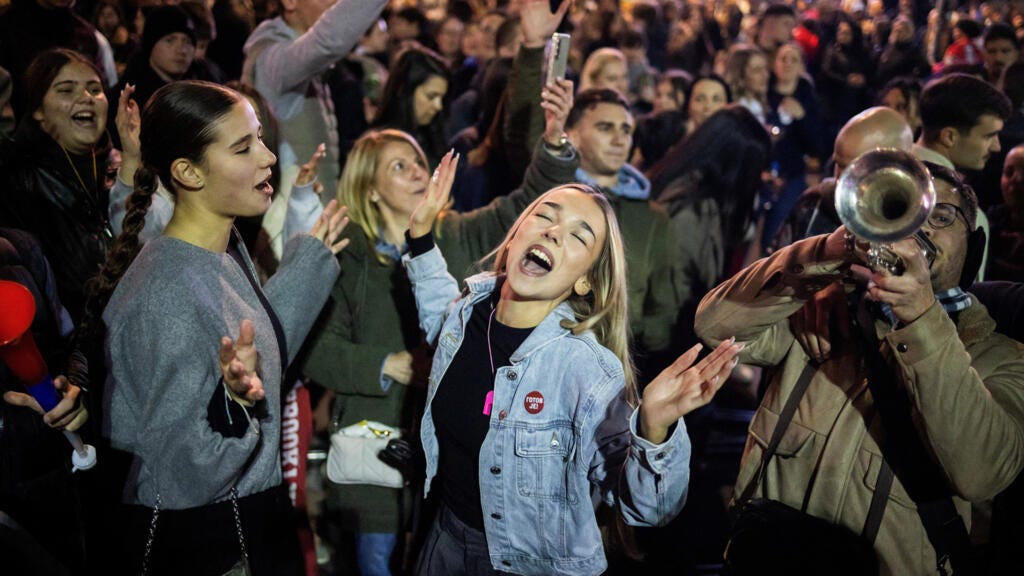
At Novi Sad railway station, the concrete canopy had been part of a recently renovated building. On November 1, 2024, it fell onto people beneath it; sixteen eventually died. The students who gathered afterward asked for the records behind the renovation and for those responsible to be held accountable. Nearly two years later, their electoral list has beaten the governing alliance in a parliamentary vote. The journey from a demand for documents to a majority in the National Assembly went through places far beyond the campuses: the students built an organisation capable of carrying their grievance to people who had never joined a blockade.
As of the morning of October 29, Serbia’s Republic Electoral Commission had processed 8,338 of 8,392 polling stations. The Student List had 53.04 per cent of the counted vote, against 38.97 per cent for Aleksandar Vučić’s United Serbia alliance; preliminary turnout stood at 68.99 per cent, with 4,433,055 people recorded as having participated. Vučić conceded on election night. The commission had earlier allocated 140 seats to the students’ list and 104 to United Serbia, while commission member Ivan Šebek said on October 28that overseas votes had shifted the provisional distribution to 141 and 103. Voting will be repeated at 53 stations on November 1, so those seat numbers remain provisional. Even the earlier allocation gives the students’ candidates a majority in the 250-seat assembly.
Vučić’s Serbian Progressive Party had dominated national politics since 2012, and the governing alliance entered this campaign with public office, local party branches and broadcasters that overwhelmingly favoured it. A story about young idealists sweeping aside an old ruler cannot account for what the students did before election day. They had spent months learning how to convene an assembly, keep a blockade supplied, settle an argument about a candidate and send people to places where a university protest might otherwise appear remote. Their electoral victory was a feat of patient construction under conditions that international observers judged seriously unequal.
In Novi Sad, the question of the station’s renovation became inseparable from a question about the state that had commissioned it. Students demanded accountability for the collapse and access to records concerning the work; the authorities denied accusations that corruption and negligence had caused the disaster. As commemorative gatherings spread, the canopy acquired a precise political meaning. A public project had been finished and presented to the public, people had died beneath it, and yet the ordinary routes to a full accounting appeared to the students to lead back into institutions controlled by those they were asking to investigate.
University occupations gave that anger somewhere to live after the first crowds went home. Farmers, teachers and other professional groups joined protests or supported them, while citizens brought food and bedding to occupied faculties. Such provisions are easy to file under the romance of a movement. Their political value was more durable: a person who delivered a meal to a faculty had a reason to return, a relationship with its organisers and a place in a network that could be called upon again. The students did not have to discover the country anew when the parliamentary campaign began.
On May 5, 2025, students demanded the dissolution of the National Assembly and an early election under Article 109 of Serbia’s constitution. They had initially pressed the existing authorities to satisfy their demands. Months of protest had left the institutions they were addressing substantially where they had been, and the call for an election therefore gave the movement a means of changing the parliamentary majority that sustained them. Vučić dismissed the timetable in May, saying elections would come in the following year and a half. When the early contest was finally called for October 2026, the movement had already spent that time building its own answer.
A protest can grow immense and still have no way to turn its demands into decisions. In their faculties, Serbia’s students used plenums to give participants a vote on the movement’s course. Outside them, working groups and local networks converted those decisions into travel, meetings, candidate selection and campaign materials. The process did not guarantee agreement, but it made disagreement manageable enough for a movement without a permanent leader to keep acting together.
Despite its name, the Student List placed no students among its 250 parliamentary candidates. It put forward professionals and public figures, with Novi Sad cardiologist and medical professor Ilija Srdanović at the top; the list also included former central bank governor Dejan Šoškić and former basketball player Dejan Bodiroga. Mašina’s account of the final ticket described doctors, professors, artists, activists and businesspeople from different parts of the country. The candidates carried the students’ programme into an institution whose work would require more than the authority conferred by a march.
Vučić’s camp could accuse students of lacking experience, and the students could point to a doctor, an economist or a lawyer without surrendering control of the choice to established opposition parties. It also gave a voter outside the university towns a local candidate or a familiar occupation through which to judge the movement. An electoral list of students alone would have made for a tidier symbol. The actual list was designed to govern.
The selection process was less photogenic than the finished slate. In Mašina’s August 2025 reporting, a student source described slots distributed among universities, nominations by local plenums or working groups, and a procedure through which plenums could object to a proposed candidate. The stated criteria excluded people who had belonged to the governing coalition and officials of parliamentary opposition parties. That report recorded the rules described during construction of the list; it was not an independent audit of every nomination. Subsequent reporting on the registered ticket confirmed the central choice: the movement had selected its candidates through its own assemblies and had kept student organisers off the ballot.
Keeping established opposition figures off the list protected a source of trust that Serbia’s party politics had struggled to reproduce. It also left a question that victory can no longer defer. The students chose the representatives, but the representatives will vote on budgets, appoint a government and negotiate with officials whose cooperation reform requires. If a candidate departs from the programme, the students cannot settle the dispute with a faculty vote. The movement’s moral authority and parliament’s legal authority now occupy different rooms.
CRTA, Serbia’s independent election monitor, recorded Student List activity in every districtduring the campaign. Its observers documented stands in markets and neighbourhoods, door-to-door canvassing, a “Student in Every Village” action and a “Guardians of the Constitution” cycling tour. The riders took two routes, held conversations and presented candidates and the programme. Copies of the constitution accompanied them, a practical emblem for a movement asking that public rules apply to those who administer them. CRTA stresses that its field reports do not form a complete inventory of campaign events. They do show a national operation rather than a series of crowded rallies in university cities.
Smaller communities mattered because they were places where the governing party could draw on years of local organisation. CRTA recorded United Serbia’s visits to families, farms, companies and associations, as well as its stands and local meetings. The students entered this same terrain without a comparable apparatus of municipal officeholders. A conversation at a market could give a voter a way to test the claims of a movement that national television had often presented as disruptive or dangerous. It also allowed organisers to hear objections that a social-media campaign would never have put before them.
There was no need to match the ruling party event for event. In CRTA’s first three weeks of observation, reports recorded 937 activities associated with United Serbia and 289 with the Student List. The figures describe what observers documented, not every meeting held or every person persuaded. Their asymmetry is useful precisely because the students won anyway. The campaign’s achievement lay in making contact across Serbia while the governing side used a far larger and older network. The students’ programme, presented at public meetings on healthcare, agriculture, education, employment and environmental protection, gave those encounters more to carry than a general demand for change.
The authorities retained a far louder channel. In its preliminary campaign assessment, CRTA found that those in power occupied nearly three quarters of airtime on broadcasters with national coverage by the end of the campaign; more than 80 per cent of the Student List’s airtime portrayed it negatively. The OSCE-led observer mission likewise found pronounced imbalances on public and private broadcasters favouring United Serbia. Students used social media and rotating speakers, but their answer to television’s reach also involved shoes, bicycles, village roads and meetings where the broadcaster’s version of them could be challenged by someone standing in front of the voter.
For much of the old opposition, that common vehicle meant accepting a supporting role. The Democratic Party said it was prepared to help a student-backed list without running its own. The movement kept an anti-corruption and institutional programme at the centre of the contest, broad enough to attract people who disagreed on foreign policy or the country’s historical disputes. Its restraint was tactical, and it did not make those disagreements disappear. It gave voters who wanted the governing majority out a single, credible place to put a ballot.
An election result of this size tempts an easy claim about the young. There is no verified election-day age breakdown in the official count or observer reporting cited here. A pre-election survey can describe the climate in which organisers worked, although it cannot tell us how every age group voted on October 25. The International Republican Institute’s survey, conducted between May 27 and June 24 among 1,502 adults, found the country almost evenly divided over the student-led protests: 42 per cent supported them and 41 per cent opposed them. Among respondents aged eighteen to thirty-five, 57 per cent supported the protests and 24 per cent opposed them; among those aged fifty-six and older, 29 per cent supported them and 58 per cent opposed them.
The divide helps explain the movement’s beginning. Its breadth explains its victory. A list backed only by students and their contemporaries could not have taken more than half the counted vote. The work in smaller towns, the choice of older professionals as candidates and the connections formed during months of occupations turned a youth-led cause into an offer to the electorate as a whole. In the IRI survey, corruption was the most frequently named national problem, chosen by 22 per cent of respondents; 38 per cent identified fighting it as the most important step for improving the economy. The students had begun with a collapse whose political meaning reached well beyond a campus.
Their eleven-point programme connected that grievance to daily life. One proposal would reduce the maximum period of fixed-term employment from twenty-four months to twelve, addressing the insecurity that makes a worker dependent on a boss or a party contact for renewal. Others concerned affordable housing for young couples and workers in shortage occupations, healthcare, schools and public-sector appointments. The promise of competent institutions can sound bloodless until the institution is the one that decides whether a job becomes permanent, whether a doctor serves a village or whether a state contract can be inspected.
A one-year limit on fixed-term work can be legislated; it still requires enforcement against employers who can find ways around the rule. Housing needs land, finance and rules for allocation that do not become a new system of favours. The students won by bringing public life back to ordinary transactions, and they will be judged at the same scale.
International observers reported high turnout and vigorous competition, and they assessed most polling-station procedures they saw positively. Their preliminary findings also described serious inequality between contestants, misuse of public resources, intimidation, pressure on voters, violent incidents and media bias. CRTA documented more than 1,500 activities by public officials during the campaign, over 650 cases with elements of misuse of public resources or office, and more than 250 cases in which jobs, contracts, assistance or public services were used to seek support. Those cases are observer findings about the electoral environment, rather than court judgments on individual incidents, and they describe the material advantage against which the Student List campaigned.
One of CRTA’s local examples makes the arrangement plain. In Sirča, near Kraljevo, work on a road towards Sirčanska banja was presented as the result of an agreement at a Serbian Progressive Party branch meeting; the account named a public utility director and a district official among the actors involved. Elsewhere, the monitor found health checks promoted through party channels and municipal works credited to the governing list. The public pays for a road or a health service and a party seeks the gratitude, and yet the governing camp still lost an election conducted across the country it had learned to administer as its own campaign map.
Vučić had an argument to make on growth, infrastructure, wages, pensions and stability, as well as an organisation capable of taking it into local communities. To recognise that appeal is to understand the scale of the students’ achievement. Their opposition was to a governing structure that could offer a voter a project, a job or a familiar authority in the same conversation. The students answered with their own human network and a promise that public institutions would serve people without requiring party loyalty. In October, more voters accepted their offer.
The count still has a legal timetable. The 53 repeat votes include 31 stations where results could not be established and 22 where voting was annulled. Final certification must follow those votes and any remaining procedures. This was a parliamentary election; Vučić resigned the presidency in September to lead his alliance’s campaign for the prime minister’s office, and a separate presidential vote is now required. A majority in the assembly gives the students’ candidates the power to form a government through the constitutional process. It does not place one in office on election night.
The Student List has promised investigations into corruption, scrutiny of major state projects, changes to policing and the judiciary, and appointments based on competence. The public broadcaster is an early test. The list called on October 27 for changes at RTS and for parliament to fill vacant seats on the electronic-media regulator’s council. It proposed temporary management at the broadcaster in agreement with representative unions and under the law. A movement that fought a biased media system will have to show exactly how it can change its leadership without turning editorial independence into a reward for the new majority.
The same difficulty runs through every institution the students want to repair. Police officers, prosecutors and procurement officials who served under the old government remain in their posts unless lawful processes change that. Contracts already signed cannot be made transparent by a speech. An independent investigation needs records, protection for witnesses and prosecutors able to follow evidence into offices where the previous government still has allies. The election grants authority to attempt those changes; it does not supply the institutional independence required to complete them.
Foreign policy offers a second reminder that the winning coalition was built around domestic accountability. The Student List said before the election that Serbia would continue to reject sanctions on Russia. It also rejects Kosovo’s independence, while its approach to eventual EU membership leaves room for a public vote. Those positions will frustrate some supporters who hoped a change of government would bring quick alignment with Brussels. They also show how the students held together a national coalition in a country where the question of Russia, Kosovo and Europe divides people who agree that a railway collapse should have consequences.
On November 1, voters at the repeat stations will return to the polls on the second anniversary of the canopy’s fall. The students have called for a commemoration in Novi Sad that day. There were sixteen deaths, almost two years of organising and an election conceded by the man who had dominated Serbian politics; and yet the documents, prosecutions and public institutions that would answer the first demand still await the people chosen to govern. The families are owed answers.