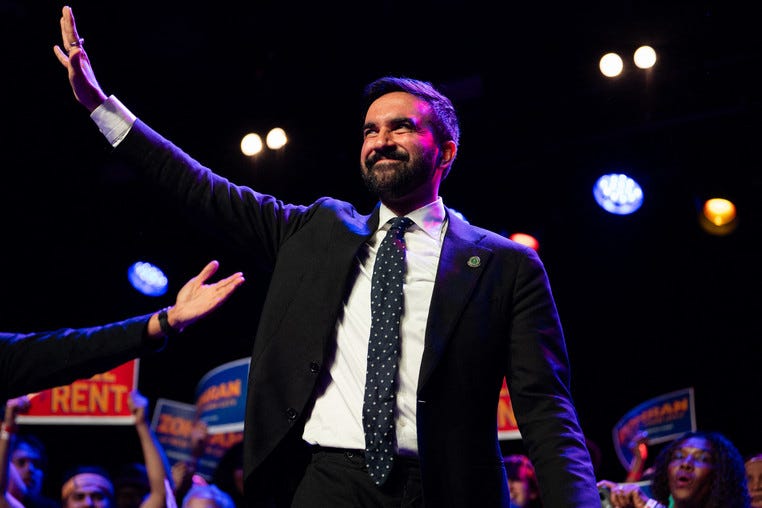
On Thursday night, June 18, at Kings Theater in Brooklyn, Zohran Mamdani walked to a microphone in a restored old palace of a room and described the forces arrayed against three congressional candidates he had spent months recruiting, funding, and mobilizing behind.
“The monsters that we are up against,” he said, “they take many different forms.”
Then he named AIPAC.
No one in that room needed the context explained. The room knew. For almost three years, the war in Gaza had shaped the political imagination of the New York left more fully than any issue since Vietnam, and maybe more fully than any issue of Mamdani’s political lifetime. It was there when he called Benjamin Netanyahu the architect of a genocidal war on the second anniversary of the October 7 Hamas attacks, mourning Israeli and Palestinian dead in the same breath and demanding that the killing stop. It was there when he said the Israeli military was taking the life of a Palestinian child every hour. It was there on January 1, his first day in office, when he revoked his predecessor’s executive orders protecting Israel from city divestment and expanding the definition of antisemitism.
It was also there in his pledge to honor the International Criminal Court’s arrest warrant for Netanyahu if the Israeli prime minister set foot in New York City. The war in Gaza was not subtext on the night of June 18. It was the text.
Five days later, all three of his candidates had won. The primary results were a verdict, not only on which candidates New Yorkers preferred in those districts, but on whether the political identity Mamdani had built around Gaza had electoral weight. It did. It had enormous weight.
To understand the Kings Theater rally, and the week it produced, you have to start two+ years earlier, in the hours after October 7, 2023, when Mamdani was still an assemblyman from Queens and the politics of the war had not yet hardened into their current shapes.
He was among the first elected officials in New York to call Israel’s response a genocide. He used the word deliberately, cited international law, and did not retract it. When Andrew Cuomo, his opponent in the mayoral primary, accused him of providing cover for Hamas, Mamdani answered with the line that came to define the campaign. He said occupation was a reference to international law and its violation, and that Cuomo had no regard for either after signing up to be Benjamin Netanyahu’s legal defense team during the genocide.
It was sharp, disciplined, and ruthless. It ended the debate. It also told New York’s political establishment what kind of mayor it was about to face.
What followed his inauguration was consistent with what he had promised. The executive orders went on day one. The divestment ban, gone. The expanded IHRA definition, gone. He kept the mayor’s office for combating antisemitism, a meaningful signal that he understood the distinction between opposing Israeli government policy and opposing Jewish people, but the policy direction was clear. AIPAC and its allies in the city’s pro-Israel institutional network had lost a mayor. The question, entering the summer of 2026, was whether they could take back the congressional seats.
They could not.
Brad Lander’s demolition of Dan Goldman in NY-10 was the cleanest test case. Both men are Jewish. Goldman had represented lower Manhattan and Brooklyn since 2022 and had been, by the standards of his district, a conventional moderate Democrat on Israel: supportive of the state, critical of specific Israeli actions, unwilling to use the word genocide or pledge to cut military aid.
Lander, the former city comptroller, had left the DSA after October 7 over the organization’s response to Hamas’s atrocities. He had called himself a progressive Zionist. He had still accused Israel of genocide in Gaza and pledged to deny further military aid. Goldman said during a debate, with visible frustration, that Israel was not the most important issue in the district. A 31-point margin on election night suggested the district disagreed.
In NY-13, the war was even more openly the organizing principle. Darializa Avila Chevalier had been a visible presence at the Columbia University protests in 2024, a record Mamdani treated not as a liability to be managed but as a credential. She ran against Adriano Espaillat, the five-term incumbent and chair of the Congressional Hispanic Caucus. Espaillat had the institutional machinery. She had the movement and the mayor. She won.
Mamdani arrived at Kings Theater having already done the strategic work. The endorsements were in. The organizing infrastructure was deployed. The votes were, in all likelihood, already cast or nearly so, since New York holds early voting for ten days before Election Day. What remained was to tell the crowd what it had done and why it mattered.
He framed it as a confrontation with monsters.
The word was not random. Mamdani later said he was invoking Antonio Gramsci, the Italian Marxist jailed by Mussolini, who wrote about living in an interregnum where the old is dying and the new cannot be born. The phrase Mamdani leaned on, “a time of monsters,” is a famous mistranslation rather than something Gramsci actually wrote. The correction spread quickly, as corrections do when a politician known for intellectual seriousness gives his opponents an easy handle.
But the philosophical error was secondary to the political allegation. Calling AIPAC’s leaders monsters, dark-money monsters in service of a genocide and a status quo of immorality, landed differently from his previous criticisms of the organization. His opponents on the right responded predictably. The New York Post editorialized. AIPAC issued a statement. Conservative media amplified the story. That noise was easy enough for Mamdani’s world to absorb.
What was harder to absorb was the response from Rabbi Jill Jacobs.
Jacobs is not a reflexive defender of AIPAC, and she is not a political enemy of the mayor. She is a figure of standing in the progressive Jewish community, the kind of ally whose criticism matters because it cannot be dismissed as bad faith. She warned that calling AIPAC and its backers monsters casts them as less than human rather than as human political opponents.
The formulation was precise. It was not an accusation of antisemitism. It was something more nuanced and, in some ways, harder to wave away: a warning from inside the coalition that dehumanizing language remains dehumanizing language, even when aimed at people whose politics you oppose.
On Monday at City Hall, Mamdani defended himself by broadening the frame. Monsters, he said, referred not specifically to AIPAC but to the entire architecture of dark money in American politics, to super PACs generally, to a political economy that forces working people to lower their expectations and aspirations. It was a retreat from the specific to the universal, delivered calmly enough that it did not look like a retreat. Whether it satisfied his critics inside the coalition is a different question, and one that will be answered in conversations without press releases.
The shape of the dissent matters more than its volume. The pushback came from progressive Jewish allies, not from institutional opponents. None of Mamdani’s three endorsed candidates distanced themselves from the monsters comment. The DSA apparatus held. The aligned labor unions held. The Working Families Party, which had backed Reynoso against Mamdani’s preferred candidate in NY-7 and watched him lose by 20 points, had little room to pile on.
The backlash was contained to a specific and important part of the coalition that made Mamdani’s election possible.
That is the part he cannot afford to lose. Mamdani won the mayoralty in part because he built a multiracial, multi-faith coalition that included thousands of Jewish New Yorkers who made a deliberate decision to support a Muslim democratic socialist who called Israel’s government genocidal. That decision required trust: trust that he would be precise, that he would maintain the distinction between opposing Israeli policy and opposing Jewish people, that he would hold the complexity of the moment with care.
Rabbi Jacobs and those who joined her critique were not declaring that trust broken. They were making clear that it is not unconditional.
Mamdani’s response suggests he heard the warning. His Monday press conference was substantively similar to the Thursday rally, but the register was different: cooler, more legalistic, less incendiary. He chose the language of political analysis over the language of combat. Whether that is a genuine recalibration or a situational adjustment will become clear only over time.
Mamdani knows how to play the game.
The election results were strong enough to make a political argument on their own.
Brad Lander is going to Washington. Claire Valdez is going to Washington, after defeating Brooklyn Borough President Antonio Reynoso with 58 percent of the vote despite Reynoso holding the Working Families Party endorsement. Darializa Avila Chevalier is going to Washington, after defeating the chair of the Congressional Hispanic Caucus in a Latino-majority district.
The precinct maps told the story plainly. Mamdani’s endorsed candidates ran best in the same geography where he had run best in 2025. His mayoral coalition had become transferable, at least under the right conditions.
What Mamdani has built across six months in office has no precise precedent in recent New York political history. His mayoralty functions as both a municipal government and an organizing headquarters for a movement that reaches beyond the five boroughs. He recruits candidates. He raises money. He deploys his donor list. He appears onstage with Bernie Sanders. He absorbs pressure from the WFP, congressional incumbents, the donor class, and the city’s political establishment, then keeps moving.
The Gaza war gave that movement its moral energy. Mamdani has said, in effect, that a status quo in which the United States funds what he calls a genocide, and in which AIPAC money disciplines members of Congress who might dissent, is not a status quo he is willing to accommodate from inside City Hall or outside it.
The three candidates he backed were chosen in part because they shared that position, and because they were running in districts where many voters had come to share it too.
The primary sweep does not resolve the tension the monsters speech exposed. It may have sharpened it.
There is a version of Mamdani’s mayoralty in which his position on Gaza becomes a source of both moral authority and political capital. In that version, his willingness to call genocide a genocide, pledge to honor international arrest warrants, and revoke pro-Israel executive orders on his first day in office becomes the animating core of a durable left coalition remaking New York City politics from the ground up. Tuesday’s results support that version.
There is also a version in which the rhetoric, once it slips away from precision, begins to cost him the allies who made the coalition possible. In that version, the word monsters, applied to an organization with a heavily Jewish membership and donor base, begins to function as Rabbi Jacobs warned it might: as a dehumanization that corrodes the cross-communal trust a mayor of New York City, governing the largest Jewish population outside Israel, cannot afford to lose.
Mamdani has, until now, navigated that tension with more skill than many of his critics expected. He condemned October 7 without equivocation, mourned Israeli dead alongside Palestinian dead, called for the hostages’ release, and refused to soften his language about what the Israeli military has done to Gaza since. That is a coherent moral position. It is also a politically demanding one. It requires constant attention to language, tone, and context.
The Kings Theater speech was a moment when that attention slipped. What made it significant is not that it will necessarily cause lasting damage. The coalition held. The candidates won. The week ended better than it began by almost any political measure. But it revealed the conditions under which the balance Mamdani has maintained could give way.
He has three and a half years left in his first term. The war in Gaza has not ended. Netanyahu has not been arrested. AIPAC has not been defunded. The three new members of Congress he helped elect will arrive in Washington carrying the movement’s expectations and their own ambitions.
The mayor will remain in City Hall, negotiating with Albany, fighting with Washington over transit, housing, and federal aid, and trying to convert a historic electoral mandate into something that outlasts the moment that created it.
The monsters, whatever name they go by, have not gone anywhere. Neither, it is now clear, has he.


