Howard Lutnick: The Man Pakistan Is Doing Business With
Pakistan’s New Washington Broker Is a Commerce Secretary Under Fire for Epstein Ties and Tariff Profiteering
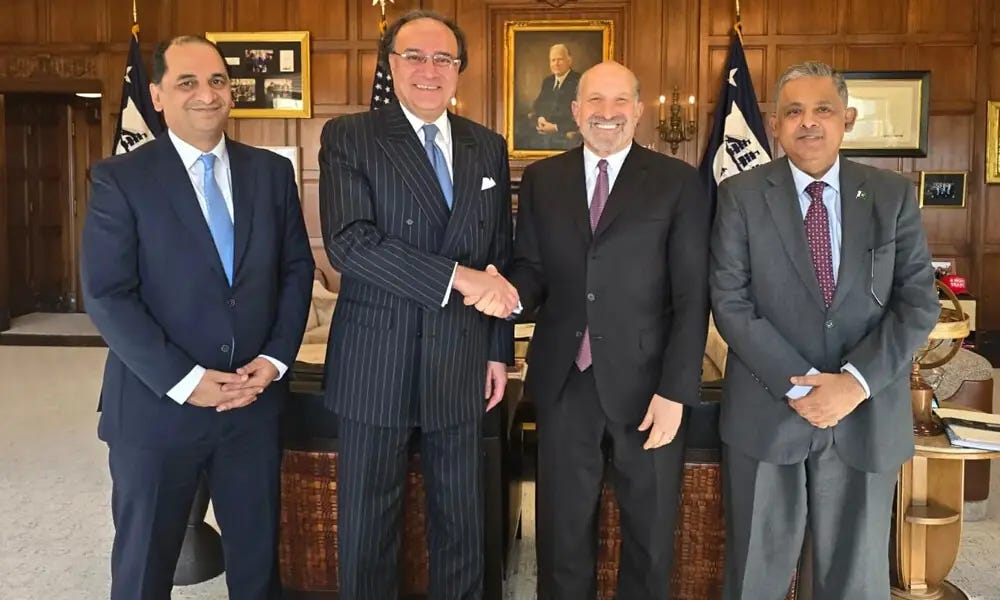
On the morning of February 21, 2026, Pakistan Finance Minister Muhammad Aurangzeb walked into a meeting at the United States Department of Commerce in Washington. The agenda, as reported by Dawn and DNA News, covered minerals cooperation, tariff relief, IMF leverage, and the framework for a bilateral trade forum. The discussions were framed in the familiar language of economic partnership: mutual benefit, strategic alignment, shared interests.
What those briefing notes almost certainly did not capture was the condition of either man in the room.
On one side sat Howard William Lutnick, 41st Secretary of Commerce of the United States, under bipartisan calls for his resignation, under formal Senate investigation for potential insider enrichment through trades executed by his family’s firm, and under congressional scrutiny for having misled the American public and Congress about a 13-year documented relationship with Jeffrey Epstein, the world’s most notorious convicted sex trafficker.
On the other sat Muhammad Aurangzeb, a Wharton-educated former banker who has never won a public election in his life. He was appointed to cabinet in March 2024 without holding a parliamentary seat, rushed into a Senate slot on a technocrat quota six weeks later, and represents a government whose electoral foundation remains formally disputed. The February 2024 elections that brought his government to power were contested not just domestically but internationally. The United States, United Kingdom, and European Union all raised formal concerns about their conduct. Results in key constituencies were reversed after hours of unexplained delays on election night. In an occurrence without precedent in Pakistan’s modern history, both the Commonwealth observer mission and the European Union observer mission declined to publish their official reports. A copy of the Commonwealth report, leaked to Drop Site News in September 2025, described systematic violations of fundamental political rights and concluded that cumulative government and judicial actions had “consistently limited one party’s ability to contest the election on a level playing field.”
Aurangzeb himself was not a product of any of this. He is a technocrat, placed in office by a government whose own arrival in power carries questions that no Pakistani court has resolved and no international body has formally cleared.
This is the bilateral relationship Pakistan and the United States are currently conducting. Two men at a table in Washington, neither with an uncomplicated claim to the mandate they are exercising.
The Man at the Table: Lutnick
To understand Howard Lutnick’s current position, you have to understand how he got there, because his biography is in almost every respect a preparation for the controversies now engulfing him.
He was born on July 14, 1961, in Jericho, a suburb on Long Island, New York, into a middle-class Jewish family. His father taught history at Queens College. His mother was an art teacher and painter. Both died before he finished college. His mother died of lymphoma when he was 16. His father died from an accidental overdose of chemotherapy drugs during Lutnick’s freshman year at Haverford College. The college’s president called him shortly after his father’s death and offered him a full scholarship. He graduated with an economics degree in 1983 and walked directly into a job at Cantor Fitzgerald, the Wall Street bond-trading firm founded by Bernie Cantor.
He was 29 when he became its President and CEO. Even by the compressed, hungry standards of 1980s Wall Street, that was fast. When his mentor Cantor began declining in the mid-1990s, Lutnick moved to secure control of the firm, filing suit against the Cantor family in a Delaware court and arguing that Bernie Cantor lacked “sufficient mental capacity” to understand his own legal documents. The settlement gave Lutnick management control. He was appointed chairman after Cantor’s death in 1996. On Wall Street, that sequence was noted.
Then came September 11, 2001.
Lutnick was not in the office that morning because he had taken his five-year-old son Kyle to his first day of kindergarten. Cantor Fitzgerald was headquartered on floors 101 to 105 of the North Tower of the World Trade Center, directly above where American Airlines Flight 11 struck the building. Every employee who reported for work that morning died. Of 960 New York-based employees, 658 were killed. Among them was Lutnick’s younger brother Gary, and his closest friend. In the days that followed, Lutnick appeared on national television weeping openly, describing his effort to search hospitals for survivors. He became, briefly, the most recognizable face of corporate grief in America.
The aftermath was complicated, as Lutnick’s story tends to be. Within days of the attack, he stopped paychecks to the families of the deceased. He said the move was necessary to ensure the firm’s survival. It triggered a furious backlash from grieving families. He subsequently reversed course, authorizing $45 million in bonuses to victims’ families and establishing the Cantor Fitzgerald Relief Fund, which ultimately distributed $180 million. He rebuilt the firm from near-obliteration into a global financial services operation with more than 14,000 employees. He was named the Financial Times’ Person of the Year for 2001.
He is, in other words, a man whose public identity rests on survival, resilience, and loyalty to the dead. That identity is now being interrogated alongside a different set of questions about what, exactly, he did with the next two decades.
Thirteen Years With Jeffrey Epstein
The core problem for Lutnick is not that his name appeared in the Epstein files. Many names appeared. The problem is what he said before those files were released, and how completely the documentary record contradicts it.
In an October 2025 interview on the New York Post podcast “Pod Force One,” Lutnick described a 2005 visit to Epstein’s Manhattan townhouse, which shared a wall with his own on East 71st Street on the Upper East Side. Epstein gave him a tour. One room had a massage table in the center surrounded by candles. Lutnick asked about it. Epstein responded with what Lutnick described as sexual innuendo. Lutnick said he and his wife left immediately. “And in the six to eight steps it takes to get from his house to my house,” he told the podcast, “my wife and I decided that I will never be in the room with that disgusting person ever again.”
He said it with the assurance of a man using the story as a credential. It was intended to establish that his moral instincts had functioned correctly, that he had seen Epstein for what he was and walked away. The story was meant to close the question.
When the Justice Department released the Epstein files in early 2026, the question reopened.
The documentary record that emerged spans 13 years of contact after 2005. Every year of that period falls after Lutnick’s claimed break, and most of it falls after Epstein’s 2008 conviction for soliciting prostitution of a minor, after he had registered as a sex offender in the state of Florida.
In May 2011, documents show the two men met for drinks. In December 2012, Lutnick coordinated through Epstein’s assistant to arrange a visit to Little Saint James, Epstein’s private island in the U.S. Virgin Islands, bringing his wife, four children, nannies, and another couple with their children. The visit was confirmed in Lutnick’s own Senate testimony. In 2013, the two men co-invested together in AdFin Solutions, a now-defunct advertising technology company, according to a CNN review of the released documents. In 2015, Lutnick invited Epstein to an intimate fundraising event for Hillary Clinton’s presidential campaign. In 2017, Epstein donated $50,000 to a charity dinner held in Lutnick’s honour. In 2018, a full decade after Epstein’s conviction and one year before his death in federal custody, the two were still exchanging emails. The last correspondence was prompted by a proposed construction project near their adjacent townhouses that Lutnick thought might block their park views.
“Are you aware as to them building to block our park views,” Lutnick wrote to Epstein’s assistant in May 2018. “What should we do about it? Time is of the essence.”
This is the texture of the relationship the files document: business ventures, charity donations, island visits with family in tow, and neighbourly emails about real estate grievances. Not the behaviour of a man who had walked away in disgust.
Lutnick appeared before the Senate Appropriations Subcommittee on February 10, 2026. He acknowledged the island visit and told lawmakers: “We had lunch on the island, that is true, for an hour, and we left with all of my children, with my nannies and my wife, all together.” He claimed that beyond 2005 he could recall meeting Epstein “two other times” over 14 years. “I did not have any relationship with him. I barely had anything to do with that person,” he told the subcommittee.
Senator Chris Van Hollen of Maryland, the subcommittee’s ranking Democrat, told him directly: “You led people to believe that you had severed all ties with Jeffrey Epstein after the 2005 encounter. The Epstein files indicate a significantly different record.” Senator Jeff Merkley of Oregon catalogued the contradiction explicitly: “Last year, you said you had cut off all contact, but there are eight incidences of interaction in the files after 2005.” Senator Roger Wicker, a Republican from Mississippi, said the island visit “would raise questions.” Senator John Kennedy of Louisiana, also a Republican, advised Lutnick to call a press conference and tell everything. Republican Representative Thomas Massie of Kentucky, co-author of the law that compelled the release of the Epstein files, called for Lutnick’s resignation that same week. “He should just resign,” Massie said on CNN’s Inside Politics. “Howard Lutnick clearly went to the island if we believe what’s in these files; he was in business with Jeffrey Epstein, and this was many years after Jeffrey Epstein was convicted.”
The White House has stood by him throughout. “President Trump maintains complete confidence in Secretary Lutnick,” press secretary Karoline Leavitt said following the testimony.
Lutnick has not been accused of any criminal wrongdoing in connection with Epstein. The central issue, as Van Hollen framed it, is not what Lutnick did on the island. It is that he misrepresented the extent of a documented, decade-long, post-conviction relationship with a convicted sex offender, and did so publicly, emphatically, and on the record.
Playing Both Sides on Tariffs
The second front of Lutnick’s problems runs through the family firm he left behind.
As Commerce Secretary, Lutnick positioned himself as the most aggressive tariff hawk in the Trump Cabinet. He championed the administration’s sweeping import duties publicly and forcefully, defending them against internal criticism from Treasury Secretary Scott Bessent and National Economic Council chair Kevin Hassett, and framing the tariffs as essential to correcting a $1.2 trillion annual trade deficit.
Behind those public statements, a different calculation was apparently being made.
In July 2025, Wired magazine reported that Cantor Fitzgerald, the firm Lutnick ran for more than 30 years before handing it to his sons Brandon and Kyle upon his Senate confirmation, had been allowing its traders to purchase the rights to tariff refunds from U.S. companies at 20 to 30 cents on the dollar. A letter obtained by the magazine from a Cantor representative stated the firm had capacity to trade “several hundred million” dollars in such refund rights, with plans to expand. The trade was a structured bet: Cantor acquired companies’ potential refund claims at a steep discount, wagering that the tariffs would eventually be struck down in court and that the full refund value would be paid out, delivering returns of three to five times the original outlay.
The commerce secretary was publicly championing the tariffs. His sons’ firm was financially betting they would fail.
Democratic Senators Ron Wyden of Oregon and Elizabeth Warren of Massachusetts launched a formal investigation in August 2025, writing to Cantor Fitzgerald that its reported trading “raises obvious conflict-of-interest and insider dealing concerns” given Lutnick’s role as one of the architects of the tariff policy. Duke University law professor Tim Meyer assessed the situation for Wired in plain terms: “It’s quite interesting that the commerce secretary’s firm is the one that is betting the tariffs will be struck down. That strikes me as very interesting, and quite telling about what those with connections to the administration think about the merits of the tariffs.”
On February 20, 2026, the day before Aurangzeb flew into Washington, the United States Supreme Court ruled 6-3 to strike down most of Trump’s tariffs imposed under the International Emergency Economic Powers Act. Chief Justice John Roberts wrote that Trump’s invocation of emergency powers to impose tariffs without congressional approval exceeded the statute’s authority and overrode decades of precedent. Cantor Fitzgerald’s positions in tariff refund rights moved immediately from speculative to potentially very valuable.
Cantor Fitzgerald issued a flat denial. “Following today’s Supreme Court ruling, we want to reiterate that Cantor Fitzgerald has never executed any transactions or taken risk on the legality of tariffs. Any report suggesting otherwise is completely false,” a spokesperson said. Lutnick himself has not commented publicly on the ruling or on his family firm’s reported positions.
What is documented and on the record is this: while Lutnick was designing and defending the tariff architecture from inside the Cabinet, his firm, under the leadership of his sons, was reported by Wired to have structured a product whose financial success depended on the courts dismantling exactly that architecture. The Senate investigation is ongoing.
The Other Side of the Table: Aurangzeb and the Government He Serves
Muhammad Aurangzeb’s biography reads as a study in elite institutional access. He attended Aitchison College in Lahore. He took his undergraduate degree and MBA at the Wharton School of the University of Pennsylvania. He built a career across Citibank, ABN AMRO, RBS, and JPMorgan, rising to run JPMorgan’s Global Corporate Bank for the Asia-Pacific region before returning to Pakistan in 2018 to lead Habib Bank Limited, the country’s largest commercial lender. By 2024 he was one of the five highest-paid bank CEOs in Pakistan, earning the equivalent of approximately $1 million annually.
He is, by any measure, a competent technocrat. What he is not is a politician, and what the government he serves is not is a straightforwardly elected one.
Aurangzeb was inducted into Prime Minister Shehbaz Sharif’s cabinet on March 11, 2024, without holding a seat in either house of parliament. Pakistan’s constitution requires unelected cabinet members to attain parliamentary status within six months or vacate their post. He was accordingly elected to the Senate on April 2, 2024, on a technocrat quota from Punjab, a process that involves selection by provincial assembly members rather than direct public vote. He has never faced a Pakistani voter. His mandate flows from appointment, not election.
The government he serves arrived in office through elections held on February 8, 2024, whose integrity was challenged almost immediately after the polls closed. On election night, early television broadcasts showed opposition-aligned candidates leading in a significant number of National Assembly seats. Results then stopped coming in for hours without explanation. When they resumed, the leads had reversed in constituency after constituency in favour of the military-backed coalition. The Election Commission of Pakistan did not release the final results for more than 48 hours after polling ended.
The international response was pointed. The United States called for any claims of interference or fraud to be fully investigated. The United Kingdom raised concerns about the exclusion of parties and candidates through legal processes. The European Union expressed concerns about freedom of expression and the conduct of the electoral environment. The Brookings Institution noted that Pakistan had been downgraded to an authoritarian regime for 2023 by the Economist Intelligence Unit, and described the incoming coalition government as likely to “function as a junior partner to the military.”
Most telling was what the observer missions did not produce. The Commonwealth of Nations sent a 13-member Elections Observer Group led by former Nigerian President Goodluck Jonathan. The European Union sent a separate expert mission. In the entire modern history of international observation of Pakistani elections, both bodies have always published their findings. After the February 2024 vote, neither did. In September 2025, Drop Site News obtained and published the leaked Commonwealth report. It was critical. It described how government and judicial decisions had violated fundamental political rights and “consistently limited one party’s ability to contest the election on a level playing field.” It noted that these limitations were “felt most acutely” by one particular formation. The EU report has still not surfaced.
What this means in practical terms is that Aurangzeb sits in Washington as the finance minister of a government that has not been cleared by the international bodies mandated to assess whether it was properly elected. He is negotiating trade frameworks, minerals access, and IMF positioning on behalf of an administration whose democratic credentials remain, formally and factually, unresolved.
What Pakistan Walked Into
Aurangzeb’s February 21 visit was substantive in its ambitions. Pakistan is pursuing relief on existing tariff classifications, a framework for minerals cooperation that would give U.S. investors preferential access to Pakistani deposits, and continued American support at the IMF during an ongoing debt stabilisation programme. The bilateral trade forum discussed would institutionalise the relationship at a governmental level. These are not minor agenda items. For a country carrying more than $130 billion in external debt and reliant on IMF tranches to maintain dollar liquidity, access to the U.S. Commerce Secretary is a meaningful card.
The question is what that access is actually worth when the man providing it is simultaneously fighting for his political survival on multiple fronts.
Any trade arrangement, minerals framework, or tariff concession negotiated through Lutnick’s office now carries embedded legal and political risk. If Lutnick resigns or is removed, a possibility that bipartisan lawmakers including members of his own party have placed squarely on the table, the institutional continuity of whatever is agreed becomes uncertain. If the Senate investigations into Cantor Fitzgerald’s tariff trades produce findings of insider dealing, the credibility of Lutnick’s tariff-related decisions, including any concessions offered to Pakistan, will be retroactively scrutinised. If congressional pressure forces greater disclosure of his Epstein-related communications, the political environment around him becomes more volatile, not less.
There is also a more structural question about what Islamabad read in the timing. Aurangzeb’s Washington visit came on February 21, the day after the Supreme Court ruling that benefited Cantor Fitzgerald, and eleven days after Lutnick’s Senate testimony on Epstein. Pakistani officials are not naive about American political weather. The timing suggests either that Islamabad was unaware of the storm gathering around its interlocutor, or that it was acutely aware and calculated that a distracted, embattled Commerce Secretary might be a more flexible one.
Neither reading is particularly comfortable for Islamabad to be associated with publicly. The first suggests poor intelligence about the partner. The second suggests opportunism of a kind that would not play well if reported in Washington, where Lutnick’s opponents are already looking for ammunition.
The Deeper Pattern
What makes this worth examining beyond the immediate diplomatic transaction is the structural picture it presents.
On one side of the table: an American Cabinet secretary operating under Senate investigation, under bipartisan calls for his resignation, and under scrutiny for having misled Congress. His family firm made financial bets against the policy he was publicly championing. His relationship with a convicted sex trafficker spans 13 documented years of contact he denied until the documentary record made denial impossible.
On the other side: a technocrat finance minister, never elected by a Pakistani voter, representing a government that arrived in office through elections that the United States, United Kingdom, European Union, and two independent observer missions all treated with documented scepticism. The observer reports that might have settled the question were never released. The leaked copy of one of them raised serious concerns.
The deals being discussed between these two men, minerals access, tariff frameworks, IMF positioning, will have consequences for Pakistani citizens who had no meaningful say in selecting either of them. That is not an incidental detail. It is the context in which all of it must be read.
Pakistan needed a meeting in Washington. It got one. Whether it got a durable interlocutor, or a legitimate government to bring the results home to, are separate questions entirely, ones that events in the coming months will answer whether Islamabad is prepared for them or not.


