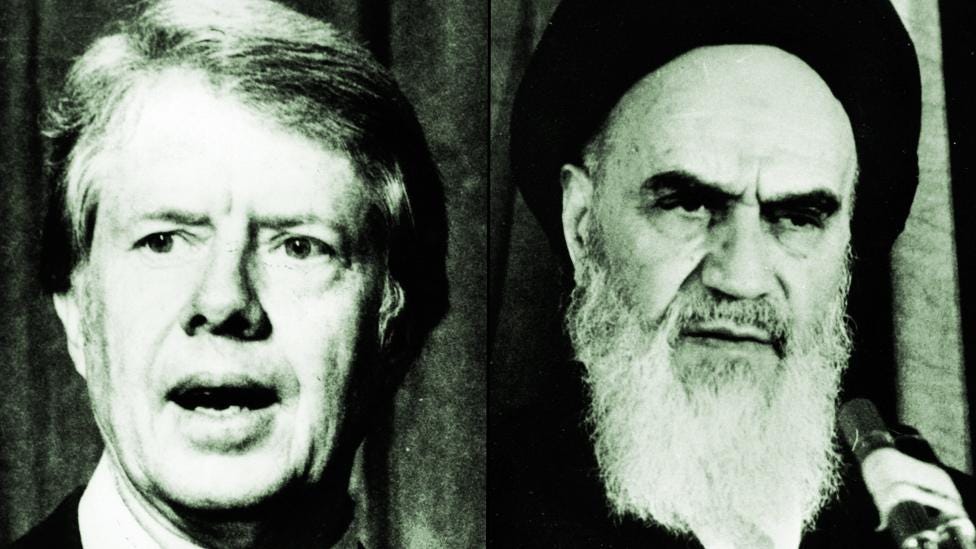
If We Cannot Have Iran ...
... How Washington Chose the Ayatollah Over the Soviets
In October 1978, a 76-year-old cleric settled into a rented villa in Neauphle-le-Château, a quiet commune twenty-five miles west of Paris, surrounded by fruit trees and the daily presence of two hundred journalists. Saddam Hussein had expelled him from Najaf under pressure from the Shah. France admitted him because, as the Elysée would later explain, it was better to have him in France than Iraq or Libya. This explanation carried a logic that extended far beyond French hospitality. Khomeini’s address in the Parisian suburbs was one of the most consequential pieces of real estate in Cold War geopolitics, and the French knew it.
The Iranian Revolution was not a clerical uprising with leftists attached to its margins. It was a broad coalition in which the left carried substantial organizational weight. The Tudeh Party, Moscow’s most disciplined asset in Iranian politics, had been suppressed but not destroyed. The Fedayeen-e Khalq, a Marxist-Leninist urban guerrilla organization, had provided much of the armed muscle that delivered the Shah’s regime its final military collapse in February 1979. The Mojahedin-e Khalq, an Islamist-Marxist hybrid, held significant student support. Secular leftists, nationalist intellectuals, trade unionists, and radical clergy aligned with figures like Ayatollah Taleghani had all built toward the same moment for fifteen years. The revolution was not Khomeini’s alone. It was a convergence, and the question of whose flag flew afterward remained open until the very last week.
Moscow’s strategists understood this. Soviet Radio had been broadcasting anti-Shah programming into Iran throughout 1978. Soviet purchases of Iranian currency on European markets were documented by American intelligence that winter. The Soviets held Article 6 of the 1921 treaty with Iran, which authorized the entry of Soviet troops should Iran become a base for foreign aggression, and Moscow invoked it publicly as a warning. The KGB assessed that the CIA was backing elements within the opposition, a reasonable suspicion in the year after the Saur Revolution brought a pro-Soviet government to power in neighboring Afghanistan.
Zbigniew Brzezinski had a name for what he saw coming. In late 1978, the National Security Adviser coined the phrase “arc of crisis” to describe the band of nations stretching along the Indian Ocean’s northern rim, from the Horn of Africa through South Yemen, Afghanistan, and Iran, which he described as fragile structures whose collapse could be filled by elements hostile to Western interests and sympathetic to Soviet adversaries. The center of that arc, in every geographic and strategic sense, was Iran. It shared a 2,000-kilometer border with the Soviet Union. It controlled the Strait of Hormuz. It held the fourth-largest proven oil reserves on earth. In a December 1978 memo to Carter, Brzezinski wrote that the disintegration of Iran would be the most significant American defeat since the beginning of the Cold War, surpassing Vietnam in its real consequences. The Shah had already ceded Afghanistan, Ethiopia, and South Yemen to the Soviet column. Iran occupied a different category entirely.
The Shah’s secular nationalism, as it turned out, was no barrier to Soviet expansion; his regime’s own contradictions had produced the revolution. The question facing Washington by December 1978 was not how to preserve the monarchy but how to shape what came after it, and specifically how to ensure that what came after it was not a leftist coalition with Soviet affinities.
Khomeini was, by doctrine and temperament, an anti-communist. He had spent years in Najaf developing the concept of Velayat-e Faqih, the doctrine of clerical guardianship of the state, which was explicitly designed to prevent any secular political organization, including Marxist parties, from capturing the revolution’s institutional machinery. His theology made the Tudeh’s alliance with him tactically suicidal from the outset, a fact the Soviets only partially grasped. The Tudeh’s Moscow-aligned leadership believed Khomeini would serve as a transitional figure: anti-imperialist enough to weaken American influence, politically unstable enough to require leftist technocratic support, and ultimately bound to give way to the forces of historical materialism. This assessment would cost the party everything within four years.
Washington, however tentatively, read the situation more clearly. The question US planners were asking was not whether Khomeini would be a friend to American interests. Sullivan’s November cable had already answered that: he would not be. The question was whether a Khomeini-led Iran posed a strategic threat comparable to a pro-Soviet Iran. On that calculation the answer was substantially no. A theocratic nationalist government would expel American military advisors, nationalize assets, and maintain permanent hostility toward Washington. It would also be categorically hostile to Moscow, expel Soviet diplomats, ban the Tudeh, and eventually execute its own left. What Washington was doing, at the level of Cold War architecture, was evaluating whether it preferred Iranian hostility or Soviet adjacency. The answer shaped everything that followed.
On January 4, 1979, Jimmy Carter flew to the French Caribbean island of Guadeloupe, where he met with French President Valéry Giscard d’Estaing, British Prime Minister James Callaghan, and West German Chancellor Helmut Schmidt. The formal agenda was nuclear arms negotiations, SALT II, and the Soviet military buildup. Iran occupied what Callaghan would later describe, in his parliamentary statement, as shorter-term foreign policy issues, a phrase that compressed an immense decision into the language of competent administration.
Carter’s own notes from the discussions record that he found very little support among the other three for the Shah. Helmut Schmidt had, by his own account, long known that the Shah’s megalomania would bring him down. Giscard, who had been sheltering Khomeini in France for three months, defended that decision explicitly: it was better to keep him in France, where he could be monitored and managed, than to let him reach Iraq, Libya, or some other platform from which he might do more damage to the West’s position than he was already doing. The logic of management had already become the logic of facilitation, and Giscard, whatever his other calculations, understood the difference.
On January 7, the summit ended. On January 11, Carter called the Shah and advised him to leave promptly. Five days later, Mohammad Reza Pahlavi flew out of Tehran in what his valet had already packed for, a trip of undetermined duration. The valet had prepared enough clothes for a long absence. He had understood something his employer could not bring himself to state.
The same day Carter called the Shah, the administration dispatched General Robert Huyser to Tehran. Huyser was the deputy commander of the US European Command, a man who had developed personal relationships with the senior leadership of the Iranian armed forces across multiple visits to the country. He remained in Tehran for thirty-one days.
The official version of his mission was to stabilize the Iranian military, prevent the generals from mounting a coup against the civilian transitional government of Shapour Bakhtiar, and keep the armed forces intact as an institution through the transition. This version was Carter’s version, Huyser’s version, and the version the State Department has maintained across every declassified document that has emerged since. The Shah’s supporters and a significant portion of Iranian public memory hold a different version, documented in numerous participant accounts: that Huyser was sent to neutralize the military, to hold the generals at their posts and prevent them from moving against the revolution, effectively clearing the field for Khomeini’s return.
The declassified cables do not fully resolve this dispute. They do establish that Huyser was tasked with preventing a military coup as a first-order priority. He met repeatedly with the senior generals and conveyed, in direct terms, that the United States would not endorse military action outside the Bakhtiar framework. He also established formal meetings between those generals and Mohammad Beheshti, Khomeini’s deputy and organizational architect, who was simultaneously building the institutional infrastructure that would shortly replace everything the generals commanded. Whether Huyser understood the full implication of that double role is one of the questions his 1987 memoir does not resolve.
Huyser departed Tehran on February 3, 1979. Two days later, Khomeini’s Air France flight from Paris landed at Mehrabad Airport. A crowd estimated at several million came to meet him. The military, whose senior commanders had spent a month meeting with both Huyser and Beheshti in separate rooms, declared neutrality on February 11. Bakhtiar’s government fell the same afternoon, and the thirty-seven-year reign of the Pahlavi dynasty closed without a shot fired in its defense by the armed forces Washington had spent fourteen billion dollars equipping between 1972 and 1978.
While Huyser managed the generals, a parallel channel was operating in the Parisian suburbs. On January 15, 1979, Warren Zimmermann, a political secretary at the US Embassy in Paris, met Ebrahim Yazdi, an Iranian-American physician who served as Khomeini’s chief of staff in France. Zimmermann met Yazdi two more times before January 18. Through those meetings, Washington signaled to Khomeini’s team that American advisors in Tehran would have no fundamental objection to a constitutional process that abolished the monarchy and moved toward a republic. This was not neutral observation. It was clearance, delivered through a channel that both sides could subsequently describe as informal.
On January 27, Khomeini sent Carter a direct message. The text, now declassified, contains three commitments placed in careful sequence: we are not in any particular animosity with the Americans; there should be no fear about oil; you should recommend to the army not to follow Bakhtiar. The guarantee on oil addressed Washington’s most concrete material interest. The instruction regarding the army addressed its most operative strategic concern. Carter’s administration did not formally accept the proposal. It did not refuse it either.
Theodore Eliot, another US emissary, met separately with Yazdi and passed Washington’s assessment that the military would not fundamentally oppose the transformation. Sadegh Ghotbzadeh, a Khomeini confidant who would later be executed by the revolutionary government he helped build, personally faxed a message of thanks to the four Guadeloupe leaders during the summit itself, which the French diplomatic advisor Bernard Bonnet read aloud to the assembled heads of state. Khomeini’s movement was conducting parallel diplomacy with the Western powers whose removal it was publicly promising, and those powers were receiving the messages and continuing their work.
The Soviet Union watched the Iranian revolutionary coalition with cautious optimism. The Tudeh leadership’s new first secretary, Noureddin Kianouri, was elected on January 15, 1979, the same day Zimmermann was meeting Yazdi in Paris. Kianouri had arrived from Moscow the day before the election. The Soviets transferred 15,000 rubles to the Tudeh for party operations that month. Their theory, elaborated by Deputy Director of the CPSU International Department Rostislav Ulianovskii, held that Khomeini represented a transitional phase in a non-capitalist path of development: the Islamic government would prove ungovernable and collapse within months, and the organized left, embedded in the state apparatus, would inherit the revolution when the clerics failed.
The Soviets had mistaken Khomeini’s tactical flexibility for structural weakness. The Ayatollah had spent fifteen years in Najaf developing a theory of state precisely because he intended to operate one. The clerics did not need the Tudeh’s administrative competence or the Fedayeen’s armed cadres. They had built their own parallel institutions during the revolution: the Revolutionary Committees that numbered fifteen hundred in Tehran alone by the time the monarchy fell, the Revolutionary Guard established by May 1979 as a deliberate counterweight to the army and to every armed leftist organization simultaneously, and the Islamic Republican Party that systematically outmaneuvered secular and leftist opponents in every constitutional body it entered.
The Tudeh, committed to supporting Khomeini as the anti-imperialist phase of a two-stage revolution, suppressed its own members’ objections, condemned other leftists as counter-revolutionary agents of imperialism, and endorsed the Revolutionary Guard’s disarmament of leftist organizations. In return, the Islamic Republic tolerated Tudeh’s presence for three years. In 1982, the government closed the Tudeh newspaper. In 1983, the senior leadership was arrested, and Kianouri appeared on national television confessing to espionage for the Soviet Union. Eighteen Soviet diplomats were expelled from Tehran for what Khomeini personally praised as the suppression of interference. The OIPFG leadership subsequently asked Gorbachev for a hundred million dollars to fund an uprising against the government they had helped bring to power. Gorbachev did not provide it. Moscow had spent forty years cultivating the Iranian left, and the Islamic Republic had dismantled it in less than four.
The outcome was not what Washington intended, but it was close to what Washington needed. A theocratic Iranian state proved viscerally anti-American in ways that produced four decades of direct conflict: the hostage crisis of November 1979, the arms embargo, the proxy wars in Lebanon and the Gulf, and the entire structure of enmity that has never resolved. Carter’s administration did not foresee the hostage taking. It did not foresee the speed with which Khomeini would dismantle the secular and leftist coalition that had carried the revolution to the threshold, because American intelligence knew almost nothing about Khomeini’s internal organizational capacity and even less about the clerical networks that would become the Islamic Republican Party.
Brzezinski’s arc of crisis doctrine had, by its own logic, been served. He had theorized that an Islamic anti-communist movement could function as a barrier to Soviet expansion along the Indian Ocean rim. In Afghanistan, he would pursue this theory deliberately, arming the mujahideen to bleed Soviet forces in a grinding occupation. In Iran, the outcome arrived without the kind of design that leaves a paper trail: France had housed the instrument, Washington had cleared the military, the generals had held their positions, and the left had been handed to Khomeini as a coalition partner. Khomeini destroyed it on a schedule that suited no one’s theory but his own.
There is a sentence that does not appear in the official record of this period: if we cannot have Iran, the Soviets cannot either. No declassified cable contains it. No memoir reproduces it. It appears nowhere in the National Security Archive’s collection of Huyser documents, nowhere in Carter’s published notes from Guadeloupe, nowhere in Sullivan’s cables or Brzezinski’s memos. What appears instead is the accumulated consequence of decisions that follow that logic precisely: the decision not to support a coup, the decision to send Huyser to hold the generals neutral rather than activate them, the decision to open the Zimmermann channel to Khomeini’s team, the decision at Guadeloupe to accept the Shah’s departure as settled, the decision to allow Giscard’s experiment in Neauphle-le-Château to run its course.
Policies do not require explicit formulation to have coherent architecture. The architecture here is visible in what did not happen. The military did not move. The Bakhtiar government fell without American intervention. The Zimmermann channel guaranteed Khomeini a safe approach while the Huyser channel signaled the military against resistance. The Guadeloupe leaders ratified the Shah’s removal two weeks before it occurred. What follows from these decisions, in sequence, is a theocratic government that spent its first three years eliminating everything the Soviets had invested in for forty years inside Iran.
The French president called his logic a matter of geography: better in France than somewhere worse. The Carter administration called its logic managed transition, which meant accepting an outcome it could not control while blocking the outcome it most feared. The Soviets called their theory non-capitalist path of development, and it held until 1982, when the Islamic Republic began arresting the leadership of the party that had believed it. In 1983, Kianouri confessed on state television. Eighteen Soviet diplomats were put on the next plane out of Tehran. Khomeini praised the expulsion by name, called it the suppression of interference, and the arc of crisis closed in Iran from exactly the direction Brzezinski had theorized and Washington had never quite dared to plan.


