

A week in which a four-year-old secret became a document, a ceasefire became a pressure cooker, and a presidential visit to China produced ceremony with a great deal less substance behind it
The Cipher Was Real

What the cable documents is a luncheon meeting between Asad Majeed Khan and Donald Lu, then the US Assistant Secretary of State for South and Central Asian Affairs. What Lu told the ambassador that afternoon was transmitted back to Islamabad as a classified diplomatic report. What followed, within weeks, was the no-confidence vote that removed Prime Minister Imran Khan from power in April 2022.
The Drop Site investigation, written by Waqas Ahmed, Murtaza Hussain, and Ryan Grim and based on leaked documents alongside interviews with former civilian and military officials, does not confine itself to the cipher alone. It traces the entire arc of the US-Pakistan relationship across five years: from the CIA director William J. Burns flying to Islamabad in June 2021 and waiting a full day before being told by phone that Khan would not see him, to the Field Marshal Asim Munir now described by Donald Trump as “my favorite Field Marshal.” The distance between those two points is the story.
Burns had come to Pakistan seeking territory for US drone bases to be used against targets in Afghanistan after the planned American withdrawal. He left with neither the bases nor the meeting. Khan had already told Axios co-founder Jonathan Swan, in plain language: “Absolutely not. There is no way we are going to allow any bases, any sort of action from Pakistani territory into Afghanistan.” Kabul fell to the Taliban weeks later. The US evacuation became a political catastrophe for the Biden administration. The rupture between Washington and Islamabad hardened.
What the cipher documents, in the reconstruction offered by Drop Site, is the next phase of that rupture. By early 2022, US officials had communicated to Pakistani interlocutors that “all would be forgiven” if Khan were removed. The cable records the specifics of that communication in classified diplomatic language. Drop Site released the document so that, in their words, “it becomes part of the public historical record.”
The political consequences inside Pakistan were immediate. Supporters of Khan, still imprisoned following multiple convictions that his Pakistan Tehreek-e-Insaf party describes as politically motivated, called the publication a vindication. What cannot be disputed by anyone reading the subsequent record is what followed Khan’s removal: under the military-backed government that replaced him, Islamabad reversed course on nearly every position Khan had held. Pakistan became a quiet supplier of artillery to Ukraine. It signed a mutual defence pact with Saudi Arabia that Khan had refused. The China-Pakistan Economic Corridor’s second phase stalled. Washington got everything it had wanted and could not extract while Khan governed.
Drop Site’s companion investigation includes a disclosure that Trump privately urged Asim Munir to “resolve” Khan’s detention during discussions last year. It also documents the irony embedded in the present moment: the same generals who engineered Khan’s removal to repair ties with Washington are now basking in international praise for mediating between the US and Iran, a role that required precisely the kind of independent regional positioning Khan was removed for attempting.
Drop Site also published an important caveat about the cipher’s provenance. The redactions next to the addressee list, as the outlet noted in a separate post, point both to the source of the leak and to who was not its source: the copy released by Drop Site did not originate from the prime minister’s office. The question of where it came from, and who held it for four years, is one the investigation has not yet fully answered.
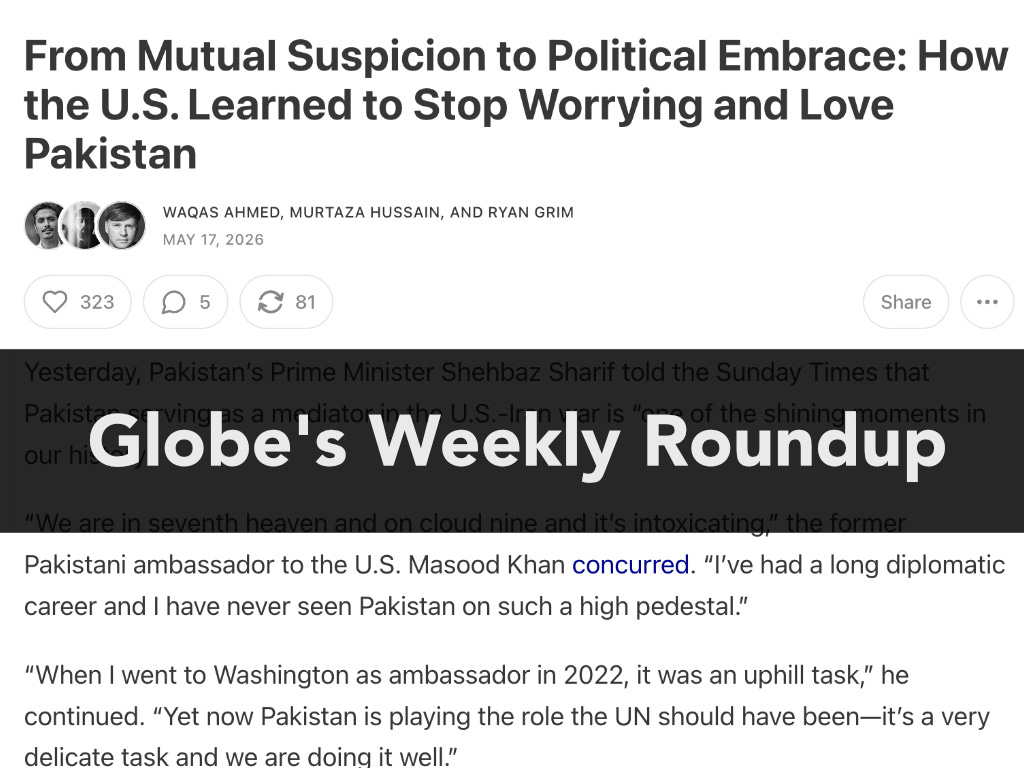
The cipher’s release arrived on the same day that Pakistan’s Prime Minister Shehbaz Sharif told the Sunday Times that the country’s role as mediator in the US-Iran war is “one of the shining moments in our history.” Former Pakistani ambassador to the United States Masood Khan told the same paper: “I’ve had a long diplomatic career and I have never seen Pakistan on such a high pedestal.” The collision of those two narratives, the diplomatic triumph and the documentary exposure of the mechanism that produced it, defined the week more precisely than any other single development.
