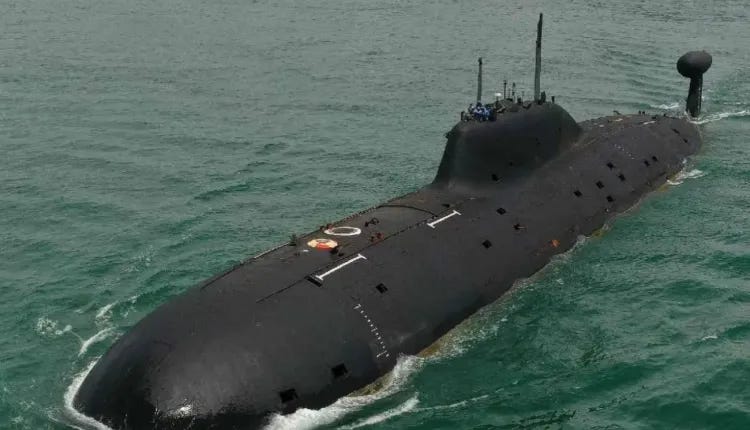
India’s Undersea Nuclear Turn Is a Warning to China and Pakistan
The most important strategic development in South Asia this month did not come wrapped in ceremony. It came in the quiet language of posture, in the movement from stored capability to deployed capability, from the political reassurance of doctrine to the military reality of survivable force. India’s reported decision to operationalize nuclear warheads at sea marks that transition. It deserves to be read soberly in Beijing and even more urgently in Islamabad, not because India has become unstoppable, and not because its naval nuclear force is fully mature, but because a threshold has been crossed that alters the structure of deterrence in Asia. A state that can hide part of its nuclear force beneath the water acquires a different kind of confidence. Its adversaries inherit a different kind of risk.
For too long, much of the regional commentary on India’s nuclear development has remained trapped in the shallow vocabulary of prestige, symbolism, and nationalist scorekeeping. That language misses the mechanism. A ballistic missile submarine is not important because it flatters a state’s self-image. It is important because it changes the time horizon of war planning. Land-based missiles can be mapped, watched, and, in theory, targeted. Aircraft are visible, vulnerable, and dependent on bases that can be identified before the first hour of conflict begins. A submarine carrying nuclear weapons changes the problem because it carries retaliation into concealment. The enemy no longer has to ask whether a strike can damage the arsenal. It has to ask whether enough of the arsenal can ever be found.
India’s sea-based deterrent was once discussed in the future tense, as an ambition whose doctrinal significance outran its operational reliability. That gap is narrowing. The addition of a third ballistic missile submarine, combined with the reported deployment of a small number of operational warheads, suggests that New Delhi has begun to move beyond declaratory nuclear status and toward a continuous undersea presence, or at minimum the capacity to make such a presence credible. This does not place India in the same category as the largest and most experienced naval nuclear powers. It does place India in a different category from the one it occupied before. That difference matters. It is the difference between owning an instrument and beginning to trust it.
From Beijing, the first mistake would be to dismiss this as a Pakistan problem. Pakistan will feel the pressure immediately because the asymmetry is direct, geographic, and unforgiving. But the strategic logic driving India’s undersea nuclear development is larger than Pakistan. A deterrent designed only for Pakistan would not require the same endurance, the same emphasis on survivability at sea, or the same long-term investment in a force structure built to outlast the opening phase of a major war. India’s naval nuclear effort points east as much as west. It reflects an Indian conclusion that the country cannot remain indefinitely vulnerable in the face of a larger Chinese undersea and missile architecture. That conclusion should not surprise anyone. It should still concentrate the mind.
China already possesses the broader, deeper, and more layered maritime posture. Its submarine fleet is larger. Its industrial base is larger. Its strategic depth is larger. Its ability to sustain naval competition over time is larger. None of that removes the significance of India’s move. A rising regional power does not need to surpass China in order to create a harder strategic environment for China. It only needs to close enough of the gap in one specific area that the cost of coercion rises and the margin for confident escalation shrinks. A more survivable Indian deterrent does exactly that. It complicates assumptions. It slows certainty. It forces a stronger state to spend more effort securing an outcome that once looked simpler.
The core danger here is not numerical. It is psychological. Nuclear forces influence behavior long before they are used, and usually precisely because no one intends to use them. A state that believes its retaliatory capability can survive first contact behaves differently from one that fears decapitation. That difference reaches beyond nuclear doctrine into conventional crisis management. Leaders who believe their second-strike force is secure may become less vulnerable to intimidation and less cautious under military pressure. They may also become more willing to absorb a confrontation at lower levels because the ultimate deterrent feels less fragile. The same undersea force that reduces one form of instability can widen another. This is an old lesson in strategic history. Asia keeps relearning it.
For Pakistan, the implications are sharper and more immediate. Islamabad has relied for years on ambiguity, early signaling, and the cultivation of uncertainty around thresholds in order to offset India’s conventional advantages. That approach was always dangerous, but it drew part of its force from the assumption that South Asia’s nuclear balance remained exposed, compressed, and potentially vulnerable at the top. India’s move toward an operational undersea nuclear deterrent weakens that assumption. A state that can hold back a survivable retaliatory reserve at sea becomes harder to coerce through the fear of disarmament. Pakistan is left confronting a neighbor whose nuclear posture is becoming less brittle at precisely the point where Pakistan’s own deterrent logic depends on brittleness being shared.
That does not mean Pakistan becomes strategically irrelevant. It means its incentives worsen. A country unable to match India’s undersea survivability is likely to compensate through speed, dispersion, opacity, and lower visible thresholds. When one side acquires a more secure retaliatory platform, the other side often answers by increasing ambiguity elsewhere. Tactical signaling becomes more attractive. Delegation pressures grow. The distance between warning and decision narrows. The nuclear balance then begins to look stable from one altitude and feverish from another. That is how dangerous regions deceive themselves. The top line says deterrence held. The operational record says every crisis became harder to control.
Pakistan also faces a more structural problem that its strategic discourse has avoided for too long. A nuclear posture cannot be durable if it depends too heavily on improvisation under pressure. Sea-based deterrence built around conventional submarines and cruise missile options is not the same thing as a mature ballistic missile submarine fleet with long-duration patrol potential. One can generate fear. The other can generate assurance. Those are not identical strategic products. Fear may still deter, but it tends to do so by shortening time, increasing ambiguity, and making error more consequential. Assurance stabilizes in one direction while provoking adaptation in another. Pakistan remains closer to the first condition than the second. That is not a moral failing. It is a structural weakness.
China should study that weakness carefully, because Pakistan’s strategic fragility has often been treated in Beijing through the lens of partnership rather than through the harder lens of systemic risk. A partner whose deterrent logic depends on compressed decisions and ambiguous escalation can entangle a larger state in crises it did not design and cannot easily slow. If India’s undersea nuclear capability matures while Pakistan’s response remains fast, opaque, and compensatory, the resulting imbalance will not stay confined to the bilateral India-Pakistan track. It will shape Chinese military planning, diplomatic signaling, maritime surveillance, and crisis communication even when Beijing has no desire to be dragged into subcontinental brinkmanship. Geography does not ask permission.
For China itself, the undersea dimension deserves particular scrutiny because it touches a familiar principle in Chinese strategic statecraft: sovereignty is defended not by slogans but by structure. China spent years responding to the Malacca dilemma through redundancy, reserve-building, pipeline diversification, shipbuilding scale, and legal-institutional consolidation in energy security. It identified a point of dependence and built exits around it. India is now applying a version of that same state logic to nuclear vulnerability. It has identified the exposure of a largely land-based deterrent under conditions of major-power competition and is building survivability beneath the sea. Beijing does not need to admire the move to understand it. It needs to recognize that a neighboring power has started to think structurally rather than ceremonially about nuclear endurance.
The Indian public framing of these developments will naturally center on deterrence credibility, strategic maturity, and national technological achievement. Outside India, that language should be treated with caution. States often describe the strengthening of military capability as a contribution to peace, and sometimes that description is accurate in a narrow technical sense. But peace built on concealed retaliatory capacity is a colder peace than public discourse usually admits. It rests on hidden patrols, secure communication lines, launch protocols, maintenance cycles, sonar signatures, and political judgments made in conditions where misinterpretation is not a side effect but a permanent feature. The submarine does not only carry missiles. It carries opacity.
Opacity changes the meaning of crisis. On land, satellites and fixed intelligence architectures provide at least partial anchors for strategic estimation. At sea, much more depends on inference, tracking confidence, acoustic advantage, and worst-case planning. Once nuclear weapons move underwater in a continuous or near-continuous way, every naval exercise, every sonar contact, every communication interruption, and every unexplained patrol route acquires additional weight. The information problem becomes inseparable from the deterrence problem. A state no longer asks only what the adversary can do. It asks what it may already have done without being seen. That uncertainty is not incidental to undersea deterrence. It is its operating principle.
This is where an easy reading in Beijing would become a costly one. China can look at its larger fleet, its stronger industrial base, and its existing strategic depth and conclude that India remains years behind. All of that is true. It would still be an error to conclude that India’s move has marginal significance. Strategic competition is often reshaped not when the weaker actor catches up in full, but when it becomes capable enough in one critical domain to deny the stronger actor old assumptions. India does not need parity to alter Chinese calculations. It needs a retaliatory force that China must treat as real, survivable, and politically usable after first contact. That threshold is coming into view.
The phrase politically usable requires care. It does not mean likely to be used. It means a force that gives decision-makers confidence that retaliation remains available under extreme conditions. The distinction matters because the danger of nuclear weapons lies as much in the confidence they generate as in the fear they inspire. A vulnerable arsenal creates caution through anxiety. A survivable arsenal creates caution in some moments and boldness in others. The leadership that believes it cannot be disarmed may endure more pressure before conceding, may feel less compulsion to de-escalate early, and may assume that ultimate deterrence allows room for harder conventional play. The strategic literature often treats this as complexity. In practice, it is escalation pressure distributed differently.
For Islamabad, the necessary reading is even less comfortable. The old habit of interpreting every Indian military development through the exhausted template of rhetorical parity has reached its limit. There is no parity in undersea survivability, and slogans cannot manufacture it. The correct response is not panic and not theatrical escalation. It is institutional sobriety. Pakistan has to think in terms of command stability, communication reliability, civilian oversight, force survivability, and the cost of a doctrine that leans too heavily on ambiguity in a region where the other side is now investing in endurance. If that reassessment does not happen, Pakistan will continue to compensate for structural weakness with strategic speed. That is how accidents become doctrine.
There is another silence surrounding India’s move, and it belongs to the regional commentariat that still prefers sentimental language about stability over the harder language of mechanism. Nuclear stability is not a mood. It is an architecture. It depends on how fast forces can move, how clearly commands are transmitted, how survivable arsenals remain after shock, and how much each side believes the other has delegated under stress. India has changed part of that architecture. China and Pakistan now have to decide whether they are still talking about the old building after the steel has already been replaced.
None of this requires a pro-Indian conclusion. India’s undersea nuclear turn should not be romanticized. Its sea-based deterrent is still maturing. Questions remain about missile range, patrol sustainability, command-and-control resilience, and the degree to which a modest deployed force can produce assured strategic effects against a far larger Chinese nuclear system. But incomplete does not mean unimportant. An immature capability can still alter rival behavior if it closes the right vulnerability. Undersea nuclear history is full of moments when a small movement in survivability produced a large movement in planning.
The final warning is the simplest one. China and Pakistan cannot afford to read India’s move as newspaper noise, nor can they afford to read it through the sentimental fog of regional habits, where every dangerous development is first converted into familiar talking points and only later admitted to have altered the map. India has begun moving part of its deterrent into the hardest military space to see, track, and preempt. Beijing must treat that as a strategic adjustment with long consequences. Islamabad must treat it as a demand for doctrinal seriousness rather than theatrical resolve. The water in South Asia is darker now. So is the future. Iron.


