Israel struck the Iranian Navy at Bandar Anzali on the Caspian Sea for the first time since the war began, destroying a corvette, four missile boats, a shipyard, and a command centre at the port Iran has used for three years to arm Russia. Iran struck the world’s largest LNG facility at Ras Laffan in Qatar and hit energy infrastructure in Saudi Arabia, the UAE, and Kuwait in a single day. Qatar expelled Iranian military and security attaches with a 24-hour deadline. Iran fired eight separate missile salvos at Israel since midnight; four people were killed in Israel overnight. US Defense Secretary Hegseth publicly stated US war objectives in Operation Epic Fury for the first time and announced the “largest strike package yet” against Iran for Day 20. Brent crude crossed $112 per barrel.
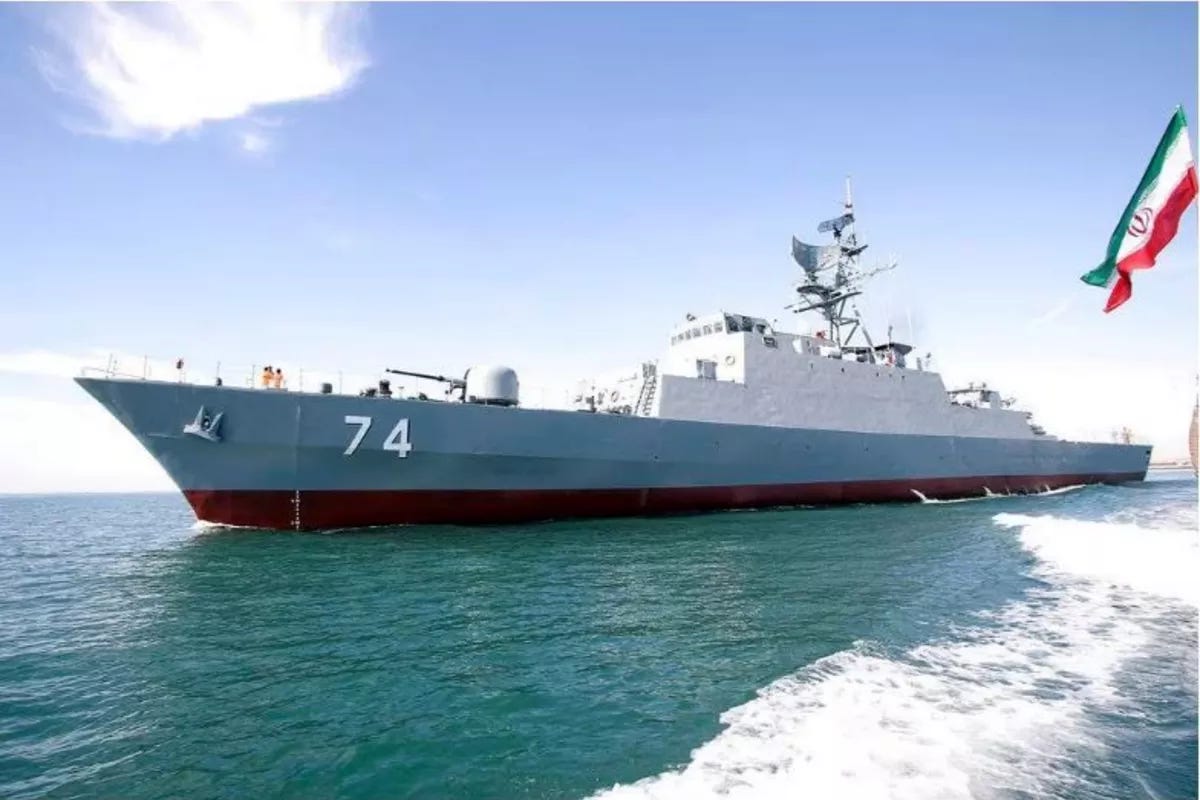
Caspian. The IDF struck the Iranian Navy’s northern fleet at Bandar Anzali, on Iran’s Caspian Sea coastline, for the first time in Operation Rising Lion. The IDF stated: “The Air Force, guided by the Navy and Military Intelligence, struck targets in northern Iran for the first time in Operation Rising Lion.” Confirmed destroyed: a Hamzeh-class corvette, four missile boats, a naval command centre, and a shipyard. Bandar Anzali and the adjacent port of Amirabad are the primary maritime corridor for Iranian arms transfers to Russia. Since at least 2022, ships from both ports have disabled AIS transponders to transfer Iranian-manufactured drones, Shahed variants, and ballistic missile components to Russian vessels at Astrakhan. Israel Hayom and JNS reported the strike was developed using joint Naval and Military Intelligence assessments of the port’s dual military-logistical function. It is the first confirmed extension of the conflict to the Caspian Sea and the first direct strike on an Iranian-Russian arms supply route in this war.
Objectives. US Defense Secretary Pete Hegseth, speaking at a Pentagon press briefing alongside Joint Chiefs Chairman Gen. Dan Caine, publicly stated the US war objectives in Operation Epic Fury for the first time: “Destroy missiles, launchers, and Iran’s defense industrial base so they cannot rebuild. Destroy their navy. And Iran never gets a nuclear weapon.” It is the first time the destruction of Iran’s navy has been named as a stated US objective, coming on the same day the IDF struck Iranian naval assets at Bandar Anzali. Hegseth announced the US would conduct “the largest strike package yet” on Day 20: “To date, we’ve struck over 7,000 targets across Iran and its military infrastructure. That is not incremental. That is overwhelming force applied with precision. And again, today will be the largest strike package yet, just like yesterday was.” His assessment of Iran’s position: “The United States military controls the fate of that country.”
IRGC leadership. Hegseth said that being a senior IRGC or Basij leader is now a “temp job.” Gen. Caine said the US is “continuing to be aggressive and assertive” in its efforts to diminish Iran’s missile capabilities. “Iran came into this fight with a lot of weapons,” Caine said. “This is why we continue to be as aggressive and assertive as we can against their ballistic missile capability, both medium-range and short-range. We are continuing to hunt and find them and kill them. And we will continue to do so.” Neither Hegseth nor Caine addressed the IDF’s public threat to Mojtaba Khamenei by name issued Wednesday.
Kharg Island. Hegseth confirmed Thursday that US forces struck Kharg Island, Iran’s primary oil export hub, over the weekend. “Iran has weaponized energy for decades. Israel clearly sent a warning, and Trump has made it very clear. Iran knows when you hit Kharg Island and you hit military capabilities on Kharg Island — which is the only thing we hit — we can hold anything at issue,” Hegseth said. It is the first on-record US confirmation that Kharg Island, which handles approximately 90 percent of Iran’s oil exports, has been struck in this conflict. Hegseth said the US did not direct the South Pars operation but confirmed Washington had approved it. His confirmation contradicts Trump’s public statement earlier this week that the White House was not informed. Neither Hegseth nor Caine reconciled the contradiction.
South Pars. Hegseth called Wednesday’s Israeli strike on Iran’s South Pars natural gas field “a warning”: “Iran has weaponized energy for decades. Israel clearly sent a warning.” He framed Kharg Island and South Pars in a single argument: both are leverage points the US and Israel are prepared to hold at risk. IDF strikes on South Pars targeted petrochemical processing facilities inside the field, per Tasnim. The full extent of the damage has not been confirmed. South Pars is jointly operated by Iran and Qatar.
Energy war. Iran struck energy infrastructure across four Gulf states in a single day: Qatar, Saudi Arabia, the United Arab Emirates, and Kuwait. QatarEnergy confirmed missile strikes caused fires and “extensive damage” at Ras Laffan Industrial City, the world’s largest LNG processing complex. Qatar’s Interior Ministry confirmed Civil Defence teams responded to a blaze “following an Iranian targeting.” QatarEnergy stated: “Emergency response teams were deployed immediately to contain the resulting fires. All personnel have been accounted for and no casualties have been reported at this time.” The IRGC had previously issued advance warnings it would strike Ras Laffan. Iran separately struck oil and gas facilities in Saudi Arabia and the UAE and targeted Kuwait’s energy infrastructure. It is the broadest single-day energy offensive of the conflict.
Qatar. Qatar’s Ministry of Foreign Affairs declared the Iranian Embassy’s military attache, security attache, and all staff of both offices persona non grata, ordering their departure within 24 hours. Doha’s official statement cited “repeated Iranian targeting and the blatant aggression against the State of Qatar, which violated its sovereignty and security, in a flagrant breach of the principles of international law, United Nations Security Council Resolution No. 2817, and the principles of good neighbourliness.” Qatar has not recalled its own ambassador from Tehran. Al Jazeera reported Riyadh separately described trust in Iran as “gone.”
Missiles. Iran fired eight separate missile salvos at Israel since midnight, per the Times of Israel. It is the highest number of discrete overnight salvos in a single period since the war began. Hezbollah simultaneously launched rockets at northern Israel; the IDF reported no injuries from the Hezbollah barrage. Four people were killed in Israel overnight from the combined Iranian attacks, per ILTV News. A fourth Palestinian woman died in the West Bank from an Iranian missile strike conducted the previous night, per the Times of Israel. A fragment of an intercepted Iranian ballistic missile was photographed lodged in the ground in the Golan Heights.
Arrests. Iranian authorities arrested 97 people inside Iran on charges of being “soldiers of Israel,” per Iranian state media. A separate sweep in Alborz province resulted in 41 additional arrests of individuals accused of sharing footage with foreign-based opposition media channels. There have been no confirmed anti-government protests inside Iran since the war began. The Iranian judiciary’s arrest operations have accelerated in each of the past four days.
STRAIT OF HORMUZ AND ENERGY MARKETS
Oil. Brent crude reached $112.05 per barrel on March 19, rising 4.35 percent in a single session, per Trading Economics, representing a 56 percent increase over the past month. The New York Times reported Brent briefly crossed $118 per barrel in intraday trading before retreating. West Texas Intermediate settled at $95.46. Global stocks slid alongside the surge. The IEA’s 400 million barrel emergency reserve release has not held Brent below $100 for more than two consecutive trading sessions.
Strait. The Strait of Hormuz remains closed to non-Chinese and non-Turkish commercial traffic. The United Kingdom, France, Germany, Italy, the Netherlands, and Japan issued a joint statement condemning Iran’s Strait closure and attacks on Gulf commercial vessels: “We condemn in the strongest terms recent attacks by Iran on unarmed commercial vessels in the Gulf, attacks on civilian infrastructure, including oil and gas installations, and the de facto closure of the Strait of Hormuz by Iranian forces.” The six governments called on Iran to cease “laying of mines, drone and missile attacks and other attempts to block the Strait to commercial shipping.” No government committed warships.
Trump. Trump publicly threatened to “massively blow up” an Iranian gas field if Tehran retaliates against Qatar’s energy infrastructure over the South Pars strike. No timeframe or specific facility was named.
LEBANON
North. Hezbollah fired rockets at northern Israel overnight; the IDF reported no injuries from the barrage. ISW’s March 18 special report documented Hezbollah claiming 57 attacks against Israeli forces and positions in northern Israel and southern Lebanon in the preceding 24-hour cycle. The IDF confirmed k*lling more than 20 Hezbollah fighters in overnight strikes across Lebanon. Defence Minister Katz authorised additional Israeli military reinforcements to deploy to Lebanon.
Toll. Lebanon’s Ministry of Public Health confirmed at least 912 people killed since March 2, including 111 children and 67 women. More than 2,200 w*unded. Over 1 million displaced, representing approximately 19 percent of Lebanon’s total population, per ACLED’s March 2026 Middle East special report.
REGIONAL SPILLOVER
Gulf-wide. Iran struck energy infrastructure in four Gulf states in 24 hours. Iran has now launched confirmed attacks against nine countries since February 28: Bahrain, Iraq, Israel, Jordan, Kuwait, Qatar, Saudi Arabia, the UAE, and Cyprus. ACLED documented that in the conflict’s first four days, the UAE suffered the highest number of confirmed strikes of any Gulf state, followed by Kuwait and Bahrain. Cumulative deaths in Gulf states outside Israel stand at 27.
West Bank. A fourth Palestinian woman died in the West Bank from an Iranian missile strike conducted the previous night. Iranian missile debris and misfires have repeatedly struck Palestinian civilian areas in the West Bank since February 28.
WASHINGTON AND WESTERN CAPITALS
First statement. Hegseth’s three war objectives, stated publicly for the first time on Day 20, represent a broader mandate than any US official has previously confirmed on the record: dismantling Iran’s missile production capacity, destroying Iran’s navy, and permanently foreclosing Iranian nuclear capability. The Bandar Anzali strike arrived within hours. The navy objective is already being executed.
Cost. Pentagon officials briefed a closed Senate Appropriations subcommittee that the first six days of Operation Epic Fury cost at least $11.3 billion. Senator Chris Coons confirmed the daily cost is “well over $1.5 billion.” No supplemental funding request has been submitted to Congress.
Senate. Democrats continued to demand public sworn testimony on the war’s duration, cost, and post-conflict planning. The Pentagon declined all public comment on the record.
THE SIGNAL
On Day 20, the US named its objectives in public: destroy Iran’s missiles and the factories that build them, destroy Iran’s navy, ensure Iran never builds a nuclear weapon. The Bandar Anzali strike arrived on the same morning. The navy objective is not a future plan. It is already underway.
Hegseth’s line landed without hedge: “The United States military controls the fate of that country.” Not a threat. An assessment.
Iran fired eight salvos overnight, burned four Gulf states’ energy infrastructure in a day, and arrested 138 people it called Israeli soldiers. Qatar expelled the attaches. Riyadh said trust is gone. Brent is at $112.
The war is not moving toward an endpoint. It is widening.


