At least 1,348 civilians in Iran have been killed since February 28, Brent crude has closed above $100 per barrel for the first time since August 2022, and Israel launched a new wave of strikes on Tehran on Friday morning as Iranian-aligned forces hit Gulf states across a 2,000-kilometre arc from Kuwait to Oman.
IRAN-US-ISRAEL WAR
New wave on Tehran. The Israeli military launched what it described as an “extensive wave” of air attacks on Iran’s capital on Friday morning, leaving thick smoke visible across the city. Heavy explosions were reported in several parts of Tehran during a mass Al Quds Day rally, with Iranian state media reporting one woman killed near the demonstration site. Iran’s national security chief Ali Larijani, speaking to Fars News Agency from the rally, called the proximity strike “desperation and fear” from Israel, and said Trump “doesn’t understand that the Iranian nation is strong, determined, and resilient.”
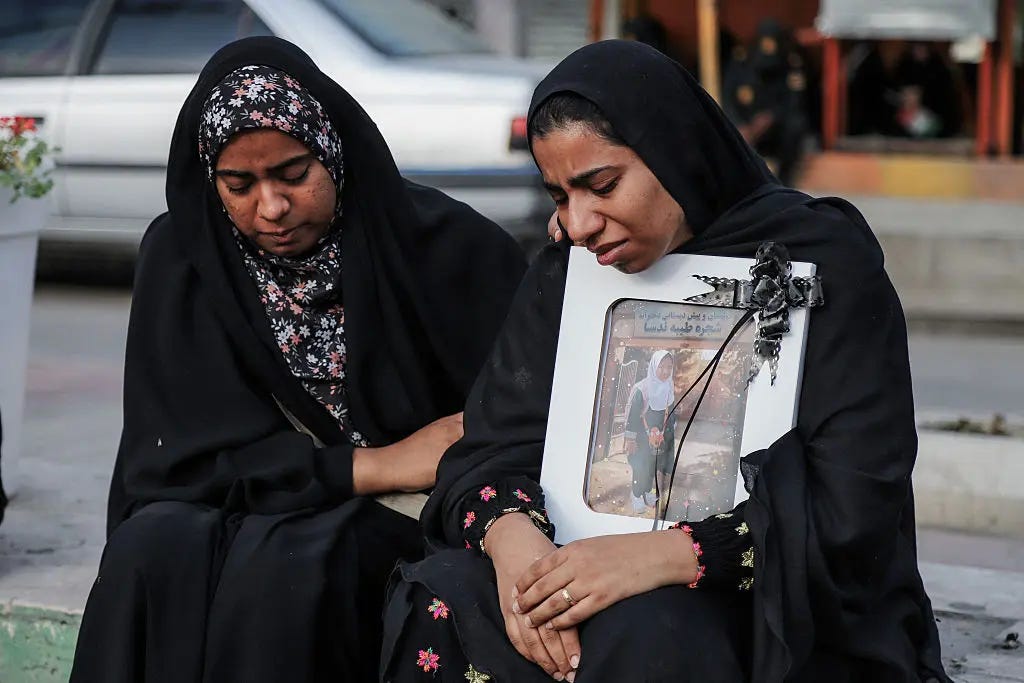
Civilian count. Iran’s ambassador to the United Nations, Amir Saeid Iravani, confirmed at least 1,348 civilians killed and more than 17,000 injured since February 28, with victims ranging in age from eight months to 88 years old. The UN Refugee Agency put the number of internally displaced Iranians at 3.2 million, a preliminary figure it said would continue to rise.
Supreme Leader speaks. In a statement broadcast on Iranian state television, attributed to new Supreme Leader Mojtaba Khamenei in his first public address since succeeding his assassinated father, Iran vowed to keep the Strait of Hormuz closed as a “tool of pressure” and to continue attacks on US military bases in the region unless those bases are shut down. The statement was read aloud by an anchor with a photo of Khamenei displayed on screen, not delivered directly by Khamenei himself. Defense Secretary Pete Hegseth told reporters on Friday that the new supreme leader “is wounded and likely disfigured,” casting doubt on his capacity to govern.
Peace conditions. Iranian President Masoud Pezeshkian outlined three conditions for ending the war: international recognition of Tehran’s legitimate rights, payment of reparations for damages, and binding guarantees against future aggression. No Western government acknowledged the offer.
Joint operations. The IRGC said it carried out a joint missile operation with Hezbollah against targets in Israel overnight. A fresh wave of missiles struck Israel early Friday, injuring two people and damaging buildings in the north. The IRGC also said it fired on two vessels that disregarded warnings in the Strait of Hormuz. Oman’s navy rescued 20 sailors from a Thai-flagged vessel that was attacked in the strait.
US aircraft down. The US military confirmed all six crew members aboard an American refueling aircraft were killed when it crashed in Iraq on Thursday. The Pentagon said the incident was “not due to hostile fire or friendly fire,” but an Iranian-aligned proxy group claimed responsibility. The total number of US troops killed in the war has reached at least 13, with eight others seriously wounded, the majority struck at US bases in countries neighbouring Iran.
Gulf attacks. Saudi Arabia shot down two drones heading toward the Shaybah oilfield in the Empty Quarter and intercepted another approaching a district housing foreign embassies in Riyadh. Drone strikes damaged fuel tanks at the port of Salalah, Oman, killing two foreign nationals. Air defenses in Dubai intercepted projectiles early Friday, with explosions heard in the city centre. Kuwait’s power grid lost six transmission lines after debris from intercepted drones struck infrastructure. Bahrain’s Interior Ministry announced the arrest of four Bahraini citizens on charges of spying for Iran’s IRGC. NATO air defenses intercepted a missile over Turkey, the third such interception since the war began. Australia ordered all non-essential government officials to evacuate the UAE and Israel.
STRAIT OF HORMUZ AND ENERGY MARKETS
Brent above $100. International benchmark Brent crude closed at $100.46 per barrel on Thursday, a 9.22% gain, the first close above $100 since August 2022. WTI settled at $95.73, up 9.72%. By Friday morning, Brent futures were trading at $101.13 as Asian markets opened sharply lower, tracking steep overnight losses on Wall Street. Major exchanges in Tokyo, Seoul, and Hong Kong all fell.
IEA: historic disruption. The International Energy Agency released its March Oil Market Report, calling the war “the largest supply disruption in the history of the global oil market.” The IEA said Gulf producers, facing full storage tanks and no viable export routes, had cut total production by at least 10 million barrels per day as of March 10. The agency coordinated a record emergency release of 400 million barrels from member state reserves, with the US contributing 172 million barrels from the Strategic Petroleum Reserve. Energy traders shrugged off the announcement, with ING strategists writing that the release would close only a quarter of the supply gap caused by the Strait’s closure.
No escorts yet. US Energy Secretary Chris Wright told CNBC on Thursday that the Navy was “not ready” to escort commercial tankers through the Strait. He said escort operations could begin by the end of the month. Trump told Fox News that tanker crews should “go through the Strait of Hormuz and show some guts.”
Russian oil licence. The US Treasury issued a temporary licence on Thursday authorising countries to purchase Russian oil products previously sanctioned and stranded at sea, a direct acknowledgment that no other bridge supply exists. The announcement did not move Brent crude downward.
Goldman revises. Goldman Sachs raised its 2026 oil price forecast by 20%, and raised its Q2 2026 Brent estimate by $10 to $76 per barrel. The EIA raised its full-year 2026 Brent forecast from $58 to $79 per barrel. Qatar has halted gas production following an Iranian drone attack on its infrastructure and declared force majeure on LNG contracts. The Qatari energy minister has warned that other Gulf producers may be forced to declare force majeure if tanker traffic does not resume.
Helium and chips. Qatar produces roughly 40% of the world’s helium, used to cool semiconductor manufacturing systems. A prolonged halt to Qatari exports risks a supply disruption to global chip production more severe than the 2021 crisis, according to analysts cited by multiple outlets.
LEBANON
Beirut expansion. Israel struck a bridge over the Litani River in southern Lebanon on Friday, the Zrariyeh crossing, in what Reuters identified as the first publicly acknowledged strike on civilian infrastructure in the current campaign. The Israeli military said the bridge was used by Hezbollah to move fighters between northern and southern Lebanon; it provided no evidence and did not disclose whether legal guidance was sought before the strike.
Christian suburbs hit. An Israeli drone struck a residential apartment in Beirut’s Burj Hammoud district on Friday, the first confirmed strike on the Lebanese capital’s predominantly Christian northern suburbs in this war.
Seafront double-tap. On Thursday, an Israeli strike hit Beirut’s Ramlet al-Baida seafront where displaced families had gathered after fleeing IDF evacuation orders for southern Beirut. A second strike followed the first while people emerged from their tents. Eight people were killed and 31 wounded, according to Lebanon’s Ministry of Public Health.
Total toll. Almost 700 people have been killed in Lebanon since March 2, with 820,000 displaced. The Lebanese Health Ministry said the evacuation order expansion northward to the Zahrani River could push displacement beyond one million within days. Two academics were killed in an Israeli airstrike on a Lebanese university on Thursday. Israeli Defense Minister Israel Katz warned Lebanese President Joseph Aoun that Lebanon would pay a “very heavy price” if the government fails to disarm Hezbollah.
Hezbollah operations. Hezbollah fired 200 rockets toward northern Israel overnight and launched drones at the Meron Air Operations Command and Control Base, claiming radar damage. UNIFIL recorded more than 210 Hezbollah missile launches into Israel since March 2. The IDF said it struck the IRGC Air Force headquarters in Beirut and 10 Hezbollah facilities in Dahiyeh within 30 minutes.
REGIONAL SPILLOVER
Iraq tankers. Two oil tankers were struck in Iraqi territorial waters near Basra on Thursday, the first oil-related strikes in Iraqi waters since the war began. Iran claimed responsibility for one strike. One person was killed and 38 crew members were rescued. Iraq suspended all oil terminal operations following the attacks.
French soldier killed. French President Emmanuel Macron announced on Friday that one French soldier was killed in a drone strike on a coalition base at Mala Qara in Iraqi Kurdistan. Five other French soldiers were injured in the same strike.
Azerbaijan plot foiled. Azerbaijani authorities said they had prevented an alleged IRGC-linked terrorist plot targeting the Baku-Tbilisi-Ceyhan oil pipeline, the Israeli embassy, and synagogues in Baku. A trial of the accused began immediately; they were identified as a cell affiliated with Islamic State’s Khorasan branch acting in coordination with the IRGC.
Rotterdam synagogue. An explosive device detonated at a synagogue in Rotterdam, Netherlands, overnight, setting the building on fire before the blaze extinguished itself. No casualties. Dutch police arrested four suspects.
GLOBAL SOUTH
Pakistan at the edge. Prime Minister Shehbaz Sharif announced sweeping emergency austerity measures on March 10, including a four-day government workweek and school closures from March 16. Petrol now costs $1.15 per litre and diesel $1.20, a 20% jump in a single week and the largest fuel price increase in Pakistan’s recorded history. Pakistan imports more than 80% of its oil; Qatar and the UAE supply 99% of its LNG. Both routes are severed. Agritech Fertilizer shut down production after Sui Northern Gas Pipelines declared force majeure citing its LNG supplier. Capital Economics said Pakistan’s central bank will likely have to raise interest rates rather than cut them, despite the economic pain. Eid al-Fitr preparations are coinciding with the highest transport fares and grocery costs in years.
Asia supply cascade. India’s state-run Mangalore Refinery declared force majeure on gasoline export cargoes. At least two Chinese refineries have cut production runs; Beijing asked all domestic refineries to suspend fuel exports. Thailand and Vietnam suspended crude shipments. The Philippines and Bangladesh are facing pump shortages. Japan’s refiners, sourcing roughly 95% of crude from Gulf states, have petitioned the government to release strategic stockpiles. Up to 30% of global fertilizer exports, including urea, ammonia, phosphates, and sulfur, pass through the Strait of Hormuz. Disruption to those flows is already raising agricultural input costs in the world’s poorest food-importing economies.
WASHINGTON AND WESTERN CAPITALS
$11.3 billion in six days. Pentagon officials briefed the Senate Appropriations Subcommittee on Defense that the first six days of Operation Epic Fury cost $11.3 billion, with munitions expenditure alone reaching $5.6 billion in the first 48 hours. The administration has not disclosed a total projection. Rep. Brendan Boyle, the top Democrat on the House Budget Committee, asked the Congressional Budget Office to produce an independent cost estimate. More than 250 civil society organisations, in a coalition coordinated by the ACLU, have come out against a reported $50 billion war supplemental spending request.
No congressional authorisation. House Speaker Mike Johnson described Operation Epic Fury as a “limited operation” on March 5, hours after House Republicans blocked a war powers resolution requiring congressional approval. Trump has referred to the conflict as a war in at least five documented public statements; Hegseth has done the same repeatedly. Democratic senators have formally demanded that Hegseth and Secretary of State Marco Rubio testify before congressional committees to explain the war’s objectives and duration. No date has been set.
Civilian protection dismantled. A ProPublica investigation published this week documented that the Pentagon’s Civilian Harm Mitigation and Response programme was dissolved before the war began under Hegseth’s stated “lethality” doctrine. Hegseth fired the military’s top judge advocate generals in February 2025, calling them “roadblocks.” Bellingcat authenticated video footage showing a Tomahawk missile strike adjacent to a school in Minab, Iran, on February 28, the war’s first day. The US has not commented. UN human rights experts have called for an investigation into whether the strike violated international law.
Trump on wartime management. In a Fox News interview, Trump said of disagreements with his national security team: “I let them speak their mind. And they do, and we have some differences, but they never end up being much. I convince them all to let’s do it my way.”
UK and allies. The UK confirmed US bombers are operating from Diego Garcia and RAF Fairford in Gloucestershire as part of Operation Epic Fury. An Iranian drone struck the UK’s RAF base in Cyprus. France’s one confirmed battlefield death brings allied casualties outside direct US engagement into the open for the first time. Australia has advised all citizens to leave the Middle East while commercial routes remain available.
THE SIGNAL
The war is now 14 days old and has produced its most consequential variable not in the targeting of Tehran’s military infrastructure but in the succession it created. Washington killed Ali Khamenei to decapitate the Iranian state; the state produced Mojtaba Khamenei within eight days, and his first public communication kept every term of the conflict intact. The US spent $11.3 billion in six days, has not escorted a single tanker through the Strait, has lost 13 troops, and is watching Brent hold above $100 while the IEA calls this the largest supply disruption in oil market history. The civilian protection architecture was dissolved before the first bomb fell. The war powers question has no scheduled answer in Congress. Pakistan is rationing fuel during Eid. France has its first confirmed dead. The actor whose decision controls the next 48 hours is Khamenei, about whom Washington now says only that he is “likely disfigured.” That is not a war assessment. That is a void.


