Iran confirmed the deaths of Ali Larijani and Basij commander Gholam Reza Soleimani. Within hours, Israel killed a third senior official: Intelligence Minister Esmail Khatib, the third assassination in 48 hours. Iran fired cluster munitions at Tel Aviv, killing two people. The United States struck hardened Iranian missile sites near the Strait of Hormuz with 5,000-pound deep penetrator bombs.
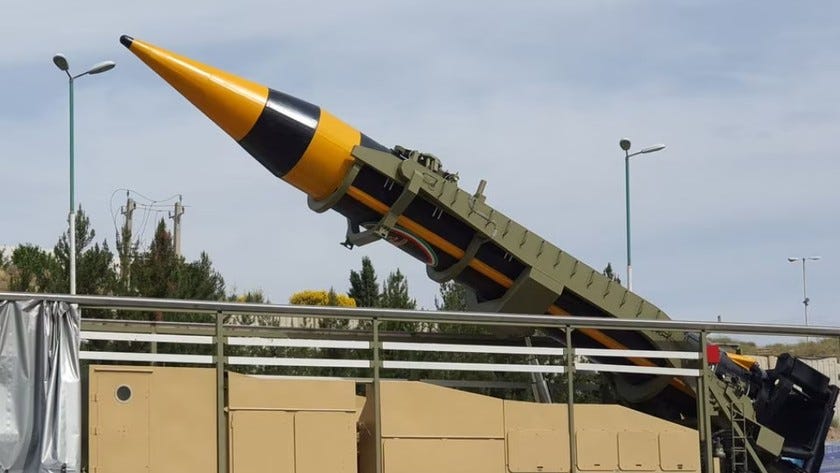
New missiles. The IRGC announced it fired Kramsh-4adr multi-warhead ballistic missiles at Israel in retaliation for Larijani’s killing. The IRGC stated the munitions are specifically engineered to evade missile defence systems and overwhelm radar capabilities. Footage obtained by the Associated Press showed at least one missile releasing cluster submunitions over Israeli territory. It is the first confirmed operational deployment of the Kramsh-4adr in this conflict. Two people were k*lled in Ramat Gan; Israel confirmed at least two separate incoming waves.
Khatib. Israel’s Defence Minister Israel Katz announced Wednesday morning that Israeli forces killed Esmail Khatib, Iran’s Minister of Intelligence, in an overnight strike on Tehran. Katz described Khatib to the Associated Press as “responsible for the regime’s internal assassination and repression activities, as well as for fostering external threats.” Iran has not confirmed his death. If confirmed, he is the third senior Iranian official k*lled in 48 hours.
The confirmation. Iranian state media confirmed Tuesday that Larijani and Soleimani had been killed in Monday night’s strikes, ending nearly 24 hours of official silence. The sequence of acknowledgements suggests Tehran’s damage assessment is lagging behind Israel’s operational tempo. The US State Department placed a $10 million reward on Khatib and other senior officials last Friday.
Three in 48 hours. Katz addressed the sequence directly: “Following the significant killings of high-ranking officials, including the de facto leader of Iran Ali Larijani, and the head of the Basij organisation Gholam Reza Soleimani, the assassination of Iranian Intelligence Minister Esmail Khatib occurred last night.” Israeli sources told Al Jazeera that intelligence had been compiled enabling the three successive announcements within a single day. Al Jazeera’s analysts assessed Khatib’s death as a direct strike on the architecture of domestic repression and external proxy operations simultaneously.
Khamenei threat. For the first time since the war began, the IDF publicly threatened Mojtaba Khamenei by name. The statement: “Mojtaba Khamenei is not safe. We will hunt him down.” Khamenei has not been photographed since being named supreme leader. Israel Katz said Wednesday: “The intensity of the attacks in Iran is escalating. We are currently engaged in a decisive victory.”
Iranian retaliation. The IRGC confirmed it fired multiple-warhead ballistic missiles carrying cluster munitions at the Tel Aviv region. The barrage struck at least eight sites across the Tel Aviv district and Bnei Brak. Air raid sirens sounded across central Israel and Jerusalem. Shrapnel damaged platforms at Savidor Central station; Israel’s national railway suspended all services.
Ramat Gan. Two people were k*lled in the Tel Aviv suburb of Ramat Gan. They were a couple in their 70s, struck by shrapnel while heading to a bomb shelter. At least one person was lightly w*unded in Bnei Brak. The deaths bring confirmed Israeli fatalities from Iranian missile attacks to at least 14 since February 28.
Targets. Israel struck an additional wave of targets in Tehran overnight: the IRGC Security Unit headquarters, a General Logistics and Support Department maintenance centre, and a ballistic missile array command centre, per IDF statements. Total Israeli strikes inside Iran have now exceeded 7,600 since February 28.
STRAIT OF HORMUZ AND ENERGY MARKETS
Bunker busters. US Central Command announced early Wednesday that American forces struck hardened Iranian missile sites along Iran’s southern coastline near the Strait of Hormuz using multiple 5,000-pound deep penetrator munitions. CENTCOM’s statement: “Hours ago, US forces successfully employed multiple 5,000-pound deep penetrator munitions on hardened Iranian missile sites along Iran’s coastline near the Strait of Hormuz. The Iranian anti-ship cruise missiles in these sites posed a risk to international shipping in the strait.” It is the first confirmed deployment of deep-penetrating munitions against Iranian coastal defence infrastructure in the war.
South Pars. Israeli forces struck facilities at South Pars, the world’s largest natural gas reserve, located offshore in the Persian Gulf along Iran’s southern Bushehr coast in Asaluyeh. Iranian state broadcaster IRIB and the state-run IRNA news agency confirmed the attack. Tasnim reported petrochemical processing facilities inside the field were targeted. The extent of damage is not yet known. It was not immediately confirmed whether the US participated. South Pars is jointly operated by Iran and Qatar; Iran has repeatedly struck Qatar during the conflict. A source familiar with the operation told the Jerusalem Post: “This was an Israeli operation.”
Bushehr nuclear plant. The IAEA confirmed a projectile struck near the Bushehr nuclear power facility in Iran’s Bushehr province. The IAEA reported no injuries and no damage to the reactor. Director General Rafael Grossi called for “maximum restraint during the conflict to avert the risk of a nuclear incident.” Rosatom chief Alexei Likhachev confirmed the strike hit near a meteorology building adjacent to the reactor and said radiation levels did not increase. He condemned it as “a flagrant disregard for key rules and principles of international security.” It is the first confirmed strike in the vicinity of the Bushehr facility since February 28.
Oil. Brent crude holds at $103 per barrel on Wednesday. The IEA’s 400 million barrel emergency reserve release has not held prices below $100 for three consecutive trading sessions. The Strait remains closed to non-Chinese and non-Turkish commercial traffic.
Coalition. No allied government has committed warships to Trump’s proposed Hormuz coalition as of Wednesday morning. France’s President Macron said France would “never” send warships to the Strait while the conflict is at its current intensity. Trump said he does not “need or desire” help from NATO allies. His response to refusals the previous day: “We will remember.”
LEBANON
Beirut. Israel struck central Beirut overnight without issuing prior evacuation warnings. Al Jazeera confirmed at least 12 people k*lled and 41 w*unded. A 15-storey residential building in the Basta neighbourhood was reduced to rubble. The IDF stated Hezbollah used the structure to store funds.
Soldiers. Reuters confirmed three Lebanese army soldiers k*lled and two w*unded in an Israeli strike on Nabatieh in south Lebanon on Tuesday.
Toll. Lebanon’s Ministry of Public Health has confirmed at least 912 people k*lled since March 2. At least 111 of the dead are children. More than 2,200 w*unded. Over 1 million displaced.
Western pushback. The UK, France, Canada, Germany, and Italy issued a joint statement calling on Israel to refrain from a broad ground manoeuvre in Lebanon, warning it could have “prolonged and destructive consequences.” German Chancellor Friedrich Merz said: “Do not take this path. It would be a mistake.” The statement stopped short of calling for a ceasefire. No government linked the demand to material consequences.
REGIONAL SPILLOVER
Baghdad. The US Embassy in Baghdad’s Green Zone sustained a drone and rocket attack early Tuesday in which at least one drone breached the perimeter. Black smoke was visible above the compound. No group claimed responsibility. The US Embassy has maintained a Level 4 security alert for Iraq since February 28.
Gulf-wide. Iran has now launched attacks against nine countries since February 28: Bahrain, Iraq, Israel, Jordan, Kuwait, Qatar, Saudi Arabia, the UAE, and Cyprus. Cumulative deaths in Gulf states outside Israel now stand at 27.
WASHINGTON AND WESTERN CAPITALS
Cost. Pentagon officials briefed a closed Senate Appropriations subcommittee that the first six days of Operation Epic Fury cost at least $11.3 billion. Senator Chris Coons confirmed the daily cost is “well over $1.5 billion.” No supplemental funding request has been submitted to Congress.
Reward. The US State Department placed a $10 million bounty on Mojtaba Khamenei’s location and on other senior Iranian officials last Friday. The IDF’s direct public threat to Khamenei by name Wednesday is the first time Israel has treated the supreme leader as an active operational target.
Senate. Democrats continued to demand public sworn testimony from administration officials on the war’s duration, cost, and post-conflict planning. The Pentagon declined all public comment.
THE SIGNAL
Three men in 48 hours. The intelligence chief. The security council chief. The commander of domestic mobilisation. Each ran a separate column of the Iranian state’s wartime function: repression, coordination, and mass manpower. Israel is not dismantling Iran’s military. It is dismantling its command class.
Tehran confirmed the first two deaths after hours of silence, said nothing about the third, and fired cluster munitions at a civilian suburb. A couple in their 70s died heading for a shelter. The IRGC called it a precision operation.
The IDF named the supreme leader next. The US drove penetrators into the coastline. The Strait is still closed.


