IRAN-US-ISRAEL WAR
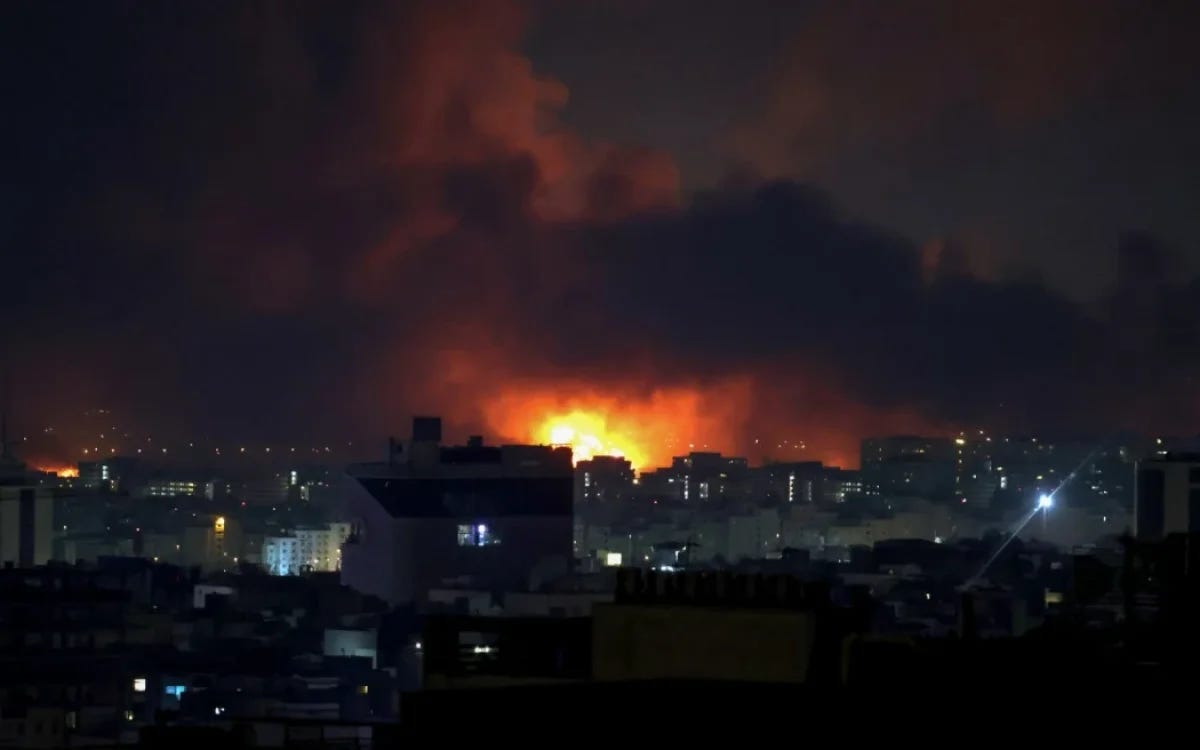
Isfahan. Missiles struck multiple sites across Isfahan province in the early hours of Sunday, according to Iranian state media, killing at least 15 people. The IDF said it launched “a massive wave of attacks” in western Iran. Isfahan has been struck repeatedly since February 28; the overnight operation hit the city one day after US and Israeli strikes destroyed facilities at Iran’s oldest Friday mosque and the Chehel Sotoun palace, both confirmed by UNESCO. Iran says at least 56 museums, historic buildings, and cultural heritage sites have been damaged since the war began.
Three more weeks. The IDF told CNN it is not working to a timetable but that hitting remaining targets will take at least three more weeks. “Thousands of targets” remain on the list, the military said. The IDF has conducted approximately 7,600 strikes inside Iran and 1,100 in Lebanon since February 28. Defense Secretary Pete Hegseth said more than 15,000 enemy targets have been struck across the campaign, averaging more than 1,000 a day.
Iranian retaliation. Iran launched multiple barrages of ballistic missiles and drones at Israel throughout Sunday. Air raid sirens sounded across central Israel. Shrapnel from one Iranian ballistic missile damaged a building housing US diplomats in Israel, according to Channel 12; the State Department has not commented. The IRGC said its attacks were coordinated with Hezbollah as a continuation of Al-Quds Day operations begun on Saturday.
Araghchi statement. Foreign Minister Abbas Araghchi said in a statement broadcast Sunday that Iran never sought a ceasefire with the United States and is ready for a long war. He described Trump’s weekend appeal for allied warships to secure the Strait of Hormuz as “begging” and called on neighbouring governments to “expel foreign aggressors” from their territory. It was the clearest formulation of Tehran’s war posture since Mojtaba Khamenei’s first public statement on Thursday.
Trump. Trump told NBC News that Iran “wants to make a deal” but that terms proposed so far are “not good enough yet.” He added that the US may hit Kharg Island “a few more times just for fun.” On Truth Social he wrote that the US had “beaten and completely decimated Iran, both Militarily, Economically, and in every other way.” He called on China, France, Japan, South Korea, and the United Kingdom to send warships to keep the Strait “open and safe.” None gave immediate indication they would
.
STRAIT OF HORMUZ AND ENERGY MARKETS
Hormuz and the coalition that is not forming. Trump’s call for an international naval coalition to police the Strait of Hormuz has produced no commitments. The UK said it is “discussing a range of options with allies”; no other government has stated a timeline or force commitment. The strait has been effectively closed to non-Chinese and non-Turkish commercial traffic since March 4. Tanker traffic has dropped to near zero. The IRGC confirmed selective passage for Chinese-owned and Chinese-flagged vessels following Beijing’s public position on shipping rights; Turkish-operated vessels have also passed after broadcasting ownership on VHF.
Gulf attacks. Gulf states reported new missile and drone attacks on Sunday. Saudi Arabia’s Defence Ministry said it intercepted 10 drones over Riyadh and the eastern region. The UAE’s Ministry of Defence confirmed that 9 ballistic missiles and 33 drones were launched toward the country on March 14. Bahrain reported it has now intercepted 125 missiles and 203 drones since the war began; two people have been killed there, 24 across neighbouring Gulf states. Two missiles struck the perimeter of Kuwait’s Ahmad al-Jaber airbase on Sunday, wounding three soldiers; drones damaged the radar system at Kuwait International Airport.
UAE warning. The IRGC declared UAE shipping ports, docks, and military facilities legitimate targets on Saturday, citing US missile operations originating from UAE territory. Fujairah, the outlet for approximately one million barrels per day of UAE Murban crude outside the strait, sustained a fire on Saturday after drone debris fell during an interception. Oil-loading operations were suspended
.
Oil. Brent crude stands at approximately $100 per barrel, up 13 percent since February 27. The IEA’s coordinated release of 400 million barrels — the largest emergency reserve release in the agency’s history — has not held prices below $100. Analysts estimate the release covers roughly 20 days of a full Hormuz blockade. The daily global supply shortfall is estimated at 15 to 20 million barrels. Iran’s joint military command reiterated on Saturday that any strike on Iranian oil and gas infrastructure will trigger reciprocal attacks on Gulf energy installations.
Khamenei’s order. In his first public statement since being elected supreme leader on March 8, Mojtaba Khamenei said the Strait of Hormuz must remain closed as “a tool to pressure the enemy” and that all US military bases in the Middle East must close and will be attacked. Oil surged 8 percent following the statement before partially retreating.
LEBANON
Toll. Israeli attacks have killed at least 773 people in Lebanon since March 2, according to Lebanon’s Ministry of Public Health. At least 98 of the dead are children. More than 800,000 people have been displaced; one analyst told Al Jazeera the figure could cross one million within days. The IDF has now conducted approximately 1,100 strikes in Lebanon since February 28.
Medical workers. Lebanon’s Health Ministry condemned an Israeli strike on a healthcare centre in Borj Qalaouiye that killed 12 medical staff, including doctors, nurses, and paramedics. A separate airstrike killed an entire family in the southern village of Qantara, including two children. Lebanese emergency services confirmed five people were killed, including a child, in strikes on two other southern towns, with seven more wounded.
UNIFIL. Israeli shells struck the headquarters of the Nepalese peacekeeping battalion serving with UNIFIL in the southern town of Meiss el-Jabal. It was the first confirmed strike on a UN position in the current phase of the war. Secretary-General Antonio Guterres arrived in Beirut on Friday for what he described as a solidarity visit.
Beirut. Israeli strikes hit the Jnah coastal neighbourhood in southwestern Beirut, the Nabaa district — struck for the first time in either this conflict or the 2024 war — and an apartment in Bourj Hammoud northeast of the capital. Hezbollah Secretary-General Naim Qassem said his group is prepared for a “long confrontation” with Israel. The IRGC said Saturday’s missile and drone attacks on Israel were coordinated with Hezbollah as Al-Quds Day operations.
REGIONAL SPILLOVER
Iraq. Smoke and flames were visible near the US Embassy compound in Baghdad on Sunday. Three Popular Mobilization Forces members were killed in a strike on a PMF headquarters in the capital on Saturday, Reuters reported from security sources. The PMF’s death toll across the conflict now exceeds 32. Baghdad has sought to remain outside the war; the PMF’s independent command structure continues to make that position untenable.
Saudi Arabia, Qatar, Bahrain. Saudi Arabia intercepted 10 drones over Riyadh and the eastern region on Sunday. Qatar’s armed forces successfully intercepted all four ballistic missiles and drones fired toward the country on Saturday, the Defence Ministry confirmed. Qatari schools have moved to remote learning and public Ramadan gatherings remain suspended. Bahrain sounded sirens overnight and urged residents to reach the nearest safe place.
Cyprus. UK Prime Minister Keir Starmer confirmed that US forces are using RAF Akrotiri and the base at Diego Garcia to “destroy the missiles at source.” An Iranian drone struck a runway at Akrotiri earlier in the conflict; Greece subsequently announced the deployment of frigates and F-16s to Cyprus.
Norway. Norwegian police are investigating an explosion at the US Embassy in Oslo that damaged one entrance and sent smoke into the street on Saturday. No injuries were reported. A suspect was identified on surveillance footage; no arrest has been announced.
GLOBAL SOUTH
Pakistan. Pakistan imports more than 80 percent of its oil and depends on Qatar and the UAE for 99 percent of its LNG supply. Both supply lines remain severed. Petrol crossed 320 rupees per litre this week, a jump of 55 rupees, the largest single fuel price increase in the country’s recorded history. Prime Minister Shehbaz Sharif has imposed a four-day government workweek, closed schools until March 31, directed 50 percent of public sector staff to work from home, and approached Saudi Arabia about alternative supply routes through the Red Sea. Pakistan’s central bank is expected to raise interest rates rather than cut them, compounding inflation that was already running above official targets before the war began.
South and Southeast Asia. Bangladesh deployed troops to suppress fuel riots and brought forward Eid holidays while imposing daily purchase limits of two litres for motorcycles and ten for private vehicles. India suspended LPG shipments to commercial operators to protect household supply. South Korea introduced the country’s first fuel pump price cap in nearly 30 years; approximately 1.7 million barrels of Korea-bound oil are blocked daily. The Philippines and Vietnam adopted shortened working weeks to conserve energy.
Sport. Iran’s Sports Minister Ahmad Donyamali confirmed the men’s national team will not participate in the 2026 FIFA World Cup, which is scheduled to be held in the United States. Trump said the team is “welcome” but that it is “not appropriate for them to be there, for their own life and safety.” FIFA has not announced a contingency plan.
WASHINGTON AND WESTERN CAPITALS
Cost. Pentagon officials briefed a closed Senate Appropriations subcommittee session that the first six days of Operation Epic Fury cost at least $11.3 billion, not including the multi-month military buildup preceding February 28. The Pentagon spent an estimated $5.6 billion on munitions alone in the opening 48 hours. Senator Chris Coons said the daily cost is “well over $1.5 billion.” A supplemental funding request to Congress is being prepared; figures cited in reporting range from $50 billion upward. No formal request has been submitted.
School strike. Senator John Kennedy said all indications point to the US being responsible for a strike near a school in Iran that killed more than 165 people. Senate Democrats demanded public testimony under oath from administration officials on the war’s duration, cost, and post-conflict planning. The Pentagon declined to comment on either the casualty figure or the cost briefing, citing the closed-door proceedings.
Escorts. US Energy Secretary Chris Wright posted on X that the first tanker had been escorted through the Strait of Hormuz by the US Navy. The White House said the claim was incorrect. Wright deleted the post.
Europe. France’s TotalEnergies capped domestic fuel prices through the end of the month. The European Commission is exploring gas price caps and energy subsidies. Spain has seen the largest European pump price increase since February 27, at 27 percent, with diesel at EUR 1.79 per litre. Diesel has crossed EUR 2 in Germany, France, Italy, Finland, and the Netherlands. Twenty-nine nations issued a joint statement condemning Hezbollah’s entry into the conflict; the US, Russia, and China did not sign.
THE SIGNAL
The IDF’s disclosure that it needs at least three more weeks to exhaust its target list sets the outer frame of what is now a war with a stated military floor but no diplomatic ceiling. Iran’s answer came from two directions simultaneously: Araghchi’s statement that Tehran never sought a ceasefire and Khamenei’s order that the Strait stays closed as a pressure instrument. Neither is a negotiating position. Trump’s twin posture — Iran “totally decimated” and deal terms “not good enough yet” — reflects the same absence of exit architecture from Washington’s side. The constraint nobody in the briefing room is discussing is that the three-week IDF timeline assumes continued Iranian missile degradation, while the IRGC promised upgraded ballistic missiles on Saturday and has not publicly confirmed any of Hegseth’s attrition figures. The actor whose decision controls the next 24 hours is Araghchi: his language today moved from resistance to doctrine. That is a different register.