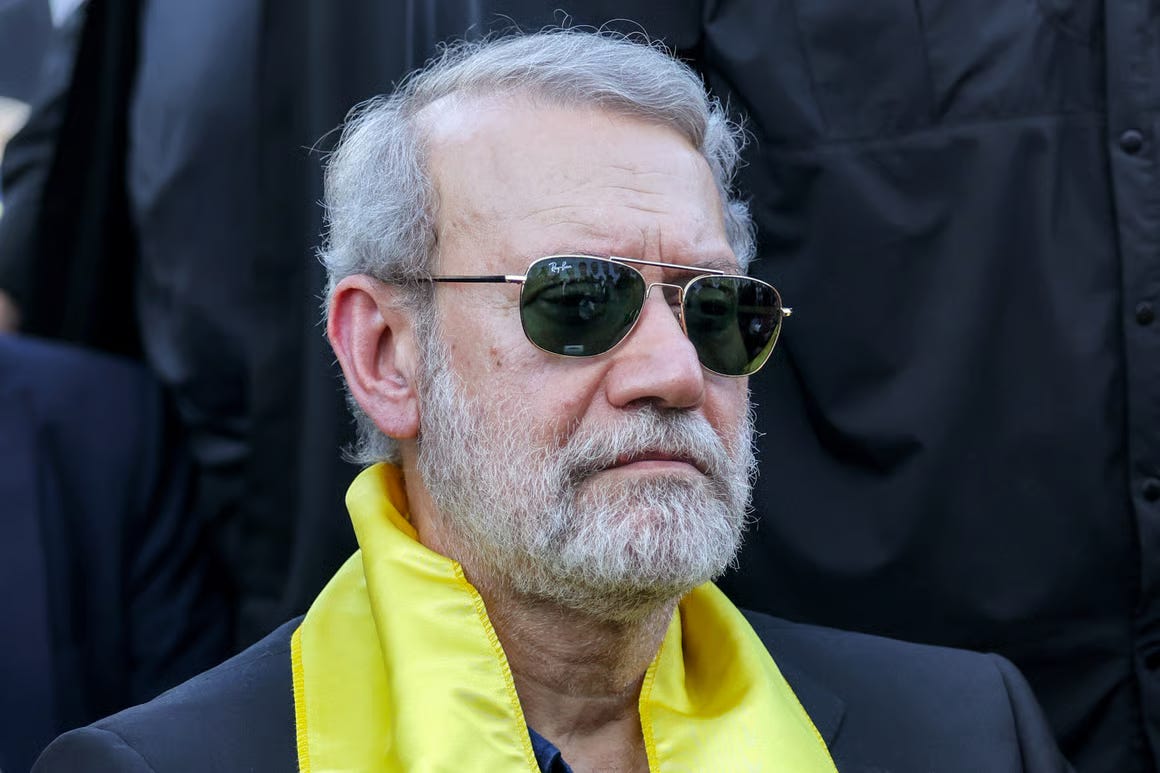
Israel claimed to have killed Ali Larijani, Iran’s supreme national security chief and its most powerful operational figure since Khamenei’s assassination on Day 1, alongside IRGC Basij commander Gholam Reza Soleimani in overnight strikes on Tehran. Iran’s new supreme leader Mojtaba Khamenei rejected ceasefire proposals from two intermediary countries, saying peace talks were impossible “until the United States and Israel are brought to their knees, accept defeat, and pay compensation.” Pakistan struck a 2,000-bed drug rehabilitation hospital in Kabul, killing at least 400 people, in the deadliest single incident of the Afghanistan-Pakistan war. Brent crude crossed $103.
IRAN-US-ISRAEL WAR
Larijani. Israel’s Defence Minister Israel Katz announced Tuesday that Israeli forces killed Ali Larijani, secretary of Iran’s Supreme National Security Council. Iranian state media published a handwritten note by Larijani commemorating Iranian sailors k*lled in a US attack; he had been expected to attend their funeral on Tuesday. Iran has not confirmed his death. Yahoo News analysts described the claimed killing as more strategically significant than Khamenei’s death, because Larijani was the functional coordinator of the war machine: the node through which the IRGC, the foreign ministry, and Hezbollah’s operational integration ran under wartime conditions.
Netanyahu’s order. A statement from the Israeli prime minister’s office said Binyamin Netanyahu had ordered “the elimination of senior officials of the Iranian regime.” The same overnight operation killed Gholam Reza Soleimani, commander of the IRGC’s Basij volunteer force, which plays a central role in domestic security and mass mobilisation. If Larijani’s death is confirmed, he would be the most senior figure assassinated since Khamenei was k*lled on February 28.
Khamenei rejects talks. A senior Iranian official confirmed to the Irish Times that Mojtaba Khamenei, holding his first foreign policy session since being named supreme leader, rejected de-escalation proposals conveyed by two unnamed intermediary countries. Khamenei’s stated position: it was not “the right time for peace until the United States and Israel are brought to their knees, accept defeat, and pay compensation.” The official said it was not clarified whether Khamenei attended in person or remotely; he has not been photographed since being named to the role.
Iranian retaliation. Iran launched overnight barrages of ballistic missiles and drones at Israel on Monday into Tuesday. Iran’s army released a formal statement confirming it targeted cybertechnology centres and weapons manufacturing facilities operated by Israeli arms manufacturer Rafael. Rafael did not immediately respond to requests for comment. Iran retains long-range strike capacity despite more than two weeks of sustained US-Israeli bombardment.
Israeli strikes. Israel launched a new wave of strikes across Tehran and Hezbollah sites in Beirut simultaneously on Tuesday. The IDF has conducted approximately 7,600 strikes inside Iran and 1,100 in Lebanon since February 28. IDF planning confirmed to CNN calls for at least three more weeks of operations to exhaust remaining target sets.
School. The Times of London confirmed Tuesday that the strike on the Shajareh Tayyebeh School consisted of two missile strikes in quick succession, killing at least 168 people, mostly girls. The confirmation follows Senator John Kennedy’s statement that “all indications” pointed to US responsibility. The Pentagon declined to comment.
STRAIT OF HORMUZ AND ENERGY MARKETS
Tanker. A tanker anchored near an Emirati port was struck by a projectile Tuesday morning, confirmed by the New York Times. It is the first vessel attack in or around the Strait in five days and the 18th such incident since February 28. Iranian attribution has not been confirmed. The Strait remains closed to non-Chinese and non-Turkish commercial traffic.
UAE. Iranian forces struck Dubai Airport on Monday, forcing a temporary closure of UAE airspace. The UAE Ministry of Defence confirmed it intercepted a missile and UAV attack originating from Iran. Iranian missiles hit an industrial area in Sharjah. One person was k*lled in Abu Dhabi from shrapnel following interception of incoming missiles. The IRGC has declared UAE shipping ports, docks, and military facilities legitimate targets, citing US missile operations originating from UAE territory.
Qatar. Multiple explosions were heard across Doha on Monday. Qatar’s Defence Ministry confirmed its armed forces intercepted a missile attack targeting the state. Qatar’s foreign ministry spokesman Majed al-Ansari said: “If they stop the attacks, then we can find a way out with diplomacy. But as long as our countries are being attacked, this is not the time to establish committees.”
Oil. Brent crude stands at $103 per barrel on Tuesday, up approximately 13 percent since February 27. Raymond James analysts estimate the war has added $43 per barrel above pre-war baseline. The daily global supply shortfall is estimated at 15 to 20 million barrels. The IEA’s 400 million barrel emergency reserve release has not held prices below $100 for three consecutive trading days.
Coalition failure. No allied government committed warships to Trump’s proposed Hormuz coalition on Tuesday. Trump called out China, France, Japan, South Korea, and the United Kingdom by name. The UK said it is “discussing a range of options with allies” without stating a timeline. The UK’s RAF is conducting strictly defensive patrols over Qatar, Cyprus, UAE, and Bahrain, intercepting Iranian drones, but has not committed to the offensive Strait mission. Trump’s response to all refusals: “We will remember.”
LEBANON
Ground operation. Israel expanded its ground operation in Lebanon on Tuesday. The IDF issued a new evacuation advisory for the village of al-Jabbain, ordering residents to vacate buildings ahead of an imminent strike on Hezbollah infrastructure. Tens of thousands of Israeli reservists remain mobilised near the Lebanese border.
Toll. Lebanon’s Ministry of Public Health confirmed 886 people k*lled and more than 1 million displaced since March 2. At least 98 of the dead are children. The Lebanese government’s disaster management authority confirmed the displacement figure crossed one million on Tuesday.
Western pushback. The UK, France, Canada, Germany, and Italy issued a joint statement Tuesday calling on Israel to refrain from a broad ground manoeuvre in Lebanon, warning it could have “prolonged and destructive consequences.” German Chancellor Friedrich Merz addressed Israel directly: “Do not take this path. It would be a mistake.” The statement stopped short of calling for a ceasefire.
Diplomacy. US and French officials are engaged in contacts with Lebanese Parliament Speaker Nabih Berri on a negotiation track, including discussions on the composition of a Lebanese delegation. US Ambassador to Lebanon Michele Isaac met Berri this week. No date or framework has been confirmed.
REGIONAL SPILLOVER
Baghdad. The US Embassy compound in Baghdad’s Green Zone sustained a drone and rocket attack early Tuesday. At least one drone breached the perimeter. Black smoke was visible above the compound. No group immediately claimed responsibility. The US Embassy had maintained a Level 4 security alert for Iraq since the war began.
Gulf-wide. Iran has now launched attacks against nine countries in the region: Bahrain, Iraq, Israel, Jordan, Kuwait, Qatar, Saudi Arabia, the UAE, and Cyprus. Two people have been k*lled in Bahrain and 24 across neighbouring Gulf states in cumulative attacks since February 28.
GLOBAL SOUTH
Omid Hospital. Pakistan’s air force struck the Omid Addiction Treatment Hospital, a 2,000-bed drug rehabilitation centre in Kabul’s Police District 9, at approximately 9 PM local time on Monday. Taliban spokesman Hamdullah Fitrat confirmed at least 400 people killed and 250 wounded. The facility, which occupies a former NATO military camp, was treating patients for substance dependency at the time of the strike. Rescue teams were still extracting bodies from the rubble on Tuesday morning. A billboard above the charred compound read “Support and Treatment Centre, Omid,” meaning Hope in Dari.
Pakistan’s denial. Pakistan’s Ministry of Information confirmed conducting “precision airstrikes” on Kabul and Nangarhar provinces on Monday night, targeting “Afghan Taliban regime terrorism-sponsoring military installations.” Information Minister Attaullah Tarar said “visible secondary detonations after the strikes clearly indicate the presence of large ammunition depots.” Videos shared with CBS News did not appear to show secondary explosions consistent with that claim. UNAMA, the UN’s Afghanistan mission, offered condolences and confirmed the strike hit the hospital.
Taliban response. Taliban spokesman Suhail Shaheen called the strike “a brutal war crime” and warned Pakistan of a response “in their language.” Former Afghan President Hamid Karzai condemned the bombardment of civilian medical sites as “unjustifiable” and warned Pakistan such actions would worsen its own position. Pakistan has formally declared it is in “open war” with Afghanistan; Afghan Taliban drone strikes hit Pakistani cities in preceding days.
Pakistan energy. Pakistan was already in active crisis before Monday night. Petrol crossed 320 rupees per litre this week, the largest single fuel price increase in the country’s recorded history, driven by the Iran war cutting off Gulf supply lines. Prime Minister Shehbaz Sharif has imposed a four-day government workweek, closed schools until March 31, and directed 50 percent of public sector staff to work from home. Pakistan imports more than 80 percent of its oil and depends on Qatar and the UAE for 99 percent of its LNG supply; both supply lines remain severed.
Southeast Asia. Bangladesh deployed troops to suppress fuel riots. South Korea introduced its first fuel pump price cap in nearly 30 years. The Philippines and Vietnam adopted shortened working weeks. India suspended LPG shipments to commercial operators. Approximately 1.7 million barrels of Korea-bound oil are blocked daily.
WASHINGTON AND WESTERN CAPITALS
Cost. Pentagon officials briefed a closed Senate Appropriations subcommittee that the first six days of Operation Epic Fury cost at least $11.3 billion, not including the multi-month military buildup preceding February 28. The Pentagon spent an estimated $5.6 billion on munitions alone in the opening 48 hours. Senator Chris Coons said the daily cost is “well over $1.5 billion.” A supplemental funding request is being prepared; no formal submission to Congress has been made.
Senate. Democrats demanded public testimony under oath from administration officials on the war’s duration, cost, and post-conflict planning following confirmation of the Shajareh Tayyebeh School strike. The Pentagon declined to comment on casualty figures or the cost briefing, citing closed-door proceedings.
Xi delay. Trump delayed his planned summit with President Xi Jinping by one month to remain in Washington. The delay comes as Trump named China among governments expected to commit warships to the Strait, and as Chinese-flagged vessels continue to transit under an IRGC selective passage arrangement.
Sport. Iran’s Sports Minister Ahmad Donyamali confirmed the men’s national team will not participate in the 2026 FIFA World Cup, held in the United States. FIFA has not announced a contingency plan.
THE SIGNAL
In a single 24-hour window: Israel killed Iran’s operational war commander, Pakistan killed 400 people in a Kabul hospital, Iranian missiles hit Dubai Airport, and a tanker was struck near the Strait. None of these events are connected by a single actor or decision chain. That is the point. The Iran war did not create the Afghanistan-Pakistan conflict, but it consumed the international attention, diplomatic bandwidth, and economic stability that might otherwise have contained it. Islamabad is running an “open war” in Kabul while its own population cannot afford petrol. Four hundred people in a rehabilitation hospital called Hope are dead. Both wars now have their own logic and their own floor. Neither has a ceiling.


