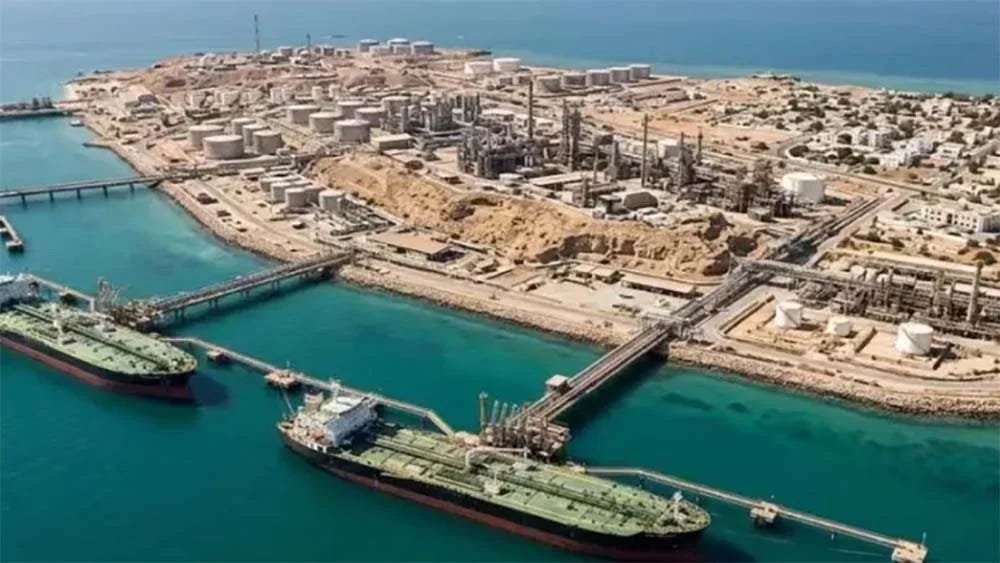
US forces struck more than 90 military targets on Kharg Island overnight, the hub through which 90 percent of Iran’s crude exports pass, as Brent crude crossed $103 a barrel and the IRGC declared US positions across the UAE legitimate targets.
IRAN-US-ISRAEL WAR
Kharg Island. CENTCOM confirmed on Saturday that the overnight US strike destroyed naval mine storage facilities, missile bunkers, and multiple other military installations across Kharg Island while deliberately preserving oil infrastructure. Trump said US forces had “obliterated every military target” on the island and warned that the oil infrastructure would follow if Iran continued blocking the strait. Iran’s deputy defence minister said Tehran would respond by deploying upgraded weapons, including more powerful ballistic missiles. The IRGC announced that US positions throughout the UAE are now legitimate targets.
Casualties. Iran’s Health Ministry puts the toll since February 28 at 1,444 killed and 18,551 injured, with victims ranging in age from eight months to 88 years. The US-based Human Rights Activists News Agency estimates at least 1,858 dead including military personnel. Iran’s government has not updated its official tally in over a week. The UN ambassador puts the combined figure at over 1,300, though multiple sourcing tiers place the number substantially higher.
Khamenei’s condition. US Defense Secretary Pete Hegseth said he believes Supreme Leader Mojtaba Khamenei is wounded and “likely disfigured.” Vice President JD Vance said Khamenei is “hurt” but acknowledged the picture is not fully clear. Khamenei has communicated only through written statements read on state television; he has not appeared on audio or video since assuming the role on March 8. The State Department announced a $10 million reward for information on his whereabouts and those of other senior Iranian officials.
Tehran strikes. Explosions struck central Tehran on Friday near the annual Al-Quds Day march, attended by President Masoud Pezeshkian, Foreign Minister Abbas Araghchi, and judiciary chief Gholam-Hossein Mohseni-Eje’i. Iranian state media reported one woman killed. Israel said it struck Iran’s main space research centre and a factory manufacturing air defence systems on Saturday, describing the targets as key nodes in Iran’s military satellite and air defence production infrastructure. Israeli air force sources told Iran International that more than 60 IRGC bulldozers intended to rebuild missile storage sites were destroyed in separate strikes.
Iran’s military posture. The IRGC said on Saturday it had launched a fresh coordinated wave of missiles and drones at Israel in conjunction with Hezbollah as part of Al-Quds Day operations. Iran’s deputy defence minister said the country would increasingly field upgraded ballistic missiles as the war continues. Hegseth said Iranian missile volume is down 90 percent and drone volume down 95 percent since the war began; Iranian officials dispute both figures. Trump declared Iran “totally defeated” and seeking a deal, then said no deal proposed so far is acceptable to him.
US force deployment. The Pentagon is deploying a Marine expeditionary unit of approximately 2,200 personnel to the region. Residents reported multiple explosions on Saturday in Isfahan, Bandar Abbas, Shiraz, and Sanandaj. The war is now in its 15th day.
STRAIT OF HORMUZ AND ENERGY MARKETS
Kharg and the oil threat. Kharg Island handles approximately 90 percent of Iran’s crude exports before tankers transit the Gulf and the strait. The US said overnight strikes avoided oil infrastructure; Trump made clear in the same statement that this restraint is conditional. The IRGC responded by designating US positions in the UAE as legitimate targets, raising the immediate question of whether Iranian retaliation targets the Fujairah bunkering hub, which suffered a fire on Saturday after drone debris fell during an interception operation. Oil-loading operations at Fujairah were suspended in the aftermath, according to Reuters sourcing from industry and trade sources.
Oil prices. Brent crude settled at $103.24 per barrel as of Friday evening GMT, up from $72.87 on February 27. The IEA’s March oil market report stated that the war has created the largest supply disruption in the history of the global oil market. Flows through the strait have fallen from approximately 20 million barrels per day to a fraction of that; the IEA estimates Gulf producers have cut total production by at least 10 million barrels per day as storage capacity reaches capacity. The 32-nation coordinated IEA release of 400 million barrels, the largest emergency reserve release in history, failed to hold prices below $100.
Russian oil reprieve. The US Treasury issued a 30-day temporary licence on Thursday authorising the purchase of Russian oil already loaded on tankers as of that date, equivalent to five to six days of normal Hormuz-bound shipments. Brent eased briefly and then crossed $103. Russia’s daily oil and gas revenue is running 14 percent above its February average, according to the Centre for Research on Energy and Clean Air.
Iranian conditions. A senior Iranian official told CNN that Tehran is considering allowing a limited number of tankers to pass through the strait provided oil cargo is traded in Chinese yuan. International oil is almost entirely dollar-denominated. The IEA said that without rapid resumption of shipping flows, supply losses will increase. US Energy Secretary Chris Wright said on Thursday that naval escorts through the strait could begin by the end of the month but that Washington is “not ready” to conduct them now.
Vessel attacks. At least 16 oil tankers, cargo ships, and other vessels have been attacked in and around the strait, the Arabian Gulf, and the Gulf of Oman since the war began, according to the UK’s maritime agency. At least five more ships were hit inside the Persian Gulf between Wednesday and Friday alone.
LEBANON
Toll. Israeli attacks have killed at least 773 people in Lebanon since March 2, according to Lebanon’s Ministry of Public Health. At least 98 of the dead are children. More than 800,000 people have been forcibly displaced, with one analyst warning the figure could cross one million within days.
Medical workers. Lebanon’s Health Ministry condemned an Israeli strike on a healthcare centre in Borj Qalaouiye that killed 12 medical staff, including doctors, nurses, and paramedics. An Israeli attack on an ambulance was confirmed in the Tayr Falsay area. Two academics were killed by a separate airstrike on a Lebanese university on Thursday.
UN base. Israeli shells struck the headquarters of a Nepalese peacekeeping battalion serving with UNIFIL in the southern Lebanese town of Meiss el-Jabal, the first confirmed strike on a UN position in the current phase of the war.
Beirut. An Israeli strike hit a car in Jnah, a coastal neighbourhood in southwestern Beirut, killing one person. A separate strike struck an apartment in the Nabaa neighbourhood, home to a sizable Armenian community; it was the first time this area had been struck in either this conflict or the 2024 war. Israeli forces also struck an apartment in Bourj Hammoud, a suburb northeast of the capital. The IDF said Israel had carried out approximately 7,600 strikes in Iran and 1,100 in Lebanon since February 28.
Hezbollah. Secretary-General Naim Qassem said his group is prepared for a “long confrontation” with Israel. The IRGC stated that Saturday’s missile and drone attacks on Israel were coordinated with Hezbollah as part of Al-Quds Day operations. Debris from Iranian cluster munitions caused fires in two suburbs of Tel Aviv, Israeli officials confirmed on Friday; the munitions pose a specific challenge to Israel’s long-range interceptors.
UN visit. Secretary-General Antonio Guterres arrived in Beirut on Friday for what he described as a “solidarity visit” to Lebanon.
REGIONAL SPILLOVER
Iraq. Three members of the Popular Mobilization Forces were killed in a strike on their headquarters in Baghdad on Saturday, Reuters reported from security sources. Smoke and flames were seen rising from a building near the US Embassy compound in the capital. The PMF, an officially integrated Iraqi security institution composed largely of Iran-backed militias, has suffered mounting losses across the conflict: more than 32 dead as of Friday, the majority soldiers from PMF formations. A French soldier was killed in a separate attack on a military base in Iraqi Kurdistan on Thursday. Baghdad has repeatedly sought to stay out of the war; the PMF’s independent command structure makes that position effectively untenable.
Saudi Arabia, Qatar, Bahrain. The Saudi Ministry of Defence reported intercepting six drones on Friday, five in the eastern region and one over the Empty Quarter. Qatari armed forces intercepted an incoming missile and issued a national alert via mobile broadcast, temporarily evacuating parts of Education City. Qatar earlier confirmed its LNG production suspension was caused by an Iranian drone attack, not market manipulation. Bahrain sounded sirens overnight and urged residents to reach safe places.
UAE. A fire broke out at Fujairah’s major bunkering hub on Saturday after drone debris fell during an interception; some oil-loading operations were suspended. Dubai International Airport was previously struck, as were hotels. Australia ordered all non-essential officials out of the UAE and urged citizens to evacuate.
Jordan, Kuwait, Cyprus. Jordan has reported interception of 119 Iranian missiles and drones since the war began, with 14 people injured. In Kuwait, an 11-year-old girl died from shrapnel injuries sustained in a March 4 drone strike; six people total have been killed. An Iranian drone struck a runway at the UK’s RAF Akrotiri base in Cyprus, which Britain confirmed is being used to support the campaign at US request. Greece announced it would deploy frigates and F-16s to Cyprus following the incident.
GLOBAL SOUTH
Pakistan. Pakistan imports more than 80 percent of its oil and relies on Qatar and the UAE for 99 percent of its LNG imports. Both supply lines are severed. Petrol crossed 320 rupees per litre this week, a jump of 55 rupees, the largest fuel price increase in the country’s history. Prime Minister Shehbaz Sharif has imposed a four-day government workweek, closed schools until March 31, directed 50 percent of public sector staff to work from home, and approached Saudi Arabia about alternative supply routes through the Red Sea. Pakistan’s central bank is expected to raise interest rates rather than cut them, compounding existing inflationary pressure. Capital Economics analysts described Pakistan as among the most acutely exposed economies in the world to this disruption.
South and Southeast Asia. Bangladesh has deployed troops to suppress fuel riots and is seeking a waiver to import Russian oil. Bangladesh also brought forward Eid holidays and imposed daily fuel purchase limits: two litres for motorcyclists, ten for private cars. India suspended LPG shipments to commercial operators to prioritise household supply. South Korea introduced the country’s first pump price cap in nearly 30 years, as approximately 1.7 million barrels of Korea-bound oil are blocked daily. The Philippines adopted a four-day workweek. Vietnam is encouraging work from home to conserve energy. Indian airlines including Air India and IndiGo raised fares sharply to cover rising aviation fuel costs.
Fertiliser and food. According to Kpler, 33 percent of the world’s fertiliser supply, including urea, ammonia, phosphates, and sulfur, transits the strait. The disruption coincides with the peak spring planting season in the Northern Hemisphere. Analysts warn prolonged disruptions will reduce crop yields in the United States and drive up food prices globally. Sudan, Somalia, Tanzania, Mozambique, Sri Lanka, Kenya, Australia, and New Zealand face particular fertiliser exposure, according to Bloomberg.
WASHINGTON AND WESTERN CAPITALS
Cost. Pentagon officials told a closed-door Senate Appropriations subcommittee session that the first six days of Operation Epic Fury cost at least $11.3 billion, a figure that does not include the multi-month military buildup preceding February 28. The Pentagon spent an estimated $5.6 billion on munitions alone during the opening 48 hours. Senator Chris Coons, the ranking Democrat on the defence appropriations subcommittee, said the daily cost is “well over $1.5 billion.” The Trump administration is preparing a supplemental funding request to Congress; figures cited in reporting range from $50 billion upward. No request has been formally submitted.
Congressional accountability. Senator John Kennedy said all indications point to the US being responsible for a strike near a school in Iran that killed more than 165 people. Senate Democrats demanded public testimony under oath from administration officials on the war’s duration and post-conflict planning. The Pentagon declined to comment on either the cost briefing or the school strike, citing closed-door proceedings.
Trump on oil. Trump posted on Truth Social that rising oil prices are good for the United States as the world’s largest producer. California gas prices have crossed $5 a gallon. The average US gallon price is $3.54, a 19 percent increase since late February. Trump described Iran as “totally defeated” and said any deal proposed so far is unacceptable.
European response. France’s TotalEnergies capped fuel prices through the end of the month. The European Commission said it is exploring subsidies and gas price caps. Spain has seen the largest European pump increase, at 27 percent since February 27, with diesel at EUR 1.79 per litre. Diesel has passed EUR 2 in Germany, France, Italy, Finland, and the Netherlands. Twenty-nine nations issued a joint statement condemning Hezbollah’s decision to join the conflict; the US, Russia, and China did not sign.
THE SIGNAL
The Kharg Island strike is the hinge. Washington hit 90 military targets on the island and preserved the oil infrastructure. The preservation was a message, not restraint: the infrastructure stays until Iran forces the question, at which point the question becomes whether the global economy can absorb a deliberate attack on the terminal through which 90 percent of Iranian crude moves. Iran answered the message in the only register available to it, declaring US positions in the UAE legitimate targets and raising the Fujairah fire as the opening move in that sequence. The constraint nobody in the room is discussing is that the Kharg threat, once executed, collapses the very leverage Washington is currently using to pressure Tehran toward a deal. The IRGC understands this. The market understands this. Trump’s Saturday statement, that Iran is “totally defeated” and seeking terms while simultaneously rejecting every term offered, is not a contradiction. It is the description of a war with no agreed exit condition. The actor whose decision controls the next 24 hours is not in Washington or Tel Aviv. It is the Iranian deputy defence minister, who said on Saturday that upgraded ballistic missiles are coming. He was not bluffing.


